The Moon over Middle-earth is easy to treat as scenery: silver light above Lothlórien, a pale guide over wilderness, or a clock by which travellers judge the passing night. Yet in the older mythology behind that familiar sky, the Moon is not simply a dead object following an automatic path.
It is steered.
Its guide is Tilion, a Maia once associated with the hunting company of Oromë. And Tilion is not perfectly obedient to the course appointed for him.
That small detail explains much more than why the Moon seems to change or disappear. In the account of the Sun and Moon, Tilion’s wandering becomes part of a larger story about the damaged world after the death of the Two Trees. The heavens themselves become less orderly than the Valar intended. Desire interferes with duty. Morgoth’s hostility reaches even into the sky. And the Moon becomes a reminder that the light available to Middle-earth is already a replacement for something greater that has been lost.
The Moon Was Made From the Last Flower of Telperion
The Moon belongs to the aftermath of catastrophe.
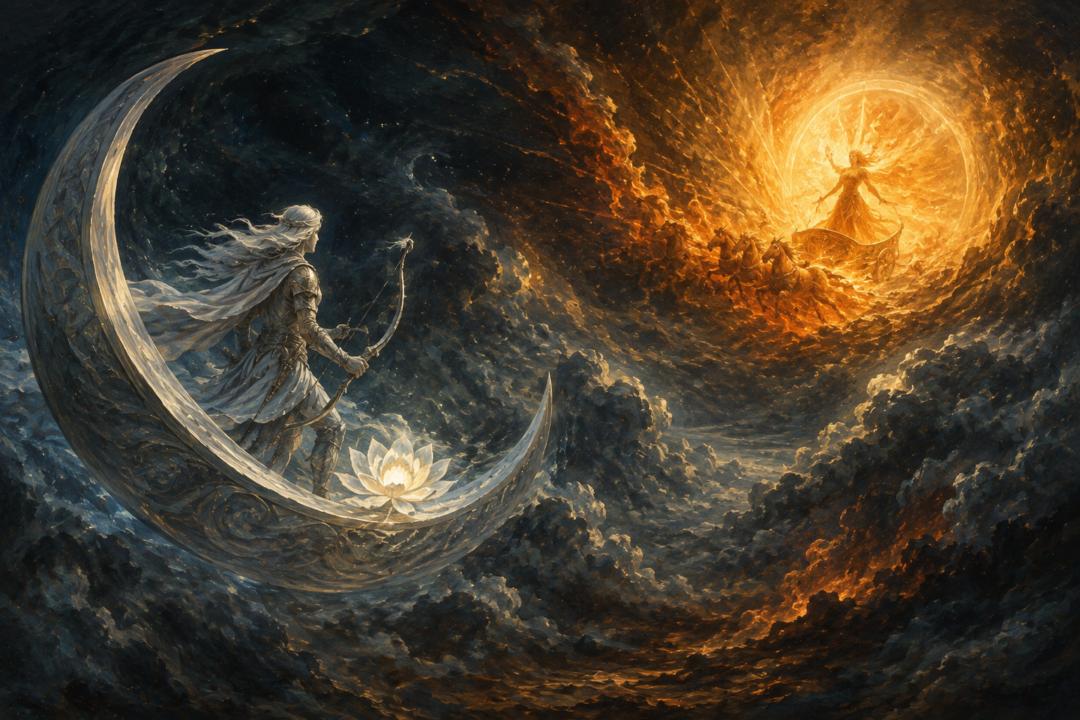
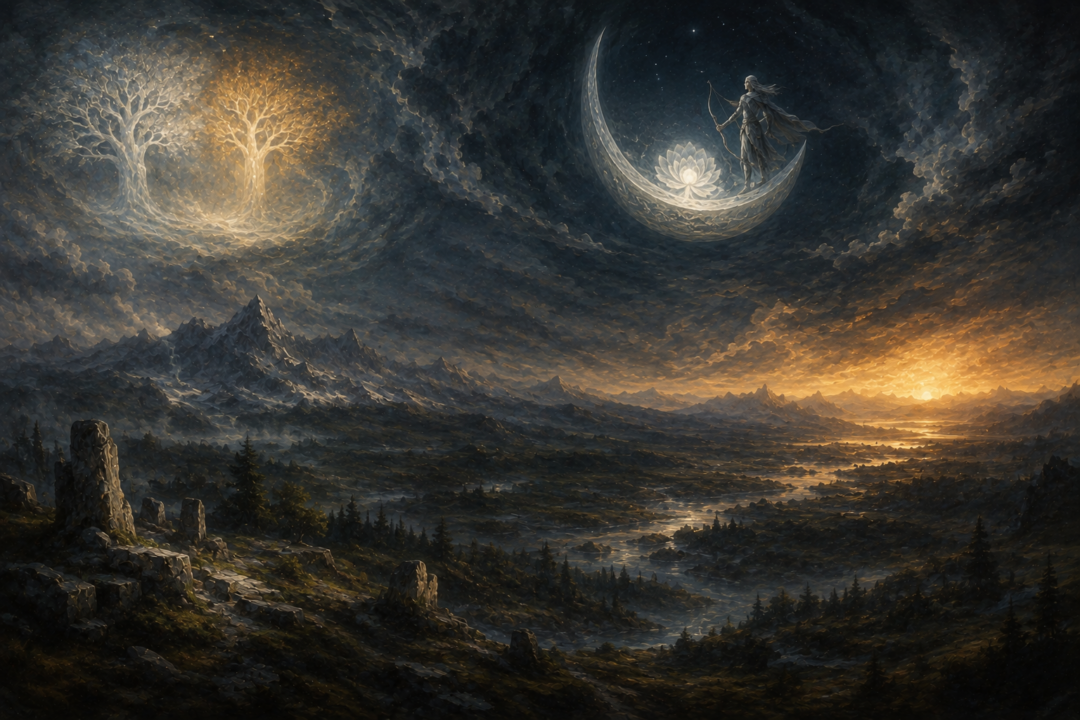
After Morgoth and Ungoliant destroyed the Two Trees of Valinor, Yavanna could not restore them to their former life. Yet each Tree produced one final gift. Telperion gave a last silver flower, while Laurelin produced a final golden fruit.
These became the Moon and Sun.
The Moon was therefore not merely created as an astronomical convenience. In the mythology presented in The Silmarillion, it preserved something of the light of Telperion. The Vanyar called it Isil, “the Sheen,” while the Sun was Anar, “Fire-golden.”
Tilion was chosen to guide the Moon.
That choice suited him particularly well. He had belonged to Oromë’s people and was a hunter armed with a silver bow. More importantly, he loved Telperion. When he rested from Oromë’s hunts, he went into Lórien and lay beside the pools of Estë beneath the Tree’s silver light.
When the last flower of Telperion was prepared as the Moon, Tilion asked to be its guardian.
His connection to it was therefore personal before it was cosmic.
That matters because the same emotional quality that makes him an appropriate guardian also helps make him an imperfect one.
Tilion Was Never as Orderly as Arien
The Sun was entrusted to Arien, another Maia.
The contrast between the two guides is striking. Arien is presented as a spirit of fire who had not feared the heats of Laurelin. She is mighty, radiant and formidable. Tilion is explicitly less powerful than she is.
He is also less predictable.
The Valar originally appointed courses for the two new lights, but Tilion did not consistently keep his path. The Silmarillion describes him as wayward and uncertain in speed.
That is the essential mythical explanation for the Moon’s irregular appearance.
Sometimes the Moon can be seen while the Sun is still in the sky. Sometimes it does not appear during the expected hours of darkness. Its movement does not resemble the simple regularity of the Sun.
Within the mythology, this is not merely mechanics.
There is someone at the helm.
And he wanders.
The Moon even bears a name reflecting this quality: Rána, commonly rendered “the Wayward” or “Wanderer.”
The irregular Moon is therefore given personality. What appears from the ground to be celestial unpredictability becomes the visible consequence of Tilion’s character.
But his wandering has a specific cause as well.
He Keeps Drawing Near to Arien
Tilion is attracted to the splendour of Arien.
Instead of remaining steadily upon his appointed road, he seeks to approach her. But the Maia of the Sun possesses a fiery power that he cannot endure at close range.
The result is disastrous for the Moon.
When Tilion comes too near, the fire of the Sun scorches him and the island of the Moon is darkened.
The myth therefore connects lunar darkness with a recurring pattern of attraction and consequence. Tilion is drawn toward something brighter and more powerful than himself, and his attempt to approach it damages the very light he was appointed to preserve.
It would be excessive to turn this into a rigid moral allegory; the text does not explicitly present Tilion as a fallen or wicked being. He remains the Moon’s guide, and nothing suggests that his waywardness makes him a servant of the Enemy.
Yet the contrast is meaningful.
Arien keeps her fiery nature. Tilion struggles to keep his appointed course.
The Moon’s instability is not caused by evil in the same sense that the darkness of Morgoth is evil. It comes from imperfection, desire and waywardness within an otherwise faithful servant.
That distinction is important throughout Middle-earth. Not every disruption comes from deliberate malice.
Sometimes disorder enters because good beings are not perfectly disciplined.
The Moon’s First Rising Changed History
Before the Moon became a familiar object in the night sky, its first appearance was an event of enormous historical importance.
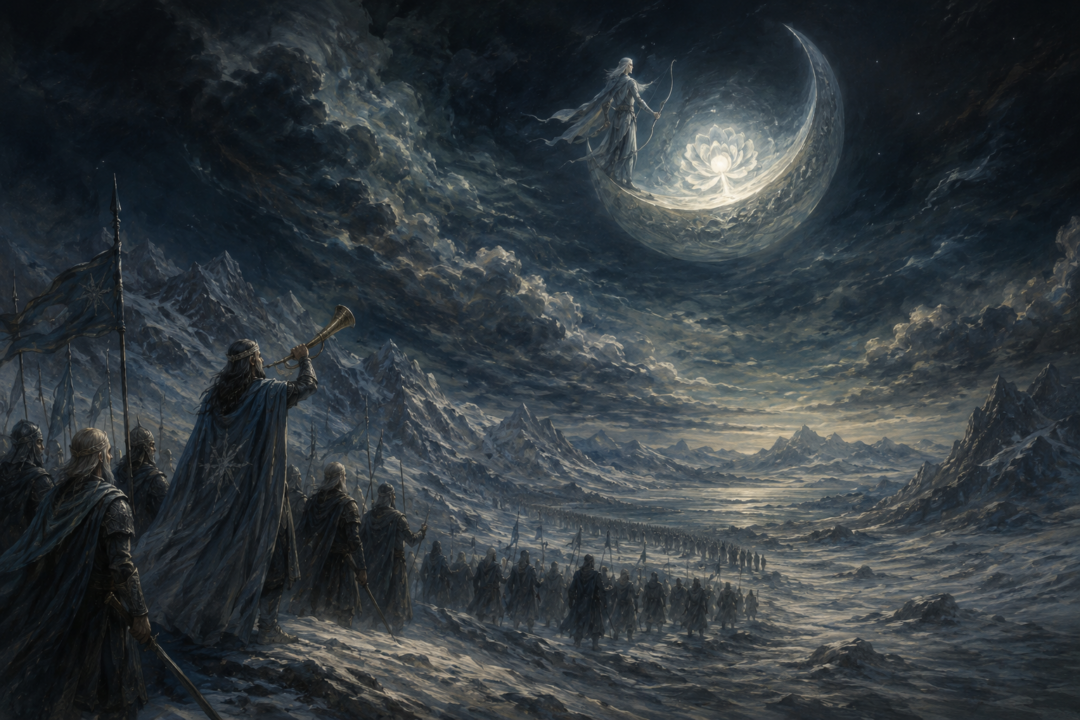
It rose while Fingolfin and his people were completing their terrible journey from the Grinding Ice.
The Noldor had crossed the Helcaraxë after Fëanor abandoned them in Aman and burned the ships at Losgar. Their march had cost them dearly.
Then the new silver light appeared in the West.
Fingolfin sounded his silver trumpets and entered Middle-earth beneath the first rising of the Moon.
That association gives Isil an importance beyond astronomy. The first Moon illuminates the arrival of one of the great Noldorin hosts into Beleriand.
For Morgoth, however, the new lights were alarming.
The world he had expected to dominate beneath darkness was suddenly being illuminated by powers he had not controlled.
The Moon therefore became part of the war almost immediately.
Morgoth Actually Attacked Tilion
One of the strangest details in this entire story is easily overlooked.
Morgoth did not simply dislike the Moon.
He attacked it.
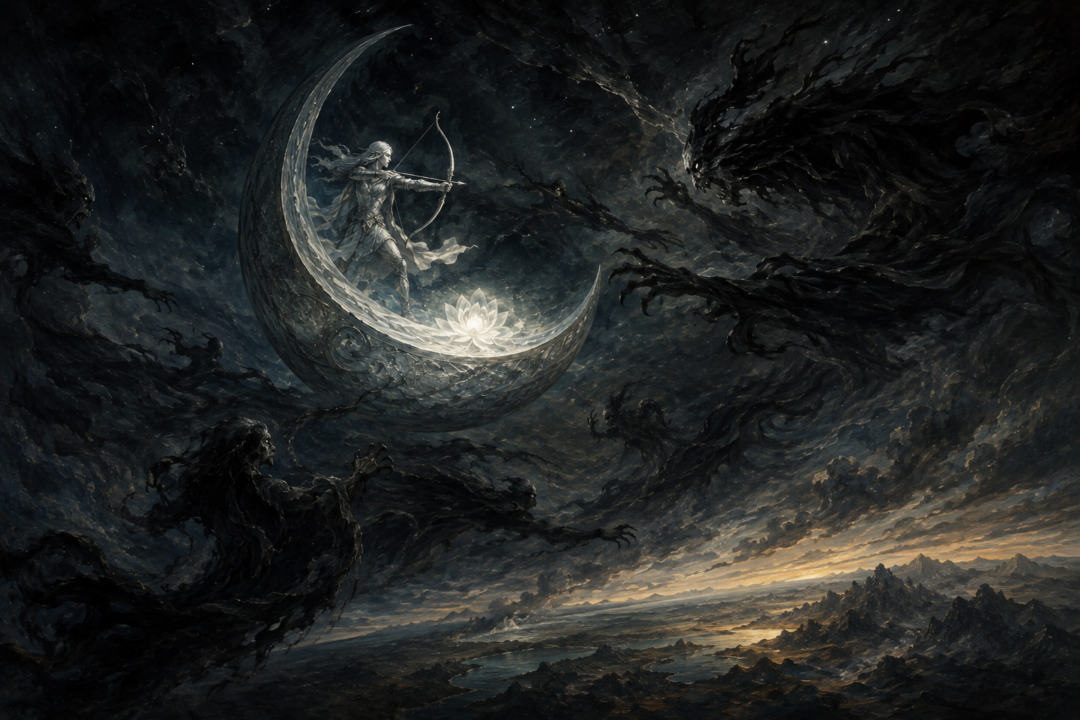
After the new lights appeared, he sent spirits of shadow against Tilion. A conflict took place in Ilmen, the high region through which the celestial vessels travelled.
Tilion defeated his attackers.
The published Silmarillion does not give a detailed battle narrative, so it would be wrong to invent one. We do not know exactly what those spirits looked like, how many there were, or precisely how the combat unfolded.
What matters is the implication.
The sky above Middle-earth was briefly another front in the struggle against Morgoth.
Moonlight was not simply beautiful illumination. Morgoth recognized the new lights as hostile to the darkness in which his servants prospered.
And Tilion, despite all his waywardness, successfully defended his charge.
That complicates his character considerably.
The Maia who cannot reliably follow his assigned path is nevertheless capable of standing against the servants of the Enemy.
Tilion is unreliable.
He is not weak.
The Attack Helped Lead to the Hiding of Valinor
The consequences went further.
After Morgoth’s assault upon Tilion, the Valar became increasingly concerned that he might attempt to attack Aman itself.
Their response was defensive.
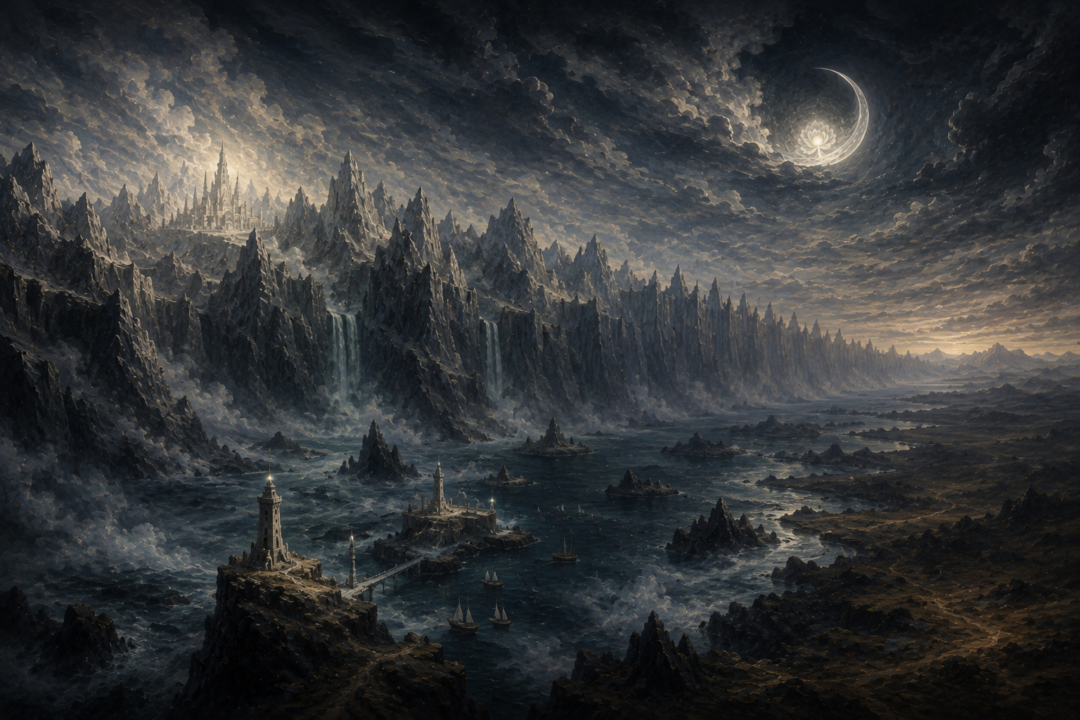
The Pelóri were raised to still greater heights. The Calacirya was guarded. The Enchanted Isles and confusing shadows of the seas made the passage toward Aman extraordinarily difficult.
This was the Hiding of Valinor.
The decision had consequences far beyond Tilion.
Aman became more thoroughly separated from Middle-earth, and the exiled Noldor were shut outside its protection. The West withdrew behind barriers while the wars of Beleriand unfolded.
Tilion’s story therefore sits unexpectedly close to one of the great themes of the First Age: separation.
His Moon crosses the heavens, but the Blessed Realm below becomes harder to reach.
The new celestial lights illuminate the world at the same moment that the road back toward the ancient light of Valinor is being closed.
That is one of the great ironies of the episode.
The world receives more visible light while becoming more divided.
The Sun and Moon Are Signs of a Diminished World
There is another reason Tilion’s imperfect course matters.
The Sun and Moon are magnificent, but within this version of the mythology they are not the highest form of light Arda has known.
They are remnants.
Their lights come from the final flower and fruit of Trees that cannot be restored.
That makes the first sunrise and moonrise simultaneously hopeful and tragic.
Light returns to Middle-earth. Creatures awaken. Morgoth’s darkness is challenged. Men awaken with the first rising of the Sun.
But the new order begins after an irreversible loss.
The heavens themselves bear traces of that difference.
Tilion wanders. The Moon is darkened. The Sun and Moon alternate across a world in which the perfect mingling of the Two Trees has disappeared.
The text even contrasts their deeper associations: the Sun is connected with the awakening of Men and the waning of the Elves, while the Moon cherishes the memory of the Elves.
The sky has become historical.
Every sunrise and moonrise belongs to the world after the Trees.
The Wayward Moon Fits Middle-earth Better Than a Perfect One
This is why Tilion’s irregular course explains more than lunar appearances.
It makes the Moon part of the moral and historical texture of Arda.
Its light comes from something lost.
Its guardian loves what he carries but does not perfectly fulfil his task.
He is drawn toward a greater brightness and suffers for approaching it.
The Enemy attempts to extinguish him and fails.
And the fear created by that assault contributes to the closing of the West.
None of this means that every later appearance of the Moon in The Hobbit or The Lord of the Rings should be interpreted as a direct intervention by Tilion. The later narratives normally treat the Moon as part of the natural world, and they do not repeatedly invoke its ancient steersman.
But behind that ordinary Moon stands an older story.
Its unpredictability is remembered in the name Rána: the Wayward.
That name captures something larger than astronomy.
Middle-earth after the destruction of the Two Trees is still illuminated, but its light no longer belongs to an untouched world. Beauty survives through remnants. Guardians remain faithful without being flawless. Darkness can attack what is good without always overcoming it.
And above all of it travels Tilion, carrying the last silver flower of Telperion across a sky whose very irregularity remembers that Arda has already been wounded.
Sources & Notes
- The Encyclopedia of Arda, “Tilion” — https://www.glyphweb.com/arda/t/tilion.html
- The Encyclopedia of Arda, “Moon” — https://www.glyphweb.com/arda/m/moon.html
- The Encyclopedia of Arda, “Arien” — https://www.glyphweb.com/arda/a/arien.html
Reference entries document the people, places, events, and objects directly discussed in this article.