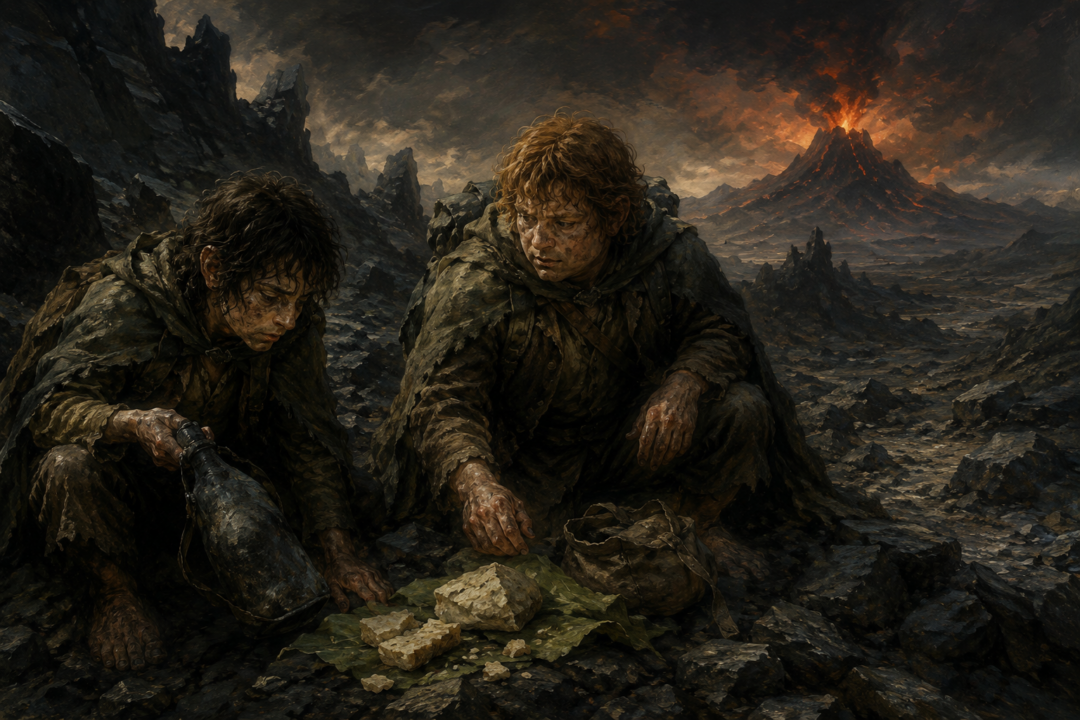
When Frodo and Sam escaped from the Tower of Cirith Ungol, they had already lost almost everything that made ordinary travel possible. Their clothing was damaged, their strength was failing, enemies surrounded them, and Mount Doom still lay far across Mordor.
Yet one small piece of equipment had become almost as important as the Ring-bearer’s remaining food: a water-bottle.
The Orcs had taken Faramir’s provisions from Frodo and slashed his bottle. But they had largely rejected the lembas. That difference created one of the most easily overlooked survival problems in the final journey. Frodo and Sam were desperately short of food, but food could still be rationed and carried. Water could not simply be stretched in the same way.
As Sam immediately recognizes, they have enough to begin their journey. Water is the greater danger.
That distinction becomes increasingly important as they move deeper into Mordor.
The Orcs Accidentally Left Them Their Most Valuable Food
Frodo discovers after his rescue that the Orcs have rummaged through his belongings. Faramir’s food is gone, and his water-bottle has been ruined.
The lembas, however, survives.
The Orcs apparently find it repellent and leave much of it scattered and damaged rather than eating it. Frodo gathers what he can, and the two hobbits therefore retain a small but extraordinarily valuable reserve of Elvish waybread.
This matters because lembas is specifically suited to long journeys. Earlier descriptions establish it as highly sustaining food intended for travellers, and during the crossing of Mordor its importance becomes unmistakable. Near the end, Sam reflects that the waybread possesses a sustaining virtue without which they would already have collapsed.
Their food situation is still desperate. Sam knows their supplies will not last indefinitely, and every remaining wafer matters.
But the crucial point is that they possess a portable reserve.
Their water situation is fundamentally different.
They cannot carry enough for the entire remaining journey, especially after Frodo’s bottle is destroyed. They must repeatedly find new sources inside Mordor.
Their survival therefore depends not merely on rationing but on Mordor itself giving them something they need.
Mordor Is Not Completely Lifeless
It is tempting to imagine Mordor as an absolutely sterile wasteland. The text presents something more complicated.
Frodo points out an important practical truth after escaping Cirith Ungol: Orcs are living creatures. Whatever corruption shaped them, they still need food and drink. Therefore somewhere within Sauron’s realm there must be supplies.
That does not mean Mordor is hospitable.
Along the western margins, Frodo and Sam encounter a dying landscape where twisted vegetation still struggles among stones and ravines. There are pools and tiny streams. Elsewhere, Sauron’s military infrastructure provides water for troops.
The distinction matters.
Mordor has water because armies, slaves, Orcs, and Men cannot function without it. But Frodo and Sam cannot simply walk into an Orc stronghold and ask where the nearest well is.
Water exists within an enemy-controlled logistical system.
The problem is access.
Their First Stream Feels Like a Miracle Because It Nearly Is
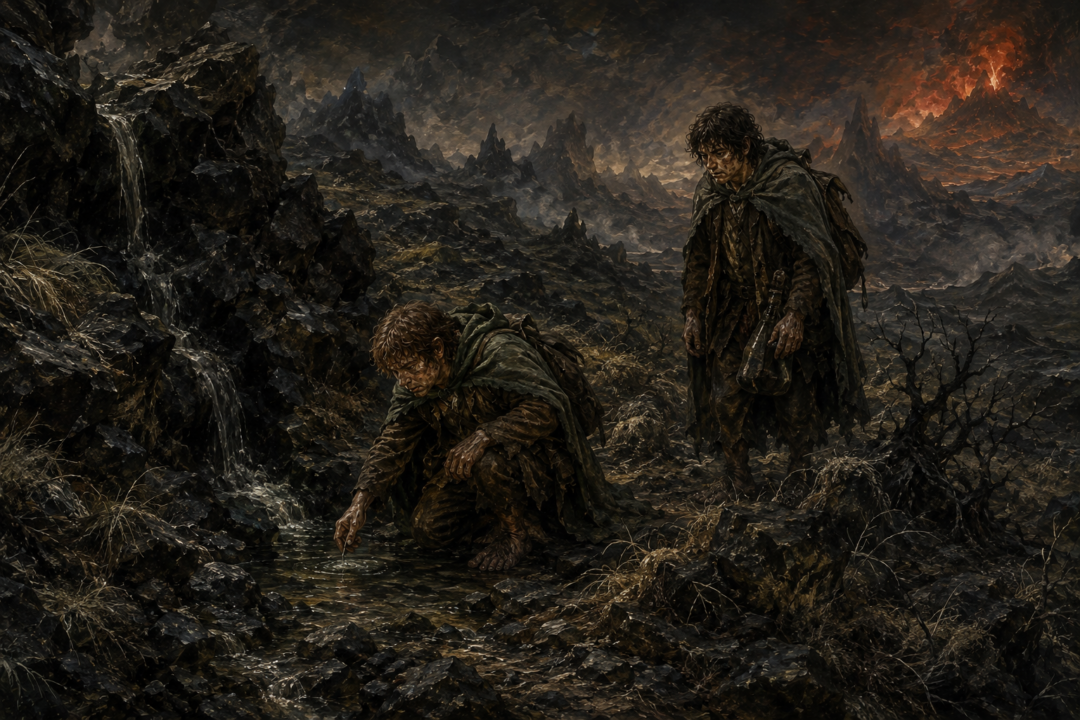
After struggling northward beneath the mountains, Frodo and Sam hear something almost unbelievable: trickling water.
A small stream descends from the rocks.
Sam’s reaction reveals just how desperate their situation has already become. Having recently received unexpected light when the darkness over Mordor begins to break, he treats the discovery of water as another extraordinary mercy.
Even then, danger remains.
Sam worries that the water could be poisonous and offers to test it first. Frodo refuses to let him bear that risk alone. The water tastes unpleasant—bitter and oily by the standards of home—but in Mordor it seems magnificent.
They drink deeply and refill their remaining bottle.
For a moment, their immediate crisis has passed.
But the relief is temporary.
Soon afterward they are thirsty again. Mordor itself worsens the problem: the air has a bitter quality that dries their mouths. The terrain demands exhausting climbing and walking, while Frodo is simultaneously being crushed by weariness and the increasing burden of the Ring.
Food can be eaten sparingly.
Water is being continually lost from their bodies.
Sam Cannot Ration Thirst the Way He Rations Lembas
Sam is remarkably disciplined with supplies.
He saves the lembas for what he calls the evil days ahead. When other provisions remain, he prefers to consume those first. He repeatedly calculates distance, strength, food, and the possibility of reaching Mount Doom.
Water defeats this kind of planning.
The hobbits can reduce how much they drink, but they cannot eliminate their need for it. As their exertion continues, thirst becomes physically overwhelming.
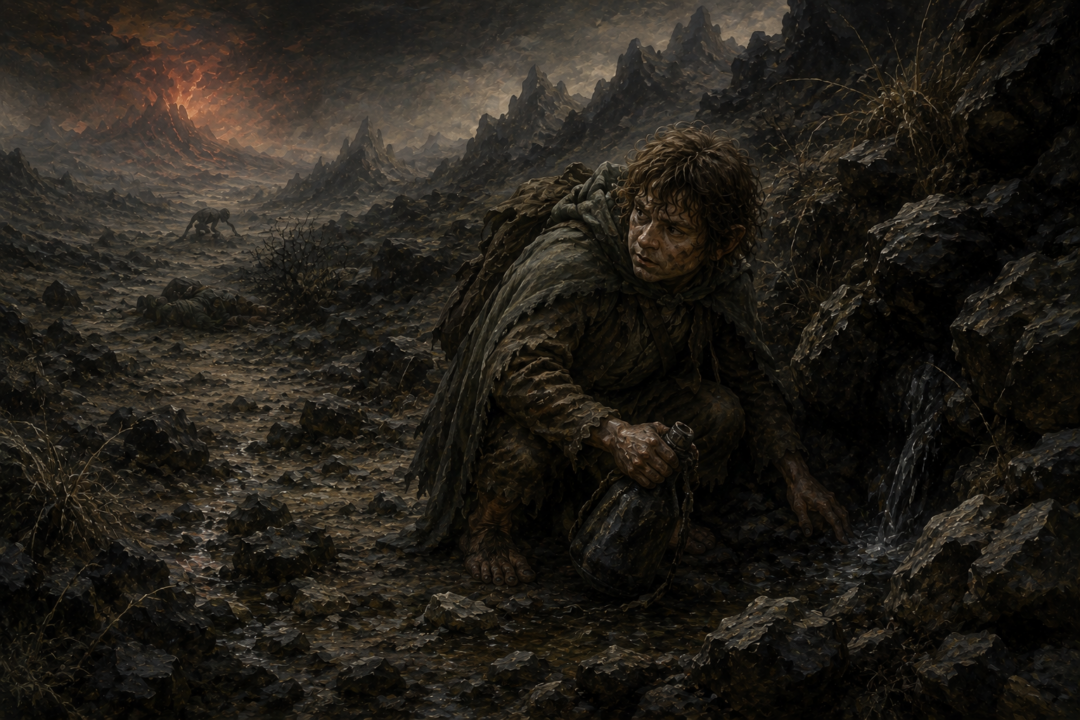
At one point Sam gives Frodo food and water before Frodo sleeps, secretly going without his own share. Then he leaves their hiding place because he understands the immediate equation clearly: without more water, they cannot continue.
He follows a nearly dry watercourse until he hears a tiny trickle and finds enough to drink and refill the bottle.
This search exposes another difference between hunger and thirst.
Looking for water means leaving concealment.
Every attempt to refill the bottle risks discovery by Orcs, Gollum, or other servants of Sauron. Indeed, during this particular search Sam sees a dark figure near Frodo’s hiding place that he believes is Gollum.
Water scarcity therefore creates not only physical danger but tactical danger.
They must expose themselves to survive.
Sauron’s Roads Become Their Unlikely Lifeline
Deeper inside Mordor, natural water becomes harder to find.
Here another overlooked detail becomes important: Sauron has prepared Mordor for war.
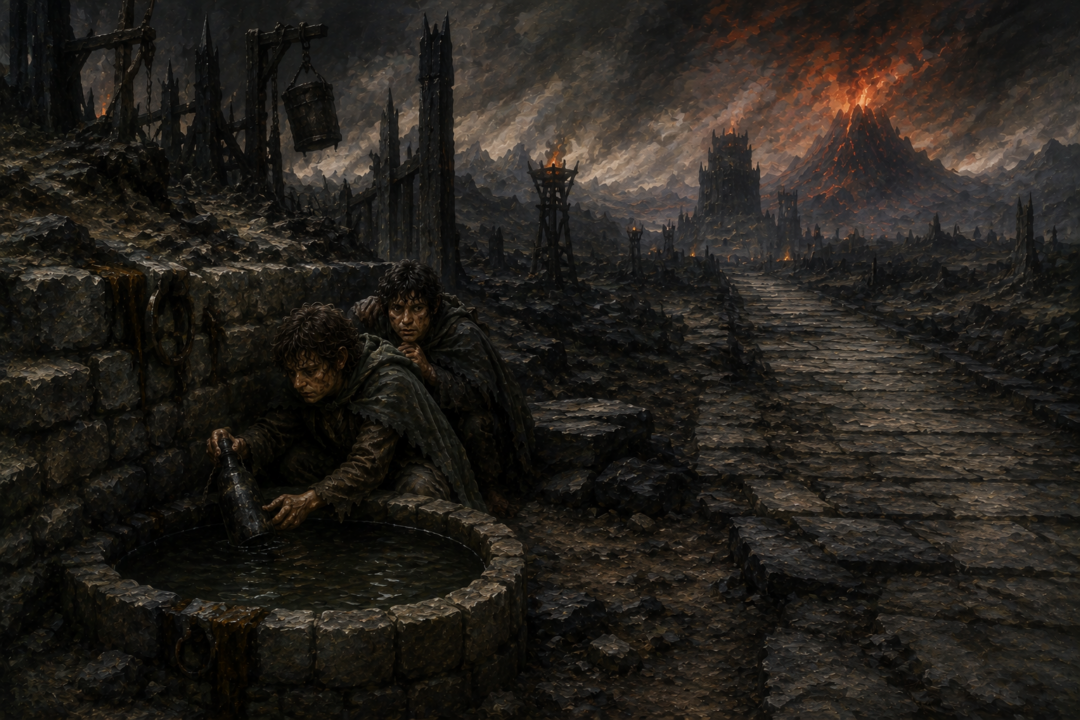
His armies require roads, fortifications, supplies, and water. Along the Orc-road, cisterns have been constructed at intervals for troops moving rapidly through otherwise waterless country.
Frodo and Sam benefit from the same military system designed to sustain the armies hunting them.
Sam finds water in one of these cisterns. It is stale and muddied by Orcs, but their condition is too desperate for such considerations to matter.
This is one of the journey’s quiet ironies.
The machinery of Mordor is built to project Sauron’s power outward. Yet for a brief moment, one fragment of that machinery helps sustain the two insignificant travellers carrying the instrument of his possible destruction.
There is no suggestion that this guarantees their survival. Quite the opposite: once they leave the road and move toward Mount Doom, even this miserable network of water disappears.
The final stage becomes far worse.
Lembas Keeps Working When the Water System Fails
By the time Frodo and Sam approach Mount Doom, their relationship with food has changed.
They are starving and exhausted, but lembas still sustains them. Sam explicitly recognizes that without its special virtue they would already have lain down to die.
Water has no equivalent.
Their remaining supply dwindles toward nothing.
Sam has deliberately stinted himself. His mouth becomes so dry that his tongue feels thick and swollen. He knows that the cistern water found earlier was probably their final opportunity. Ahead lies the exposed waste beneath Orodruin.
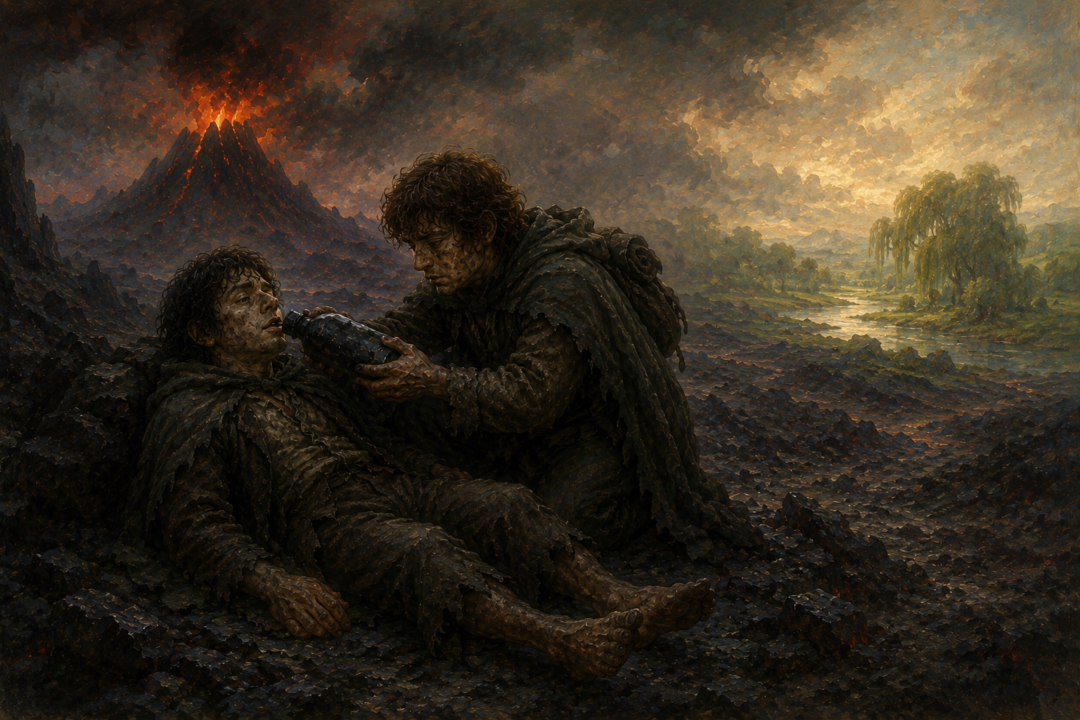
Eventually Frodo can only tell Sam that he is thirsty.
Sam gives him a mouthful.
Only one mouthful remains.
And Sam does not take it.
At this point the contrast between their shortages is complete. Their food is terribly limited, but it remains something they can possess, divide, and carry. Water has become a disappearing resource with no known replacement.
The closer they come to their destination, the less meaningful careful rationing becomes.
Sam Begins Seeing Water in His Memory
The most powerful expression of the crisis is not a calculation of supplies.
It is memory.
As Sam suffers from thirst, his mind fills with water from home: brooks, streams, fountains, willow-shaded places, and the Pool at Bywater. The ordinary abundance of the Shire becomes almost unbearable to remember.
That contrast reaches beyond physical survival.
Throughout the journey, Mordor strips away everything that once seemed ordinary. Food becomes treasure. Sleep becomes dangerous. Clean air becomes a luxury. Daylight becomes a gift.
And water becomes something almost sacred in its simplicity.
Earlier Sam imagines that if Galadriel could hear him, he would ask not for jewels but for light and clean water.
That is one of the deepest reversals of the Mordor chapters.
The quest began amid objects of enormous legendary significance: Rings of Power, ancient swords, Elven gifts, kingdoms, prophecies, and the fate of Middle-earth.
Near its end, what Frodo and Sam desperately want is water.
The Journey Reduces Heroism to Its Smallest Scale
The water crisis also reveals what the final march to Mount Doom actually demands from Sam.
He cannot defeat Mordor.
He cannot remove Frodo’s spiritual burden, and when he briefly offers to help carry the Ring, Frodo reacts under its influence with fear and suspicion. Sam cannot guarantee that another spring waits beyond the next ridge.
He can only manage the next necessity.
A sip.
A hiding place.
A few hours of sleep.
Another search for water.
Another mile.
That is why the shortage of water becomes more frightening than the shortage of food. Lembas gives them a thin thread of continuity: something from Lórien that can be carried into the heart of the Shadow and consumed little by little.
Water depends upon the land beneath their feet.
And Mordor increasingly gives them none.
By the final approach to Mount Doom, Sam is no longer planning a comfortable return or even confidently calculating supplies for the days ahead. The scale of the quest has collapsed into immediate survival.
Yet they continue.
The destruction of the Ring ultimately depends upon armies, kings, deception, courage, mercy, and events no single character controls. But on the road to the Mountain, the fate of the quest repeatedly hangs on things much smaller.
A wafer of waybread.
A half-empty bottle.
A hidden spring.
And one hobbit deciding that the last mouthful of water belongs to his friend.
Sources & Notes
- The Encyclopedia of Arda, “Frodo Baggins” — https://www.glyphweb.com/arda/f/frodobaggins.html
- The Encyclopedia of Arda, “Samwise Gamgee” — https://www.glyphweb.com/arda/s/samwisegamgee.html
- The Encyclopedia of Arda, “Mordor” — https://www.glyphweb.com/arda/m/mordor.html
Reference entries document the people, places, events, and objects directly discussed in this article.