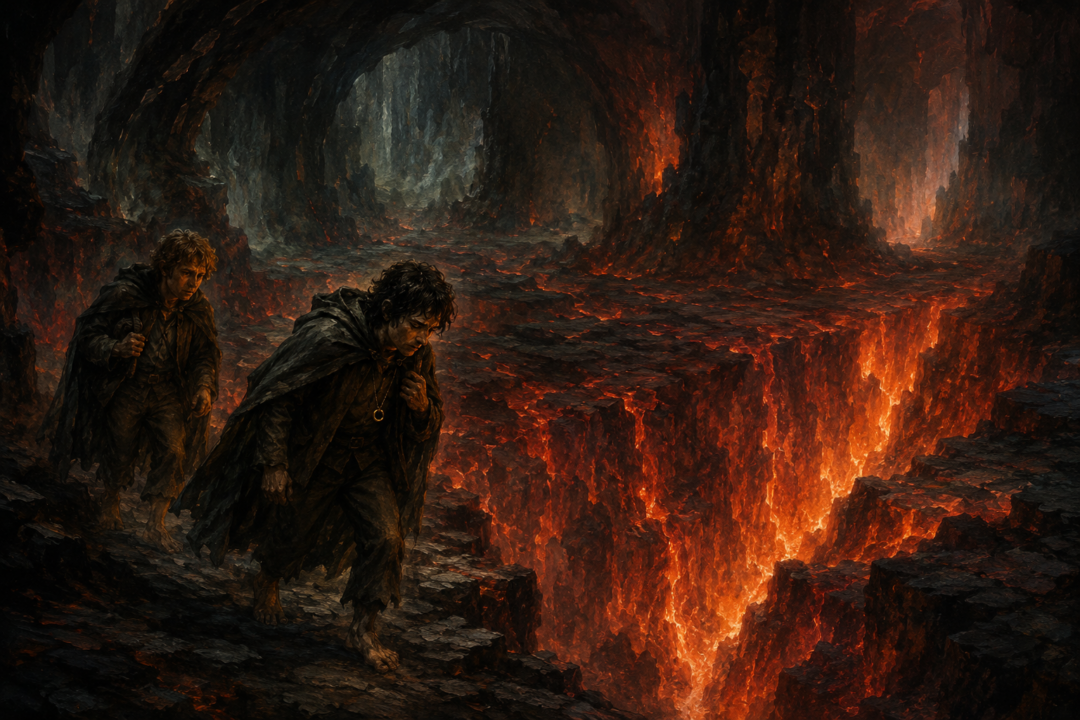
The One Ring is almost impossible to destroy. That sounds like its greatest protection.
It is not.
The deeper protection is that the one place capable of destroying it is also the place where the Ring becomes most dangerous to the person trying to destroy it.
That is what makes the Crack of Doom so important. Mount Doom is not merely the correct furnace at the end of a long quest. As Frodo and Sam approach the mountain, the Ring’s power increases. By the time Frodo reaches the Sammath Naur, the physical problem of destroying the Ring and the psychological problem of surrendering it have converged in the same place.
The result is a remarkable security mechanism. To destroy the Ring, an enemy must carry it through Sauron’s realm, toward the place where it was forged, while enduring an increasingly powerful Ring—and then voluntarily surrender it at the exact point where its hold is greatest.
That changes how we should understand Sauron’s apparent failure to guard Mount Doom.
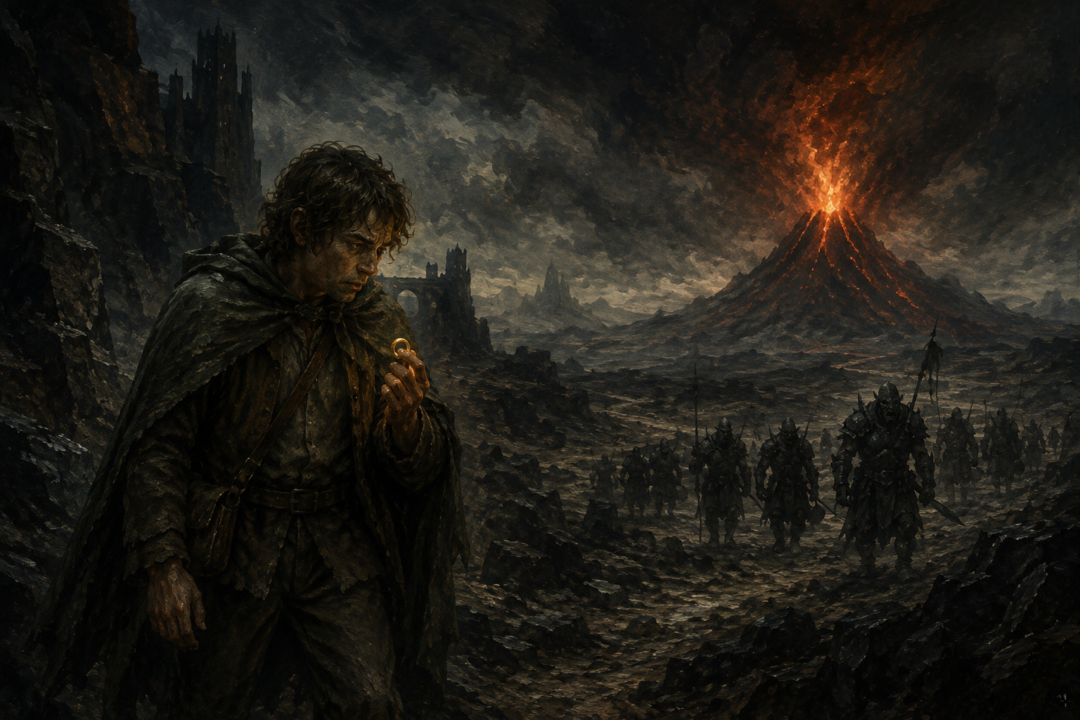
The Ring Cannot Simply Be Broken
The first layer of the Ring’s security is material.
When Gandalf explains the Ring to Frodo in “The Shadow of the Past,” ordinary destruction is effectively ruled out. The lesser Rings might potentially be harmed by sufficiently powerful dragon-fire, although Gandalf doubts that any dragon then living possessed such fire. But the Ruling Ring is different.
Not even Ancalagon the Black, Gandalf says, could have harmed the One Ring.
The essential point is simpler: the Ring must be returned to the fire in which it was made.
The Cracks of Doom therefore create an extraordinary geographical limitation. Possessing the Ring is not enough. Knowing what it is is not enough. Wanting it destroyed is not enough.
Its enemies must transport it into Mordor.
This transforms destruction from an act into a journey.
A sword can be broken wherever the sword happens to be. A document can be burned in any suitable fire. The One Ring forces its enemies to carry the object they fear across Middle-earth and eventually into the heart of the Enemy’s own country.
The Ring’s apparent vulnerability is therefore geographically imprisoned.
The Only Exit Leads Toward Sauron
Consider what this means strategically.
If the Wise keep the Ring in Rivendell, Sauron may eventually find it.
If they send it over the Sea, that solution is rejected at the Council of Elrond.
If they hide it, they merely postpone the problem while Sauron’s military strength continues to grow.
If they attempt to use it, they risk replacing one Dark Lord with another.
Destroying it is the only solution that permanently removes the danger. Yet destruction requires taking it closer to Sauron rather than farther away.
This is the great contradiction built into the quest.
Every mile toward safety for Middle-earth is a mile toward danger for the Ring-bearer.
The Fellowship cannot solve the problem by maximizing distance from the Enemy. They must deliberately reduce that distance until Frodo is standing inside Sauron’s land, inside Sauron’s mountain, above the fire associated with the Ring’s creation.
And another danger grows during that approach.
The Ring itself becomes stronger.
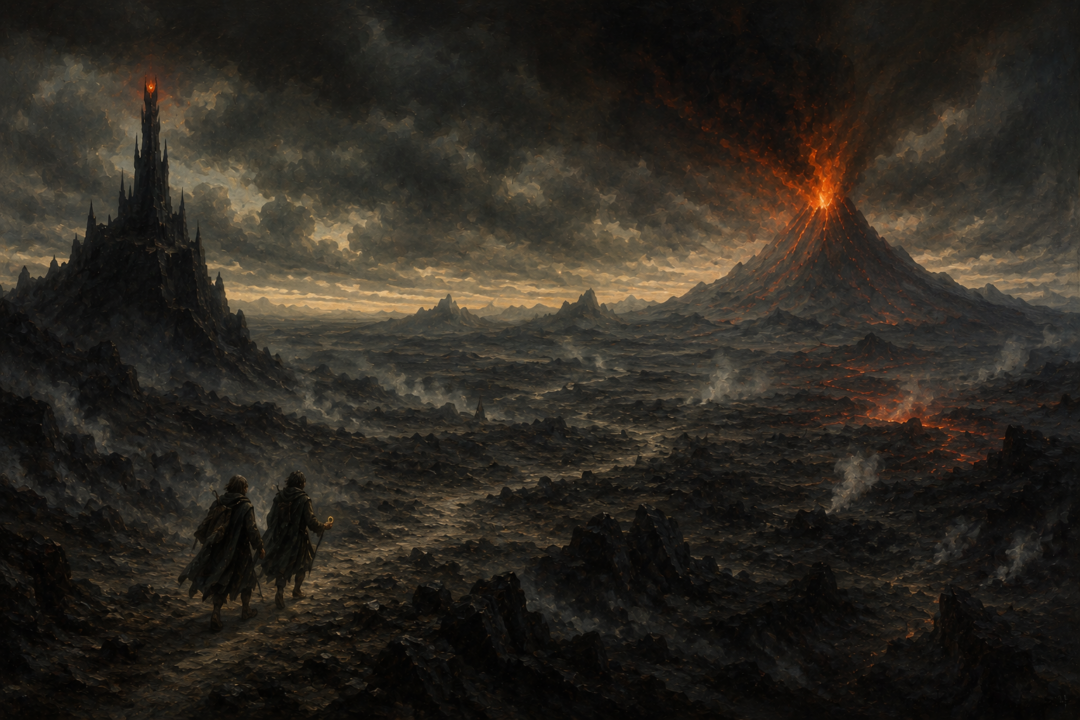
The Ring Grows in Power Near Its Making
This detail is explicit in the narrative.
When Sam briefly bears the Ring near Cirith Ungol, his experience differs markedly from the comparatively mundane invisibility associated with Bilbo’s use of it in The Hobbit.
Sam’s perceptions are altered. His hearing becomes extraordinarily acute. He is conscious of the searching Eye. He even understands the speech of Orcs, though the narrator cautiously leaves open exactly how this understanding works.
Then comes the crucial observation: the Ring has grown greatly in power as it approaches the places where it was forged.
Later, when Sam sees Mount Doom, the change becomes still more threatening. The Ring’s power is growing, and it seems increasingly dangerous—something that cannot simply be mastered by an ordinary bearer.
This means the journey toward the Crack is not taking the Ring toward a neutral vulnerability.
The weapon becomes more formidable as it approaches the one location capable of ending it.
That distinction matters.
A simplistic reading imagines Mount Doom as the Ring’s weak point. A more accurate reading is that Mount Doom is simultaneously its point of destruction and the region in which its power becomes especially intense.
The closer the quest comes to success physically, the more difficult success becomes spiritually.
Frodo Must Do Something Ring-bearers Struggle to Do
There is another layer of security that no wall or Orc-garrison could provide.
The final action must be voluntary.
Someone has to bring the Ring to the fire and relinquish it.
Throughout the story, however, surrendering the Ring becomes extraordinarily difficult for those who possess it.
Gollum cannot willingly abandon his Precious.
Bilbo’s surrender at Bag End is therefore immensely significant. Even then Gandalf must guide him through an agonizing struggle before Bilbo leaves the Ring behind.
Frodo later finds himself increasingly attached to it. Sam, after possessing it only briefly, hesitates when Frodo asks for it back, though he does return it.
The pattern is clear without needing to imagine the Ring as a mechanical mind executing a precise defensive program. Possession produces attachment, temptation, and resistance to surrender.
The quest therefore contains a brutal paradox.
The person qualified to destroy the Ring must become its bearer.
But becoming its bearer makes the final act of relinquishment increasingly difficult.
And the bearer must carry it for months, through exhaustion, fear, starvation, wounds, and repeated temptation before reaching the place where its pressure is greatest.
The Ring does not merely need to survive the journey.
The journey helps make its destruction harder.
Why Sauron Does Not Expect the Attempt
This also helps explain one of the most misunderstood features of the ending: why Sauron does not simply place overwhelming guards inside the Sammath Naur.
His failure is not based merely on carelessness.
He fundamentally misunderstands what his enemies intend to do.
At the Council of Elrond, the possibility of using the Ring is rejected precisely because the Wise understand that attempting to wield such power against Sauron would corrupt the wielder. Sauron, by contrast, has reason to fear that a sufficiently powerful opponent might claim the Ring and challenge him.
That is why Aragorn’s later actions are so effective.
When Aragorn reveals himself through the palantír and then marches toward the Black Gate, Sauron interprets events through his own understanding of power. The strategy encourages him to believe that his enemies may possess the Ring and are becoming dangerously confident.
The real plan—to carry supreme power into Mordor in order to throw it away—is almost outside his strategic imagination.
This is not because Sauron does not understand that the Ring can theoretically be destroyed. The deeper point is that he does not expect someone possessing it to pursue that course successfully.
The Ring’s corrupting nature supports his assumption.
And at the Crack of Doom, that assumption very nearly proves correct.
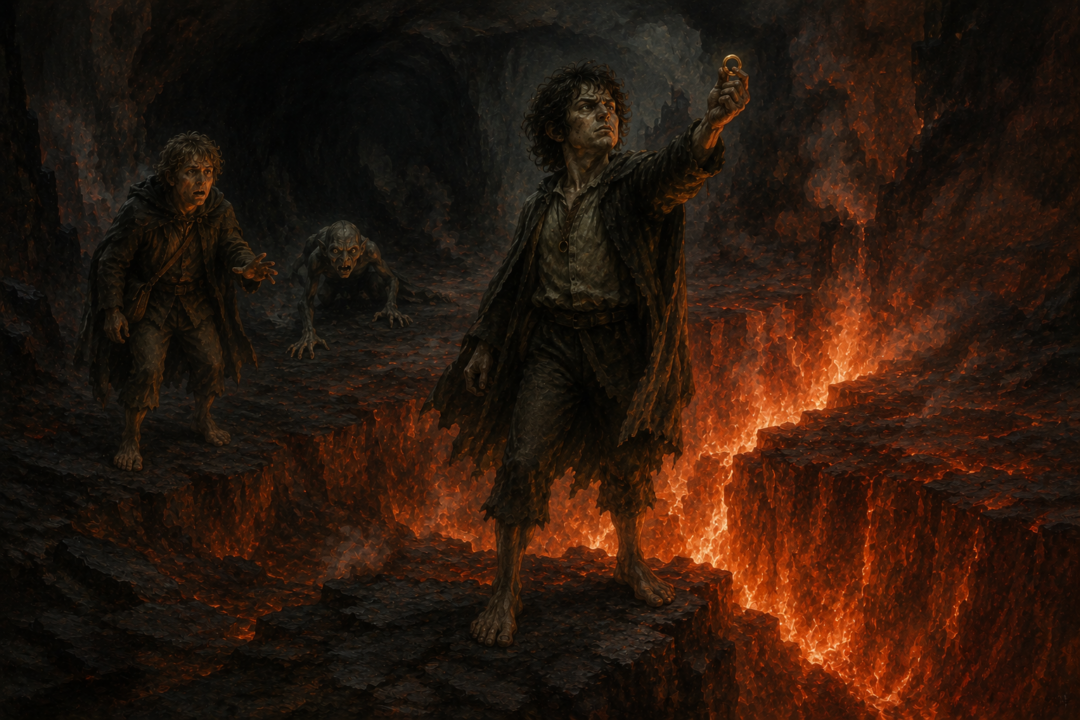
At the Final Moment, Frodo Cannot Do It
Frodo reaches the destination.
This achievement should not be diminished. He has crossed an almost impossible distance, endured the Ring for months, resisted repeated opportunities to abandon the quest, passed through Mordor, climbed Mount Doom in extreme exhaustion, and entered the Sammath Naur.
Then the quest reaches the one action for which everything else existed.
Frodo does not throw the Ring away.
He claims it.
That moment reveals the full severity of the Ring’s final defense better than any hypothetical guard-post could.
The Ring has been carried to the only place where it can be destroyed, yet the bearer who carried it there cannot complete the destruction voluntarily.
Tolkien’s discussion of Frodo’s failure in Letter 246 is especially important here. He argues that Frodo’s inability at the final moment should not simply be treated as an ordinary moral collapse. The pressure placed upon him had reached an extreme beyond what could reasonably be demanded after everything he had already endured.
In other words, the final test is not merely difficult.
It reaches the limit of what the bearer can withstand.
The quest succeeds through something other than Frodo simply finding one last reserve of willpower.
Gollum Breaks the Ring’s Security
The Ring’s destruction comes through the one factor its logic cannot safely contain: Gollum.
Frodo had previously spared him.
Sam had opportunities to kill him and did not.
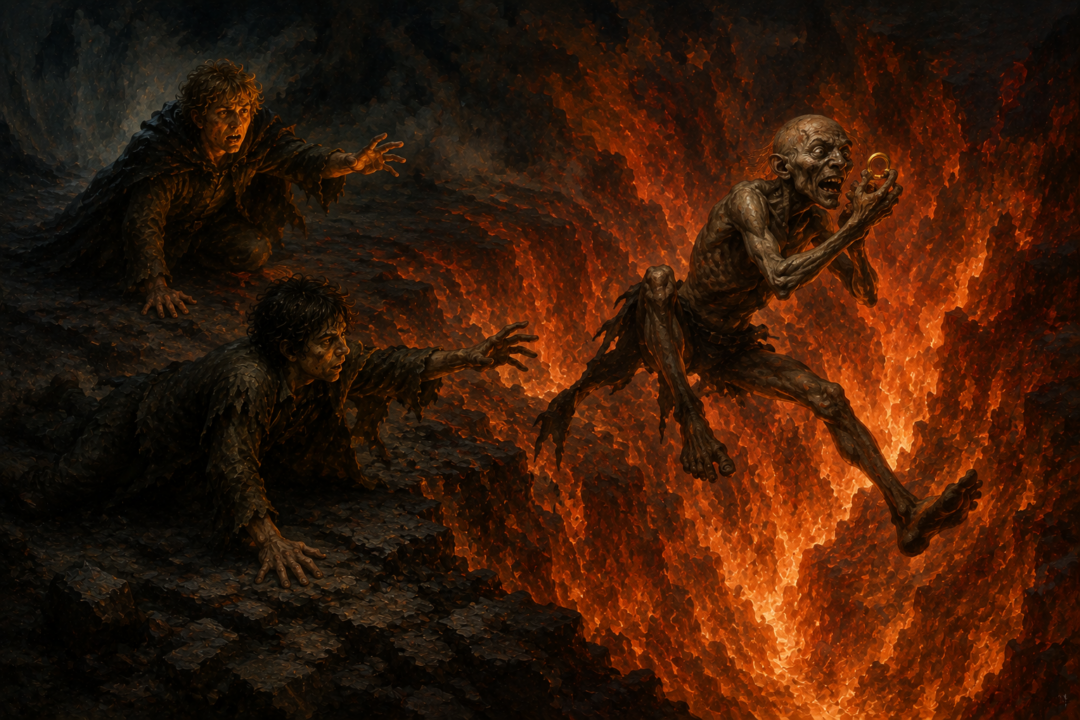
Gollum follows them to Mount Doom, attacks Frodo, bites the Ring from his finger, and in his wild joy falls into the Crack.
The Ring is not willingly cast away by its bearer.
It is destroyed through a chain of events involving pity, earlier choices, Gollum’s obsessive desire, and his final fall.
There is even a dark irony in Gollum’s role. The Ring’s power over him is so complete that recovering it becomes the greatest possible triumph from his perspective. Yet that same obsessive possession brings the Ring directly over the abyss.
The force that helped preserve the Ring for centuries contributes to its destruction.
This does not mean the Ring somehow engineers its own doom. The texts do not describe such a deliberate mechanism.
Rather, the ending turns its strongest protection—desire for possession—against itself.
Mount Doom Is Both Lock and Key
The Crack of Doom therefore changes the entire security problem surrounding the One Ring.
The Ring is protected materially because almost nothing can destroy it.
It is protected geographically because the necessary fire lies inside Mordor.
It is protected strategically because carrying it there means approaching Sauron’s power.
It is protected psychologically because possession makes surrender increasingly difficult.
And near its place of forging, its own power grows.
These protections overlap.
That is why the apparently obvious question—“Why wasn’t Mount Doom better guarded?”—does not fully capture the problem.
A guard can stop someone from entering a room.
The Ring’s deeper defense is that even if someone reaches the room, carrying the Ring in hand, intending to destroy it, the final act may still prove impossible.
Sauron’s mistake was not simply leaving a door open.
It was believing that nobody could walk through that door carrying ultimate power and genuinely intend to throw that power away.
At the final moment, Frodo shows how close Sauron’s reasoning came to being correct.
But Sauron’s understanding of power leaves too little room for pity, mercy, humility, and consequences he cannot control.
The Crack of Doom is therefore more than the Ring’s physical weakness.
It is the place where the entire paradox of the Ring becomes visible.
The Ring can only be destroyed where it was made.
Yet the closer it comes to that place, the harder it becomes to destroy.
And in the end, Middle-earth is saved not because someone proves strong enough to master that paradox, but because mercy had already placed Gollum beside the fire when strength finally failed.
Sources & Notes
- The Encyclopedia of Arda, “One Ring” — https://www.glyphweb.com/arda/o/onering.html
- The Encyclopedia of Arda, “Mount Doom” — https://www.glyphweb.com/arda/m/mountdoom.html
- The Encyclopedia of Arda, “Sammath Naur” — https://www.glyphweb.com/arda/s/sammathnaur.html
Reference entries document the people, places, events, and objects directly discussed in this article.