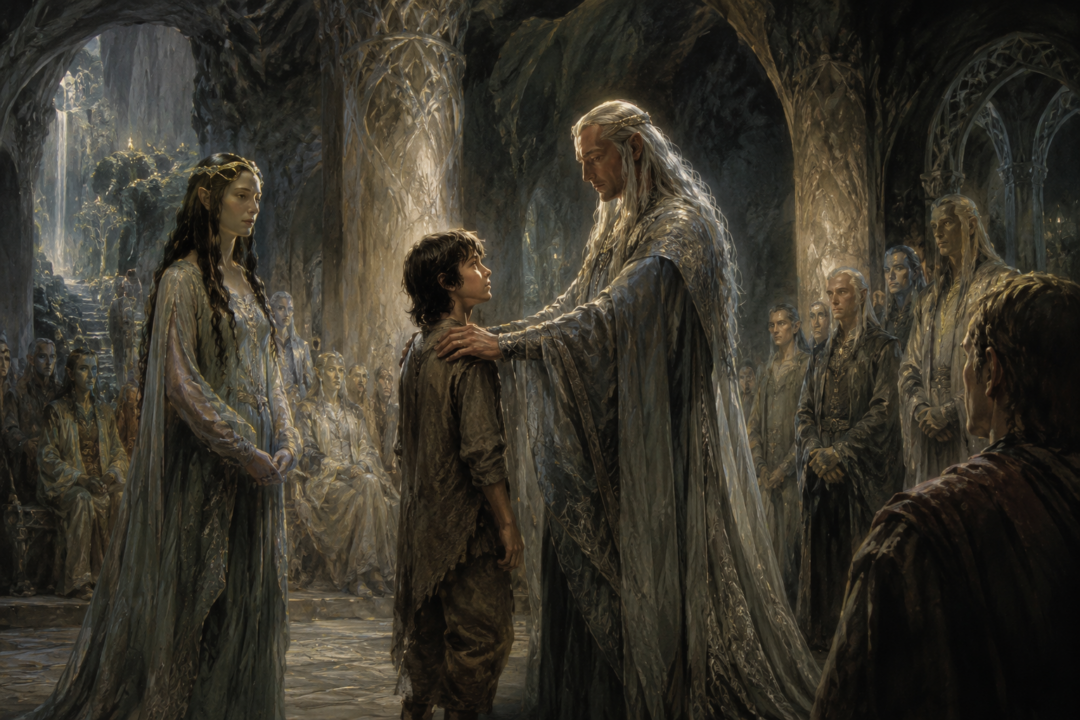
When the young Túrin first entered the halls of Thingol in Doriath, he was not merely a refugee receiving shelter. He was the son of Húrin, heir to a ruined household, placed among a people who were not his own. Yet Thingol did something extraordinary: he received the mortal boy as a foster-son and ordered that Túrin should be treated as though he were the king’s own child.
That distinction matters.
Across the histories of Middle-earth, fosterage repeatedly does more than provide safety for an orphan or endangered heir. It creates a second family around someone whose blood already binds him elsewhere. The result can be politically powerful because affection, obligation, education, and identity begin crossing the boundaries between peoples.
Túrin becomes attached to Doriath without ceasing to be Húrin’s son. Tuor grows among the Grey-elves while remaining heir to the House of Hador. Aragorn is raised in Elrond’s household while secretly carrying the inheritance of Isildur.
Fosterage does not erase blood loyalty. More often, it complicates and enlarges it.
And that can redirect the course of history.
Túrin: When a King Makes a Stranger His Son
One of the clearest examples appears in the story of Túrin Turambar.
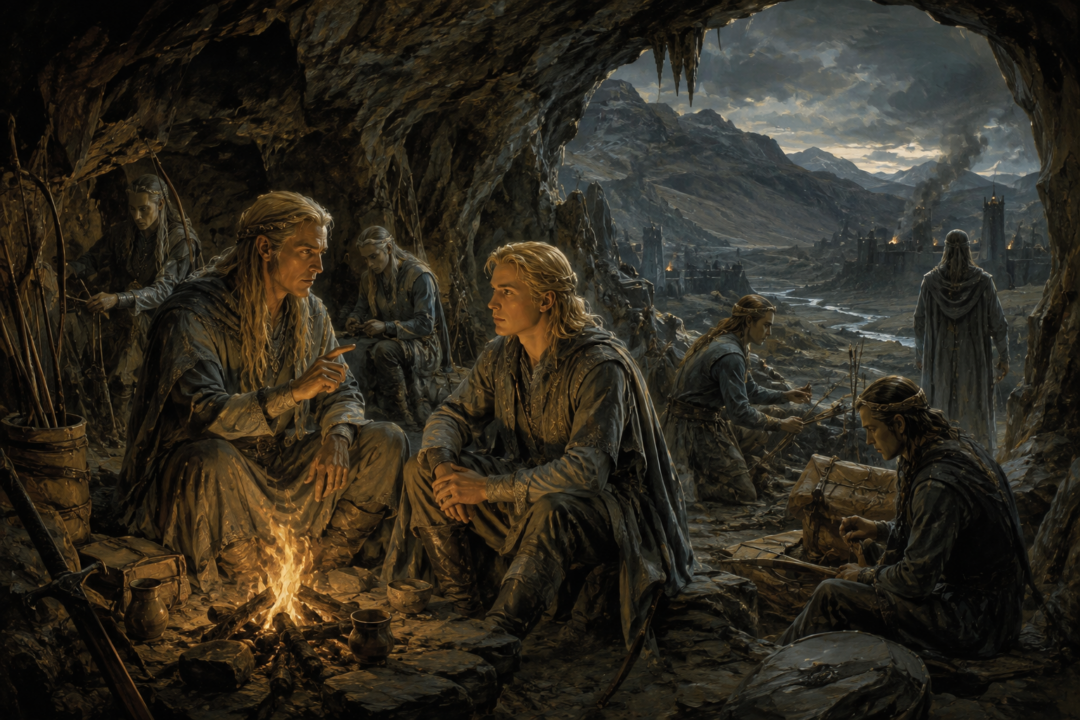
After the catastrophe of the Nirnaeth Arnoediad, Húrin is captured by Morgoth while Morwen remains in Dor-lómin with Túrin. As conditions worsen under the Easterlings, Morwen eventually sends her son away to Doriath.
Túrin therefore arrives in Thingol’s realm carrying an important identity before he has done anything himself: he is the son of Húrin of Dor-lómin.
Thingol remembers Húrin’s deeds and receives the boy generously. In the fuller tradition preserved in Unfinished Tales, the significance of the king’s action is made particularly clear: Thingol accepts Túrin as a foster-son and declares that he will be held as his own son despite being a Man.
This is much more than hospitality.
Túrin has crossed from the political and cultural world of the Edain into the protected Elven kingdom of Doriath. Yet he does not simply become an anonymous dependent there. His relationship with the king gives him standing inside a royal household.
The son of Húrin now belongs, in a meaningful social sense, to two worlds.
That double belonging shapes everything that follows.
Fosterage Does Not Replace Blood
Túrin never forgets who he actually is.
His loyalty to his mother, his father, and the dispossessed people of Dor-lómin remains fundamental to his character. Indeed, much of his tragedy comes from his fierce attachment to inherited identity, honour, and grievance.
Fosterage therefore should not be imagined as political adoption in the sense of deleting one allegiance and replacing it with another.
It creates an additional bond.
Thingol can act toward Túrin with paternal authority and affection, while Túrin can still regard himself as the heir of Húrin. Beleg can become one of his closest companions without Túrin ceasing to think of Dor-lómin as the land from which he came.
The political importance lies precisely in this overlap.
Someone raised between communities can carry obligations to both.
That possibility appears again in another child of the Houses of the Edain.
Tuor Grows Up Among the Elves
Tuor’s childhood offers a quieter but equally revealing example.
His father Huor falls in the Nirnaeth Arnoediad before Tuor is born. His mother Rían, overwhelmed by grief, eventually leaves her infant in the care of the Grey-elves of Mithrim.
Annael becomes Tuor’s foster-father.
Tuor therefore spends his formative years among Sindarin Elves rather than among the surviving people of his own House. In Unfinished Tales, his upbringing among Annael’s people is an important part of the background to his later journey.
Yet Tuor does not cease to be the son of Huor.
This becomes politically consequential because Tuor eventually enters Gondolin carrying several identities at once. He is a Man of the House of Hador, the son of the warrior who had once aided Turgon, but he is also a Man who has actually been raised among Elves.
That does not automatically explain his acceptance in Gondolin; Ulmo’s intervention, Huor’s earlier relationship with Turgon, and Tuor’s appointed mission are far more direct causes.
But his fosterage gives him something unusual.
Elven society is not entirely alien to him.
Tuor can cross a cultural boundary that would have been far greater for many other Men of his age. Eventually he marries Idril, daughter of Turgon, and their son Eärendil becomes one of the central figures in the fate of both Elves and Men.
Fosterage did not predetermine that outcome. But Tuor’s life shows how raising a child across political and cultural boundaries can create a person capable of belonging to more than one inherited world.
Aragorn Is the Third Age’s Great Example
Thousands of years later, the same pattern appears again in a different form.
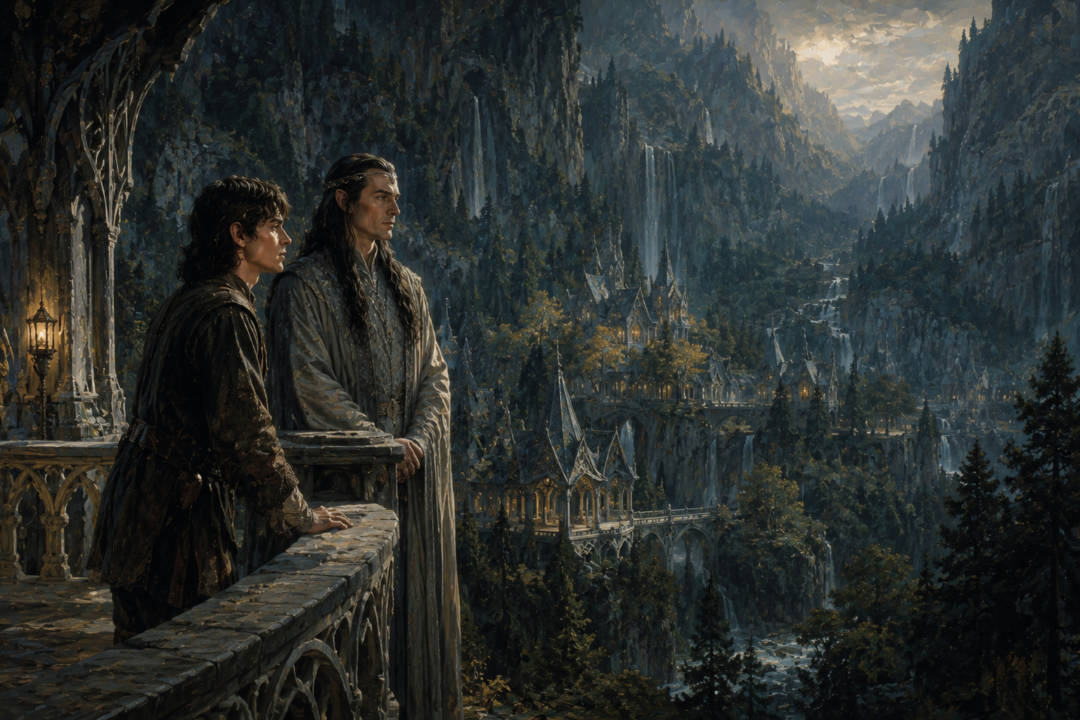
Aragorn’s father, Arathorn, is killed when Aragorn is only two years old. Gilraen takes her son to Rivendell, where his identity is concealed for his protection.
Elrond effectively takes the place of his father and comes to love him as a son.
Even Aragorn’s name is temporarily hidden. In Rivendell he is called Estel, “Hope,” while his descent from Isildur is kept secret.
The future king of the Dúnedain is therefore not raised primarily in a royal court of Men.
He grows up in the house of Elrond.
That matters enormously.
Rivendell is simultaneously a refuge, a repository of memory, a center of counsel, and one of the last great households of the Eldar in Middle-earth. Aragorn’s upbringing places the heir of Isildur inside a living tradition far older than the surviving kingdoms of Men.
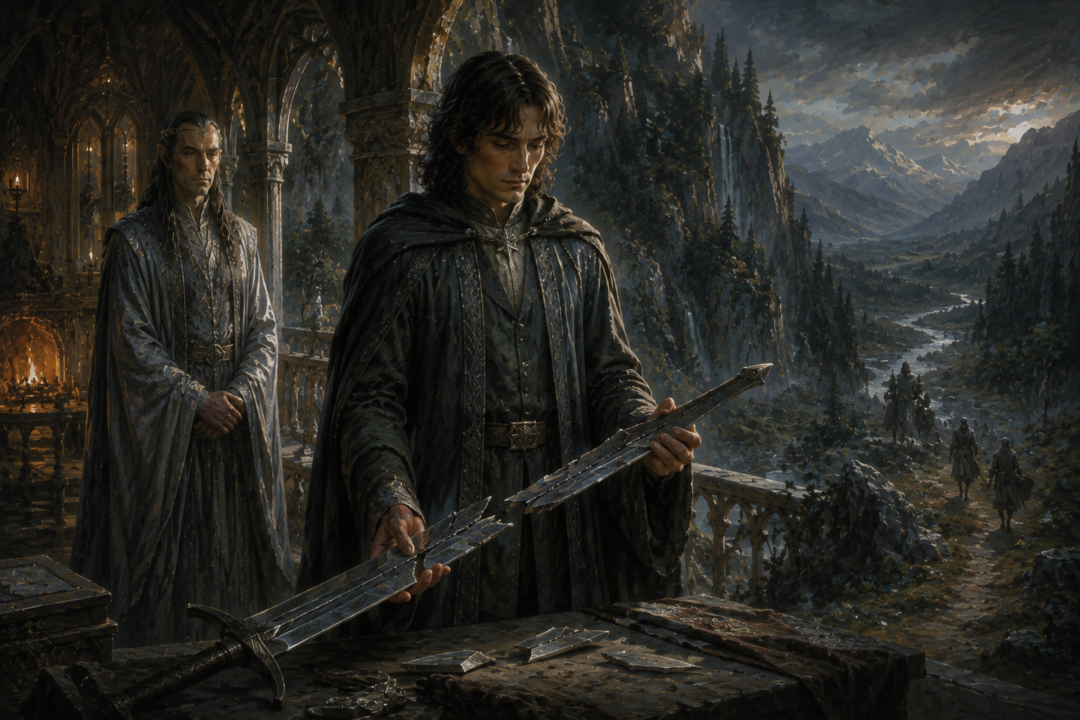
When Elrond finally reveals Aragorn’s ancestry to him, he gives him the heirlooms of his house, including the shards of Narsil. Aragorn does not discover that his foster-family has replaced his true identity.
He discovers that the household which raised him has been preserving it.
That is fosterage at its most politically significant.
Elrond Does Not Make Aragorn Less Dúnadan
The remarkable thing about Aragorn’s upbringing is that Elrond does not turn him away from the obligations of his bloodline.
The opposite happens.
Aragorn emerges from Rivendell prepared to assume them.
After learning his identity, he spends decades travelling and fighting against Sauron’s servants. Appendix A records his service in both Rohan and Gondor under the name Thorongil, long before he openly claims the kingship.
His loyalties become remarkably broad.
He is Chieftain of the Dúnedain of the North, heir of Isildur, friend and ally of Elves, an experienced servant of Gondor, and a man who understands peoples far beyond the narrow borders of his ancestral realm.
It would be too strong to claim that fosterage alone creates this political flexibility. Aragorn’s experiences in the Wild and his long years of service are essential.
But Rivendell is the household in which his character is first formed.
His fosterage demonstrates that political kinship can strengthen inherited duty while simultaneously expanding the world toward which that duty is directed.
The House of Théoden Shows a Human Version
A related pattern appears in Rohan, although the terminology is somewhat different.
After the deaths of Éomund and Théodwyn, King Théoden receives their children Éomer and Éowyn into his household and raises them as his own.
They are already his close blood relatives: Théodwyn is Théoden’s sister. This is therefore not the same kind of cross-cultural fosterage seen with Túrin, Tuor, or Aragorn.
Yet the political effect is revealing.
Éomer is not simply Théoden’s nephew. He becomes part of the king’s immediate household and eventually succeeds him after Théodred’s death.
Éowyn likewise loves Théoden as a father, and her long service to the failing king becomes central to her personal suffering.
Here household kinship reinforces blood kinship until political and familial loyalty are nearly inseparable.
The king is not merely the ruler they obey.
He is the man who raised them.
Why This Kind of Kinship Is Politically Powerful
Middle-earth contains treaties, oaths, marriages, hereditary claims, and formal alliances. Fosterage belongs to a different category because it operates inside the household.
A treaty can tell two rulers that their kingdoms are allies.
Fosterage can make the heir of one people sit at another lord’s table while still young enough for that household to become home.
That creates loyalty through lived experience rather than decree.
Túrin receives a place in Thingol’s kingdom.
Tuor learns among Annael’s people.
Aragorn grows to manhood under Elrond’s protection.
Éomer and Éowyn become children of Théoden’s household as well as members of his dynasty.
None of these relationships guarantees obedience. Túrin in particular proves that fosterage cannot overcome temperament, pride, doom, or disastrous choices.
But it can make political relationships personal.
And personal loyalty can survive circumstances in which abstract allegiance might fail.
The Darker Mirror: Elrond and Elros
There is also a disturbing variation on this pattern at the end of the First Age.
After the attack on the Havens of Sirion, the young Elrond and Elros fall into the hands of the sons of Fëanor. Later tradition associates their upbringing particularly with Maglor, and the texts indicate that affection eventually arose between them.
This is emphatically not a normal or voluntary fosterage arrangement. The children had been separated from their parents through violence committed by the very people who then cared for them.
That distinction should not be softened.
Yet the episode reveals something unsettling about household bonds: affection can arise even across a relationship born in catastrophe.
Middle-earth does not present kinship as mechanically dependent upon blood.
People can become emotionally bound through shared household life even when history gives them every reason not to be.
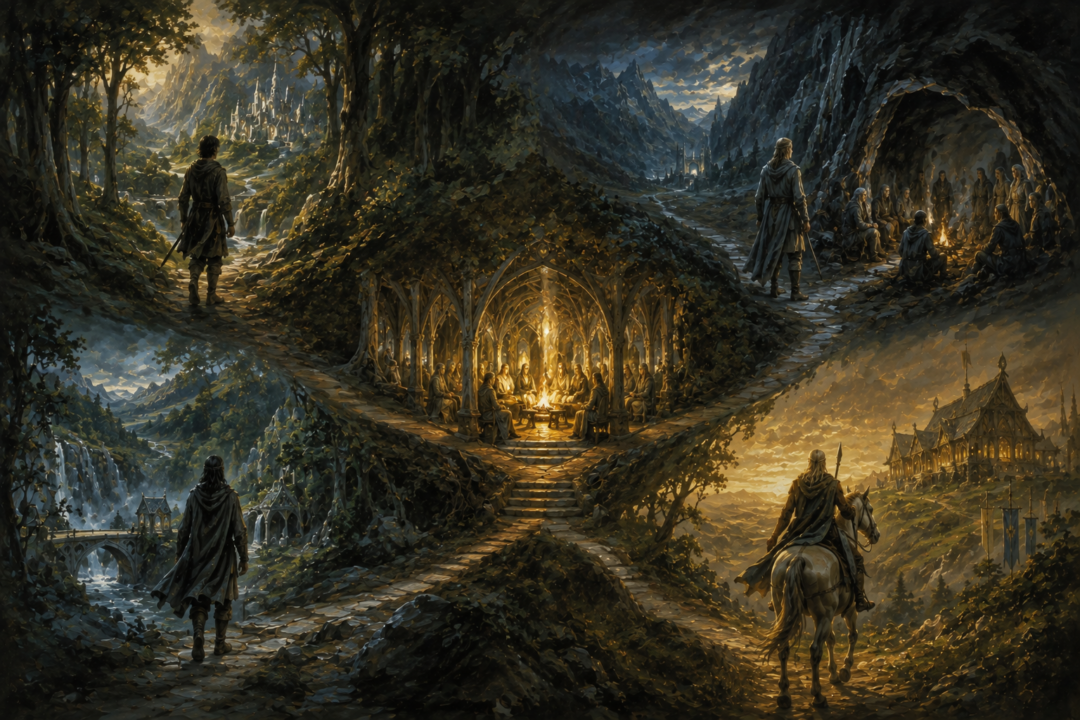
Fosterage Creates People Who Belong to More Than One World
The most important consequence of fosterage in Middle-earth is therefore not that one loyalty simply defeats another.
It is that identity becomes layered.
Túrin remains Húrin’s son while becoming Thingol’s foster-son.
Tuor remains Huor’s heir while growing among the Sindar.
Aragorn remains Isildur’s heir while becoming beloved in Elrond’s house.
Their inherited loyalties survive, but new loyalties grow beside them.
That is why fosterage can have consequences far beyond childhood.
A child raised in another household may eventually become a warrior, heir, king, messenger, or bridge between peoples. When that happens, diplomacy is no longer merely happening between strangers.
One side has helped raise someone who belongs to the other.
In Middle-earth, where ancient grievances and inherited identities can survive for thousands of years, that is an extraordinary form of political power.
Not the power to command loyalty.
The power to make another people part of what “home” means.
Sources & Notes
- The Encyclopedia of Arda, “Éomer” — https://www.glyphweb.com/arda/e/eomer.html
- The Encyclopedia of Arda, “Théoden” — https://www.glyphweb.com/arda/t/theoden.html
- The Encyclopedia of Arda, “Rohan” — https://www.glyphweb.com/arda/r/rohan.html
Reference entries document the people, places, events, and objects directly discussed in this article.