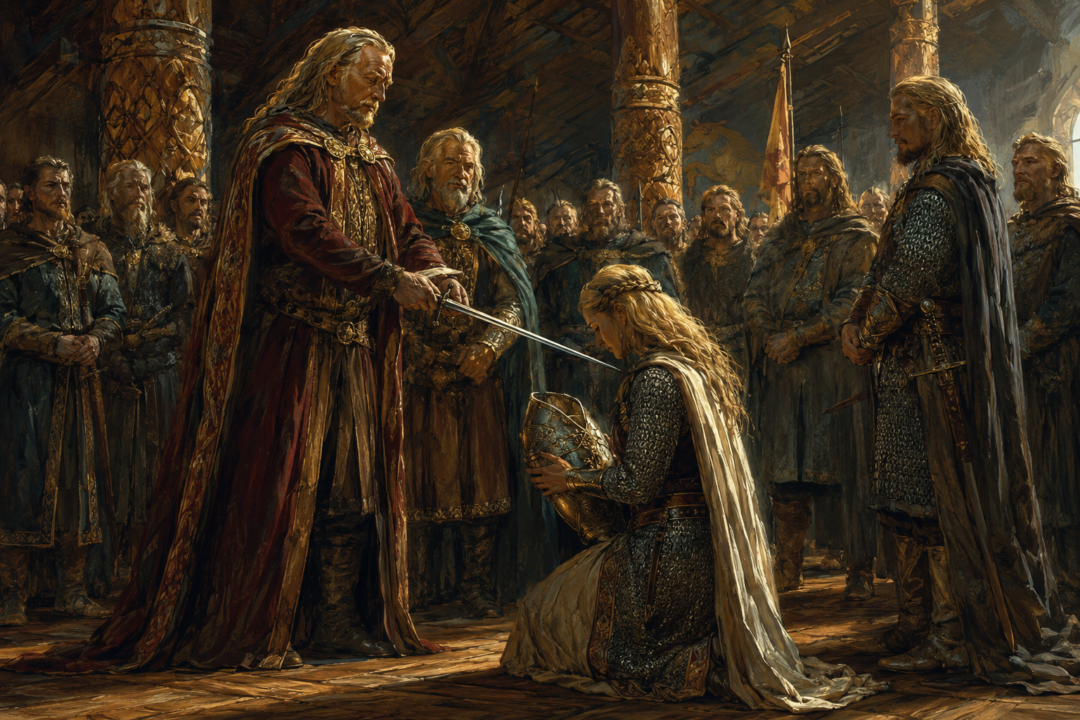
When Théoden rides out from Edoras after casting off the influence of Gríma Wormtongue, one problem cannot be solved with horses and swords. Rohan's king is going to war. His son Théodred is dead. Éomer must ride with him. Yet thousands of people will remain behind while Saruman's armies threaten the kingdom.
Someone has to hold Rohan together.
The person chosen is Éowyn.
It is tempting to remember this simply as Théoden ordering his niece to stay home while the men ride to battle. But the text presents something considerably more important. Éowyn is not merely left behind. She is publicly entrusted with the people of the Mark, armed by the king, and accepted because the Rohirrim themselves trust her.
That makes the decision both an extraordinary recognition of Éowyn's stature and one of the bitterest parts of her story.
Théoden Does Not Simply Send Éowyn Away
The crucial scene occurs at Edoras in The Two Towers, after Théoden has recovered his strength and resolved to ride against the forces threatening Rohan.
He knows the ride may be his last.
Théodred, his only son, has already been killed at the Fords of Isen. Théoden therefore publicly names Éomer, his sister-son, as his heir. But succession is only one problem. Théoden also asks who will remain behind to govern the people he cannot take with him.
No man volunteers.
The king then asks whom the people trust.
Háma gives the decisive answer: the House of Eorl. When Théoden points out that Éomer must ride with him, Háma reminds him that Éomer is not the last representative of that house.
There is also Éowyn.
Háma describes her as fearless and high-hearted and emphasizes that the people love her. Théoden accepts the recommendation and declares that Éowyn will lead the people while he is gone.
This distinction matters.
Éowyn is not selected merely because she happens to be Théoden's niece. Háma specifically presents her as someone possessing the confidence of the Rohirrim.
Her authority rests on both lineage and reputation.
Éomer Is the Heir, Éowyn Is the Leader Left Behind
The scene carefully separates two responsibilities.
Éomer is named Théoden's heir.
Éowyn is entrusted with the people remaining in Rohan.
Those are not the same office.
If Théoden dies but Éomer survives, Éomer succeeds him as king, which is exactly what eventually happens after Théoden's death on the Pelennor Fields. Éowyn's appointment does not displace Éomer from the succession.
Instead, Théoden is preparing for a different danger: the possibility that the king and his available fighting strength may be absent while the civilians of Rohan face invasion.
Someone capable of command must remain.
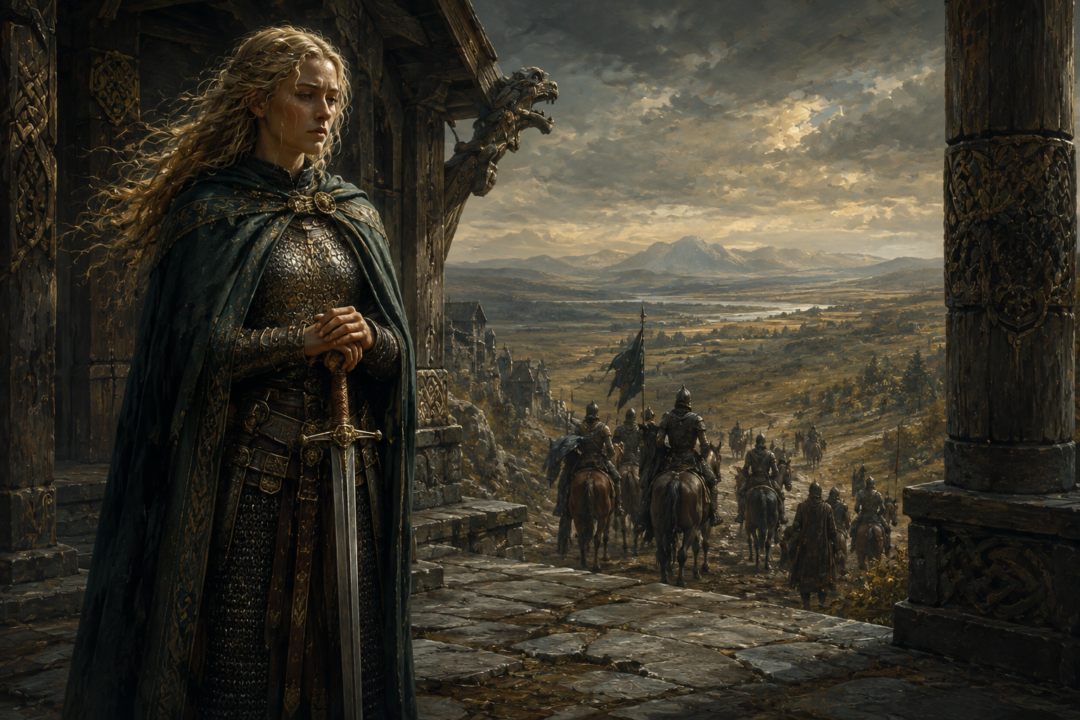
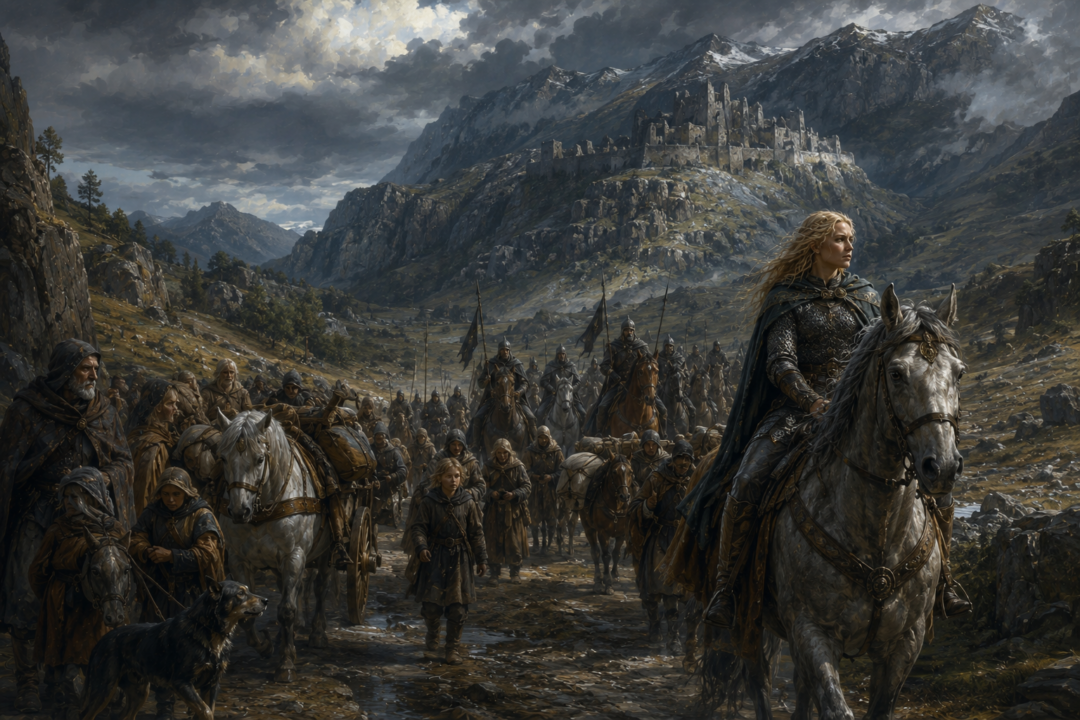
This is why reducing Éowyn's role to "staying in Edoras" is slightly misleading. After the decision, the people are associated especially with Dunharrow, the mountain refuge above Harrowdale. Théoden explicitly recognizes Dunharrow as a place where the people may defend themselves for a long time if events go badly.
Éowyn's responsibility is therefore larger than guarding an empty Golden Hall.
She has been given charge of the people themselves.
Why Théoden Cannot Leave Éomer
Théoden briefly explains the central military problem himself: he cannot spare Éomer.
Rohan has already suffered severe losses. Théodred is dead. Saruman's offensive is underway. The king needs experienced commanders in the field, and Éomer is not merely a royal relative but one of Rohan's most important military leaders.
The situation therefore creates a grim division of responsibility.
Théoden and Éomer must go where Rohan's mounted strength is needed.
Someone else must preserve authority among those who cannot ride.
Éowyn is the obvious remaining member of the royal house whom the people trust.
From Théoden's perspective, leaving her behind is not a judgment that she lacks courage. The opposite is much closer to what the scene establishes. She is chosen precisely because courage, authority, and loyalty will be required if the king does not return.
The tragedy is that Éowyn herself does not experience the honor in quite the same way.
What Théoden Sees as Trust, Éowyn Experiences as Confinement
This is where the political logic of Théoden's decision collides with Éowyn's private despair.
She has already spent years in Meduseld during Théoden's decline, watching over an aging king while Wormtongue's influence poisoned the royal household. Her later conversation with Aragorn makes clear how deeply she fears being trapped while others perform deeds that determine the fate of the world.
Her famous fear is not simply death.
It is a cage.
More precisely, she fears remaining behind barriers until habit and old age make escape impossible, while every opportunity for great action passes beyond her reach.
That gives Théoden's appointment a painful double meaning.
To the king and his people, Éowyn is being entrusted with Rohan.
To Éowyn, she is once again the one who remains.
The same act can therefore be both genuine political responsibility and emotionally unbearable confinement.
The text does not require us to treat either perspective as fraudulent.
Éowyn Had Already Been Serving Rohan
Éowyn's frustration becomes even more understandable when we remember what her life has recently involved.
During Théoden's weakness, she remained close to him. Gandalf later recognizes the cost of those years when discussing her condition after the Battle of the Pelennor Fields. She had watched the king she loved fall into premature decline while living under the shadow of Wormtongue.
Her service was real, but it was largely hidden service.
Then Théoden rises again.
The king rides.
Éomer rides.
Aragorn rides.
The great struggle she has watched approaching finally arrives—and her duty once again requires her to remain behind.
There is a cruel irony here. Éowyn is trusted because she has already demonstrated steadfastness. Yet that very trust produces another obligation to endure the kind of life she increasingly cannot bear.
Her competence becomes one reason she is denied the escape she desires.
The Sword and Corslet Reveal the Nature of Her Office
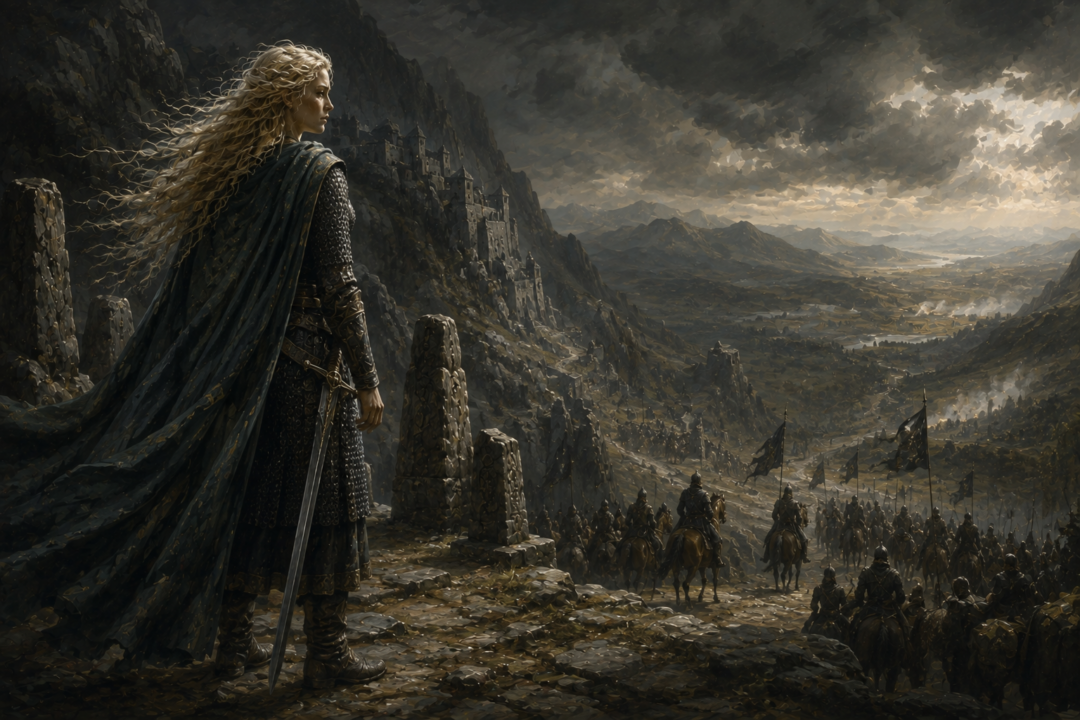
Théoden's appointment is also ceremonial.
Éowyn kneels before him and receives a sword and a corslet.
That is significant imagery. She is not presented merely as a caretaker performing domestic duties while the warriors are absent. She is equipped as someone responsible for defending the people if necessary.
The danger is genuine.
Rohan does not yet know how the war will end. Saruman remains a threat when the appointment is first made, and later the wider war against Sauron draws Théoden and his Riders eastward. If Rohan's field army is destroyed, those remaining behind will still need leadership.
Théoden even anticipates survivors retreating toward Dunharrow if battle goes badly.
Éowyn has therefore been entrusted with Rohan's continuity in disaster.
That is a remarkable responsibility.
Yet it still does not satisfy what she wants.
She does not merely want authority. She wants the freedom to hazard herself in the same struggle that others are permitted to enter.
Why Éowyn Eventually Disobeys
By the time Théoden prepares to ride from Dunharrow toward Gondor, Éowyn's despair has deepened.
She has also suffered another wound: her hope concerning Aragorn has come to nothing, and Aragorn has taken the Paths of the Dead despite her attempt to dissuade him.
She ultimately abandons the role assigned to her.
Disguised as the Rider Dernhelm, she joins the host and secretly carries Merry with her.
Her decision should not be simplified into a single motive. The text presents Éowyn as increasingly despairing, and Merry perceives something grim in Dernhelm before discovering the Rider's identity. Her ride toward battle contains courage, but it is also entangled with hopelessness and a desire to escape the life she believes awaits her.
That distinction matters because Éowyn's story is not merely about someone proving that she can fight.
Her courage was never seriously in doubt.
Háma had already called her fearless when recommending her to govern Rohan.
The deeper problem is what Éowyn believes courage is for.
Théoden's Decision Proves Something Éowyn Cannot Yet Believe
There is a final irony in the appointment.
Éowyn longs for the chance to demonstrate her worth through great deeds.
But Théoden's decision shows that her worth has already been recognized.
The king trusts her with his people.
Háma trusts her.
The Rohirrim love her.
She belongs to the House of Eorl and is publicly given authority at one of the most dangerous moments in Rohan's history.
Yet none of this heals her.
That is because Éowyn's crisis is not fundamentally caused by a shortage of respect. Honor cannot automatically cure despair. Responsibility cannot necessarily feel like freedom simply because it is important.
She eventually rides to the Pelennor Fields and performs one of the greatest deeds of the War of the Ring, standing before the Lord of the Nazgûl when others have fallen or fled. But even that victory nearly destroys her.
Her deeper recovery comes afterward.
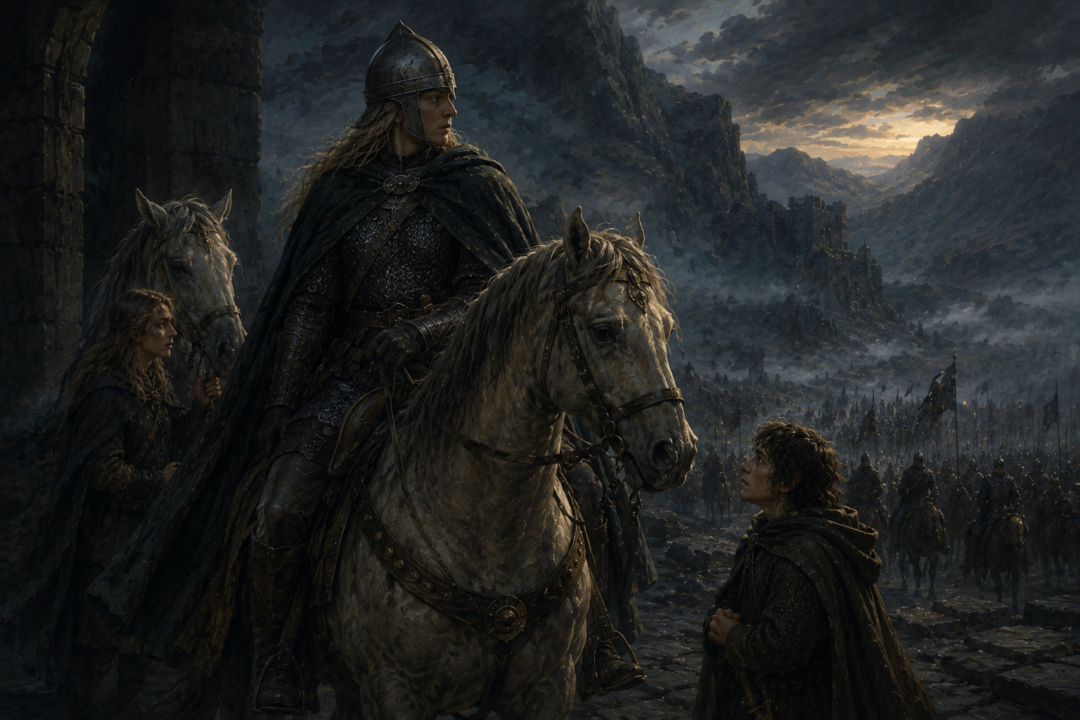
The Hidden Meaning of Théoden's Choice
Théoden does not leave Éowyn behind because she is useless in war.
He leaves her because someone must preserve the people for whom the war is being fought.
That is the overlooked distinction.
The Riders represent Rohan's power to strike its enemies. The people sheltered behind them represent the kingdom's reason for surviving at all.
Théoden needs Éomer beside him because Éomer is indispensable to the army.
He entrusts Éowyn with those who remain because she is trusted to lead them.
Seen that way, the scene at Edoras quietly anticipates the larger arc of Éowyn's story. She believes greatness lies somewhere beyond the walls, on dangerous roads where songs are won by the sword. Yet the story never dismisses the quieter forms of courage she has already practiced: endurance, protection, healing, and responsibility for other lives.
Théoden's command hurts her because it touches the deepest wound she carries.
But it is not an insult.
It is one of the strongest statements of confidence anyone in Rohan gives her.
Before Éowyn ever rides as Dernhelm, before she faces the Witch-king, and before songs can celebrate what she has done, the people of the Mark have already answered Théoden's question about whom they trust.
Their answer is Éowyn.
Sources & Notes
- The Encyclopedia of Arda, “Éowyn” — https://www.glyphweb.com/arda/e/eowyn.html
- The Encyclopedia of Arda, “Théoden” — https://www.glyphweb.com/arda/t/theoden.html
- The Encyclopedia of Arda, “Rohan” — https://www.glyphweb.com/arda/r/rohan.html
Reference entries document the people, places, events, and objects directly discussed in this article.