The Sun Was Not Always Born from Laurelin: Middle-earth’s Two Different Solar Origins
One of the most memorable images in The Silmarillion comes after the destruction of the Two Trees.
Valinor has gone dark. Telperion and Laurelin have been poisoned by Melkor and Ungoliant, and even Yavanna cannot restore them. Yet each Tree gives one final treasure: Telperion produces a last silver flower, while Laurelin bears a final golden fruit.
From these remnants come the Moon and the Sun.
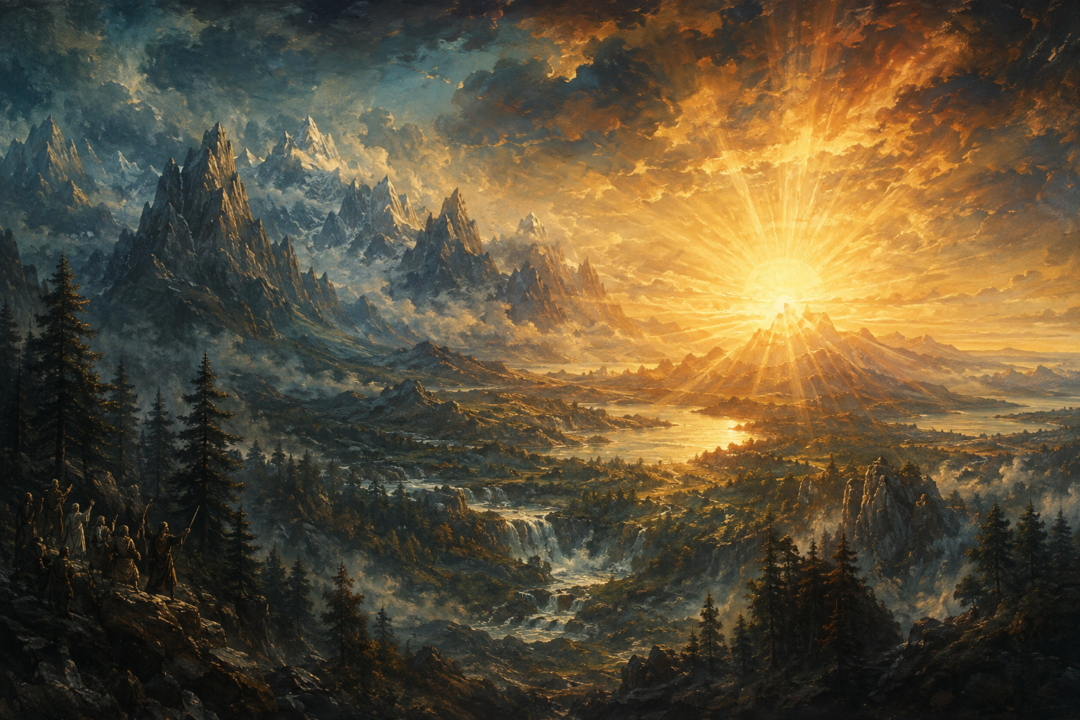
It is an extraordinarily elegant piece of mythology. The ordinary daylight known throughout The Lord of the Rings is therefore not ordinary at all. The Sun is the last surviving fire of Laurelin, carried through the heavens by Arien.
But this was not the only cosmology developed for Middle-earth.
In later writings preserved especially in Morgoth’s Ring, a radically different possibility appears. The Sun was no longer necessarily a new light created after the death of the Trees. Instead, it could be vastly older. In these late cosmological experiments, the Sun already existed before the Two Trees.
That change sounds astronomical.
Its consequences are mythological.
The Published Silmarillion Gives the Sun a Beginning
The sequence in the published Silmarillion is straightforward.
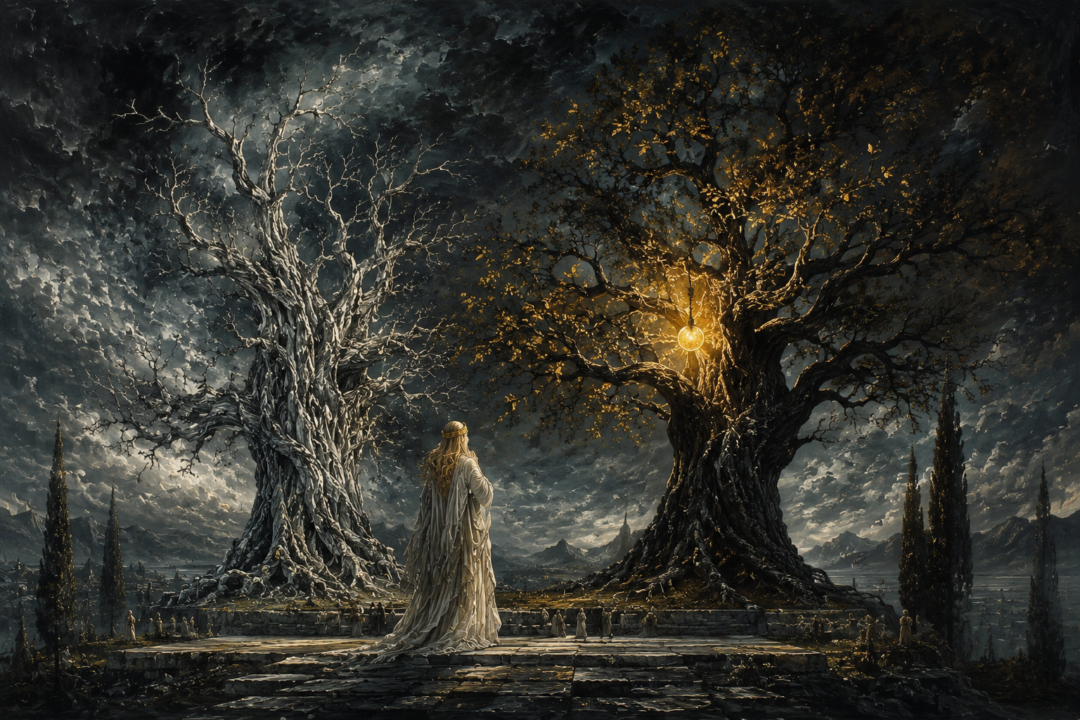
Before the Sun and Moon, the Valar illuminate their realm first through the Two Lamps and later through the Two Trees of Valinor. Telperion shines silver and Laurelin gold, their alternating radiance creating the great cycle of light in Aman.
Middle-earth, meanwhile, remains beneath the stars during the Years of the Trees.
Then comes the catastrophe.
Melkor and Ungoliant destroy the Trees. Yavanna attempts to heal them, aided by Nienna's tears, but their former life cannot be restored. Telperion produces one last flower and Laurelin one last fruit before dying.
Aulë and his people prepare vessels for these surviving lights. Varda establishes their courses through the heavens.
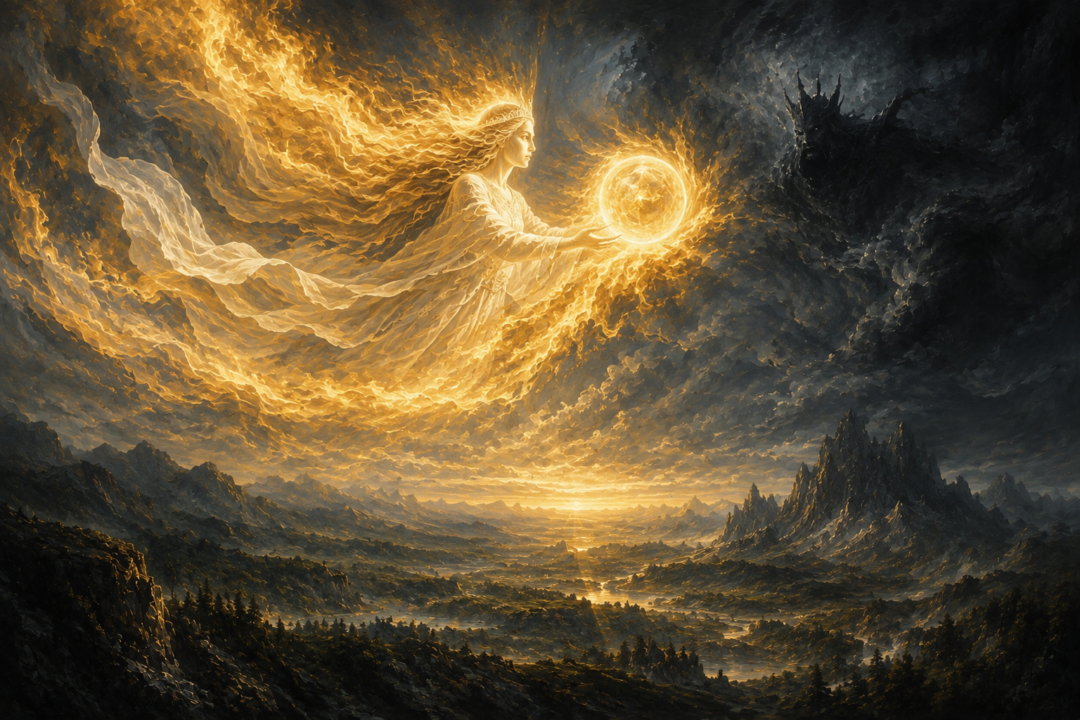
The golden fruit of Laurelin becomes Anar, the Sun.
Arien, a Maia associated with fire and formerly with the care of Laurelin's flowers, is chosen to guide it. She is powerful enough to endure its radiance and has not been corrupted by Melkor.
The silver flower of Telperion becomes Isil, the Moon, guided by Tilion.
In this cosmology, therefore, there is a real historical moment when the Sun first rises over Middle-earth.
Sunrise Is Also a Turning Point in History
The first sunrise is woven directly into the chronology of the First Age.
The Moon rises first. Fingolfin and his people, having crossed the Helcaraxë, enter Middle-earth beneath its new light.
Then the Sun rises.
Its coming awakens much that had lain beneath the Sleep of Yavanna, and Morgoth fears the new illumination. Most importantly for the history of the Children of Ilúvatar, the first rising of the Sun is associated with the awakening of Men in Hildórien.
That means the Sun is more than a celestial object in the published narrative.
It marks a transition between ages of the world.
The Elves awoke beneath stars. Men awake with the Sun.
This distinction remains embedded in Elvish memory and language. The stars belong especially strongly to the oldest experience of the Eldar, while Men enter history in a world illuminated by daylight.
The cosmology and the mythology reinforce each other.
That is one reason changing the origin of the Sun creates such large problems.
The Later Cosmology Begins from a Different World
In writings published in the “Myths Transformed” section of Morgoth’s Ring, a different cosmological model was explored.
Instead of Arda beginning as the kind of mythic flat world implied by the older cosmology and becoming round only after the downfall of Númenor, these writings consider Arda as physically round from the beginning.
Once that premise is accepted, other parts of the older mythology have to change with it.
Most dramatically, the Sun cannot simply appear extremely late in the physical history of the world.
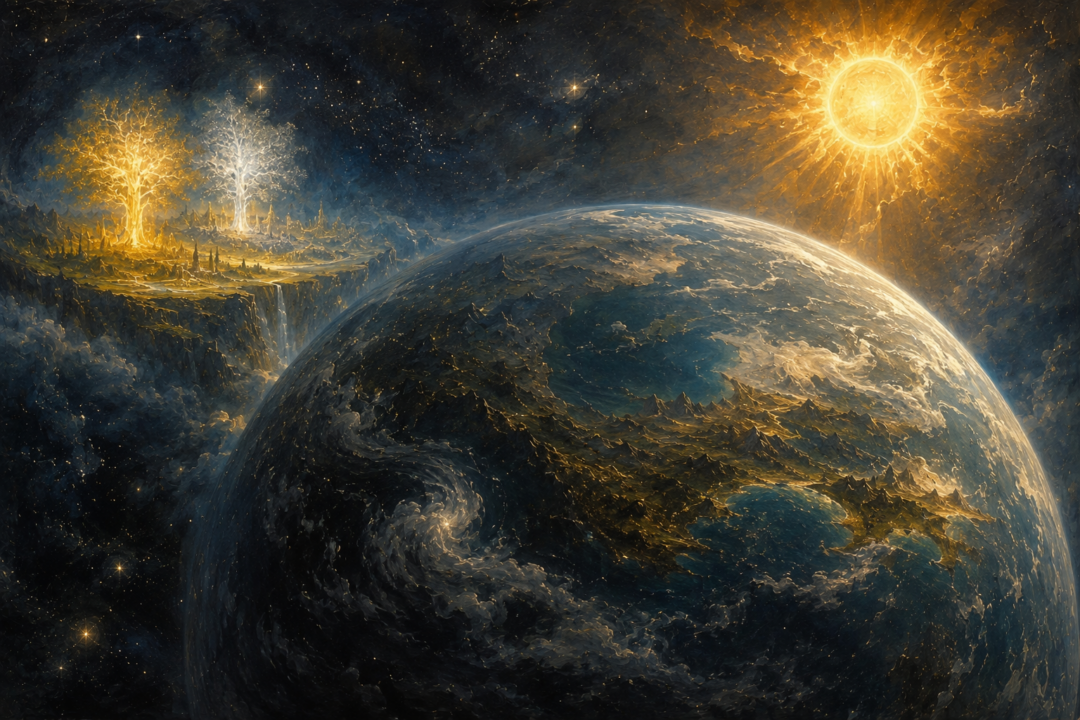
In versions of this revised conception, the Sun existed long before the destruction of the Two Trees. The Trees therefore could no longer be the original source from which the physical Sun was made.
This was not merely a minor rewrite of “Of the Sun and Moon.”
It reordered the foundations of Arda.
The late material was exploratory and was never comprehensively reconciled into a finished replacement for the older mythology. It is therefore safest to speak of a late cosmological conception rather than treating every idea within these writings as one final, settled canon.
The Two Trees Become Something Different
Removing the Sun's birth from Laurelin creates an obvious question.
If sunlight already existed, what made the Two Trees special?
One answer developed in the late material makes their significance, in some ways, even stranger.
The light preserved in the Trees could be understood as an uncorrupted or specially preserved form of primordial light, connected with the Sun before Melkor's corruption affected the world.
Under this conception, Laurelin is no longer important because the physical Sun will someday be made from its final fruit.
The Trees instead preserve something that the ordinary world has lost.
That changes the meaning of the Silmarils as well.
In the familiar published mythology, Fëanor captures the blended light of the Two Trees inside the Silmarils before the Trees are destroyed. After the Darkening of Valinor, their unmarred light survives principally within those jewels.
In the revised cosmological direction, the chain can become even deeper:
ancient unmarred light is preserved in the Trees, and the light of the Trees is preserved in the Silmarils.
The jewels are therefore not merely beautiful artifacts containing the radiance of Valinor. They become vessels carrying a remnant of a more pristine condition of the world.
Arien’s Story Also Changes
The published Silmarillion introduces Arien when the new Sun requires a guide.
She is a spirit of fire, one of the Maiar, and her nature allows her to bear Laurelin's final fruit through the heavens.
Some late material considered a dramatically different relationship between Arien, Melkor, and the Sun.
These ideas exist in unfinished and sometimes difficult textual forms, so they should not be flattened into a single definitive narrative. Broadly, however, the revised cosmology connects the corruption or alteration of the Sun with Melkor's assault upon the world's original light, and some late notes associate this with his attack upon Arien.
The crucial distinction is that Arien is no longer simply the appointed pilot of a newly created Sun.
She belongs to a much older solar history.
That changes the conflict from the creation of light after catastrophe into the preservation—or corruption—of light that already existed.
Why the Older Version Remains So Powerful
From a purely astronomical perspective, a world in which the Sun predates Elves, Trees, and recorded history resembles the physical universe familiar to the reader.
Mythically, however, the published version accomplishes something extraordinary.
It makes sunrise an event.
Imagine Middle-earth before it: starlight over Cuiviénen, forests and mountains beneath darkness, the Sindar living through long ages without seeing a dawn.
Then suddenly the heavens change.
The Moon crosses the sky.
Soon afterward comes the Sun.
For the first time, shadows fall beneath a light like fire. Dormant life stirs. Morgoth retreats beneath the earth. And somewhere far to the east, Men awaken into a world whose newest great light has just appeared.
The astronomical implausibility is inseparable from the mythic power.
The Sun is not background scenery.
It is history.
The Later Version Creates a Different Kind of Tragedy
Yet the revised conception gains something of its own.
In the published cosmology, the great pattern is destruction followed by partial recovery.
The Lamps are destroyed.
The Trees replace them.
The Trees are destroyed.
The Sun and Moon preserve something from their final flower and fruit.
Light survives catastrophe by changing form.
The later cosmology can produce a darker pattern.
Instead of progressively replacing destroyed lights, the world possesses ancient light from very early in its existence, but that light becomes damaged, diminished, obscured, or preserved only in exceptional sanctuaries.
The Trees then become refuges of purity rather than predecessors of the Sun.
That fits one of the deepest recurring patterns of Middle-earth: beauty is rarely increased without cost, while much of history consists of preserving fragments of what once existed more fully.
Valinor preserves what Middle-earth has lost.
The Trees preserve an older light.
The Silmarils preserve the light of the Trees.
And eventually even the Silmarils are removed from the ordinary possession of the peoples of Arda.
This interpretation should not be mistaken for a single finalized late narrative, but it reveals why the revised cosmology was potentially so significant.
The Problem Has No Completely Clean Solution
Readers sometimes try to resolve the contradiction by declaring one account “true” and the other merely obsolete.
The surviving textual history is less tidy.
The published Silmarillion presents the fruit-of-Laurelin origin of the Sun as part of its narrative world. It is internally connected to the first rising of the Moon, Fingolfin's arrival, Morgoth's reaction to daylight, and the awakening of Men.
The late cosmological writings demonstrate that a fundamentally different structure was seriously considered: a round world from the beginning, an ancient Sun, and a reinterpretation of the Two Trees and primordial light.
But those revisions were not fully worked through into a complete replacement of the entire mythology.
Changing the Sun affects too much.
It affects the chronology of the First Age.
It affects the significance of the Two Trees.
It affects the awakening of Men.
It affects Arien.
It affects the cosmology surrounding Númenor and the Changing of the World.
Pull one thread, and enormous sections of the legendarium begin to move.
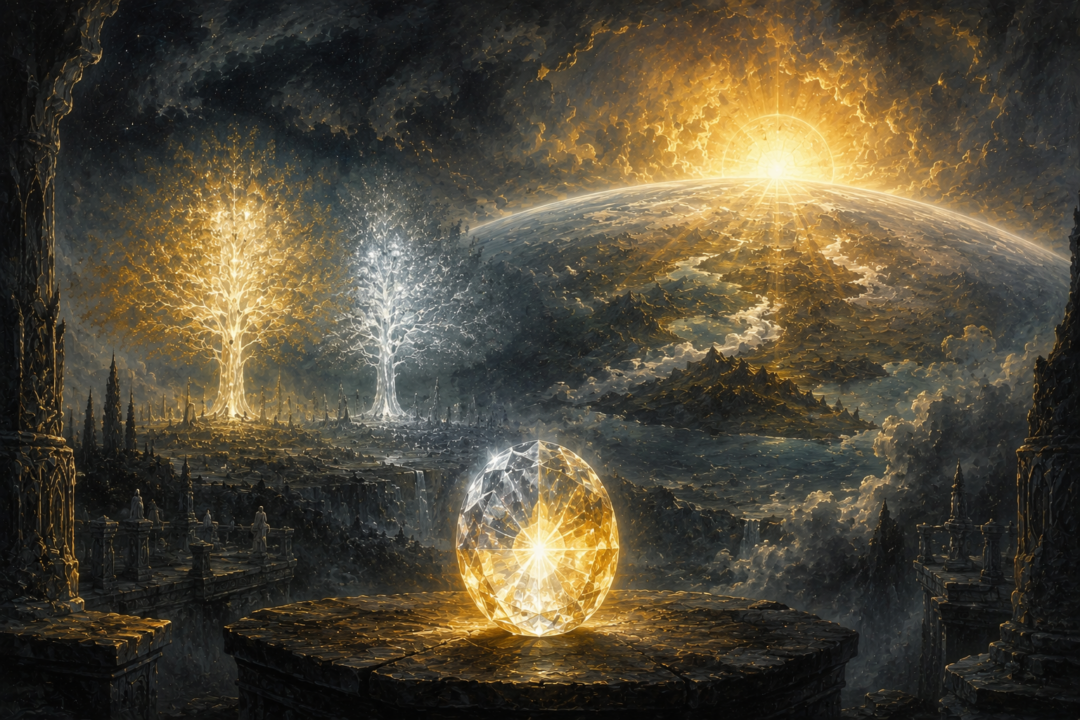
Two Suns, and Two Ways of Understanding Middle-earth
The contradiction therefore reveals something more interesting than a continuity error.
The two cosmologies tell different kinds of stories.
In the published Silmarillion, the Sun is a survivor.
Laurelin dies, but its last fruit carries golden light beyond Valinor. What had belonged to the Blessed Realm becomes visible across Middle-earth. The first sunrise is therefore born from catastrophe, yet it also becomes an unexpected victory over Morgoth's darkness.
In the late cosmological conception, the Sun can be ancient.
The deeper tragedy is then not that the world once lacked sunlight, but that the world's original light could be corrupted and its purity increasingly difficult to preserve.
One mythology asks how light can survive destruction.
The other asks how something ancient and originally good can remain unspoiled in a damaged world.
Neither question is small.
And behind the familiar sunrise over Middle-earth lies one of the legendarium's most fascinating unresolved transformations: whether the Sun was the last fire of a dying Tree—or whether Laurelin itself was preserving the memory of a light far older than the Trees.
Sources & Notes
- Kristine Larsen, “The Sun, the Son, and the Silmarillion” (Mythlore, 2023) — https://dc.swosu.edu/mythlore/vol42/iss1/11/
- Kristine Larsen, “The Cloud of Unseeing: Myths Transformed and Pseudo-scientific Interpretations of the Book of Genesis” (Journal of Tolkien Research, 2018) — https://scholar.valpo.edu/journaloftolkienresearch/vol6/iss2/4/
- The Encyclopedia of Arda, “The Sun” — https://www.encyclopedia-of-arda.com/s/sun.php
- The Encyclopedia of Arda, “Arien” — https://www.encyclopedia-of-arda.com/a/arien.php
Sources compare the published Sun-and-Moon myth with Tolkien’s late Round World and Myths Transformed cosmology, and document Laurelin, Arien, and the first sunrise.