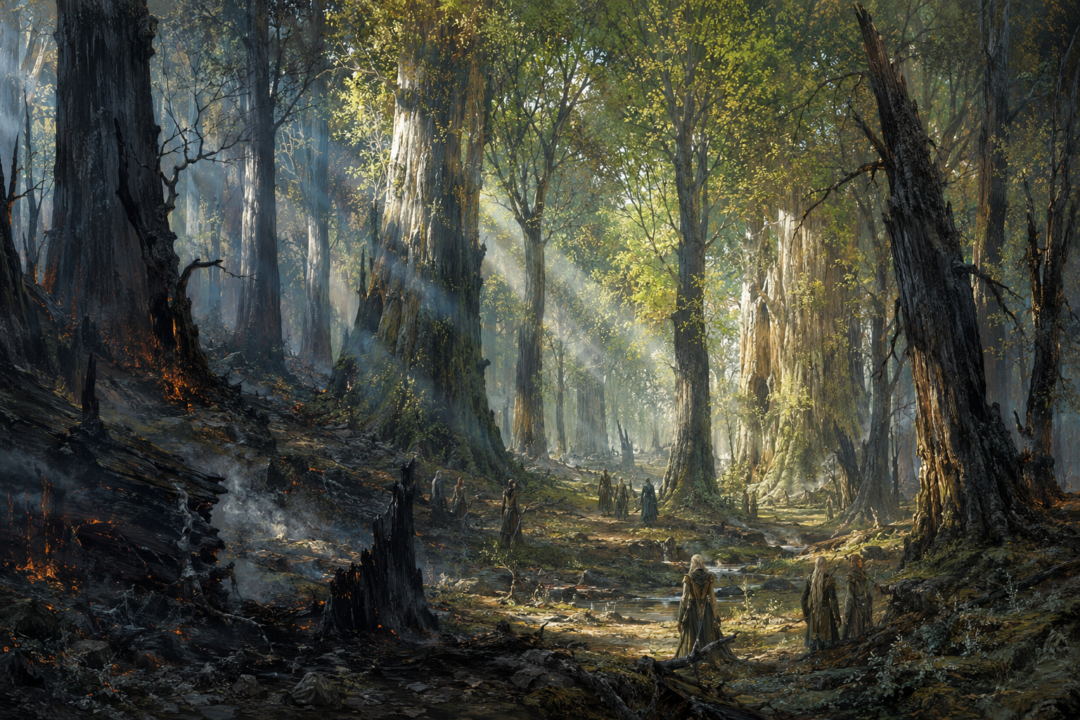
For most readers, Mirkwood is almost impossible to imagine without darkness.
It is the forest where Bilbo and Thorin’s company lose the path, where the trees seem to close around travellers, where giant spiders hunt beneath the branches, and where even daylight struggles to reach the ground. By the War of the Ring, its southern reaches are dominated by the threat of Dol Guldur, the fortress from which Sauron had once concealed his return.
Yet “Mirkwood” is not the forest’s true or permanent identity.
Long before the Shadow, it was Greenwood the Great. After Sauron’s final defeat, something remarkable happens: the darkness that defined the forest for much of the Third Age is broken, Dol Guldur is destroyed, and the great wood receives another name.
Eryn Lasgalen — the Wood of Greenleaves.
But this restoration does not simply return everything to the way it was. The political geography of the forest changes. Thranduil’s realm acquires new boundaries. Celeborn establishes a realm in the south. Men receive a vast territory between the Elven domains.
The end of Mirkwood is therefore more than the removal of evil.
It is the beginning of a new order.
Mirkwood Was Greenwood Before It Was Dark
The transformation at the end of the Third Age makes more sense when we remember that Mirkwood itself was already the product of an earlier transformation.
The great forest east of the Anduin was once known as Greenwood the Great, or Eryn Galen. The Shadow came later.
During the Third Age, Sauron established himself secretly at Dol Guldur in the southern forest. His presence was initially mysterious; for a long period the power dwelling there was known only as the Necromancer. As the darkness spread, Greenwood became Mirkwood.
That history matters because the forest’s corruption was never entirely natural.
The oppressive character encountered in The Hobbit is connected to a much larger evil operating within the wood. Bilbo and the Dwarves are not simply crossing an unusually unpleasant wilderness. They are travelling through a land that has existed beneath the influence of the Shadow for centuries.
Thranduil’s people survive within that environment rather than mastering the whole forest.
Their kingdom lies in the north, far from Dol Guldur. Later traditions concerning the Woodland Realm, especially those preserved in Unfinished Tales, describe how the Silvan Elves had progressively withdrawn northward as Sauron’s power increased.
That gives Thranduil’s underground halls a different significance.
They are magnificent, but they also belong to a kingdom living under pressure.
The Woodland Realm is an Elven civilization that has endured while a far greater hostile power occupies the opposite end of its forest.
The War Reaches Thranduil’s Own Trees
Sauron’s fall does not come to the Woodland Realm peacefully.
While the central narrative of The Lord of the Rings follows events around Gondor and Mordor, Appendix B reveals that the War of the Ring is being fought elsewhere at the same time.
Lórien is attacked repeatedly.
And Thranduil is attacked too.
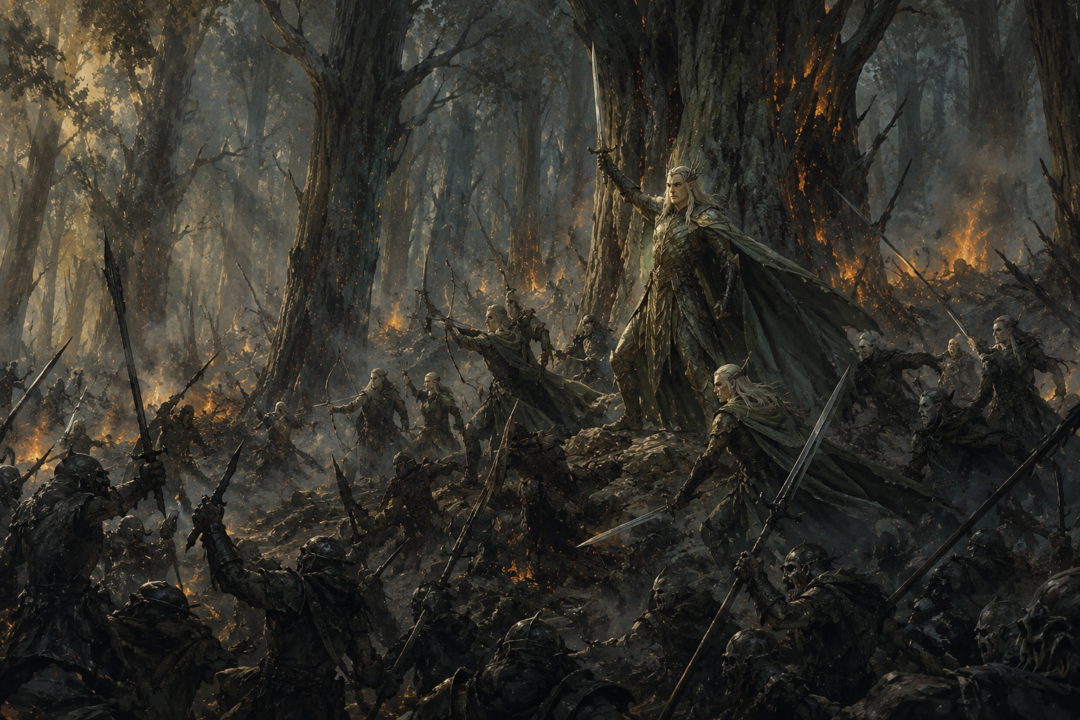
On March 15, 3019 — the same day as the Battle of the Pelennor Fields — forces from Dol Guldur attack the Woodland Realm.
The conflict is remembered as a long battle beneath the trees. Thranduil ultimately wins, but the victory is costly to the forest itself: there is great destruction by fire.
That detail prevents us from imagining the end of Mirkwood as an effortless awakening in which sunlight simply returns and everything becomes green again.
The forest emerges from war wounded.
Some of the very trees the Elves had defended through the long years of the Shadow are destroyed in the final struggle against it.
Only after Sauron falls can the surviving powers of the north turn decisively against Dol Guldur.
Dol Guldur Is Not Merely Abandoned
Sauron had already left Dol Guldur for Mordor decades before the War of the Ring, but the fortress remained one of his great northern strongholds.
Its destruction comes after the One Ring is destroyed.
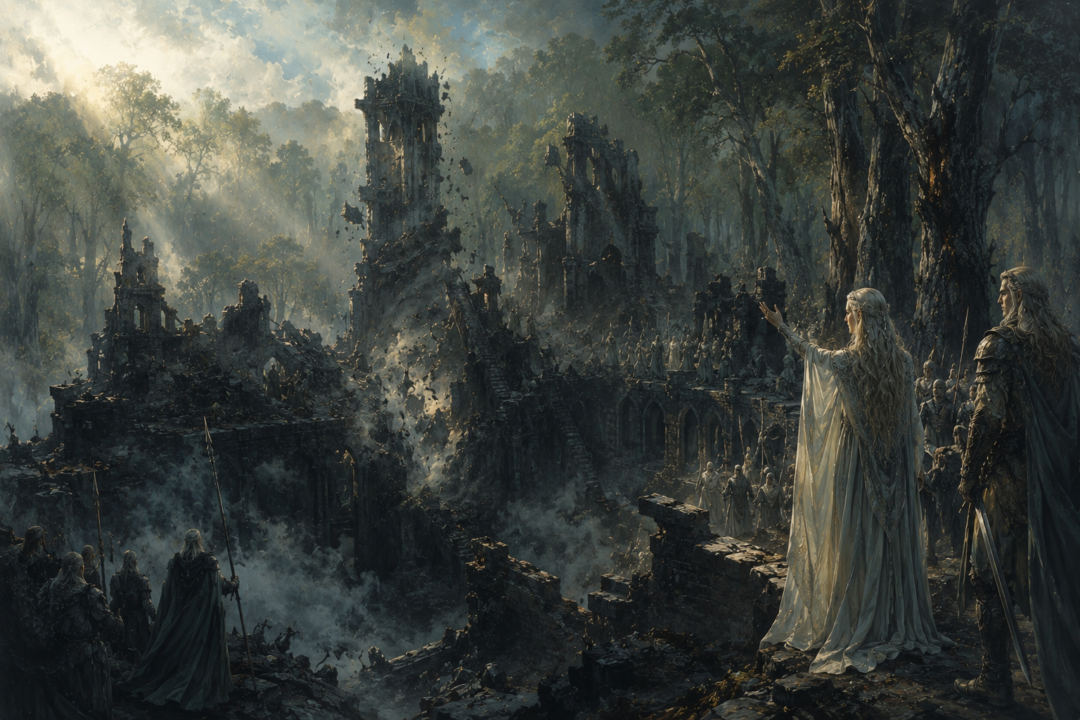
On March 28, Celeborn leads the host of Lórien across the Anduin and takes Dol Guldur. Galadriel then throws down its walls and lays bare its pits.
The forest is cleansed.
This is one of the most important differences between Sauron’s earlier departure from Dol Guldur and his final defeat.
After the White Council moved against him in 2941, Sauron withdrew from Dol Guldur — but he had already prepared his return to Mordor. The Shadow had not been permanently defeated.
In 3019 there is no such retreat.
Barad-dûr has fallen. The Ring is destroyed. Sauron has lost the power by which he could again take shape and dominate Middle-earth.
Dol Guldur can therefore be dismantled as a stronghold of an enemy who will not return.
For the first time in nearly two thousand years, the great forest no longer has Sauron looming over its southern reaches.
Mirkwood Receives a New Name
Then comes an extraordinarily symbolic moment.
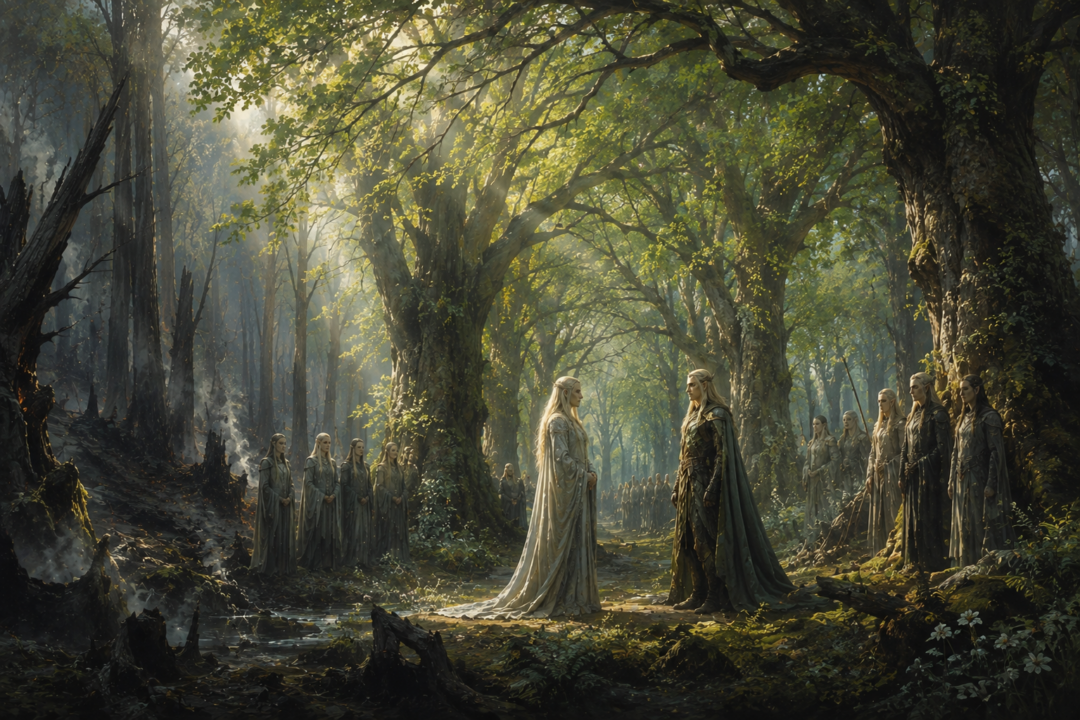
On April 6, the Elven New Year, Celeborn and Thranduil meet in the midst of the forest.
They rename Mirkwood.
Its new name is Eryn Lasgalen: the Wood of Greenleaves.
The choice deliberately recalls the forest’s older identity as Greenwood the Great. Yet it is not simply given its ancient name again.
That distinction is appropriate.
The forest has been restored, but history cannot be erased.
Greenwood existed before the long dominion of the Shadow. Eryn Lasgalen exists after surviving it.
The difference is subtle but important. The new name acknowledges renewal without pretending that the intervening centuries never happened.
“Mirkwood” described a forest under darkness.
“Wood of Greenleaves” describes a forest capable of life again.
Thranduil’s Realm Changes Its Boundaries
The political transformation is just as important as the cleansing.
After meeting in the forest, Thranduil and Celeborn divide its territories.
Thranduil receives the northern region down to the Mountains of Mirkwood. Celeborn receives the southern forest below the Narrows and calls it East Lórien.
Between those two Elven territories lies a large central region.
That land is given to the Beornings and the Woodmen.
This arrangement tells us something important about what restoration means after the War of the Ring.
The entire forest does not become one enormous Elven kingdom.
Thranduil does not claim everything once Sauron is gone. Celeborn does not simply extend Lórien across the whole wood either.
Instead, Elves and Men occupy distinct regions.
For the Woodland Realm, this means greater security and a clearly defined southern extent, but not domination over all Eryn Lasgalen.
The postwar settlement is shared.
The Woodmen and Beornings Gain Something Enormous
The central grant is easy to overlook because the famous names in the passage are Thranduil and Celeborn.
Yet the Beornings and Woodmen receive an immense share of the renewed forest.
Both peoples already belong to the world around the Anduin and the forest. The Woodmen in particular had long lived in and around western Mirkwood, while the Beornings controlled lands and passages associated with the upper Anduin.
After the war, their place in the region is formally reflected in the division of Eryn Lasgalen.
This is not merely Elven restoration.
It is also a human expansion into lands previously overshadowed by Sauron.
That fits the larger movement at the end of The Lord of the Rings. The victory over Sauron does not restore the Elder Days. Instead, it prepares Middle-earth for an age increasingly dominated by Men.
Even in a forest famous for its Elvenking, the new political landscape points toward that future.
The Woodland Realm Is Safer — But the Elves Are Still Fading
There is an important limit to how far we can describe Thranduil’s later kingdom.
The texts give remarkably little detail about his life after the division of Eryn Lasgalen.
We should therefore resist imagining a detailed Fourth Age history that is never actually provided.
Thranduil does not receive a narrated final departure. We are not explicitly told when, or even whether, he eventually sails West.
What we can say is that his realm survives Sauron.
And that is significant.
The Woodland Realm has endured the Shadow, the Battle of Five Armies, the renewed power of Mordor, and finally direct assault during the War of the Ring. At the moment when the Third Age closes, Thranduil still stands as king in the northern forest.
Yet the wider fate of the Elves has not changed.
Sauron’s defeat does not halt their fading.
The Three Rings lose their power after the destruction of the One Ring. Galadriel eventually departs Middle-earth. Elrond departs. Celeborn later leaves Lórien and dwells for a time in Rivendell. Legolas himself ultimately develops a longing for the Sea and, according to the tradition recorded in the appendices, eventually sails West.
So Eryn Lasgalen is not the beginning of a new permanent Elven golden age.
It is something more bittersweet.
The Elves finally receive a forest freed from the Shadow precisely when their own great age in Middle-earth is ending.
Legolas Shows What the New Age Can Become
One consequence of the victory appears outside the Woodland Realm itself.
After the War of the Ring, Legolas brings Elves from Greenwood south to Ithilien.
There they help make the war-damaged land beautiful again.
That movement is revealing.
During the age of Mirkwood, the Woodland Elves had spent centuries living under pressure from a darkness within their own forest. After Sauron’s defeat, some of them can instead travel into lands formerly threatened by Mordor and participate in restoration.
The direction of movement has reversed.
Sauron’s influence once pushed Elven life away from Dol Guldur.
After his destruction, Elves of the Woodland Realm can move southward into the restored kingdom of Gondor.
Legolas therefore represents another aspect of what changes when the Shadow disappears: the Woodland Realm no longer exists primarily as a refuge resisting encroaching darkness.
Its people can help heal other lands.
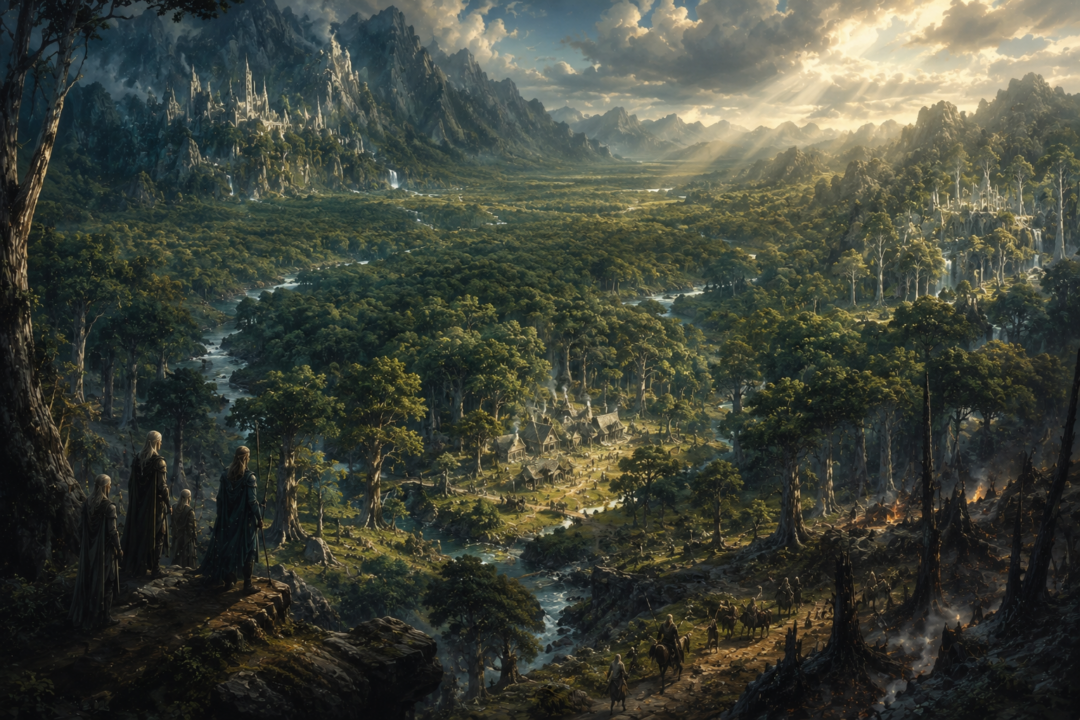
The Greatest Change Is That the Forest Has a Future Again
It would be tempting to imagine the transformation of Mirkwood entirely in visual terms.
More sunlight.
Greener leaves.
Open paths.
Fewer terrifying things beneath the branches.
Some degree of physical renewal is certainly implied by the cleansing and the new name, but the texts do not provide a detailed ecological account of exactly how every part of the forest changed. Claims about the disappearance of particular creatures or the restoration of specific roads should therefore remain cautious.
The deeper transformation is clearer.
The forest is no longer organized around Sauron’s presence.
Dol Guldur is gone as a functioning power. Thranduil’s kingdom no longer faces an enemy fortress in the south. Celeborn establishes East Lórien. The Beornings and Woodmen receive the broad middle country. The name “Mirkwood” itself is abandoned.
For centuries, darkness had become so characteristic of the forest that it replaced Greenwood in the memory of Middle-earth.
Then the Shadow passed.
Not everything returned to what it had been. The burned trees of the final battles could not simply be undone. The Elves themselves were entering the twilight of their history in Middle-earth.
But that may be precisely why Eryn Lasgalen is such a fitting name.
The forest does not become the old Greenwood again.
It becomes the Wood of Greenleaves — a land carrying the scars of the Third Age while growing beyond them.
And for Thranduil’s people, after centuries beneath the threat of Dol Guldur, that may be the most profound change of all.
For the first time in an age, their forest is no longer defined by the enemy living within it.
Sources & Notes
- The Encyclopedia of Arda, “Eryn Lasgalen” — https://www.encyclopedia-of-arda.com/e/erynlasgalen.php
- The Encyclopedia of Arda, “Mirkwood” — https://www.encyclopedia-of-arda.com/m/mirkwood.php
- The Thain’s Book, “Mirkwood” — https://thainsbook.minastirith.cz/mirkwood.html
- The Thain’s Book, “Celeborn” — https://thainsbook.minastirith.cz/celeborn.html
Sources cover the forest’s renaming and division, the War of the Ring fighting in Mirkwood, Dol Guldur’s fall, and Celeborn’s southern realm.