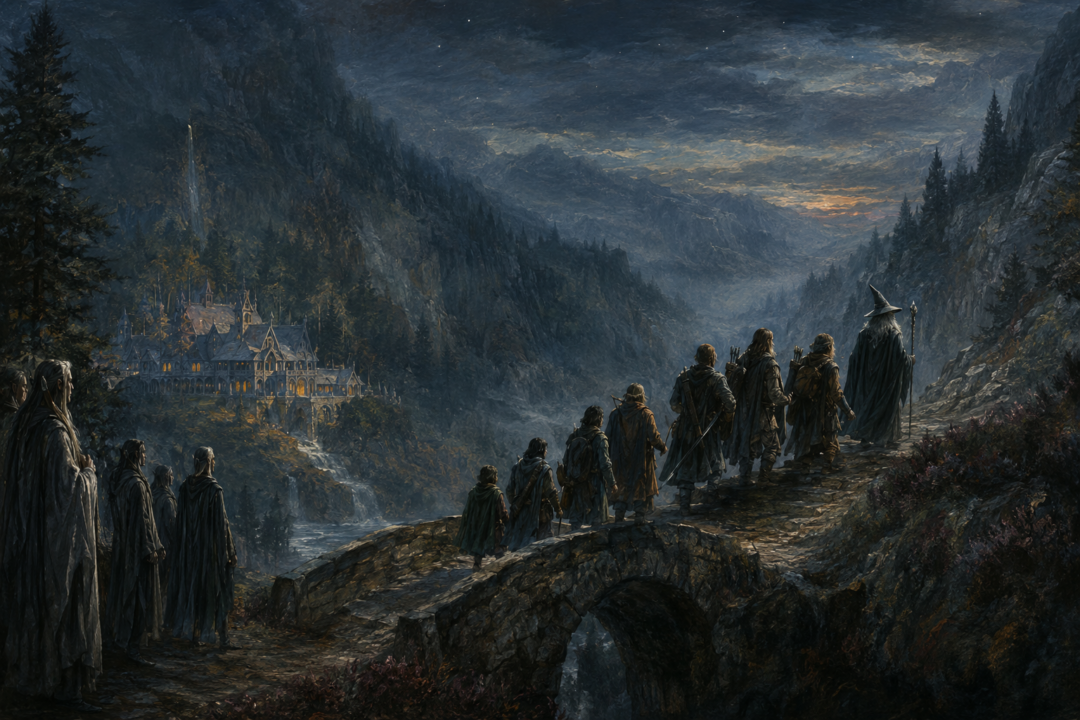
Rivendell seems like the safest place in Middle-earth when Frodo reaches it. The Black Riders have been swept away at the Ford, Elrond’s house is protected, Gandalf is present, and some of the wisest people still resisting Sauron have gathered there.
Yet the Council of Elrond does not solve the most dangerous practical problem.
The Ring still has to leave.
That creates a contradiction at the heart of the quest. Rivendell can conceal and protect Frodo for a time, but victory requires sending him back into lands where Sauron’s servants are searching for him. The moment of departure therefore cannot simply be chosen for comfort or speed.
It has to be controlled.
The Fellowship waits roughly two months after the Council before setting out. That delay is not presented as hesitation. It is part of the strategy. Scouts must return, the movements of the Nazgûl must be investigated, companions must be chosen, and the Company must depart in a manner that gives the Enemy as little useful information as possible.
The secrecy of the quest begins before the Fellowship takes its first step.
Sauron Already Knows Too Much
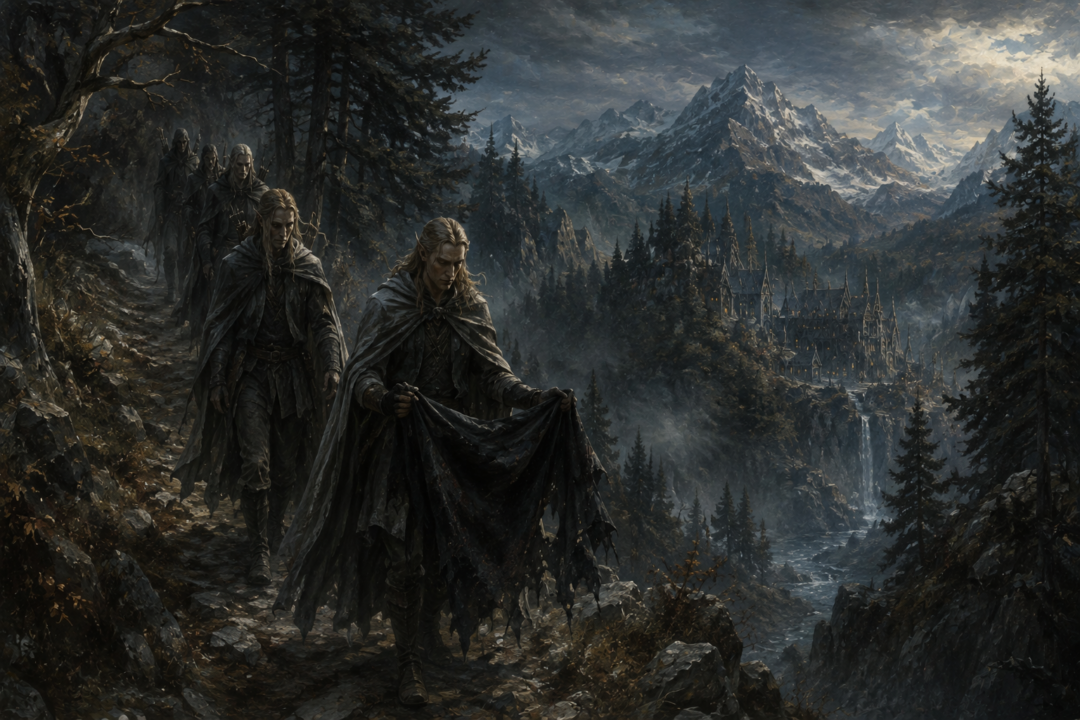
The Council cannot assume that Rivendell itself is unknown to the Enemy.
The Nazgûl have already pursued Frodo almost to its borders. They know that the Ring-bearer escaped them at the Ford of Bruinen. Even if they cannot simply enter Elrond’s hidden valley and seize him, Sauron has every reason to suspect that the Ring has reached a place of refuge among his enemies.
This changes the nature of secrecy.
Elrond and Gandalf cannot depend upon keeping Frodo’s general whereabouts permanently unknown. Their greater advantage lies in concealing what happens next.
Where will the Ring go?
Who will carry it?
By what road?
And, crucially, when will it leave?
At the Council, Elrond rejects the apparently easier westward solution partly because the obvious road will be watched. The quest must instead take the hard and unexpected road toward Mordor.
The same logic applies on a smaller scale to the Fellowship’s departure.
If the Enemy knows where something valuable is but does not know when it will move, the defenders still possess an important advantage. Once the movement is detected, that advantage begins disappearing.
Why Frodo Could Not Simply Leave After the Council
The Council takes place on October 25, 3018. According to the chronology in Appendix B, the Company does not leave Rivendell until December 25.
That long pause is striking because the Council has already reached its central decision: the Ring must be taken to the Fire.
Why wait?
Because the fate of the Nazgûl remains uncertain.
After the flood at the Ford, there is hope that the Riders have been temporarily crippled. Their horses have been destroyed or scattered, but that does not mean the Ringwraiths themselves are gone.
Gandalf explains that scouts have been sent in many directions and that Frodo cannot leave until they return.
This is one of the clearest indications that timing is a security question rather than a matter of convenience.
The scouts travel far from Rivendell. Some investigate routes north and south; others cross the Misty Mountains and search into Wilderland. Their purpose includes discovering what became of the Black Riders and whether immediate danger remains around the approaches to Rivendell.
The Company cannot safely depart while that picture is unclear.
Leaving too early might mean walking directly into an enemy screen that survived the disaster at the Ford.
Waiting forever is equally impossible.
The decision therefore depends on finding a temporary window in which the Enemy’s most dangerous hunters appear to have been disrupted.
The Scouts Create a Window, Not Certainty
Eventually the scouts return without finding the Nine roaming near Rivendell.
That does not prove that the Nazgûl have ceased to be a threat. Nor does anyone assume that Sauron has abandoned the search.
It means something narrower and more useful.
The immediate pursuit has been broken.
The Fellowship has an opportunity to move before the Enemy fully reconstructs his knowledge of events.
This distinction matters. Elrond is not waiting for Middle-earth to become safe. It never will.
He is waiting until the danger becomes uncertain enough that secrecy has a chance.
Once the scouts have returned, preparations accelerate. The Company is chosen, supplies are gathered, and the Ring-bearer finally leaves.
The delay and the departure are therefore two halves of the same strategy: first gather information, then move before that information becomes obsolete.
Why the Fellowship Leaves in the Evening
The Company does not march out of Rivendell like an army.
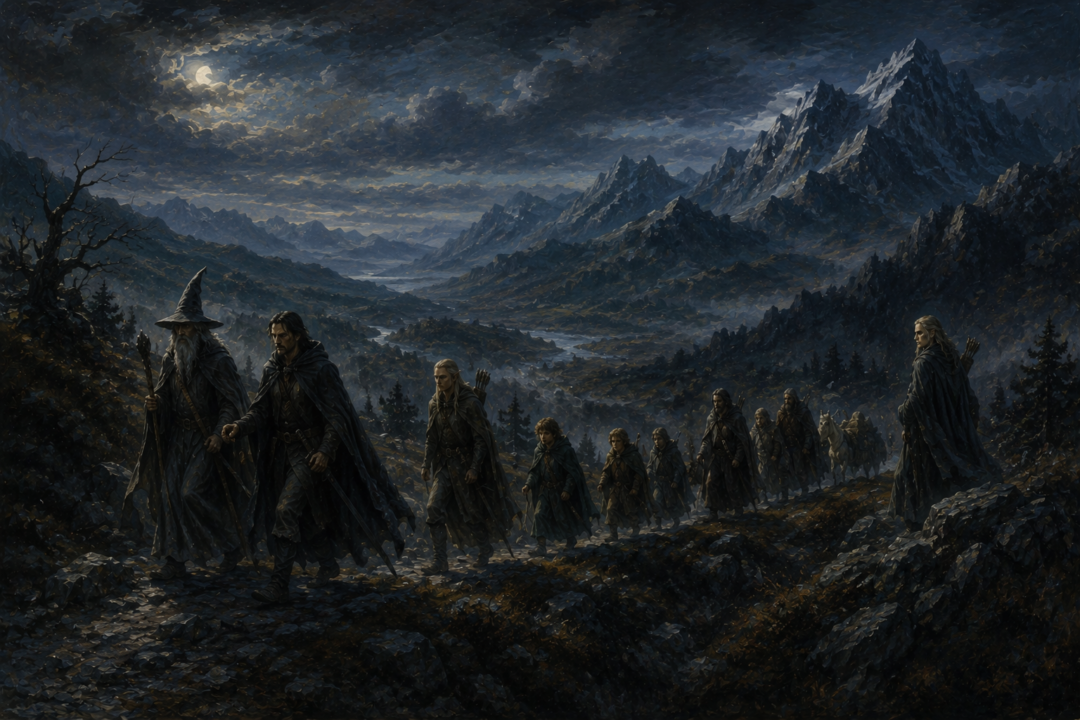
They depart as the early evening shadows are falling.
Elrond’s household watches quietly. There is no great public celebration, no procession, and no attempt to make their leaving a spectacle.
Boromir’s horn is the conspicuous exception.
His insistence on sounding it reflects something deeply characteristic of him: he is a warrior of Gondor accustomed to open defiance. He does not wish to creep away as though ashamed.
Elrond’s strategy is different.
The quest cannot succeed through displays of strength.
As the Company leaves Rivendell, they are nine travellers carrying the most dangerous object in Middle-earth through territory increasingly exposed to the Enemy. Their best defense is not intimidation but uncertainty.
The timing of their departure reinforces that principle.
They enter the Wild under darkness.
Their Entire March Is Built Around Concealment
Controlling departure time would accomplish little if the Fellowship then travelled openly by daylight.
They do the opposite.
After leaving the Ford of Bruinen, they abandon the Road and turn south through rougher country west of the Misty Mountains. The route is slower and less comfortable, but the text explicitly connects the choice with avoiding unfriendly eyes.
The paths are little known except to the people of Rivendell.
Their daily routine follows the same logic.
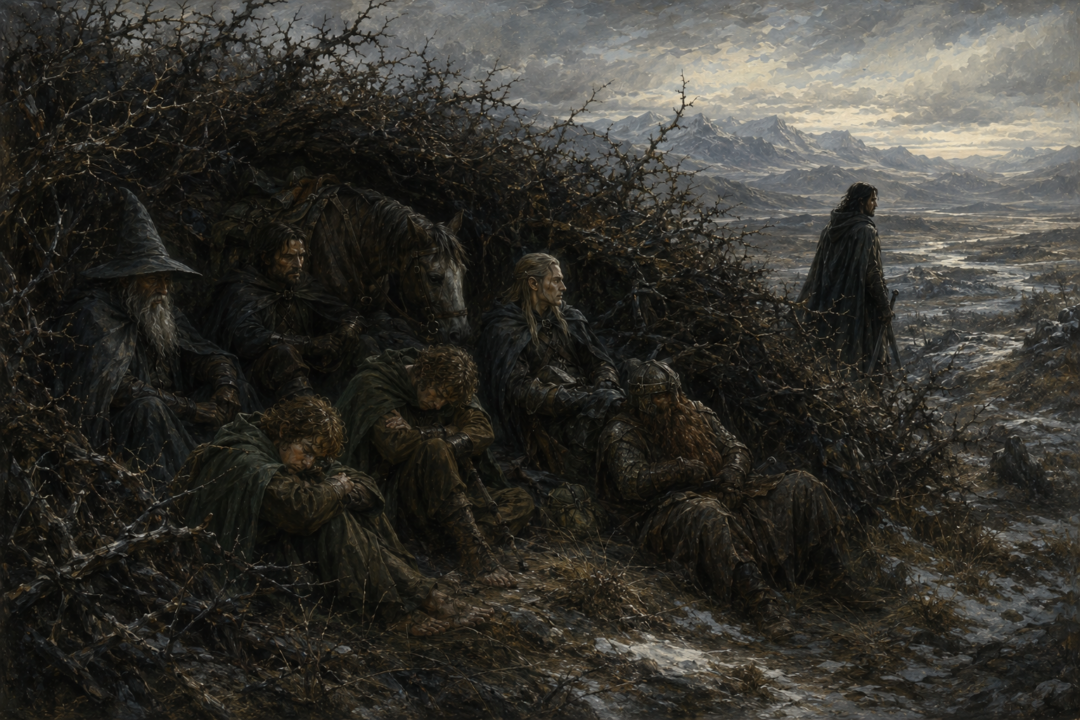
The Company commonly travels during the night. During daylight they hide and rest, sometimes in hollows or among thorny cover. Fires are often avoided because even ordinary comforts can reveal a hidden party.
This is the larger pattern behind the controlled departure from Rivendell.
They are managing visibility.
The question is never simply, “What is the fastest road to Mordor?”
It is, “What movement is least likely to tell the Enemy where the Ring is?”
A Small Company Was Part of the Same Strategy
Elrond also refuses the logic of military strength when choosing Frodo’s companions.
The Company will contain nine walkers, symbolically set against the Nine Riders, but Elrond does not attempt to surround Frodo with an army.
Numbers would work against secrecy.
A large armed force needs more food, makes more noise, leaves a larger trail, and is harder to conceal. More importantly, the whole purpose of the quest depends upon doing something Sauron is poorly prepared to imagine: carrying the Ring into his own realm in order to destroy it.
The Fellowship therefore represents concentrated capability rather than overwhelming force.
Gandalf brings wisdom and power. Aragorn brings extraordinary knowledge of the Wild. Legolas brings Elvish sight and woodland skill. Gimli brings the endurance and knowledge of the Dwarves. Boromir is a formidable warrior. The hobbits possess qualities that the great powers of the world repeatedly underestimate.
But they remain only a small travelling company.
Secrecy is not merely one protection among many.
It is the central protection.
Hollin Shows How Quickly the Advantage Can Vanish
The danger becomes visible after the Fellowship has been travelling for roughly two weeks.
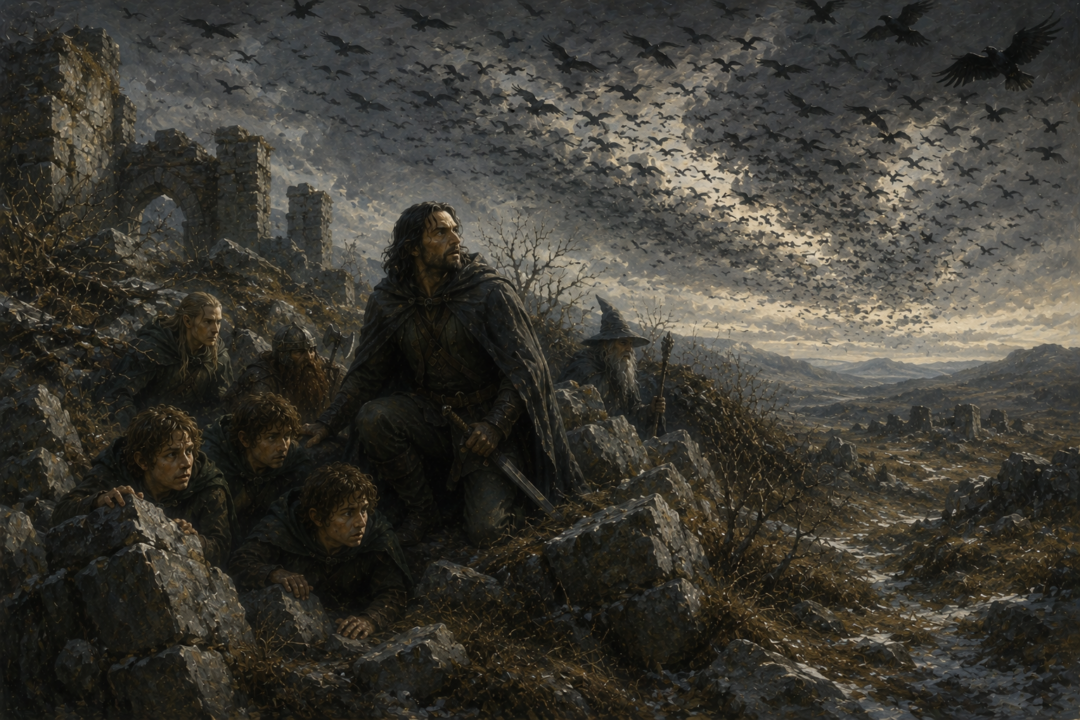
In Hollin, Aragorn becomes uneasy. Soon the Company sees great flocks of black birds, including crebain coming out of Fangorn and Dunland.
Whether every bird is directly controlled by the Enemy is not established, and the Company itself cannot know exactly who is receiving whatever intelligence might be gathered.
That uncertainty is enough.
They hide.
They alter their behaviour.
They wait for darkness.
This episode demonstrates why controlling the departure from Rivendell mattered so much. The Fellowship is moving through a world in which information can travel through unexpected channels. A traveller seen in the wrong place can reveal a route. A fire can betray a campsite. A group moving openly can become a report carried elsewhere.
The Fellowship does not need to lose a battle to fail.
It only needs to be found.
Secrecy Was Really About Buying Time
This is the deeper purpose behind the two-month wait at Rivendell.
Elrond cannot make Frodo invisible forever.
He can only try to delay the moment when Sauron understands what his enemies are doing.
That delay is enormously valuable.
Every day in which the Enemy does not know the Ring’s route is a day in which armies cannot easily be positioned against it. Every uncertain report forces Sauron’s servants to consider multiple possibilities. Every night march and hidden resting place preserves the ambiguity a little longer.
The texts never present the December departure as a magical moment when surveillance becomes impossible.
Instead, the strategy is cumulative.
Scouts clear the immediate approaches.
The Fellowship leaves only after their reports return.
They depart under evening shadow.
They avoid obvious roads.
They travel largely at night.
They hide during daylight.
They avoid fires when necessary.
They choose difficult country because obscurity matters more than speed.
These are all expressions of the same principle.
Rivendell’s Last Gift Was Uncertainty
Rivendell gives Frodo many things.
He receives healing there. He gains knowledge of the Ring. He finds companions. Bilbo gives him Sting and secretly passes on the mithril coat that will later save his life.
But Elrond gives the quest something less visible.
A controlled beginning.
The Fellowship does not leave simply because everyone is finally ready. It leaves after intelligence has been gathered and when the immediate threat of the Black Riders appears to have receded enough to permit movement.
Even then, nothing is guaranteed.
That is what makes the strategy so important.
The Wise cannot defeat Sauron by knowing everything. They cannot predict every spy, every road, or every disaster awaiting the Company. What they can do is control the information available to their enemy for as long as possible.
So the long wait in Rivendell is not a pause before the real quest.
It is already part of the quest.
Before Frodo can hide the Ring from the Dark Lord across hundreds of miles of Middle-earth, Elrond must first hide the most important fact of all:
the moment when the Ring begins to move again.
Sources & Notes
- https://tolkiengateway.net/wiki/The_Ring_Goes_South
- https://tolkiengateway.net/wiki/Council_of_Elrond
- https://tolkiengateway.net/wiki/Third_Age_3018
- https://encyclopedia-of-arda.com/n/ninecompanions.html
Sources verify the Council date and decision, the two-month wait for scouts investigating the Black Riders, the Fellowship’s formation, and its dusk departure from Rivendell on 25 December 3018.