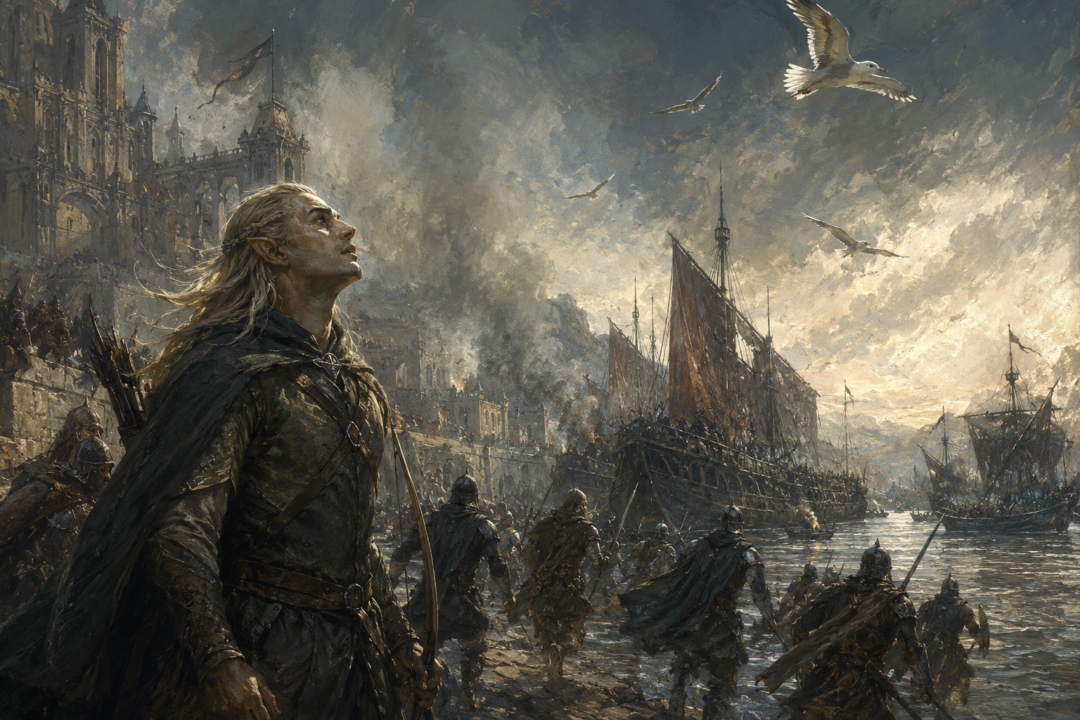
Legolas had crossed mountains, walked beneath ancient forests, entered the Golden Wood, survived the darkness of Moria, and followed Aragorn through the Paths of the Dead. Yet none of those wonders changed him quite like the sound of an ordinary bird.
At Pelargir, amid war and the capture of the Corsair fleet, Legolas heard gulls crying overhead.
For a moment, the battle itself seemed to vanish from his mind.
Later, in Minas Tirith, he explains what happened: before Pelargir he had never encountered gulls. Their voices awakened something that he believed had always been buried within his people—the longing for the Sea.
That distinction matters. Legolas did not suddenly decide that he liked the coast. Nor had he actually seen the Great Sea when the change occurred. Something dormant was stirred, and afterward he believed that life beneath the trees could never again satisfy him in quite the same way.
So why did this happen only at Pelargir?
The answer lies in Legolas’s woodland upbringing, Galadriel’s remarkably precise warning, and a much older relationship between the Elves and the Sea.

Legolas Had Never Seen the Sea
The simplest part of the answer is also the most important: Legolas tells us directly that he had not yet beheld the Sea.
He came from the Woodland Realm in northern Mirkwood, where his father Thranduil ruled the Silvan Elves. His world was one of immense forests, rivers, caves, mountains, and the long shadow of Dol Guldur—not the western coasts of Middle-earth.
The narrative never supplies Legolas with a precise age or a complete biography before the War of the Ring. We therefore cannot safely claim exactly where he had or had not travelled during his earlier life.
But Legolas himself settles the relevant question.
When he sees gulls flying inland over the Anduin after the Battle of the Pelennor Fields, he says that he had never encountered such birds before Pelargir. More importantly, he explicitly says that he has still never seen the Sea.
That makes Pelargir a threshold.
The city stood on the Anduin far south of the lands Legolas knew, downstream toward the Bay of Belfalas. He had entered a landscape where signs of the Sea could reach him even though the Sea itself remained beyond his sight.
And one of those signs was enough.
Galadriel Had Already Warned Him
The awakening was foreshadowed before Legolas ever reached Pelargir.
When Gandalf reunites with Aragorn, Gimli, and Legolas in Fangorn, he delivers messages from Galadriel. Her warning to Legolas tells him to beware of the Sea if he hears the cry of a gull upon the shore, because afterward his heart will no longer rest in the forest.
At first, the warning is mysterious.
Legolas is a Wood-elf. Trees are central to the world he loves. Nothing during his journey has suggested that he intends to abandon them for ships and distant shores.
That is precisely why Galadriel’s warning carries such weight.
She is not warning him about something he consciously desires. She is warning him about a desire that has not yet awakened.
At Pelargir, the warning becomes reality.
As Aragorn and his companions approach the struggle for the Corsair ships, Legolas hears gulls crying above them. He later remembers that he stopped and, for an instant, forgot the war around him.
The voices of the birds spoke to him of the Sea.
It is one of the strangest small moments in the War of the Ring: while kingdoms are fighting for survival, Legolas suddenly becomes aware of a longing larger than the battle itself.
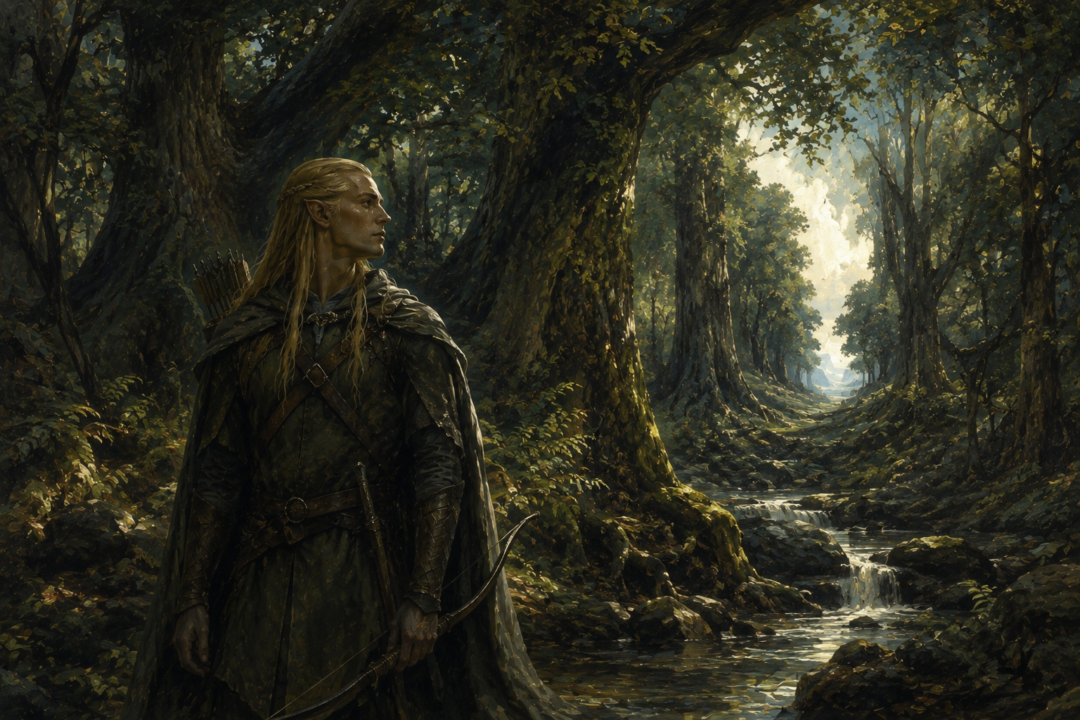
The Longing Was Already There
Legolas’s own explanation is crucial.
He says that deep in the hearts of his kindred lies a sea-longing and that it is dangerous to awaken it.
His language suggests something latent rather than newly created.
The gulls do not manufacture the longing. They stir it.
That idea fits the much older Elvish relationship with the West. In the Elder Days, the summons of the Valar drew the Elves westward toward Aman. Some completed the Great Journey; others halted or remained behind. The histories of the Eldar thereafter became deeply entangled with the Sea, the Blessed Realm beyond it, exile, memory, and departure.
Not every Elf experienced that history in the same way. It would therefore be too simple to treat sea-longing as an identical mechanical impulse operating in every Elf.
Legolas’s own case is more specific.
Whatever his precise ancestry and personal history, he understands the longing as something that lies within his people and can remain unstirred until an encounter awakens it.
For him, that encounter is the gulls at Pelargir.
Why Didn’t Rivers Awaken It Earlier?
This creates an interesting question.
Legolas had already encountered great waters. He travelled beside the Anduin with the Fellowship. He passed the Falls of Rauros. He knew rivers in his homeland.
Why did none of those experiences produce the same result?
The text never gives us a rule saying that any large body of water automatically causes sea-longing. In fact, Legolas’s experience demonstrates the opposite.
The trigger is not simply water.
At Pelargir, it is specifically the cry of the gulls that reaches him. Their voices somehow communicate the Sea to an Elf who has never actually seen it.
That explains why his earlier journeys beside rivers did not necessarily matter. A river was still part of the Middle-earth he already knew. The gulls were different: they were living messengers, in effect, from a realm of experience beyond his woodland world.
This is also why the geographical setting matters. Pelargir lies on the lower Anduin, within reach of birds associated with the coast. Legolas had finally travelled far enough south for the Sea to announce itself before he could see it.
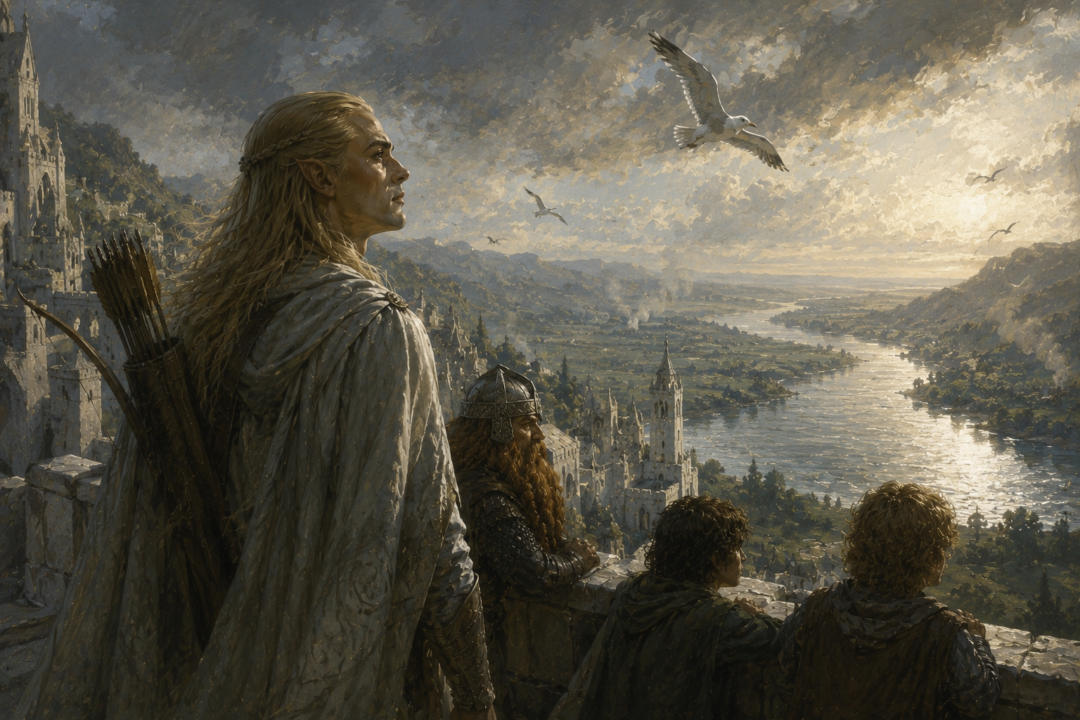
He Heard the Call Before He Saw Its Source
Perhaps the most beautiful part of the episode is that Legolas’s longing precedes his actual sight of the Sea.
He hears before he sees.
Later, while recovering in Minas Tirith, he spots white seabirds flying up the Anduin. Their appearance immediately returns his thoughts to Pelargir. He describes them as both a wonder and a trouble to his heart.
The Sea has become real to him through absence.
He cannot see it from Minas Tirith. He had not seen it at Pelargir. Yet he now knows that it is there, beyond the river and the southern lands, and that knowledge has permanently altered his relationship with Middle-earth.
This is why his statement about finding no peace beneath beech or elm is so powerful.
The forest has not become ugly.
Legolas has changed.
He can still love trees, friendship, Ithilien, and the beauty of Middle-earth. But another horizon has entered his imagination, and he cannot unknow it.
The Sea-Longing Does Not Make Him Leave Immediately
The most important evidence that sea-longing is not simple compulsion comes afterward.
Legolas does not abandon his companions.
He continues with Aragorn. He fights in the final campaign against Sauron. After the war, he remains in Middle-earth for many years.
According to the chronology in the appendices, Legolas eventually brings Elves from the Woodland Realm south and dwells in Ithilien, helping make that land fair again. The Sea has called him, but his attachments and purposes in Middle-earth still matter.
Only after Aragorn’s death, many years into the Fourth Age, does Legolas finally build a grey ship and sail down the Anduin and over the Sea. The tradition recorded there adds that Gimli went with him, while acknowledging the extraordinary nature of a Dwarf receiving such a fate.
The delay is essential to understanding Pelargir.
The gulls do not issue an irresistible command that must immediately be obeyed.
They create an enduring unquiet.
Legolas can postpone departure. He can build, travel, serve his friends, and enjoy the remaining beauty of Middle-earth. But the awakened desire does not disappear.
Pelargir therefore marks the beginning of a very long farewell.
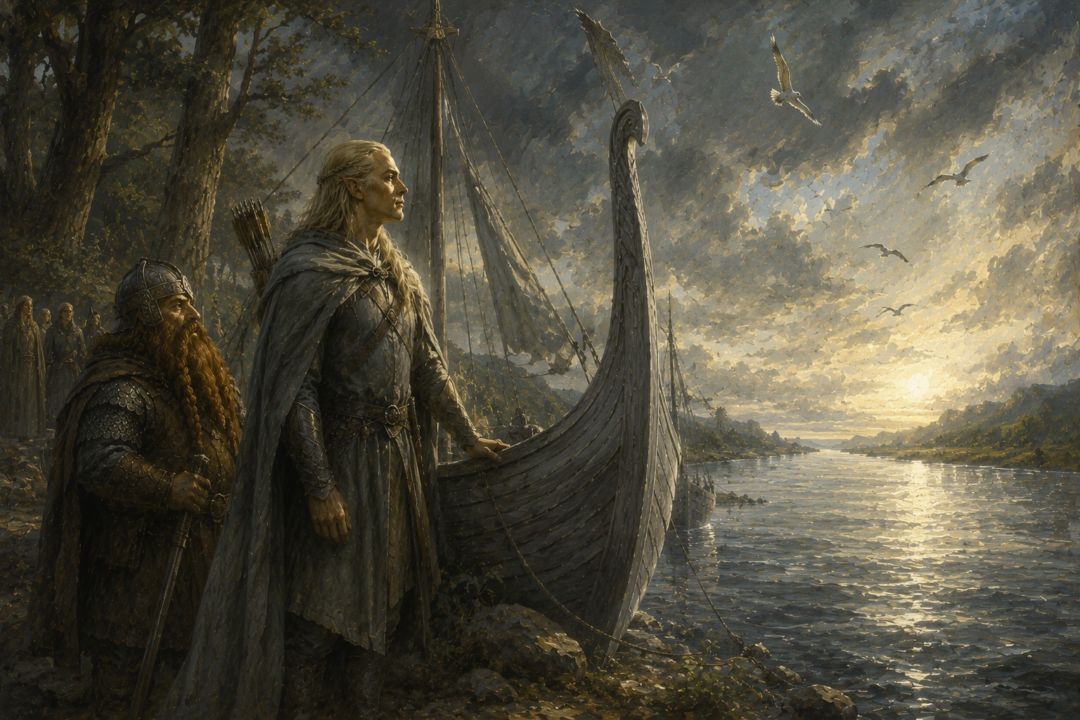
Pelargir Quietly Changes the Meaning of Legolas’s Story
Legolas enters the story as an Elf of the forest.
His senses, delight, and imagery repeatedly connect him with the living world of Middle-earth. Even after the War of the Ring, he chooses Ithilien, a wounded land capable of becoming beautiful again.
Yet the gulls introduce another direction into his life.
Westward.
That makes his story part of the larger departure of the Elves without reducing it to an immediate escape from Middle-earth. Legolas remains because there are still friendships to keep and things worth doing. Nevertheless, after Pelargir, remaining and belonging are no longer exactly the same thing.
That is the hidden importance of the location.
Pelargir is not where Legolas finally sails into the West. It is not even where he first sees the Sea.
It is where the Sea first reaches him.
The gulls cross the invisible boundary before he does, carrying the sound of the coast inland. One cry is enough to awaken what had slept through all his years beneath the trees.
Decades later, after Aragorn is gone, Legolas finally follows that call down the same great river toward the Sea.
His departure begins, in that sense, long before his ship is built.
It begins at Pelargir, when a Wood-elf hears gulls above a battlefield and suddenly remembers a longing for something he has never seen.
Sources & Notes
- The Encyclopedia of Arda, “Legolas” — https://www.encyclopedia-of-arda.com/l/legolas.html
- The Encyclopedia of Arda, “Pelargir” — https://www.encyclopedia-of-arda.com/p/pelargir.html
- The Encyclopedia of Arda, “Sea-longing” — https://www.encyclopedia-of-arda.com/s/sealonging.html
Reference entries document the characters, places, events, and textual details discussed in this article.