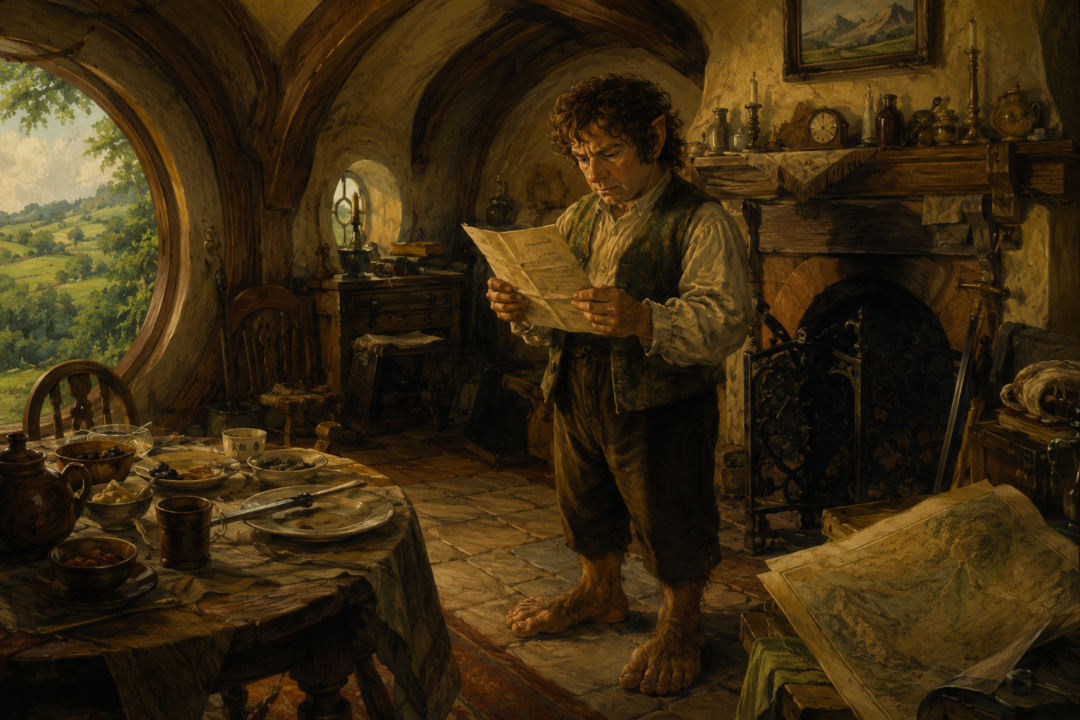
Bilbo Baggins begins his adventure with something wonderfully ordinary for a story involving trolls, goblins, giant spiders, and a dragon: a business arrangement.
The note left for him at Bag End promises payment “up to and not exceeding one fourteenth of total profits (if any),” alongside travelling expenses and, rather ominously, funeral expenses if necessary.
At first glance, the arithmetic seems almost comically simple. There are thirteen Dwarves. Bilbo makes fourteen. Recover the treasure, divide the proceeds, and the burglar receives his portion.
But by the time Smaug is dead and the treasure of the Lonely Mountain can actually be claimed, almost every important word in that agreement has become difficult.
What counts as a profit? What belongs to Thorin in the first place? How should gold, silver, jewels, weapons, and unique heirlooms be valued against one another? What happens when other people have legitimate claims against the hoard? And what does a fourteenth share mean when the original expedition has become a war involving several peoples?
The remarkable thing is not that Bilbo eventually receives less than a fourteenth of Erebor’s wealth.
It is that a precise fourteenth was probably never something anyone could simply calculate.
The Contract Promises Profit, Not the Entire Hoard
The wording at Bag End matters.
Bilbo is not simply promised one fourteenth of everything beneath Erebor. The written terms refer to “total profits,” and even place an upper limit on his payment.
That distinction becomes important once the company reaches the Mountain.
Smaug’s hoard is not merely a newly discovered pile of ownerless gold. Much of the wealth represents the accumulated riches of the Dwarves of Erebor, seized when Smaug attacked the kingdom generations earlier. Thorin regards that treasure as the inheritance of his house and people.
That already makes the word “profit” troublesome.
If a king recovers property stolen from his ancestors, is the entire recovered property profit? Or is profit only whatever value has been gained beyond property already belonging to the claimant?
The story never supplies an accounting rule, and there is no reason to impose modern financial definitions upon Dwarven agreements. What matters is that the language of the original note is less precise than it initially appears.
Later conversations increasingly speak of Bilbo’s “share” of the treasure rather than attempting to distinguish recovered capital from profit.
The adventure has outgrown its paperwork.
Smaug Had Mixed More Than One People’s Wealth Together
There is a larger problem.
Not everything in Smaug’s hoard necessarily belonged to the Dwarves.
When Bard comes to the Front Gate after the destruction of Lake-town, he reminds Thorin that Smaug had also attacked Dale. Bard, as the heir of Girion, therefore claims that wealth taken from Dale is mingled with the treasure under the Mountain.
This is one of the strongest complications in any attempt to calculate Bilbo’s percentage.
Before anyone could divide the hoard accurately, they would theoretically have to determine which objects had belonged to Erebor and which had belonged to Dale.
After nearly two centuries in a dragon’s possession, that would hardly be a simple task.
A cup might be recognizably Dwarven. A jewel might have a remembered history. Famous objects could have known owners.
But an ordinary heap of coins?
Loose gold?
Silver vessels?
Unmarked gems?
The text gives no indication that anyone performs a complete inventory tracing the provenance of every item. Bard’s argument instead turns the ownership problem into a political claim: at the least, he demands one twelfth of the treasure as dragon-slayer and heir of Girion, intending from that portion to aid the people of Esgaroth.
So before Bilbo’s fourteenth could even be calculated, the parties would have needed to decide what property was actually available for division.
They never reach such a peaceful accounting.
A Fourteenth of Gold Is Easy. A Fourteenth of Erebor Is Not.
Even if ownership were settled, valuation would remain difficult.
Smaug’s treasure is heterogeneous. It includes gold and silver, wrought objects, jewels, weapons, armour, and treasures whose importance cannot sensibly be reduced to weight alone.
The clearest example is the Arkenstone.
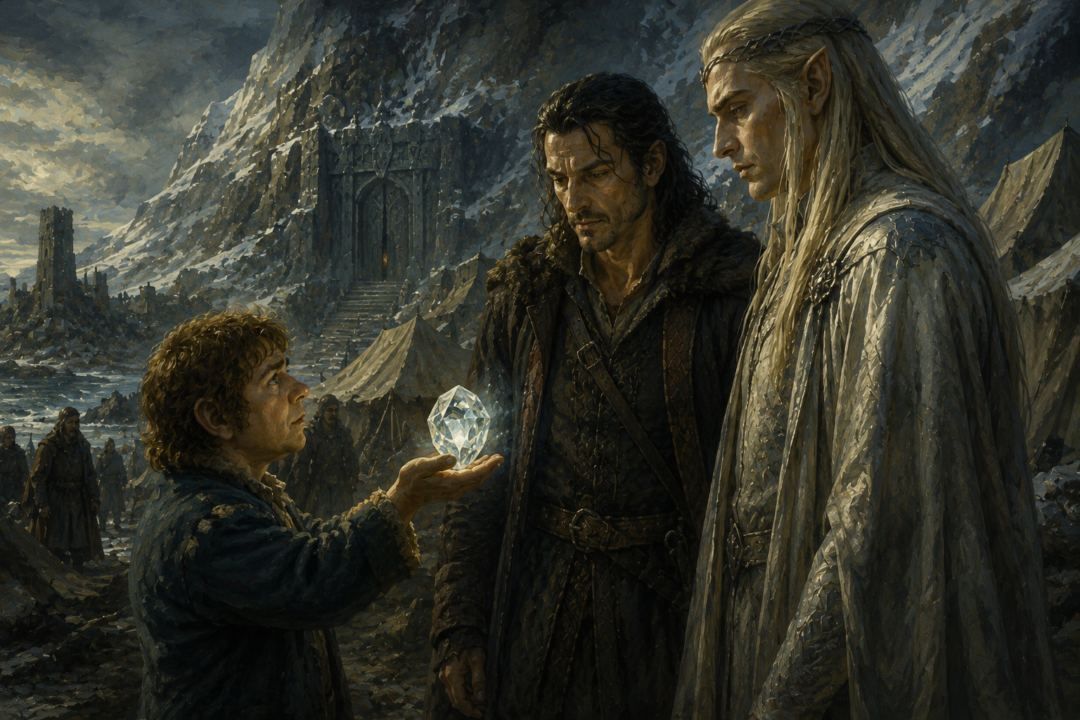
Bilbo finds the great jewel and secretly keeps it. When negotiations between Thorin and the forces outside the Mountain approach disaster, Bilbo gives the Arkenstone to Bard and the Elvenking as a bargaining tool.
Bilbo later appeals to the idea that he was permitted to choose his own fourteenth share.
But does the Arkenstone equal one fourteenth of the hoard?
The text never establishes such a valuation.
Its importance to Thorin is not merely monetary. It is an heirloom of his house and a symbol bound to the kingship of the Mountain. Its bargaining power comes precisely from the fact that Thorin values it in a way that ordinary arithmetic cannot capture.
Thorin eventually offers one fourteenth of the hoard in silver and gold for its return, explicitly setting aside the gems and treating that payment as Bilbo’s promised share.
That exchange reveals how unstable the idea of an equal division has become.
The Arkenstone can function as Bilbo’s chosen share in one argument and command a fourteenth of the hoard as ransom in another without anyone establishing that the two are financially equivalent.
Value in Erebor is no longer merely weight.
It is memory, inheritance, kingship, desire, and leverage.
Then Came the Claims of Lake-town
There is also the question of people who were never parties to Bilbo’s agreement.
The inhabitants of Esgaroth had welcomed and assisted Thorin’s company. Smaug later attacked Lake-town after Bilbo and the Dwarves disturbed him, although Thorin rejects the argument that the Dwarves’ treasure should therefore be used to compensate for Smaug’s deeds.
Bard nevertheless has several claims: he slew Smaug, he is Girion’s heir, and his people are now homeless and in urgent need.
Whether every part of Bard’s demand would constitute a legally enforceable claim under some imagined law of Middle-earth is never established. The story presents a moral and political dispute, not a courtroom proceeding.
But economically, the consequence is obvious.
There are now competing claims against the same treasure.
Bilbo understands this better than Thorin does at this stage. His decision to surrender the Arkenstone is essentially an attempt to transform an impossible standoff into a negotiated settlement.
His fourteenth share becomes bargaining capital.
That is a profound change from the cheerful agreement made at Bag End.
The Battle Makes the Original Division Obsolete
Then the entire calculation collapses.
Dáin arrives with Dwarves from the Iron Hills. Goblins and Wargs descend upon the Mountain. Dwarves, Elves, and Men who had been preparing to fight one another instead face a common enemy in the Battle of Five Armies.
Thorin is mortally wounded. Fíli and Kíli die defending him.
Afterward, the book explicitly says that there is no longer any question of dividing the hoard according to the shares originally planned for Thorin’s companions and Bilbo.
That statement is crucial.
The original expedition recovered the Mountain, but it was no longer possible to pretend that only the original expedition had secured its treasure. Many others now had claims connected with its winning and defence.
Dáin nevertheless honours the agreement associated with Thorin and the Arkenstone. A fourteenth share of the silver and gold, wrought and unwrought, is given to Bard.
Notice how much more concrete this final settlement is than the original contract.
It is not one fourteenth of vaguely defined “total profits.”
It is a fourteenth of the silver and gold.
The gems are not included in that formulation.
The great treasure has finally become divisible only by narrowing what is being divided.
Bilbo Ultimately Refuses the Accounting Problem
There is a final irony.
Bilbo could have returned to the Shire enormously wealthy.
Dáin considers the treasure as much Bilbo’s as Bard’s and is willing to reward him generously despite the collapse of the old arrangements. Bard likewise offers him wealth.
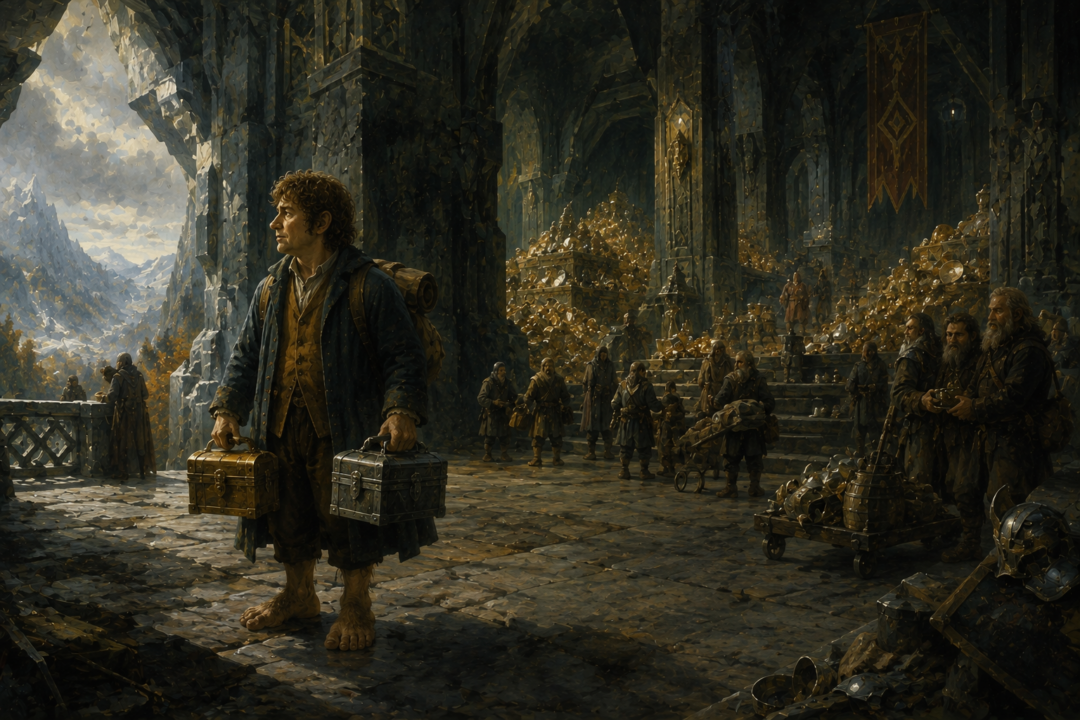
Bilbo declines the vast majority of it.
He takes only two small chests, one filled with gold and one with silver, explaining in effect that this is as much as he can manage.
That choice resolves the problem more effectively than any accountant could.
Bilbo does not need a valuation of the Arkenstone against the emeralds of Girion. He does not need every coin classified as Dwarven or Mannish property. He does not need travelling expenses deducted, wartime claims assessed, or the surviving members of the expedition assigned revised percentages.
He simply decides what is enough.
And that is where the mathematics of the contract meets the moral heart of the story.
The Number Was Precise. The Treasure Was Not.
“One fourteenth” sounds reassuring because fractions create an illusion of certainty.
But the journey to Erebor demonstrates that dividing wealth requires far more than arithmetic.
Before Bilbo’s contractual reward could truly be calculated, someone would need to define “profit,” determine ownership of property accumulated from both Erebor and Dale, value incomparable objects, resolve outside claims, and decide how the Battle of Five Armies changed the rights of those who had helped preserve the recovered kingdom.
The book never provides such a system.
Instead, the neat commercial language of Bag End gradually gives way to something older and less measurable: promises, inheritance, honour, generosity, political settlement, and personal judgment.
Thorin’s tragedy is partly that treasure becomes increasingly difficult for him to see as anything except possession. Bilbo moves in the opposite direction. Faced with a fortune large enough to make exact division almost meaningless, he discovers that the most important calculation is not what percentage he can claim.
It is how much he actually needs.
The contract begins with a fraction.
The adventure ends with Bilbo choosing two small chests.
Sources & Notes
- The Encyclopedia of Arda, “Thorin and Company” — https://www.encyclopedia-of-arda.com/t/thorinandcompany.html
- The Encyclopedia of Arda, “Thorin” — https://www.encyclopedia-of-arda.com/t/thorin.html
- The Encyclopedia of Arda, “Bilbo Baggins” — https://www.encyclopedia-of-arda.com/b/bilbobaggins.html
Reference entries document the characters, places, events, and textual details discussed in this article.