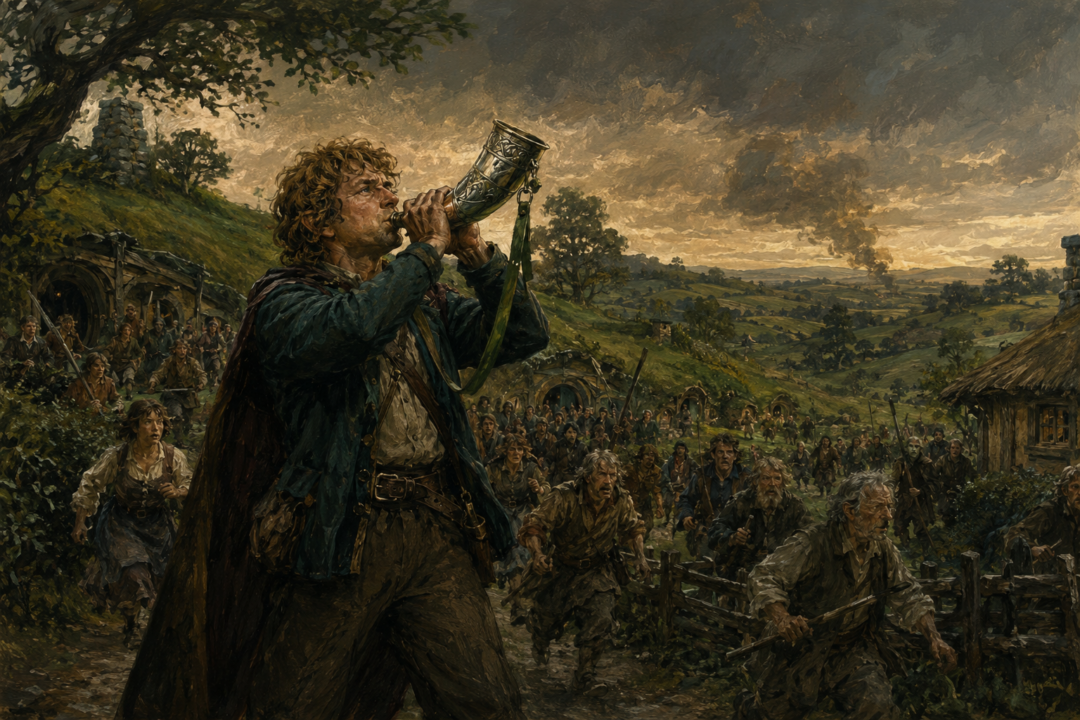
When Merry Brandybuck returns to the Shire, he carries something that seems almost absurdly grand for a hobbit: a silver war-horn from Rohan, ancient enough to have passed through the treasure of a dragon.
Yet the Horn of the Mark is not merely a souvenir of Merry’s adventures. At the decisive moment of the Scouring of the Shire, Merry uses it for exactly what such an object is meant to do.
He uses it to turn frightened individuals into a community capable of acting together.
That distinction matters. The horn does not defeat Saruman’s ruffians. It does not magically summon an army. What it provides is something more practical: a recognizable signal that danger has arrived, resistance has begun, and anyone willing to stand against the invaders is no longer standing alone.
In that sense, the horn becomes one of the most effective instruments of mobilization in the final chapters of The Lord of the Rings.
The Horn Was Already an Object of War and Memory
The horn Merry brings home has a history reaching far beyond the Shire.
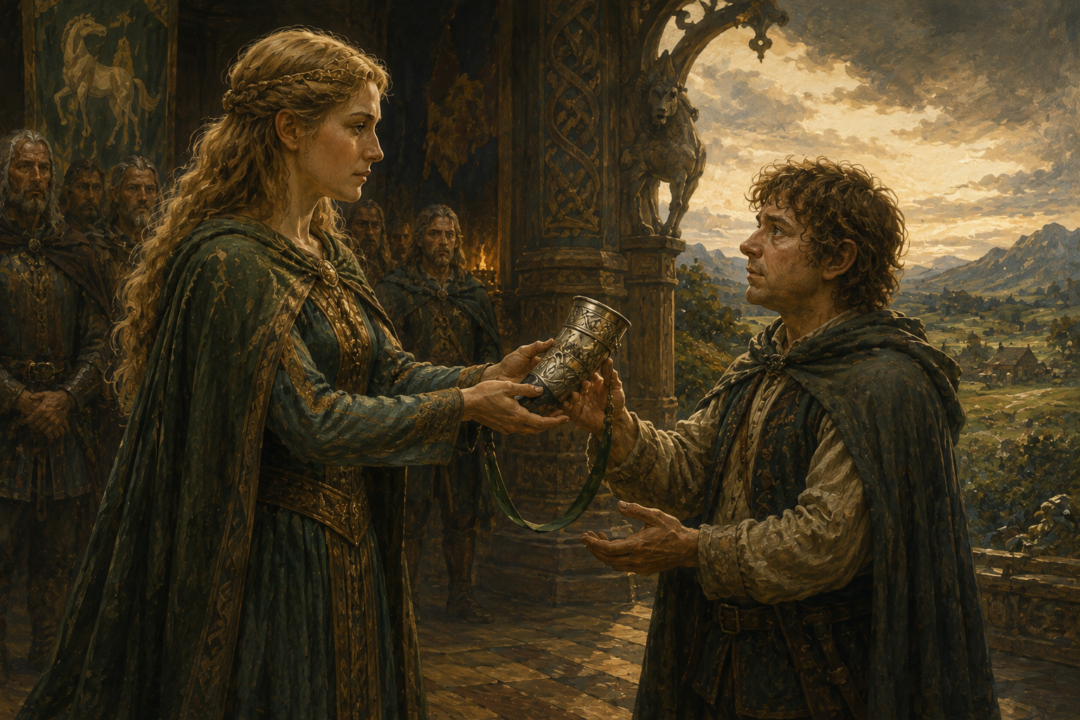
In “Many Partings,” Éowyn presents Merry with a small silver horn from the treasure of Rohan. It bears horsemen winding around it and is fitted with a green baldric. She explains that it came from the hoard of Scatha the Worm and had been brought south from the North by Eorl the Young.
Appendix A provides the larger background. Scatha was a great dragon of the Grey Mountains slain by Fram, an ancestor of the Éothéod. The dragon’s treasure had originally included wealth taken from the Dwarves, and its possession became a source of bitter dispute afterward.
The horn therefore belongs to several layers of history before Merry ever receives it: Dwarven craft, a dragon-hoard, the ancestors of the Rohirrim, and eventually the royal house of the Mark.
Éowyn’s gift transfers a piece of that history into hobbit hands.
She also tells Merry something especially important about its character. When it is sounded in need, its call will not pass unheard among those who hear it.
That should not be inflated into a precisely defined magical rule. The text never provides a mechanical explanation for the horn’s power. But the wording clearly gives the object an unusual potency: its sound is associated with heartening friends and daunting enemies.
Merry will soon discover how perfectly that quality suits the crisis awaiting him at home.
Merry Returns to a Shire That Has Forgotten How to Resist
The returning hobbits do not find the Shire destroyed in the manner of Mordor.
What they find is in some ways more unsettling.
Rules have multiplied. Food and goods have been taken away. Trees have been cut down. Ugly new buildings have appeared. Armed Men enforce the authority of the “Chief,” while many hobbits have learned to obey because resistance seems dangerous or pointless.
This is not primarily a battlefield problem.
It is a problem of demoralization.
The ruffians maintain control partly because ordinary hobbits are scattered, intimidated, and uncertain about what everyone else will do. A single hobbit confronting the Men risks punishment. A village acting together is a very different proposition.
Merry understands the difference almost immediately.
He and Pippin have returned from a world in which mustering is part of warfare. Merry has ridden with the Rohirrim and witnessed a society capable of transforming alarm into organized action. Pippin has served Gondor and experienced military command from another direction.
They are no longer merely adventurous hobbits coming home.
They have learned how people are rallied.
Why a Horn Matters in the Shire
The crucial point is that Merry does not introduce the idea of an alarm horn to hobbit culture.
Buckland already has one.
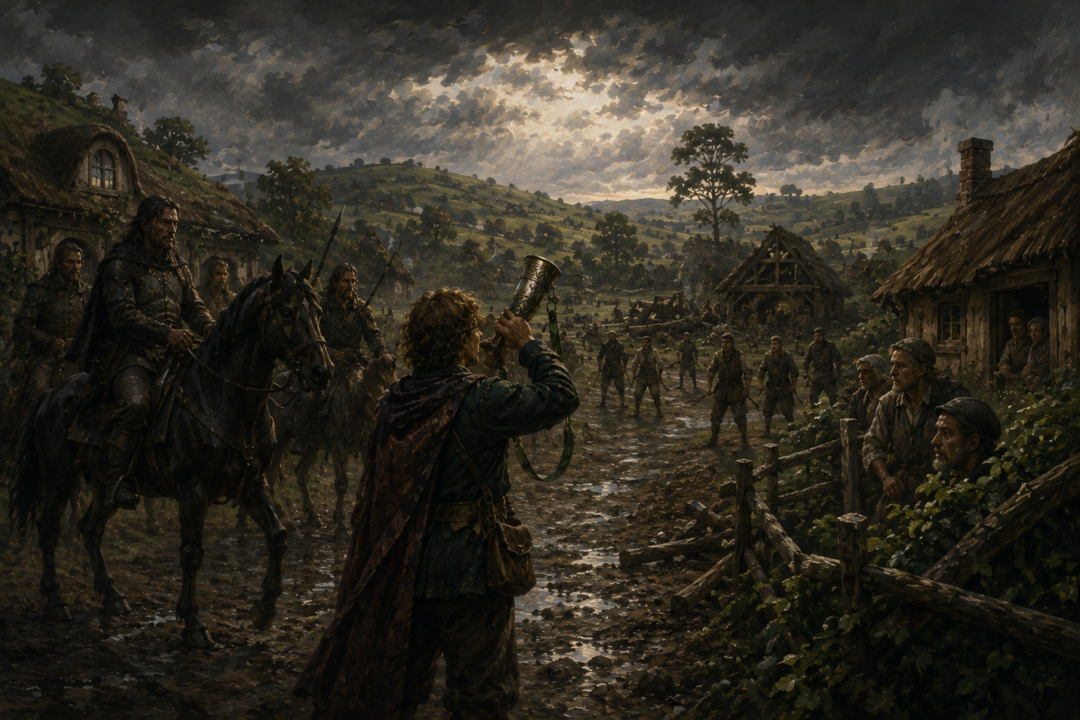
Earlier in The Fellowship of the Ring, when the Black Riders attack Crickhollow, the alarm spreads through Buckland by horn-calls. The Horn-call of Buckland is associated with immediate communal danger: fear, fire, and foes.
The response is rapid because the meaning is already culturally understood.
That makes Merry’s later use of the Horn of the Mark particularly effective. He possesses a magnificent Rohirric instrument, but he employs it through a distinctly hobbit tradition.
Rohan supplies the horn.
Buckland supplies the social language that makes its call actionable.
This is why describing the horn simply as a “magical rallying horn” misses something important. Whatever special virtue the object possesses, Merry’s success also depends upon shared custom. People know what an alarm means.
A horn-call collapses uncertainty.
Someone has sounded the warning.
Someone has openly declared resistance.
Everyone within hearing distance now knows that something is happening.
Merry Does Not Wait for an Army
At Bywater, the returning Travellers realize that the ruffians must be confronted rather than merely endured.
Merry’s response is characteristically practical.
He proposes raising the Shire.
The phrase is important because Merry does not expect some outside military power to arrive and rescue them. Aragorn is now king, and Pippin invokes the King’s authority when dealing with the ruffians, but the immediate liberation of the Shire will be carried out by its own inhabitants.
Sam goes to find Tom Cotton.
Merry blows the horn.
These are complementary forms of mobilization.
Sam works through personal relationships: household, neighbour, village.
Merry works through signal.
The horn carries farther than conversation can. It announces that the private resentment of individual hobbits has become public resistance.
Soon the response spreads.
The Shire-folk gather, and Merry begins directing their preparations. By the time the ruffians attempt to crush the uprising, they no longer face isolated civilians. They face an organized local force.
The Lesson Merry Learned from Rohan
Merry’s behavior makes particular sense because of what he experienced among the Rohirrim.
Rohan is a culture in which horns, riders, messengers, oaths, and musters bind dispersed communities into military action. Merry witnesses the kingdom preparing for war and rides secretly to the Pelennor Fields with Éowyn.
He sees the Rohirrim arrive at perhaps the greatest crisis of the war.
The horns of Rohan there are not incidental decoration. They accompany the moment when a scattered people arrives as a unified host.
Merry cannot reproduce Rohan in the Shire, nor does he try.
Instead, he adapts what he has learned.
The Shire has no cavalry host waiting in mountain valleys. It has farmers, gardeners, families, village leaders, hunters, and ordinary hobbits who have rarely needed organized warfare.
But the basic principle remains the same.
People who are separated must be warned.
People who are afraid must discover that others are standing with them.
People willing to resist must know where to gather.
The horn helps accomplish all three.
The Horn Is Only the Beginning
It is equally important not to give the horn too much credit.
Merry does not win the Battle of Bywater by blowing it.
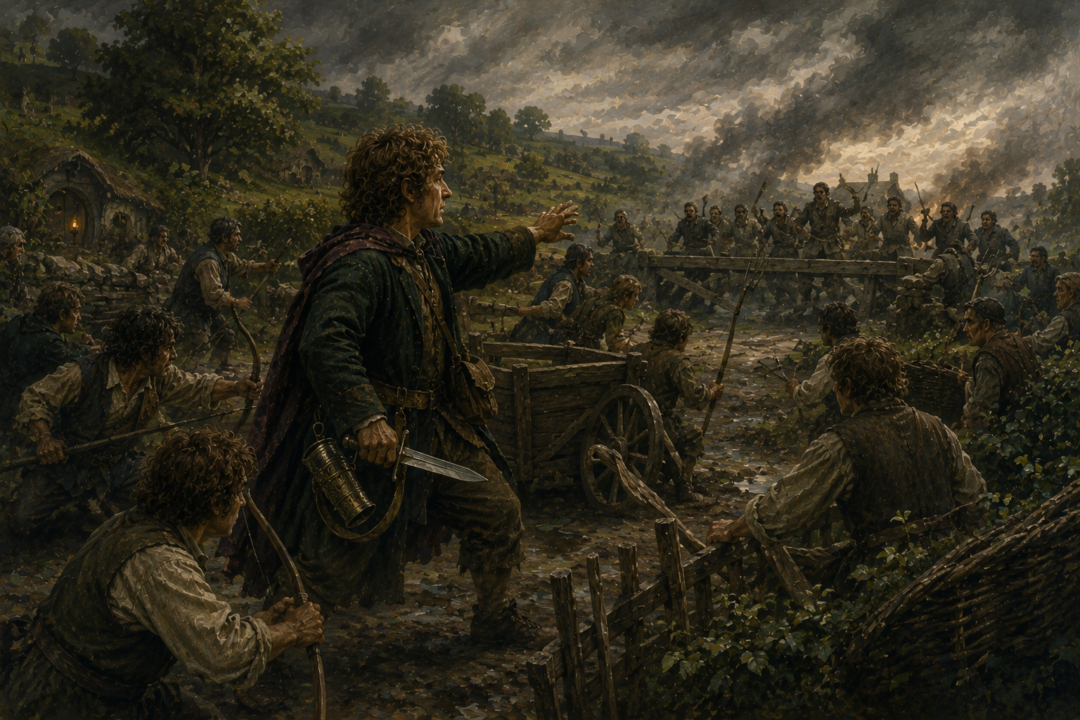
After the alarm comes organization.
Barricades and obstacles are prepared. Hobbits are gathered and deployed. Scouts provide information. Merry evaluates how the ruffians are likely to move and helps arrange the defense accordingly.
This is where the Scouring reveals how much Merry has changed.
The hobbit who once helped plan Frodo’s departure from the Shire has become someone capable of organizing a local military response.
His courage matters, but his competence matters just as much.
The horn is therefore best understood as the first stage of Merry’s strategy.
It converts willingness into mobilization.
Leadership must do the rest.
Why the Ruffians Cannot Answer the Call
There is also a striking contrast between the two sides.
Saruman’s Men possess physical strength and weapons. Their authority, however, depends heavily upon intimidation.
They need hobbits to believe resistance is futile.
The horn attacks that assumption.
Once neighbours begin gathering openly, the psychological advantage changes. A bully who appears overwhelming before isolated victims can look much less impressive when an entire district begins answering the alarm.
The horn therefore has an effect beyond the number of hobbits it physically summons.
It demonstrates publicly that fear is breaking.
This does not mean every hobbit instantly becomes brave or that resistance is effortless. The Battle of Bywater is real violence, and hobbits are killed. Frodo, notably, remains concerned with preventing unnecessary killing even during the uprising.
But Merry understands that peace cannot be restored merely by wishing the ruffians away.
The Shire has to become capable of collective action.
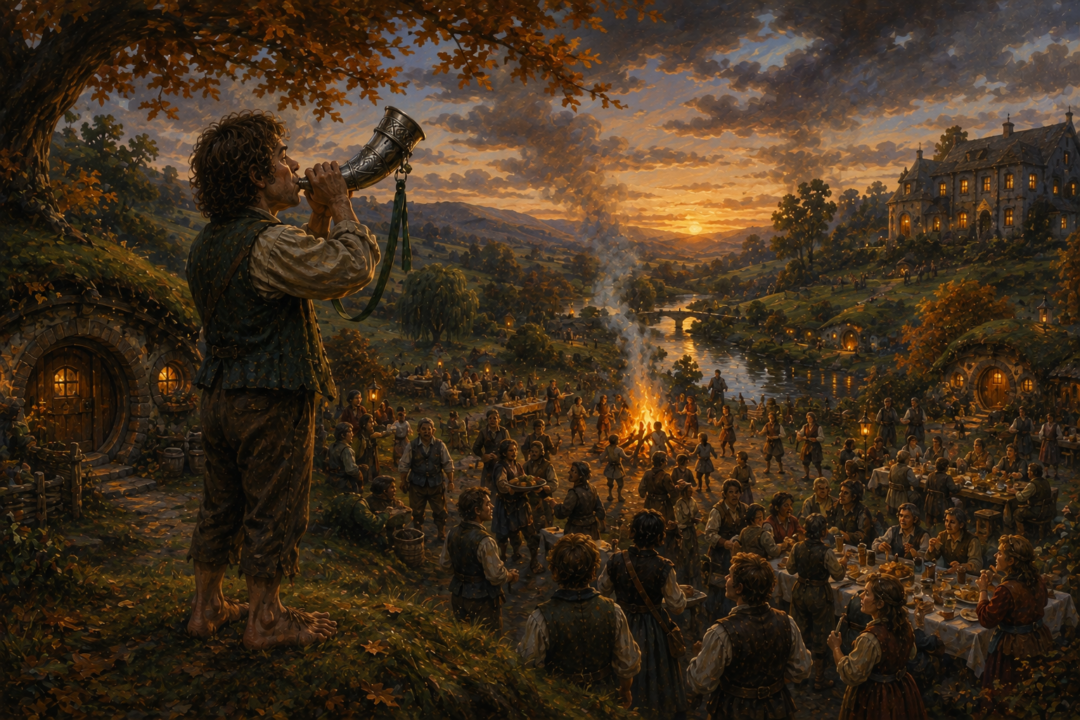
Rohan’s Gift Becomes a Hobbit Tradition
The final transformation of the horn occurs after the fighting is over.
Appendix D records that the Horn of the Mark was sounded in Buckland every year on November 2, the anniversary of the day Merry first blew it during the uprising. Bonfires and feasting followed.
That is a remarkable fate for an ancient object.
The horn begins as Dwarven craft.
It passes through a dragon’s hoard.
It becomes associated with the ancestors and kings of Rohan.
Then it travels north with a hobbit and becomes part of Buckland’s communal memory.
Its purpose changes too.
During the Scouring, the horn says: gather because danger is here.
Afterward, the annual sounding effectively says: remember that we gathered.
The instrument of mobilization becomes an instrument of remembrance.
And that may be the deepest reason the horn matters.
The Shire is saved not because its inhabitants suddenly become Rohirrim, but because Merry brings home something he has learned beyond its borders and translates that lesson into the customs of his own people.
He does not turn hobbits into warriors permanently.
He reminds them that when fear isolates them, they can still answer one another.
The Horn of the Mark gives that realization a sound.
And once that sound has been answered, Saruman’s control of the Shire is already beginning to fail.
Sources & Notes
- The Encyclopedia of Arda, “Horn of the Mark” — https://www.encyclopedia-of-arda.com/h/hornofthemark.html
- The Encyclopedia of Arda, “Meriadoc Brandybuck” — https://www.encyclopedia-of-arda.com/m/meriadocbrandybuck.html
- The Encyclopedia of Arda, “Buckland” — https://www.encyclopedia-of-arda.com/b/buckland.html
Reference entries document the characters, places, events, and textual details discussed in this article.