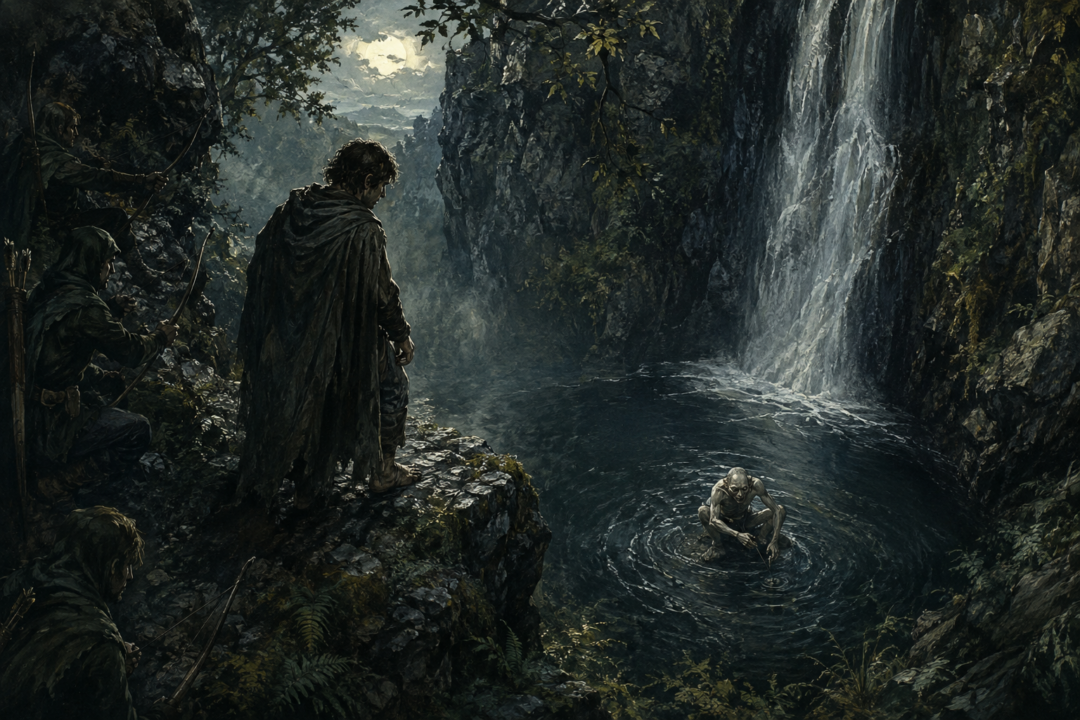
At Henneth Annûn, Frodo is confronted with one of the strangest moral choices of his journey.
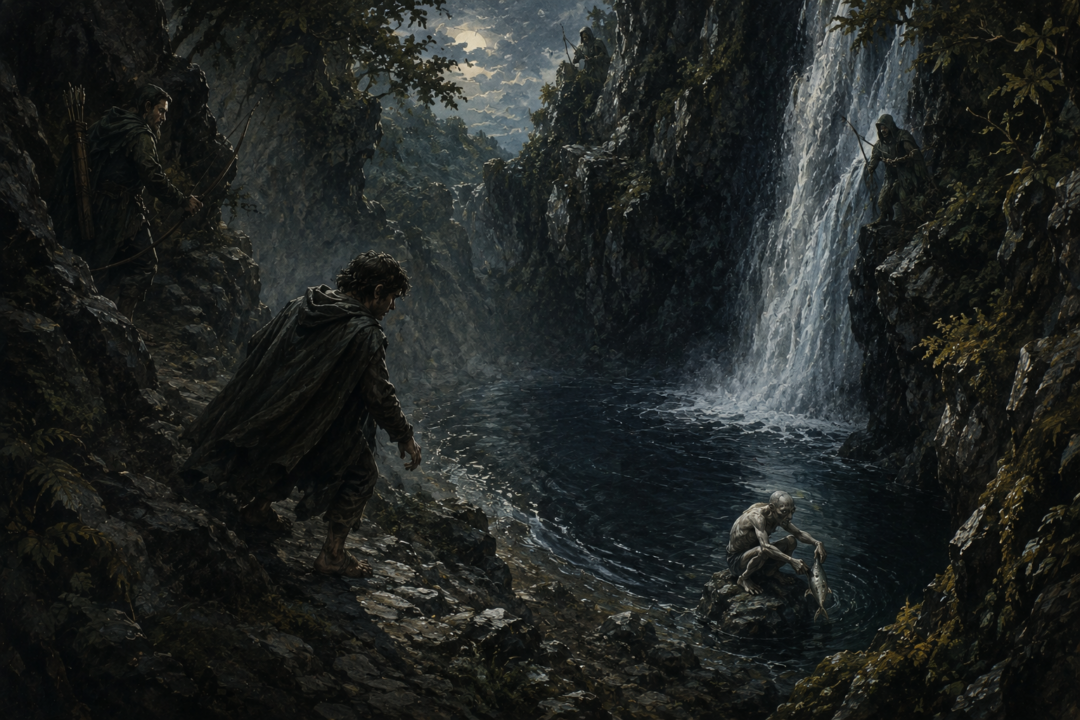
Below him, in the dark water beneath the Rangers’ hidden refuge, Gollum is catching fish. He does not know that he has crossed a forbidden boundary. He does not know that Gondorian archers are watching him. And he certainly does not know that, according to the law guarding this secret place, his life is already forfeit.
Frodo can simply allow the Rangers to kill him.
For one painful moment, part of him is tempted to do exactly that.
Instead, Frodo asks Faramir to spare Gollum and personally goes down to bring him out.
The obvious explanation is practical: Frodo still needs his guide. But “The Forbidden Pool” makes the decision far more complicated. Frodo descends because Gollum has served him, because Frodo accepts responsibility for that service, because Gandalf’s earlier mercy still weighs upon his conscience, and because saving Gollum requires Frodo to do something morally painful in return.
He must save Gollum’s life by appearing to betray his trust.
Gollum Has Wandered Into a Death Sentence
The setting matters.
Henneth Annûn is not merely a pleasant cave behind a waterfall. It is a concealed refuge of the Rangers of Ithilien, operating in a land increasingly threatened by Mordor. Its secrecy is therefore a military necessity.
The pool beneath the waterfall forms part of the guarded precinct. Faramir tells Frodo that death is the penalty for entering it without permission.
Gollum has no idea.
He has followed Frodo and Sam and has come to the water looking for fish. From the Rangers’ perspective, however, an unknown creature has penetrated dangerously close to their hidden stronghold.
Faramir therefore asks Frodo to identify him.
Frodo immediately understands the danger. Gollum can be killed before he even realizes that anyone is watching.
That creates the first reason Frodo must act personally: he is the one person present who has a realistic chance of bringing Gollum away without bloodshed.
The Rangers cannot simply approach him as friends. Gollum fears Men and is extraordinarily suspicious. Sam certainly has no relationship of trust with him. Faramir is a stranger.
Frodo, however, is “master.”
And that word carries obligations in both directions.
Frodo Admits That Gollum Has a Claim Upon Him
One of the most important details in the chapter occurs inside Frodo’s own thoughts.
He does not suddenly become sentimental about Gollum.
Indeed, when Frodo hears Gollum below, an ugly thought passes through him: he feels that he would like the hidden archers to shoot.
That moment matters because it prevents us from reducing Frodo’s mercy to simple affection.
Frodo is exhausted. Gollum has been troublesome, secretive, and frightening. Frodo already understands that trusting him is dangerous. Allowing Faramir’s men to solve the problem permanently would make the road ahead simpler in one respect.
Yet Frodo rejects that temptation.
The text makes his reasoning unusually explicit: Gollum has acquired a claim upon him through service. The relationship between master and servant is not merely a convenient fiction that gives Frodo authority over Gollum. Service places an obligation upon the master as well.
Gollum has guided Frodo through the Dead Marshes. He has led the hobbits toward Mordor. However corrupted his motives may be, he has rendered real service.
Frodo therefore cannot simply take that service and then stand aside while Gollum is killed.
This is one of the deeper meanings of Frodo going down himself. He assumes responsibility for the creature who has placed himself under Frodo’s authority.
Gandalf’s Mercy Is Still Working Through Frodo
There is another voice behind Frodo’s decision: Gandalf’s.
Long before Ithilien, in Bag End, Frodo had wished that Bilbo had killed Gollum when he had the opportunity. Gandalf challenged that judgment. Bilbo’s pity had stayed his hand, and Gandalf warned Frodo against being too eager to decide who deserves death.
At the Forbidden Pool, that old conversation is no longer philosophical.
Frodo is now effectively standing in the position once occupied by Bilbo.
A helpless Gollum is within reach of death. Frodo could permit it. There would even be a legal justification from the Rangers’ perspective.
But Frodo remembers enough of Gandalf’s wisdom to recognize what kind of decision lies before him.
In the chapter, Frodo specifically thinks that Gandalf would not approve of killing Gollum in this situation.
That does not mean Frodo knows what Gollum’s ultimate role will be. He does not. Nor does mercy magically make Gollum trustworthy.
It means Frodo refuses to kill merely because killing would be convenient.
The distinction will become enormously important.
Frodo Also Believes Gollum May Still Matter to the Quest
Mercy is not Frodo’s only consideration.
He also suspects that Gollum remains connected to his errand.
This is a cautious intuition rather than certain foreknowledge. Frodo cannot see the future. He does not know how the Quest will end, and he certainly cannot know what will happen at the Cracks of Doom.
But he has reasons to hesitate before treating Gollum as expendable.
Gollum has possessed the Ring. He understands something of its power and its burden. He knows ways into Mordor that Frodo and Sam do not know. Most immediately, he is their guide.
Frodo therefore combines moral responsibility with practical necessity.
That combination is characteristic of the scene. Saving Gollum is neither pure calculation nor blind compassion. Frodo recognizes both that the creature has served him and that his part in the journey may not yet be finished.
So Frodo offers Faramir an alternative to execution.
He will go down himself.
Why Frodo Cannot Simply Send a Ranger
Sending someone else would defeat the purpose.
Gollum’s relationship is with Frodo.
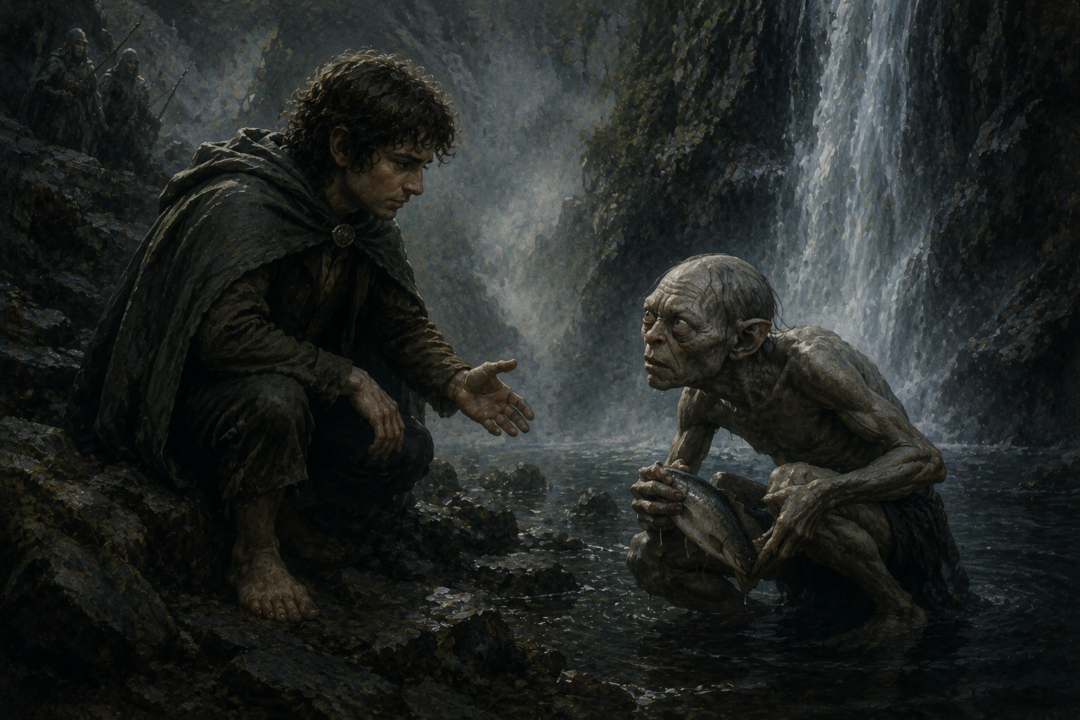
He has sworn to serve the master of the Precious, and Frodo has developed an unusual ability to command him. That authority is not gentle in every moment. Frodo understands the Ring’s hold upon Gollum and, when necessary, uses frightening language connected with it to compel obedience.
At the pool, Frodo needs exactly that mixture of familiarity and authority.
He approaches Gollum while the Rangers remain concealed. Gollum is reluctant to leave his fishing, and Frodo must persuade and command him to come.
No Ranger could plausibly have done the same.
More importantly, Frodo is not merely retrieving an inconvenient companion. He is personally taking responsibility for saving Gollum from a danger that Gollum cannot even perceive.
There is, however, a cruel catch.
Gollum thinks he is following Frodo to safety.
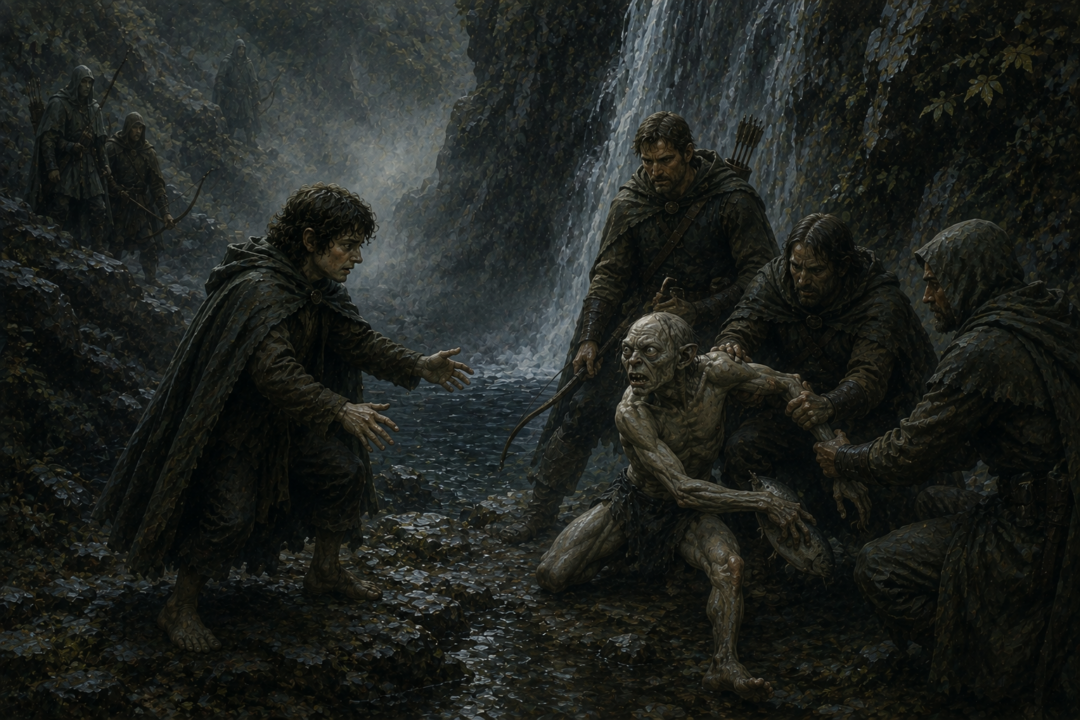
He is actually walking into the hands of Faramir’s men.
Frodo Saves Gollum by Betraying Him
This is the tragedy at the heart of the scene.
From Frodo’s perspective, he is rescuing Gollum from certain death.
From Gollum’s perspective, his master has deceived him.
Both perceptions have some truth in them.
Frodo cannot openly explain the situation beside the pool without risking Gollum fleeing, resisting, or otherwise bringing the Rangers’ sentence upon himself. To preserve his life, Frodo must lead him toward concealed Men who seize him.
Gollum experiences this as treachery.
Frodo knows that he will.
That is why the episode carries such moral weight. Frodo does not descend because he has discovered an easy solution. He descends because every available solution has a cost.
If he does nothing, Gollum dies.
If he warns Gollum and Gollum attempts to escape, the archers may kill him.
If Frodo persuades him to come peacefully, Gollum lives—but the fragile trust between them is wounded.
Frodo chooses the wound over the death.
Faramir Makes Frodo Responsible for Gollum
After Gollum is captured, Frodo continues to intercede for him.
Faramir questions the creature and eventually grants him protection under conditions. Gollum must swear not to return to the forbidden place, and his status is tied to Frodo.
This reinforces what the descent to the pool has already established.
Frodo has effectively claimed responsibility for Gollum.
He cannot insist that Gollum is his servant when that relationship is useful and then deny it when the servant is in danger. Authority creates duty.
This is also why the scene is more significant than a simple rescue.
Frodo is attempting something far harder than defeating an enemy: he is trying to remain morally responsible toward someone who may yet betray him.
Faramir is much less optimistic. He warns Frodo about Gollum and senses danger in the path ahead. His suspicions are justified.
Frodo’s mercy does not make Faramir wrong.
Mercy in this story is not the belief that dangerous people are harmless.
It is the refusal to conclude that their danger alone gives one the right to destroy them unnecessarily.
The Cruel Irony of What Happens Next
The consequences become darker after Frodo and Sam leave Henneth Annûn.
Gollum’s resentment has been deepened by his capture. Later, as the hobbits rest, Sam wakes and sees Gollum approaching Frodo in a remarkably vulnerable state. The text suggests a moment in which the better part of the creature might still have responded to Frodo.
Sam misunderstands what he sees and speaks harshly.
The moment passes.
It would be too strong to claim that the Forbidden Pool alone determines Gollum’s later treachery. His corruption by the Ring is ancient and profound, and he had already struggled between competing impulses.
But the pool unquestionably becomes part of his grievance against Frodo.
That is the painful irony.
Frodo saves Gollum’s life, yet the very method required to save him damages the trust upon which Frodo has been trying to build.
Good intentions do not erase consequences.
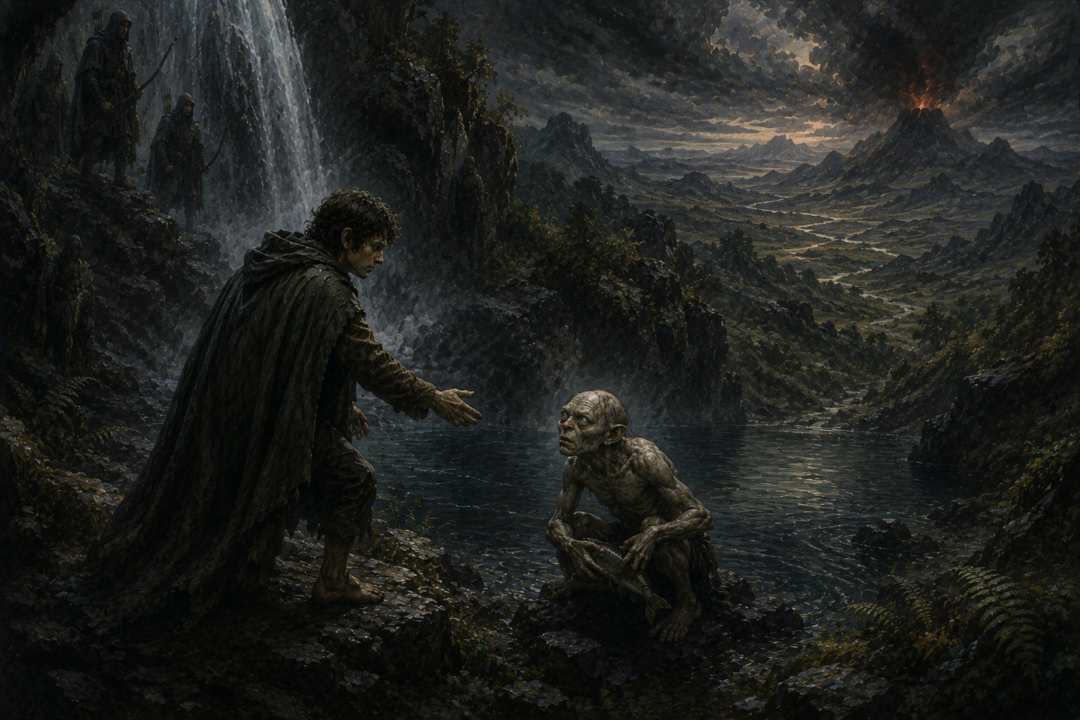
Why Frodo Had to Go Down Himself
Frodo goes down because nobody else can occupy his place.
Only Frodo possesses Gollum’s fragile trust. Only Frodo has accepted him as a guide and servant. Only Frodo fully understands that Gollum has borne the Ring. And Frodo, more than the Rangers watching from above, carries Gandalf’s lesson about pity into the decision.
Yet there is an even deeper reason.
Going down turns Frodo’s mercy into an action for which he must personally bear the cost.
He does not merely order that Gollum be spared. He enters the darkness, faces the creature himself, persuades him to follow, and then witnesses the hurt caused when Gollum discovers the waiting Men.
That makes the Forbidden Pool a small version of Frodo’s larger burden.
Again and again, his road requires choices between imperfect possibilities. Mercy does not guarantee gratitude. Doing the right thing does not guarantee that everyone involved will understand it. And preserving another person from destruction can create obligations that are painful to carry.
Frodo goes down because Gollum has a claim upon him.
Much later, at Mount Doom, the full significance of keeping Gollum alive becomes clear in a way Frodo could never have predicted beside that moonlit pool.
The creature whom Bilbo spared, whom Gandalf refused to condemn, and whom Frodo personally descended to save still had a part to play.
At Henneth Annûn, Frodo does not know what that part will be.
He only knows that Gollum is helpless beneath the hidden bows—and that allowing him to die would be easier than going down to save him.
So Frodo goes down.
Sources & Notes
- The Encyclopedia of Arda, “Henneth Annûn” — https://www.encyclopedia-of-arda.com/h/hennethannun.html
- The Encyclopedia of Arda, “Faramir” — https://www.encyclopedia-of-arda.com/f/faramir.html
- The Encyclopedia of Arda, “Gollum” — https://www.encyclopedia-of-arda.com/g/gollum.html
Sources document Henneth Annûn and its forbidden pool, Faramir’s authority there, and Gollum’s relationship with Frodo.