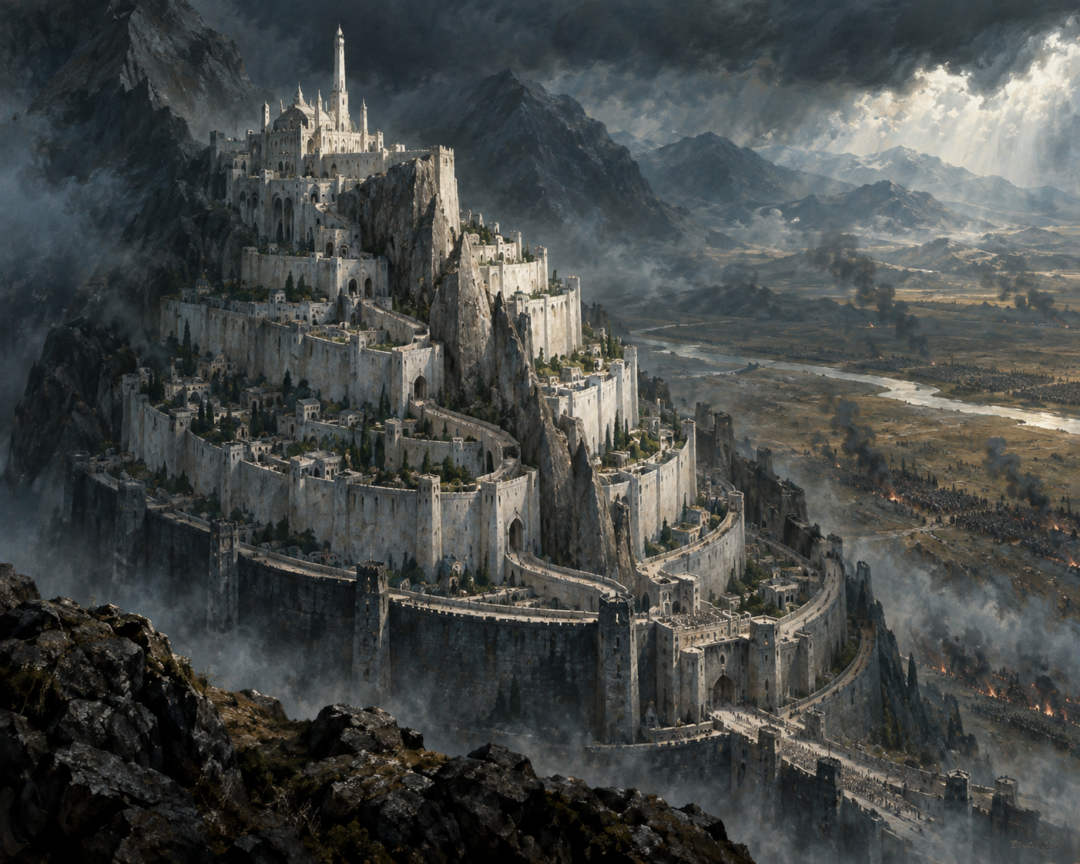
When Gandalf and Pippin entered Minas Tirith, the road did something that is easy to overlook: it refused to go straight.
The White City rose in seven walled levels beneath Mindolluin, but its gates were deliberately—or at least very effectively—misaligned. The Great Gate opened eastward. The next gate lay toward the south. The third turned back toward the north, and the pattern continued as the road climbed toward the Citadel.
That detail transforms the military meaning of Minas Tirith.
Breaking the Great Gate did not open a direct road to the White Tower. An attacker who entered the First Circle still faced a succession of separate walls, gates, turns, climbs, and passages through the enormous stone spur dividing the city.
The city was not simply a fortress with seven walls. Its very geography prevented one successful breach from becoming an uninterrupted assault on its heart.
Seven Circles, Seven Separate Barriers
The essential description appears when Gandalf brings Pippin into Minas Tirith in The Return of the King.
The city was built upon seven levels cut into the hill. Each level had its own surrounding wall, and each wall had a gate. Crucially, those gates were “not set in a line.”
The Great Gate stood at the eastern point of the outer wall. The Second Gate faced partly south, while the Third faced partly north. The road therefore climbed back and forth across the eastern face of the city rather than ascending directly toward the Citadel.
This matters because gates are natural weak points in fortified walls.
If the gates of Minas Tirith had all been aligned, an enemy who smashed through one could theoretically keep pushing along the same axis toward the next. Siege engines, troops, and momentum would all be directed along one obvious avenue.
Minas Tirith denied an attacker that geometry.
After passing one gate, an invading force had to change direction and move through part of the captured circle before reaching the next entrance.
Then it had to break another gate.
And then do it again.
Breaking the Great Gate Was Not Breaking Minas Tirith
This distinction becomes especially important during the Siege of Gondor.
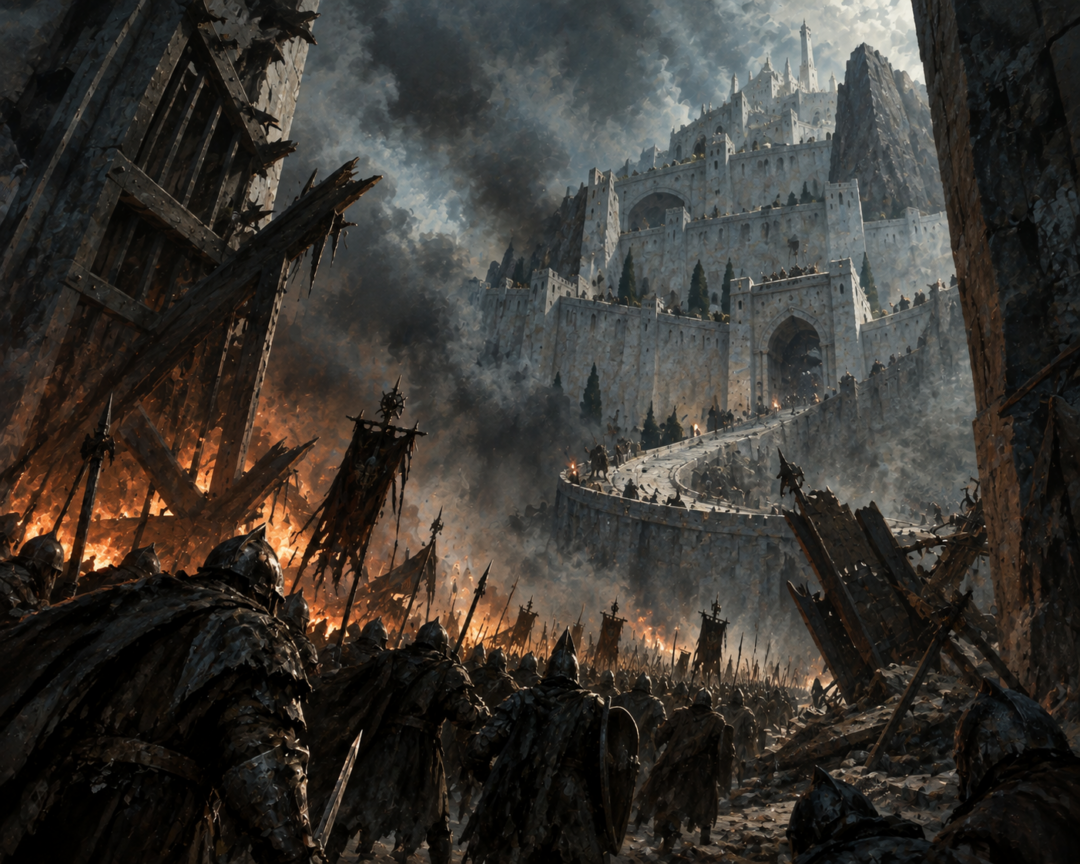
Sauron’s forces eventually succeeded in destroying the Great Gate. Grond, the enormous battering ram brought against it, struck until the entrance was broken, and the Witch-king rode beneath the archway.
It is one of the darkest moments in the siege.
Yet even then, the entire city had not suddenly become open.
The Great Gate admitted the enemy only into the First Circle. Six higher levels remained between that breach and the Citadel.
The narrative never gives us a prolonged street-by-street defence of those circles, because the Battle of the Pelennor Fields changes the course of events almost immediately. The arrival of the Rohirrim forces the Witch-king to turn away from the city before Mordor can exploit the breach into a deeper assault.
So Tolkien never shows exactly how a full defence of every inner gate would have unfolded.
But the physical arrangement is clear.
Any force attempting to capture Minas Tirith from bottom to top would have encountered successive enclosed levels rather than one continuous open avenue.
The destruction of one gate was a terrible victory for the attacker—but it was not automatically the destruction of the fortress.
The Road Itself Worked Against a Rapid Advance
The climbing road made the problem worse for an invading army.
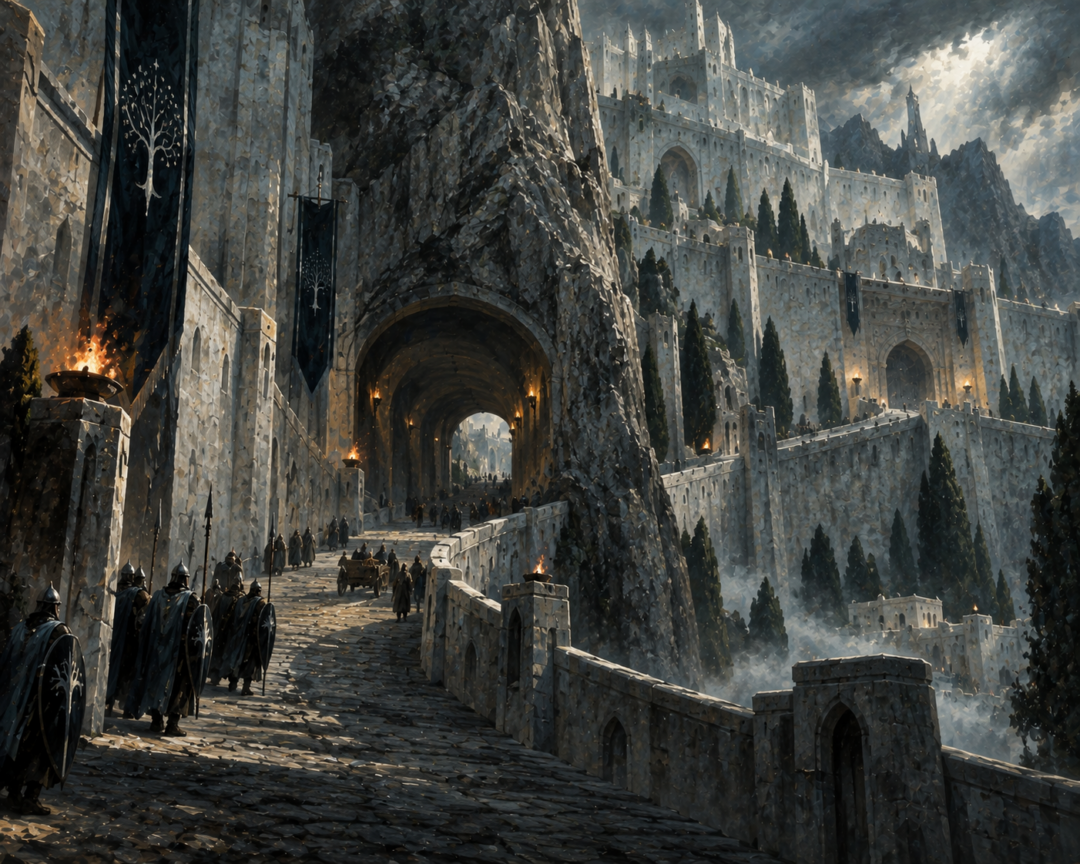
Instead of running directly uphill, it turned back and forth across the face of the city. That arrangement increased the distance between successive gates and prevented an enemy from simply charging straight from the Great Gate toward the Citadel.
This does not mean the text describes every possible tactical advantage in technical military terms. We should be careful not to assign specific defensive mechanisms that are never stated.
But the consequences of the layout are difficult to miss.
An attacking formation passing through a breached gate would need to reorganize inside the next circle, find and approach the next gate from a different direction, and then overcome another fortified entrance.
Momentum would repeatedly be interrupted.
Siege equipment would also have to follow the winding ascent rather than being driven straight uphill through aligned gateways.
For defenders, meanwhile, every surviving wall represented another position from which resistance could potentially continue.
Minas Tirith was built in depth.
That depth was one of its greatest strengths.
The Stone “Keel” Made the City Even Stranger
The offset gates were only part of the design.
A huge mass of rock projected from the hill through the city. Its eastern edge stood like the sharp prow or keel of a gigantic stone ship. It divided every circle except the First.
Whenever the climbing road crossed the line above the Great Gate, it had to pass through an arched tunnel cut through this rock.
This feature is fundamental to understanding Minas Tirith.
The road did not merely zigzag around ordinary city blocks. Its course interacted with a colossal natural-and-worked stone barrier embedded in the city itself.
From the Citadel, the projecting bastion rose above the Great Gate far below. The height from the upper city to the gate was seven hundred feet.
The result was a fortress in which vertical height, concentric walls, offset entrances, tunnels, and the underlying hill all reinforced one another.
An invader was not merely attacking masonry.
He was attacking a mountain-shaped defensive system.
Why Aligned Gates Would Have Been More Dangerous
Imagine Minas Tirith built differently.
Suppose all seven gates faced east and stood directly behind one another.
An attacker breaking the Great Gate would immediately see the next objective uphill. If that gate fell, the next would lie along essentially the same route. The city would possess multiple barriers, but they would share a common line of penetration.
The actual city avoids that weakness.
Only the Great Gate and the entrance to the highest level are described as facing eastward in line with one another. Between them, the ascent moves from side to side.
That means the fortress does not offer a single continuous breach corridor.
This is the central defensive significance of the offset gates.
They do not make Minas Tirith impossible to capture. No fortification in the story is treated as absolutely immune to sufficient force, treachery, fear, or overwhelming power.
Instead, the design makes success at one barrier difficult to convert immediately into success at the next.
An attacker must repeatedly begin another local assault.
Minas Tirith Was Designed Around Delay
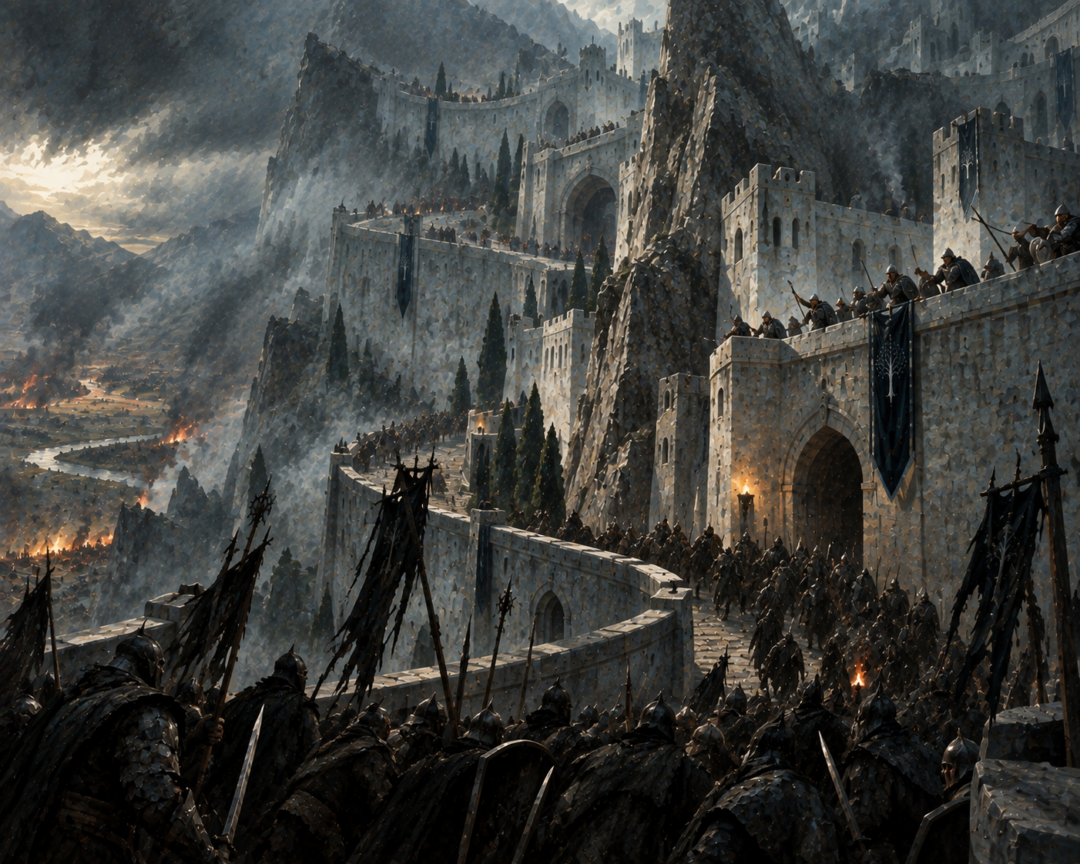
One useful way to understand the city is not as an impregnable fortress, but as a fortress designed to make penetration progressively harder.
The outer wall was exceptionally formidable. During the siege, the attackers could not simply smash its stonework apart; their decisive effort was concentrated upon the Gate.
Once that entrance fell, however, the structure of the city still imposed depth.
Every additional circle bought distance.
Every wall created another boundary.
Every offset gate forced another change of direction.
Every climb carried the enemy farther above the plain and deeper into the fortress.
The text does not provide a detailed doctrine explaining that this was the builders’ conscious tactical theory, so it is safest to speak of the effect of the design rather than invent motives for its architects. But militarily, the implication is strong: Minas Tirith could not normally be taken by converting one frontal breakthrough into a straight rush for its command centre.
The enemy had to conquer the city in stages.
The Siege Shows Why That Depth Mattered
There is a tragic irony in the Battle of the Pelennor Fields.
Mordor achieves what had seemed almost unthinkable: the Great Gate is destroyed.
But the enemy never gets the opportunity to turn that breach into the systematic capture of the upper circles.
At the moment when the Witch-king enters, horns sound from the north.
Rohan has arrived.
The Witch-king leaves the Gate to confront the new threat, and the battle shifts back onto the Pelennor. What might have become a brutal struggle through the successive levels of Minas Tirith never happens.
That means the city’s deepest defensive architecture remains largely untested in the narrative.
Yet the layout helps explain something important about the stakes of the broken Gate.
Minas Tirith had been breached, but it had not yet been conquered.
There were still walls above the enemy.
There were still gates.
There was still the winding ascent.
There was still the Citadel.
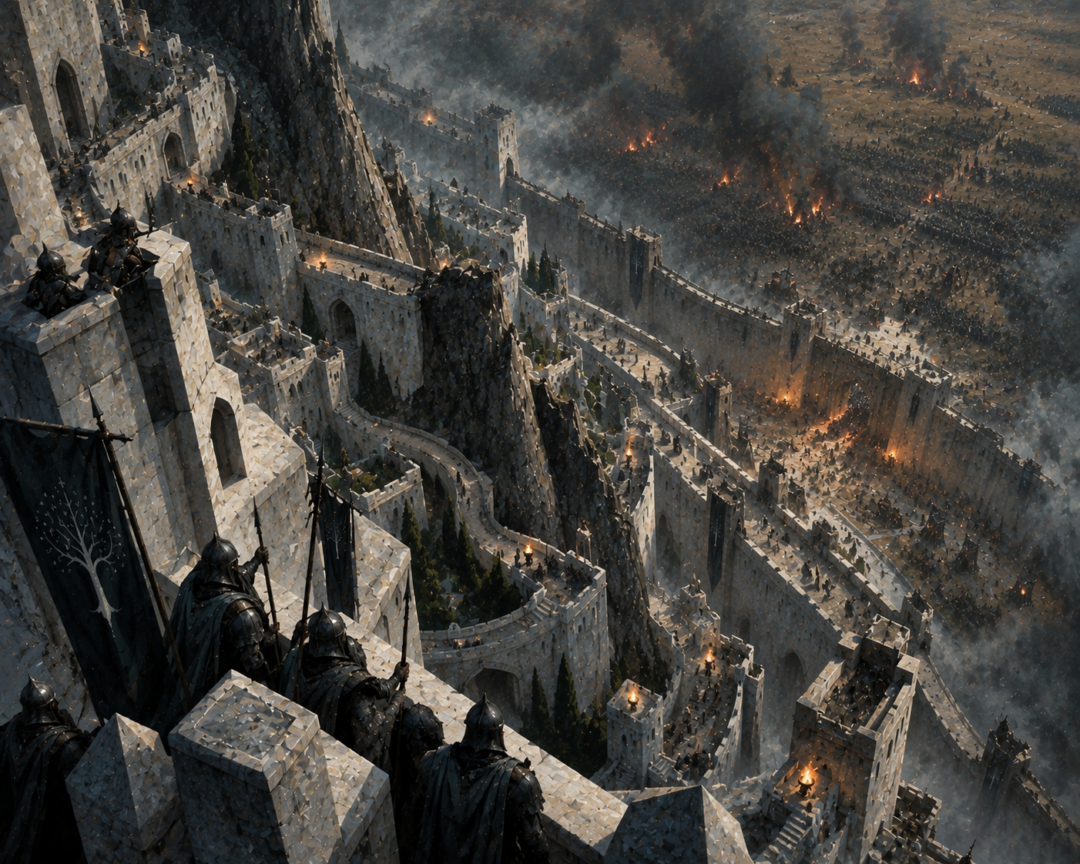
The White City Was a Fortress in Three Dimensions
Minas Tirith is often remembered visually as a spectacular city climbing a mountain, but its shape is not merely decorative.
Its seven circles create horizontal barriers.
Its hill creates vertical separation.
Its alternating gates prevent a direct route through those barriers.
Its great stone spur interrupts the ascent and forces the road through tunnels.
Together, those features turn the city into something more complex than a series of walls placed one behind another.
The attacker must move sideways as well as upward.
That is the overlooked brilliance of Minas Tirith’s layout.
The Great Gate was the city’s most obvious point of entry, and when Grond shattered it, Gondor stood frighteningly close to disaster. But there was never a straight road from that broken entrance to the White Tower.
Even after the first wall failed, the shape of Minas Tirith itself continued to resist.
The enemy could break a gate.
To reach the Citadel, it would still have to conquer a city.
Sources & Notes
- The Encyclopedia of Arda, “Minas Tirith” — https://www.encyclopedia-of-arda.com/m/minastirith.php
- The Encyclopedia of Arda, “Great Gate of Minas Tirith” — https://www.encyclopedia-of-arda.com/g/greatgateofminastirith.php
- The Encyclopedia of Arda, “Rammas Echor” — https://www.encyclopedia-of-arda.com/r/rammasechor.php
- The Encyclopedia of Arda, “Siege of Gondor” — https://www.encyclopedia-of-arda.com/s/siegeofgondor.php
Reference entries document the people, places, events, and textual details discussed in this article.