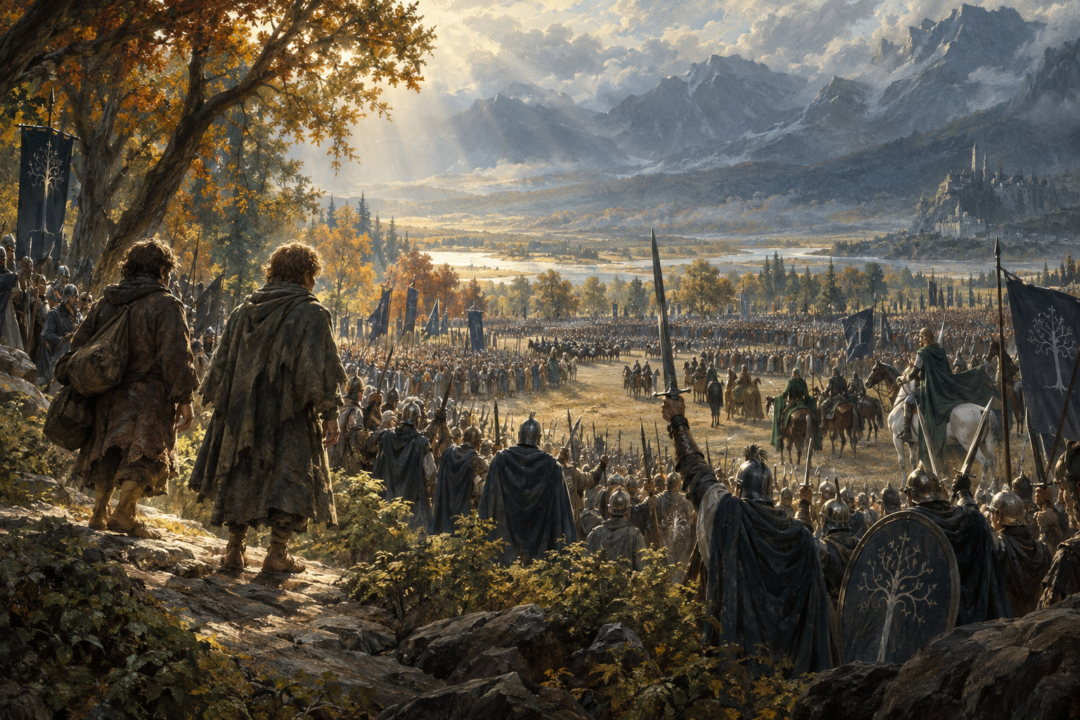
When Samwise Gamgee wakes in Ithilien after the destruction of the One Ring, one of his first shocks is discovering that Gandalf is alive. But another surprise is waiting beyond the trees. Frodo and Sam are not simply going to meet their surviving friends. They are about to walk into one of the most carefully staged public moments in The Lord of the Rings.
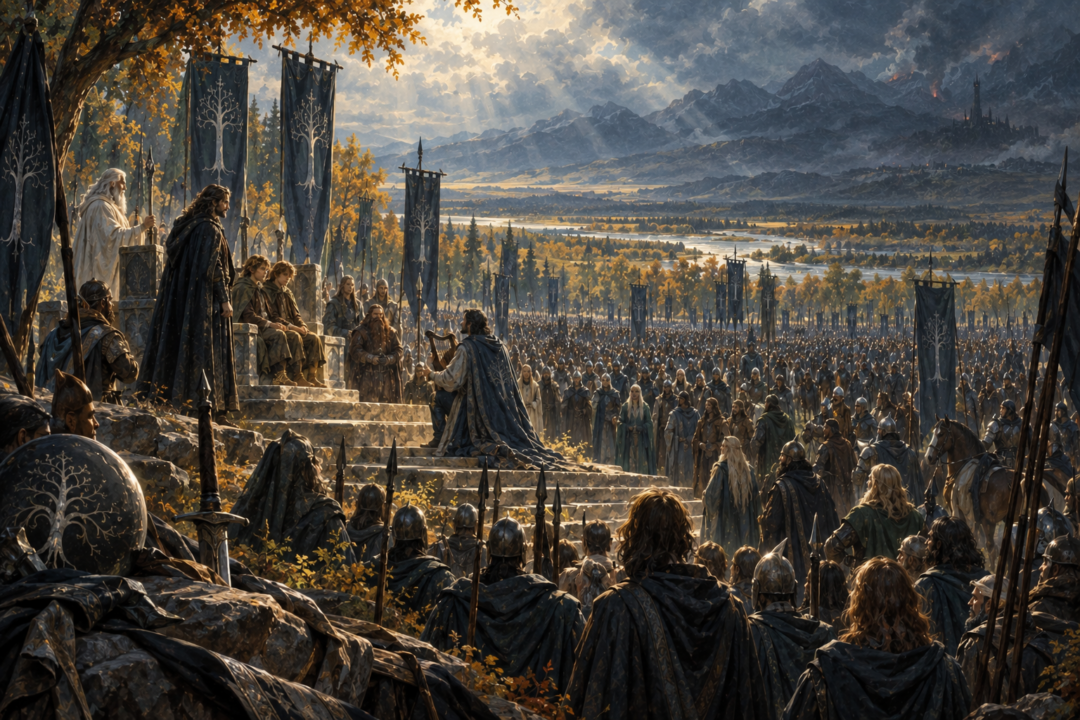
The Field of Cormallen turns the Fellowship’s reunion into something larger than a private homecoming. A great host is assembled. Weapons flash ceremonially. Horns sound. Multiple peoples acclaim the hobbits. Aragorn receives them before everyone. A minstrel transforms their journey into public memory.
Only after this enormous act of recognition does the story give Frodo and Sam the more intimate reunion they might have expected.
That order matters. Cormallen is where a secret quest becomes shared history.
Frodo and Sam Are Deliberately Sent Out in Their Old Clothes
One easily overlooked detail establishes the character of the entire scene.
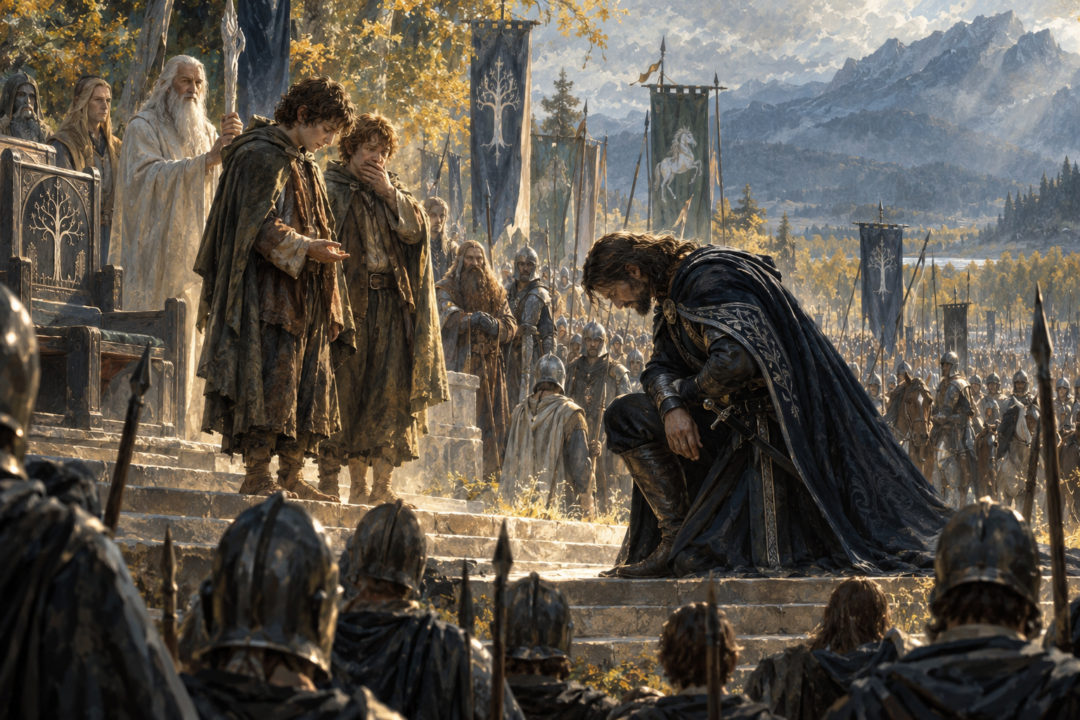
When Frodo and Sam awaken, Gandalf tells them that clothes have been prepared for them. Yet he also directs them to wear the garments in which they travelled to Mordor. Frodo therefore goes before the assembled host not dressed as a newly honoured lord, but visibly marked by the journey he has survived.
This is more than a practical choice.
Their battered clothing makes the Quest visible.
The people gathered at Cormallen did not walk through the Dead Marshes. They did not climb the pass above Minas Morgul, cross Mordor in disguise, or crawl toward Mount Doom with almost nothing left. Most could never fully understand what happened there.
But they can see what the journey did to the travellers.
The contrast is deliberate and powerful: two small hobbits in worn clothing approach ranks and companies of warriors glittering in the sunlight.
Normally the army would dominate such an image.
At Cormallen, the army becomes the audience.
The Host of the West Is Already Waiting
Frodo and Sam are not casually brought into a camp where celebrations happen to begin.
They approach a field where a great host has already been drawn up in ordered ranks and companies.
That makes the scene feel ceremonial from the beginning.
The surviving forces of the West have assembled as witnesses. Gondor is represented, but the gathering reaches beyond Gondor alone. The later address of the minstrel explicitly invokes lords, knights, Gondorians, Riders of Rohan, the sons of Elrond, the Dúnedain of the North, an Elf, a Dwarf, the Shire, and the free peoples of the West.
The victory is therefore not presented as belonging to one kingdom.
Neither is the honour.
The Quest began in secrecy because Sauron could not be allowed to understand what his enemies intended. Even many allies knew little or nothing of Frodo’s actual mission.
Cormallen reverses that secrecy.
The hidden Ring-bearers are brought into the centre of the surviving West.
The Soldiers Become a Ceremonial Audience
As Frodo and Sam approach, swords are drawn, spears are shaken, horns and trumpets sound, and voices rise in praise of the Halflings and Ring-bearers.
It resembles a military acclamation, but its meaning has been transformed.
These are the outward instruments of armies and kingship: weapons, ranks, banners, horns, massed voices. Yet the warriors are not celebrating a victorious general leading conquered enemies before them.
They are honouring two exhausted travellers whose decisive work was performed far away from the battlefield.
That distinction reaches to the heart of the War of the Ring.
Aragorn and the Captains of the West deliberately marched on the Black Gate knowing that military victory over Sauron was beyond their realistic strength. Their purpose was to draw the Eye outward and give Frodo whatever small chance remained.
The warriors at Cormallen therefore understand, at least in broad terms, that the apparent military climax was not the true source of victory.
The public ceremony acknowledges that truth.
The smallest figures receive the greatest praise.
Aragorn Reverses the Normal Hierarchy
Then Frodo sees the person waiting for him at the centre of the assembly: Aragorn.
For the hobbits, he is still recognizably Strider, their companion from the wild. But the situation has changed dramatically since they parted.
Aragorn now stands at the threshold of restored kingship.
That makes his response to Frodo and Sam especially significant.
Rather than demanding their homage, Aragorn honours them. He bows to them and then raises them up, setting them in the place of honour while the host cries out its praise.
The symbolic reversal is difficult to miss.
A king elevates hobbits.
The public nature of the gesture is essential. Aragorn is not merely expressing personal gratitude to friends. Before the assembled peoples of the West, the man who will become King acknowledges that his own victory and restoration depended upon people who possess almost none of the conventional signs of worldly power.
The throne-like seat, the assembled army, and Aragorn’s own authority could have made the ceremony about him.
Instead he uses royal authority to direct attention away from himself.
Cormallen therefore anticipates an important quality of Aragorn’s kingship: authority is shown not only by receiving honour, but by recognizing where honour is due.
Then the Story Becomes a Song
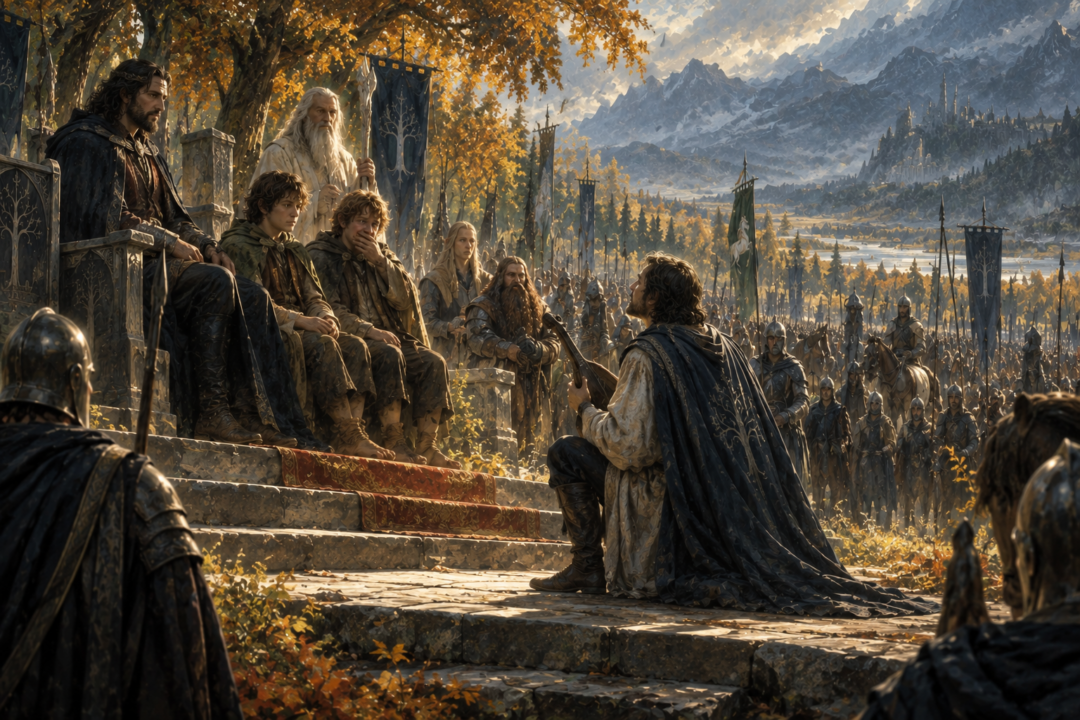
The ceremony reaches another level when a minstrel of Gondor steps forward and asks permission to sing.
His subject is announced as Frodo of the Nine Fingers and the Ring of Doom.
For Sam, this is almost overwhelming.
Throughout the journey, Sam has repeatedly understood experience through stories. On the stairs of Cirith Ungol, he and Frodo famously discuss the great tales and wonder what kind of story they themselves have fallen into. Sam recognizes that the old stories continue because people inside them keep going when they could turn back.
At Cormallen, that private conversation receives an astonishing answer.
They have become part of such a tale.
The transformation happens almost immediately. Their ordeal has barely ended, yet a minstrel is already giving it the form through which other people will remember it.
Sam laughs and then weeps.
His reaction makes sense because the song confirms something deeper than fame. The suffering that seemed isolated and almost unseen has entered communal memory.
Someone knows.
Someone will tell it.
Cormallen Turns Private Suffering Into Public Memory
This helps explain why the scene is staged with such scale.
If Frodo and Sam had simply awakened and embraced Merry, Pippin, Aragorn, Legolas, and Gimli, the emotional reunion would have been satisfying. But it would have remained primarily personal.
Cormallen does something else first.
It creates witnesses.
The gathered peoples hear the Ring-bearers named and praised. They see Aragorn honour them. They listen together as the story is sung.
Their joy becomes communal.
This is particularly important because the central act of the Quest was almost completely unwitnessed by the people who benefited from it. Frodo and Sam reached the end with no army beside them and no herald recording their deeds. At the Cracks of Doom, even the final destruction of the Ring comes through the intervention of Gollum after Frodo claims the Ring for himself.
Cormallen does not simplify those events into a conventional battlefield triumph. The text never presents Frodo as a warrior who personally conquered Sauron.
Instead the celebration honours the Ring-bearers and the terrible road they endured.
That distinction preserves the moral complexity of the Quest while still allowing the free peoples to recognize what they owe them.
The Fellowship Reunion Comes After the Acclamation
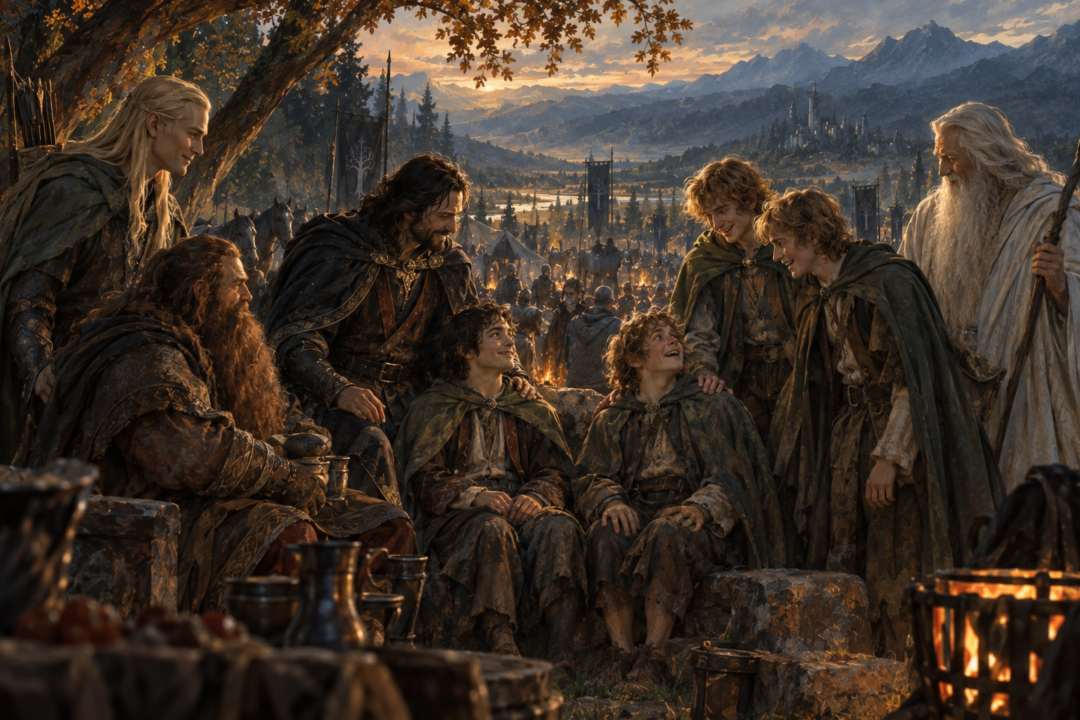
Only after the great ceremony does the narrative settle into the more personal reunion.
Frodo and Sam encounter the surviving members of their company and discover what has happened while they were separated. Merry and Pippin are there. Legolas and Gimli are there. Aragorn and Gandalf are restored to them.
Sam is particularly astonished by Merry and Pippin, who seem enormous to him after drinking Ent-draughts in Fangorn.
The effect is almost comic after the grandeur that came before it.
That contrast is valuable.
The public event has turned Frodo and Sam into legendary figures, but their friends immediately make the world personal again.
These are not merely “Ring-bearers” and “greathearts of the Shire.”
They are Frodo and Sam.
The Fellowship cannot truly return to what it was at Rivendell: Boromir is dead, Gandalf has passed through death and returned, and every surviving member has been altered by the war. Yet Cormallen allows the survivors to gather again after completing the different parts assigned to them.
For a brief moment, the scattered paths converge.
Victory Does Not Erase the Cost
The brilliance of Cormallen is that its celebration never completely loses sight of suffering.
The minstrel’s song produces laughter and tears together. The language surrounding the audience’s response deliberately mingles pain and delight.
That emotional mixture is appropriate because the victory itself contains both.
Sauron is defeated and the Ring destroyed. Yet Boromir is dead. Théoden is dead. Countless unnamed soldiers have fallen. Frodo has lost a finger and endured wounds that will never entirely leave him. The Shire, unknown to the returning hobbits, will still require liberation.
Even the Fellowship’s reunion cannot last.
Legolas and Gimli will eventually depart on their own road. Aragorn will remain in his kingdom. Gandalf’s task in Middle-earth is approaching its conclusion. Frodo will discover that returning home does not mean returning unchanged.
Cormallen is therefore not the restoration of the old world.
It is the celebration of a victory that makes a new world possible.
The Secret Quest Finally Becomes Everyone’s Story
For most of The Lord of the Rings, Frodo’s greatest task must remain hidden.
At Cormallen, secrecy is no longer necessary.
The Ring is gone. Sauron has fallen. The surviving peoples can finally speak openly about the Halflings and the Ring-bearers. The soldiers who marched as a diversion can now see whom their desperate march helped. The King can publicly honour those upon whose hidden courage his kingdom depended. A minstrel can begin converting recent suffering into remembered history.
That is why the reunion feels staged like a public event.
It is one.
Cormallen is simultaneously a military acclamation, a royal ceremony, a memorial gathering, a storytelling performance, and a reunion of friends.
And at its centre stand Frodo and Sam, still wearing the clothes of their terrible road.
The image captures one of the deepest reversals in the entire story.
The powerful assemble in ranks.
The King bows.
The warriors become witnesses.
And the two smallest travellers are placed where everyone can see them.
Sources & Notes
- The Encyclopedia of Arda, “Field of Cormallen” — https://www.encyclopedia-of-arda.com/c/cormallen.php
- The Encyclopedia of Arda, “Fellowship of the Ring” — https://www.encyclopedia-of-arda.com/f/fellowshipofthering.php
- The Encyclopedia of Arda, “Frodo Baggins” — https://www.encyclopedia-of-arda.com/f/frodobaggins.php
- The Encyclopedia of Arda, “Aragorn” — https://www.encyclopedia-of-arda.com/a/aragorn.php
Reference entries document the people, places, events, and textual details discussed in this article.