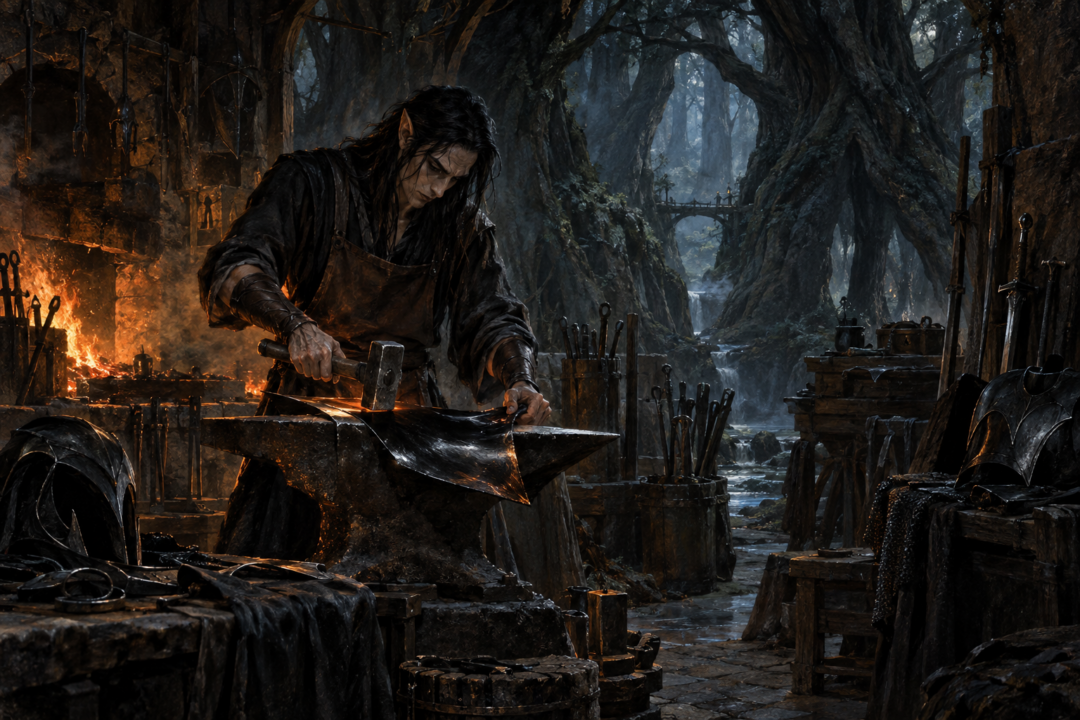
Among the strange materials of the First Age, galvorn is easy to misunderstand.
It sounds like something that ought to have become an industry: a black, shining metal that could be made thin and supple while remaining extraordinarily resistant to weapons. In a world repeatedly devastated by war, such a material should have been coveted by every armourer from Beleriand to the Blue Mountains.
Yet the surviving story does not describe warehouses of galvorn, companies of soldiers wearing it, or Dwarven smithies producing it by the cartload.
Instead, galvorn appears beside one Elf.
Eöl.
That association matters. The text presents galvorn not as an ordinary metal that Eöl happened to discover, but as the product of his personal craft: knowledge learned partly from the Dwarves, transformed by his own skill, and embodied in armour that distinguished him whenever he left the shadows of Nan Elmoth.
Galvorn therefore belongs to a recurring pattern in Middle-earth. Extraordinary craftsmanship is often personal. Knowledge can be taught, but the greatest works are not necessarily reproducible merely because their maker learned from someone else.
What Galvorn Actually Was
The clearest account comes in “Of Maeglin” in The Silmarillion.
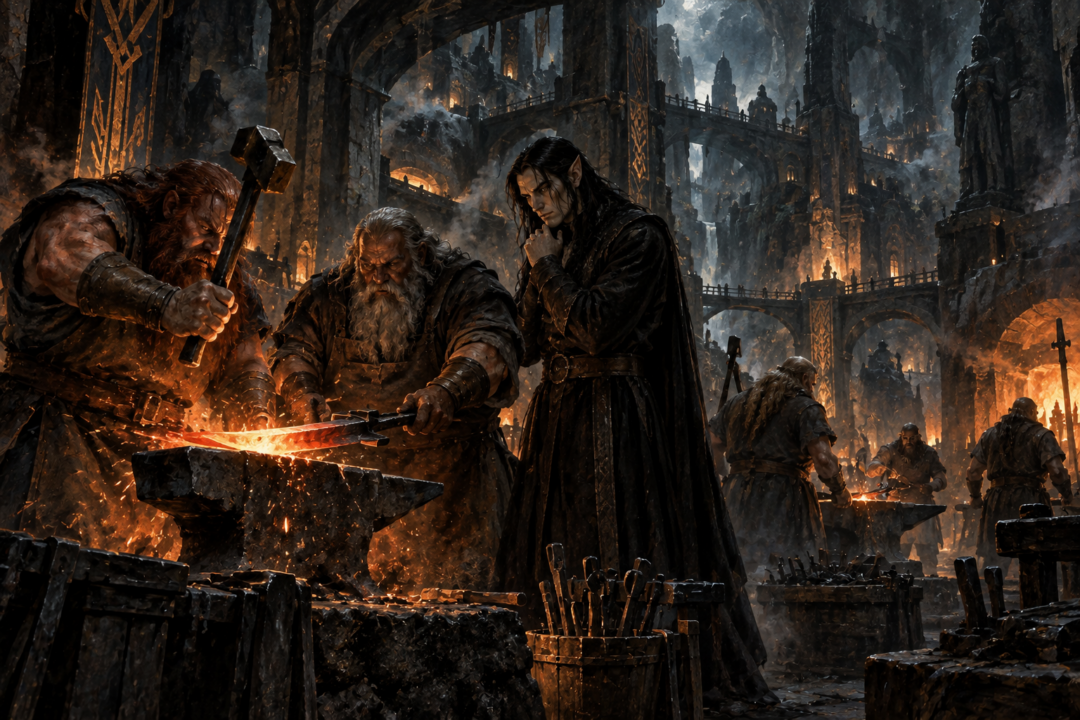
Eöl had established himself in Nan Elmoth, the dark forest east of Doriath. Unlike many Elves, he had a remarkable friendship with the Dwarves. Their roads from the Blue Mountains passed near his forest, and Eöl met and spoke with them.
Eventually he became their guest in Nogrod and Belegost.
There he learned much about metalworking and developed great skill. But the crucial wording comes afterward: Eöl himself “devised” galvorn.
The distinction is important.
The narrative does not say that the Dwarves taught him how to manufacture galvorn. Their metalworking traditions helped form the environment in which his own abilities developed, but galvorn is attributed directly to Eöl.
Its properties were exceptional. It was as hard as Dwarven steel, yet Eöl could work it so that it became thin and supple. Despite that flexibility, it remained resistant to blades and projectiles.
Its appearance was equally distinctive: black and shining like jet.
Eöl wore armour made from it whenever he went abroad.
That is essentially the canonical technological biography of galvorn—and its narrowness is revealing.
The Dwarves Taught Eöl, but Galvorn Was His
It would be tempting to call galvorn a Dwarven invention because Eöl learned metalworking in Nogrod and Belegost.
The text does not support that conclusion.
What it gives us instead is something more interesting: transmission followed by innovation.
Eöl already possessed his own character and interests as a craftsman, but his friendship with the Dwarves gave him access to their extraordinary metallurgical knowledge. From that learning he became highly skilled. Galvorn then emerges as something he devised.
That makes Eöl neither an isolated genius working without teachers nor simply a student reproducing Dwarven techniques.
He is both heir and inventor.
The same distinction helps explain why galvorn should not automatically be imagined as a standard product of the great Dwarven cities. The text explicitly compares its hardness to Dwarven steel. That comparison makes good sense if galvorn is something distinct from the ordinary products of their smithies.
If every smith of Nogrod could make galvorn, Eöl’s personal association with it would be far less significant.
Nothing in the surviving narrative says that they could.
Eöl’s Craft Was Highly Individual
Galvorn also makes more sense when placed beside Eöl’s other famous works.
He was an exceptional swordsmith. Most importantly, he forged Anglachel and Anguirel from iron that had fallen from heaven. Anglachel eventually entered Thingol’s possession and, after a long and tragic history, became the sword associated above all with Túrin.
The heavenly origin applies specifically to the iron used for those swords. It should not simply be transferred to galvorn. The published Silmarillion does not state that galvorn itself was made from meteoric iron.
What matters here is the broader pattern.
Eöl repeatedly appears as a craftsman capable of producing unusual things.
His work is not described in terms of organized manufacturing. There is no suggestion of a large metallurgical trade centered upon Nan Elmoth. His smithy belongs to the secluded world of his household, just as Eöl himself prefers darkness, secrecy, and distance from the political centers of the Noldor.
Galvorn fits that environment remarkably well.
It is dark, distinctive, practical, and intimately associated with its maker.

Galvorn Was Armour Before It Was an Economic Resource
Another revealing detail is what Eöl actually does with his invention.
He wears it.
The narrative could have told us that he traded galvorn with the Dwarves. It could have mentioned weapons forged from it, armour supplied to allies, or the knowledge passing to other smiths.
It does none of these things.
Instead, galvorn becomes Eöl’s personal protection.
That does not prove that he never made any galvorn object for anyone else. The surviving texts simply do not give us evidence for such production. But the only explicit use described is Eöl’s own armour.
This changes the way galvorn should be imagined.
Rather than something comparable to a widely available category such as iron or steel, galvorn appears more like the signature material of one extraordinary smith.
The distinction is especially important because Middle-earth does contain major centers of craft. The Dwarven cities possessed generations of accumulated knowledge. Gondolin maintained smiths and armourers. The Noldor were renowned for craftsmanship.
Yet galvorn never becomes identified with any of those larger traditions.
It remains Eöl’s.
Why Maeglin Does Not Turn Galvorn Into a Gondolin Industry
Maeglin creates the most interesting question.
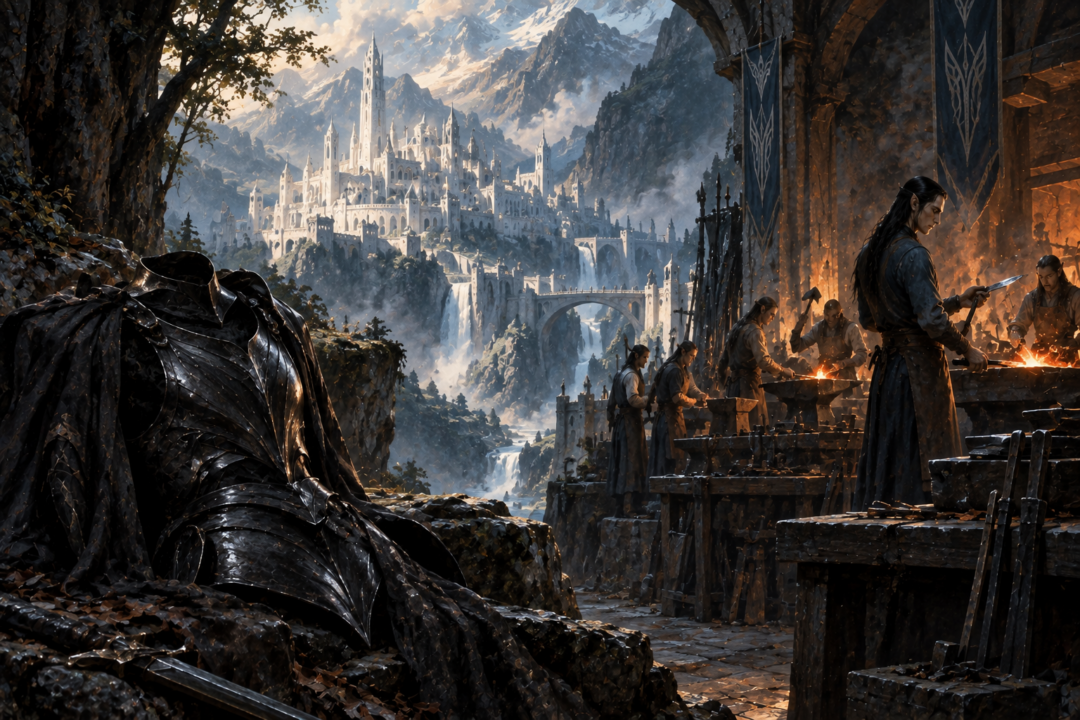
Eöl’s son inherited remarkable abilities. In Gondolin, Maeglin became powerful and influential, and his knowledge of mining and metalwork proved valuable to Turgon. The mountains around the hidden city contained rich resources, and Maeglin’s skill contributed to their exploitation.
If anyone might have carried Eöl’s metallurgical knowledge into a larger production system, it would seemingly have been Maeglin.
Yet the texts never say that he manufactured galvorn.
That silence cannot prove that Maeglin did not know its secret. Nor can we confidently say Eöl deliberately withheld the process from him. Neither claim is established.
What we can say is narrower and more useful: galvorn never becomes a stated feature of Gondolin’s military equipment.
This is significant because Gondolin’s later history gives ample opportunity for notable weapons and armour to matter. If galvorn had become a widespread Gondolindrim material, we might reasonably expect some trace of it in the traditions surrounding the city.
None is given.
The safest conclusion is therefore not that Maeglin definitely lacked the knowledge, but that the surviving legendarium never depicts galvorn escaping Eöl’s personal sphere and becoming a reproducible Gondolin industry.
Middle-earth Does Not Treat Knowledge Like a Modern Blueprint
The temptation to ask, “Why didn’t everyone copy it?” comes partly from applying modern assumptions to ancient-style craft.
Modern industry depends on reproducibility. Once a useful material has been understood, processes can be documented, standardized, scaled, and taught to large numbers of workers.
Exceptional craftsmanship in Middle-earth frequently works differently.
The identity of the maker matters.
Fëanor’s Silmarils are the supreme example: their existence does not mean that another sufficiently competent jewel-smith could simply follow instructions and manufacture replacements. Likewise, the existence of unique swords, jewels, and other great works repeatedly reminds us that knowledge and personal creative power are not interchangeable.
Galvorn should not be equated with the Silmarils in importance or nature. The comparison is structural rather than literal.
A thing can be invented without becoming easily reproducible.
Eöl’s ability to make galvorn may have depended on techniques, judgment, experience, or knowledge that the narrative never describes. We should not invent a secret formula for it. The text provides no recipe.
But it very deliberately identifies a maker.
Eöl devised it.
The Material Suits the Maker
There is also a literary dimension to galvorn that should not be mistaken for a technical explanation.
Eöl is the Dark Elf of Nan Elmoth, living beneath trees so dense that sunlight does not penetrate them. He loves night and twilight. His halls and smithy lie deep within this shadowed environment.
Then the narrative gives him a metal that is black yet shining.
That visual identity is almost inseparable from the character.
When Aredhel enters Nan Elmoth, her whiteness stands against Eöl’s darkness. The contrast between the White Lady of the Noldor and the dark smith of the forest becomes one of the strongest visual oppositions in their story.
Galvorn reinforces it.
His armour does not merely protect him. It makes Eöl look like Eöl.
A black, gleaming, flexible shell forged by a solitary smith beneath an ancient forest is exactly the kind of material his story requires.
That does not mean its properties are merely symbolic. Within the story, galvorn is genuinely effective metal.
But its narrative purpose and its physical properties work together.
Why Galvorn Vanishes
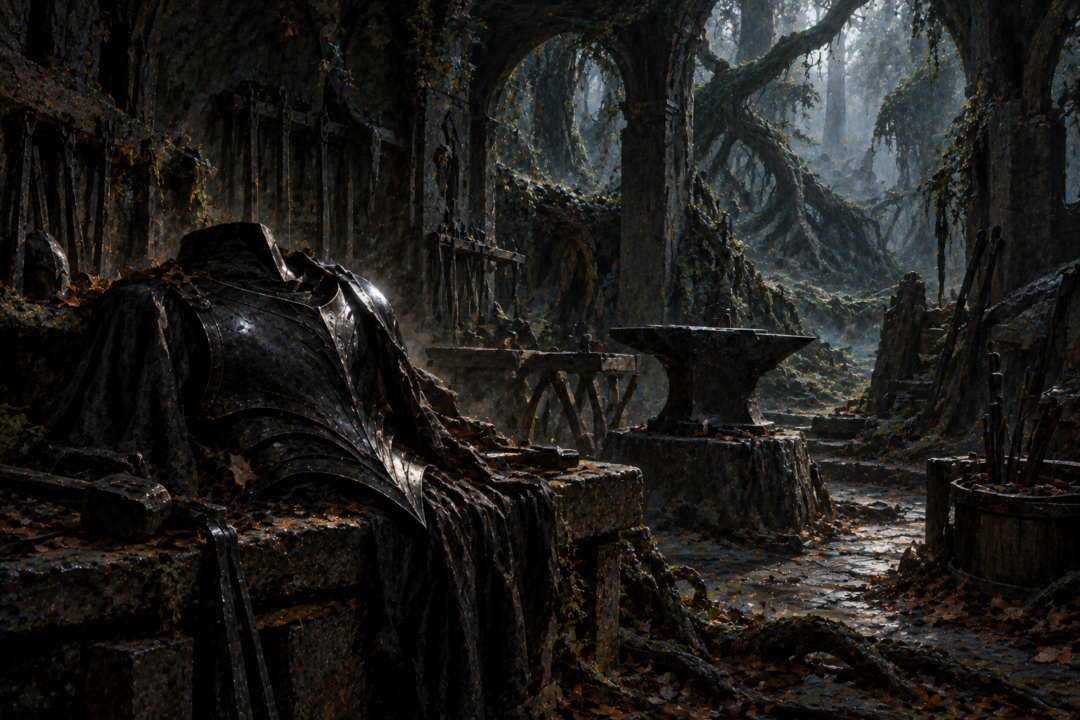
After Eöl’s death in Gondolin, galvorn effectively disappears from the recorded history of Middle-earth.
It would be too strong to say that the secret was certainly lost at that exact moment. Maeglin survived his father for years, and the texts never explicitly tell us who did or did not know how galvorn was made.
But no later tradition establishes continued production.
There are no galvorn-clad armies in the later First Age. No surviving cache becomes famous in the Second Age. No heirloom of galvorn emerges during the War of the Ring.
Its absence is striking precisely because its properties were so useful.
The most conservative explanation is also the simplest: the texts present galvorn as Eöl’s invention and never establish a broader craft tradition capable of continuing it.
Whatever knowledge was required to produce it did not become part of the recorded technological inheritance of Middle-earth.
Galvorn Was a Masterpiece, Not a Commodity
That is what makes galvorn fascinating.
Its significance does not lie in imagining an entire forgotten industrial system behind it. The evidence points in the opposite direction.
Eöl learned much from the Dwarves of Nogrod and Belegost, but the invention was attributed to him. He produced extraordinary armour from it and wore that armour himself. His son became an important smith and miner in Gondolin, yet no text says that galvorn entered Gondolin’s workshops as a standard material.
Then it disappears from the narrative.
Galvorn therefore sits beside the many wonders of Middle-earth whose existence depended not merely upon resources, but upon particular makers.
Its black surface reflected the character of the smith who devised it: brilliant, secretive, isolated, and difficult to separate from the shadows in which he chose to live.
The tragedy is that the metal may have been more durable than the tradition that created it.
Galvorn could resist blades and darts.
What it could not survive, at least in the histories that remain, was the death of Eöl and the ruin of the world in which his singular craft had flourished.
Sources & Notes
- The Encyclopedia of Arda, “Galvorn” — https://www.encyclopedia-of-arda.com/g/galvorn.php
- The Encyclopedia of Arda, “Eöl” — https://www.encyclopedia-of-arda.com/e/eol.php
- The Encyclopedia of Arda, “Nan Elmoth” — https://www.encyclopedia-of-arda.com/n/nanelmoth.php
- The Encyclopedia of Arda, “Maeglin” — https://www.encyclopedia-of-arda.com/m/maeglin.php
Reference entries document the people, places, events, and textual details discussed in this article.