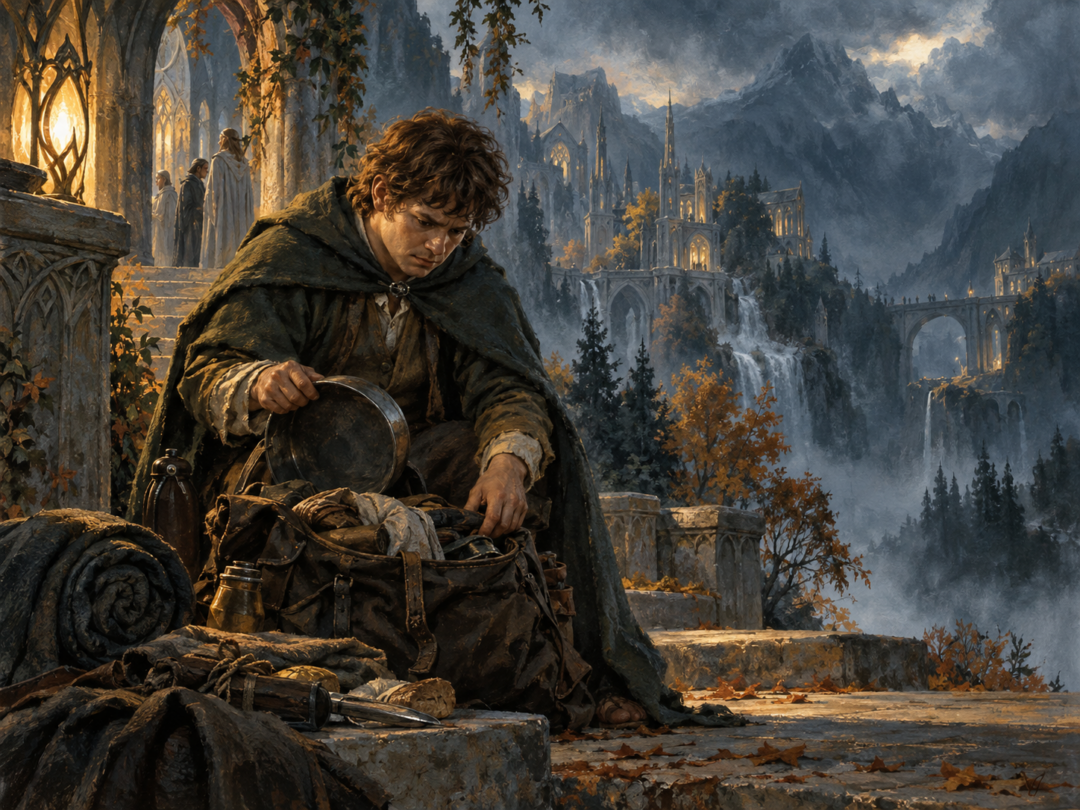
Samwise Gamgee begins the Quest thinking like a hobbit packing for a long road. He worries about rope. He carries spare clothes, salt, pipe-weed, flint and tinder, and, above all, his beloved cooking gear. By the time he stands within sight of Mount Doom, almost all of that careful preparation has become dead weight.
That change is easy to miss because Sam never becomes a trained soldier or wilderness commander. He remains recognizably Sam. Yet during the final crossing of Mordor, he repeatedly makes hard logistical decisions that reveal something important about how he survives: he stops asking whether an object is useful in general and starts asking whether it is useful for the next stage of the Quest.
The distinction becomes brutal near Orodruin. Food, water, weapons, disguises, cookware, rope, even treasured possessions are no longer judged by what they once meant. They are judged against Frodo's remaining strength and the distance still ahead.
Sam Begins as a Hobbit Who Wants to Be Prepared
When the Fellowship leaves Rivendell in The Fellowship of the Ring, Sam mentally checks his pack. His possessions include his cooking gear, salt, pipe-weed, flint and tinder, clothing, and miscellaneous things belonging to Frodo. His immediate regret is that he has forgotten rope.
This is Sam's original philosophy of travel: bring things because circumstances may require them.
It is sensible. His cooking gear later proves genuinely useful. The rope supplied to the Fellowship in Lórien becomes indispensable on the journey with Frodo. Sam's instinct to prepare for ordinary physical needs repeatedly helps them survive.
But Mordor destroys the assumptions behind ordinary preparation.
A pan is useful if there is food to cook. Flint is useful if making a fire is safe and worthwhile. Armor is useful if surviving a fight is a realistic objective. A disguise is useful only while disguise can actually get you somewhere.
Sam gradually begins judging equipment against these changing conditions.
The First Priority Is Whatever Keeps Frodo Moving
After rescuing Frodo from the Tower of Cirith Ungol, Sam immediately thinks about clothes, equipment, food, and escape.
The Orcs have taken Faramir's provisions from Frodo and damaged his water-bottle, though much of the lembas remains because the Orcs have apparently rejected it. Sam recognizes at once that water will be the greater problem.
That distinction matters.
Food is scarce, but lembas is extraordinarily sustaining. Water cannot be replaced by willpower. The text repeatedly shows Sam searching for it, conserving it, and thinking anxiously about where the next supply might come from.
When he finds drinkable water in Mordor, he even proposes testing it himself first in case it proves harmful. Later he deliberately stints his own drinking.
His decisions therefore are not based simply on reducing weight. Some heavy necessities remain necessities.
The real calculation is closer to this: does carrying this thing improve Frodo's chances of reaching the Mountain enough to justify its burden?
Water passes that test. Waybread passes it. Many other possessions eventually do not.
Temporary Necessities Can Become Liabilities
One of the clearest examples is Orc equipment.
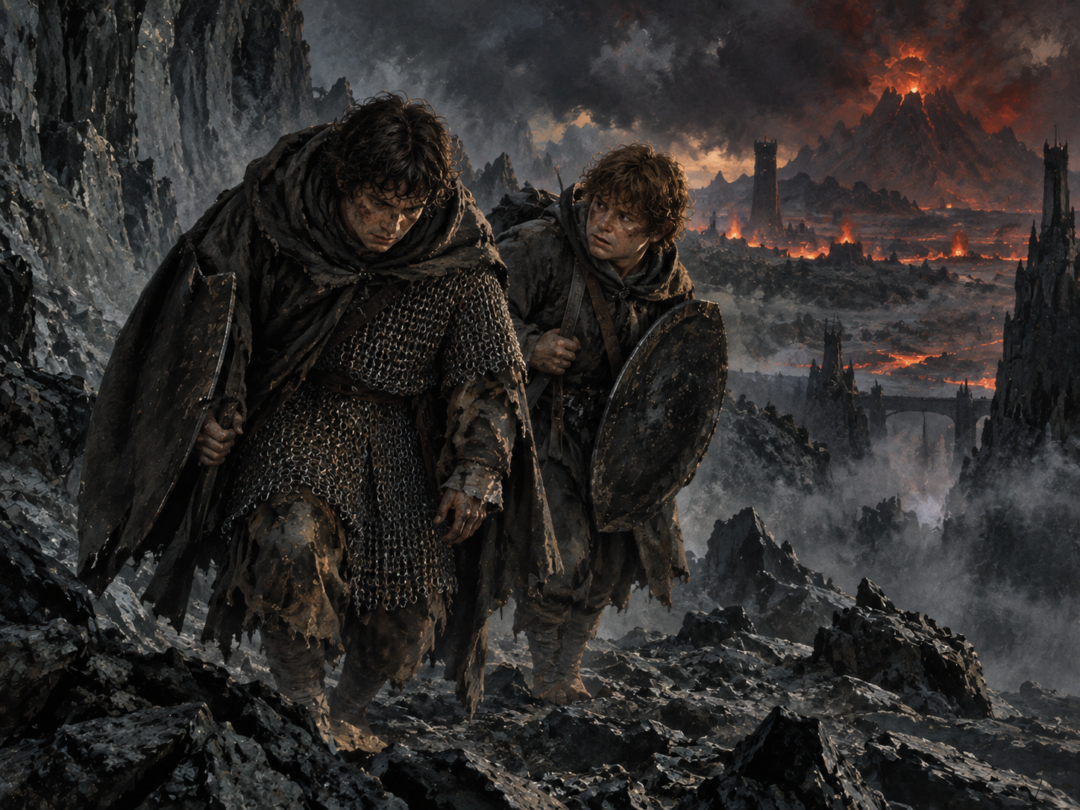
Sam dresses Frodo in Orc clothing after the rescue because walking openly through Mordor in their own appearance would be dangerously conspicuous. They take shields as part of the disguise. At that stage, enemy gear has considerable tactical value.
Yet Frodo soon finds the Orc mail unbearably heavy.
Sam initially argues for keeping some protection. He knows knives, arrows, and Gollum remain possible dangers. But Frodo explains that the extra weight is exhausting him and that they cannot realistically fight their way through Mordor anyway.
The mail is discarded.
Later, near Mount Doom, the same principle is applied even more completely. Their route has changed. They are no longer attempting to move along Mordor's roads indefinitely while passing as Orcs. They are turning directly toward Orodruin.
What once protected them now consumes strength without providing enough advantage.
This is one of Sam's most important logistical instincts: usefulness expires.
He does not keep an object merely because it saved them yesterday.
Sam Finally Accepts That There May Be No Return Journey
The darkest transformation in Sam's planning comes when he studies the distance to Mount Doom and thinks through their provisions.
Until then, some part of him has continued imagining the return.
Eventually he realizes that their remaining supplies might carry them to the Mountain but cannot carry them back again. The text does not present this as a carefully measured mathematical certainty; it is Sam's grim practical conclusion after looking at their condition, distance, food, and water.
That realization changes everything.
Equipment for a hypothetical journey home no longer deserves the same priority as strength needed to reach Orodruin.
This is not despair in the sense of abandoning the Quest. Strangely, accepting the possibility of death makes Sam more decisive. His hope of returning to Bywater, Rosie, the Gaffer, and his family remains emotionally alive, but he stops allowing that hope to dictate his packing.
The mission becomes one-way in his calculations even before fate proves otherwise.
The Cooking Pans Reveal the True Cost of the Decision
Nothing shows the emotional price of this process better than Sam's cooking gear.
These pans are not random utensils. Earlier in the story they represent one of Sam's strongest connections to ordinary hobbit life: hot food, domestic competence, hospitality, and the conviction that even on a terrible road a decent meal still matters.
In Ithilien, Sam uses them while preparing the rabbits that Gollum brings. That meal becomes attached to one of the last relatively peaceful memories before the Quest enters its final darkness.
Near Mount Doom, however, the pans have almost no remaining practical function.
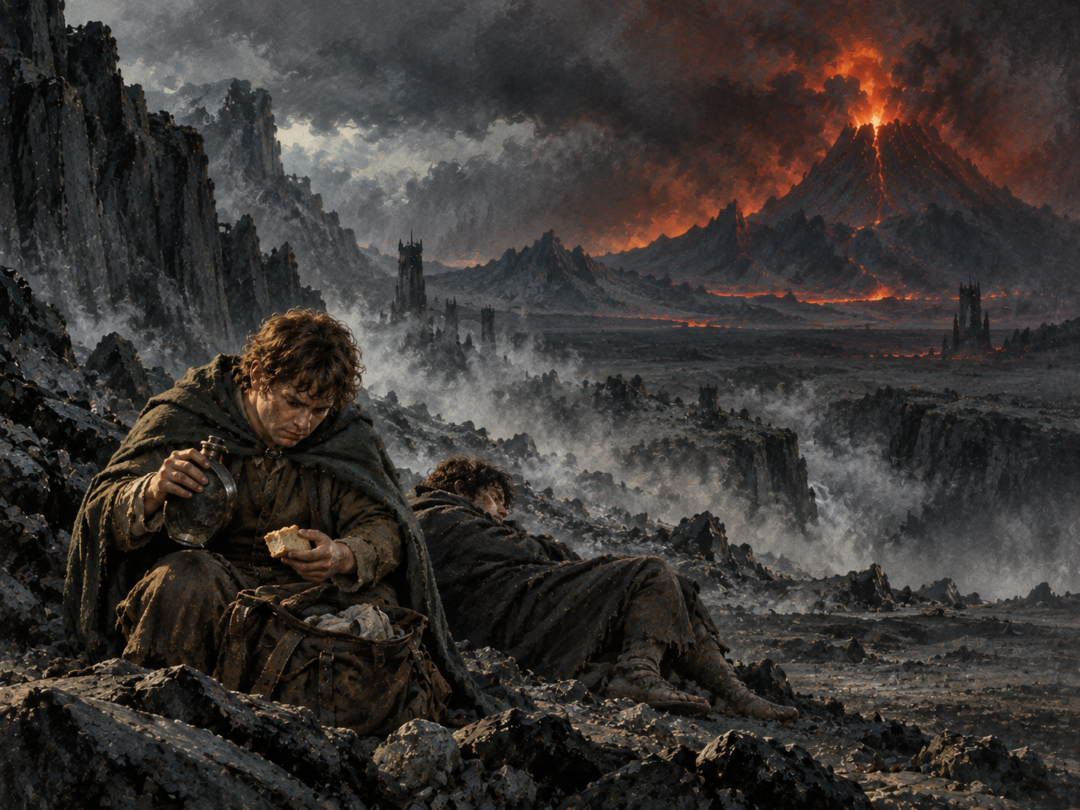
Frodo and Sam are surviving chiefly on lembas. Water is desperately scarce. There is no meaningful supply of ordinary food waiting to be cooked. Their remaining time and physical strength matter more than maintaining the habits of camp life.
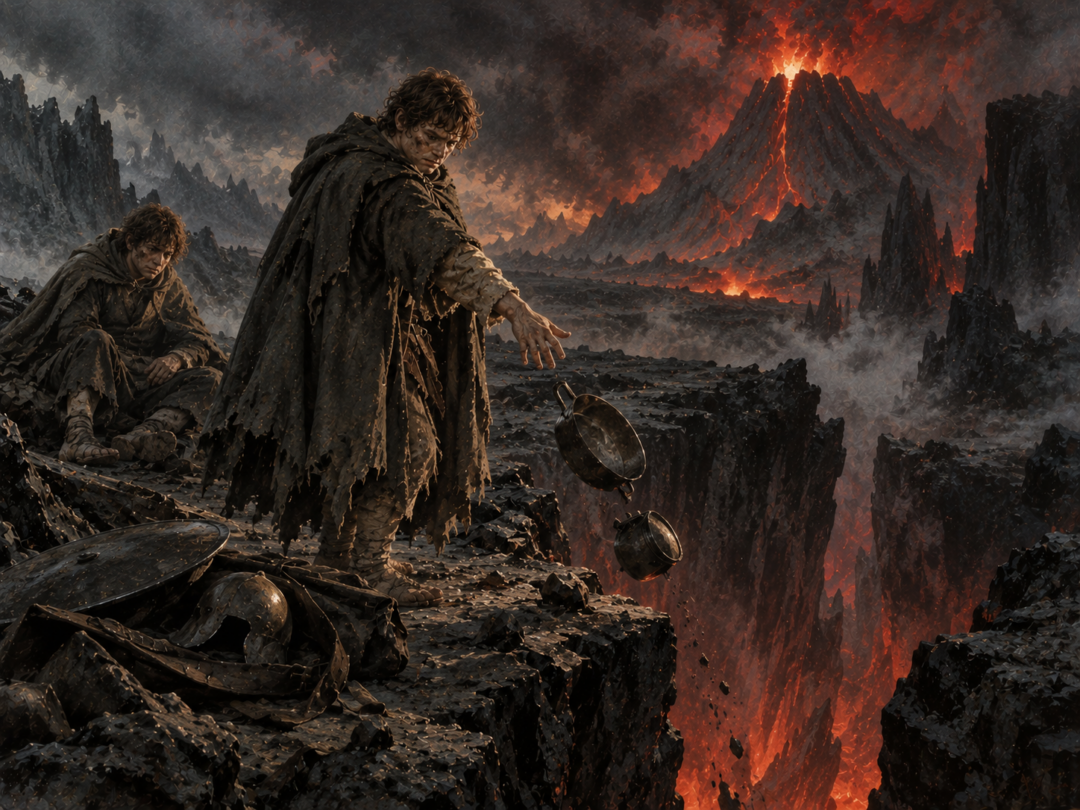
Sam therefore does something that would have seemed almost unimaginable to the hobbit who left Rivendell: he throws his cooking gear away.
The moment hurts precisely because the pans are not worthless.
They have become useless for this particular road.
That is a much harder distinction.
Sentimental Value Does Not Automatically Save an Object
Sam explicitly feels that the things he has carried have become dear simply because he has borne them through so much hardship.
That is a recognizable human instinct. Effort creates attachment. After carrying something hundreds of miles, abandoning it can feel like declaring all that effort wasted.
Sam overcomes that instinct.
The past cost of an object does not determine whether he carries it another mile.
The pans are the strongest example, but the discarded equipment around them reinforces the point. Frodo abandons shield, helmet, belt, sword, and unwanted Orc trappings. Sam likewise removes unnecessary gear.
He even takes care not simply to leave everything exposed where Gollum might find useful equipment. He throws the discarded articles into a fissure.
So his decision has two stages: determine what has ceased helping them, then make certain it cannot easily help a potential enemy.
That is not elaborate military strategy. It is practical caution carried to its logical conclusion.
What Sam Keeps Is Just as Important
After the great shedding of equipment, the surviving inventory is remarkably small.
Sam keeps the remaining lembas and the water-bottle. He retains Sting. He keeps the Elven rope, cutting a piece to help secure Frodo's cloak and carefully coiling the rest. He also keeps the Phial of Galadriel and the small box Galadriel gave him.
These choices prevent the scene from becoming a simple lesson in ruthless minimalism.
The Phial has already proven capable of helping against terrible darkness and the Watchers of Cirith Ungol. Sting remains a compact weapon in a land where Gollum and other dangers are still possible. Rope is light enough to retain and has repeatedly demonstrated practical usefulness. Food and water are non-negotiable.
The little box is different. Nothing in the Mordor journey suggests that Sam expects its contents to help them reach Mount Doom. It is small, kept close to him, and survives the final march.
That matters because Sam has not abandoned everything that connects him to another life.
He discards what materially threatens the Quest. He does not erase himself.
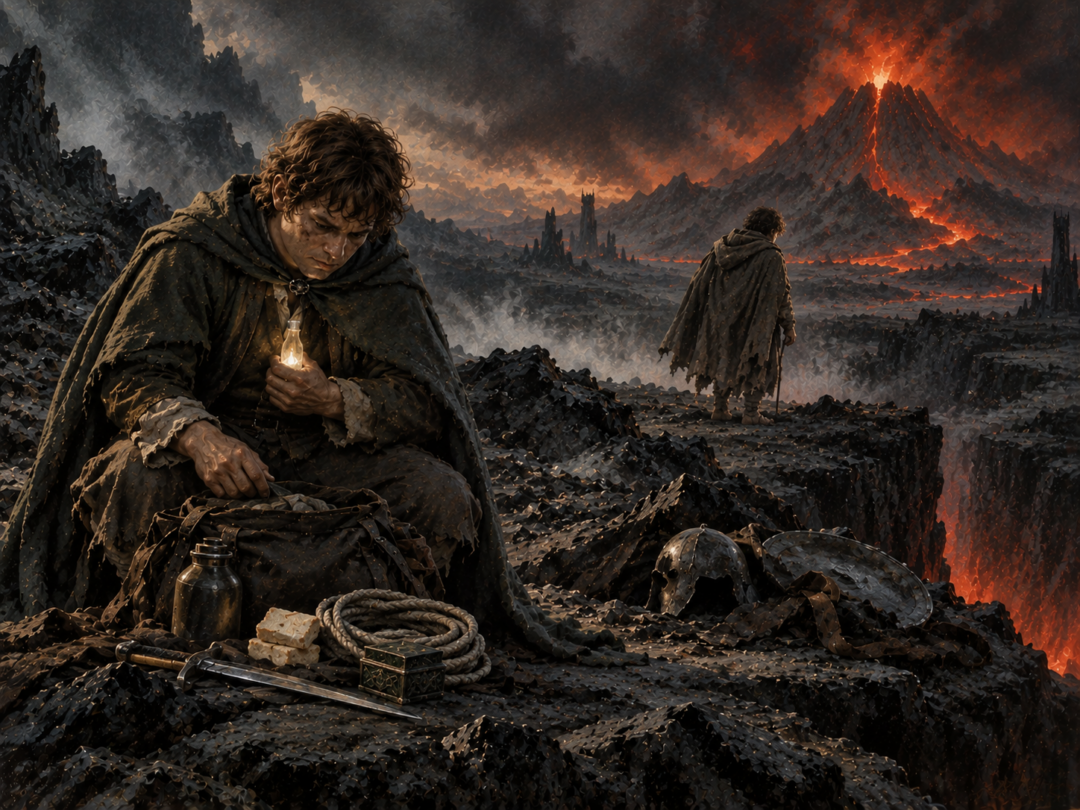
Sam's Rule Is Not “Carry Less” but “Carry for the Road You Actually Have”
Sam never states a formal system, but his choices suggest one.
First, he considers the immediate objective. Near Mount Doom there is only one meaningful destination.
Second, he compares an item's present usefulness with the strength required to carry it. Armor becomes unacceptable when its weight is more dangerous than the protection it offers.
Third, he recognizes when circumstances have removed an item's purpose. Cooking gear without cookable provisions is memory made of metal.
Fourth, he protects the essentials that cannot be improvised: water, lembas, and a handful of proven tools.
And finally, he accepts that planning must change when the imagined future changes.
The Sam who worried about forgetting rope at Rivendell was not foolish. He was preparing correctly for that stage of the journey. The Sam who throws beloved pans into a crack in Mordor is not contradicting him.
He has simply learned the harsher half of preparedness.
Knowing what to bring matters.
Knowing when to let it go may matter more.
By the final road to Orodruin, Sam's greatest logistical achievement is not possessing the perfect equipment. It is recognizing that every unnecessary pound is ultimately being carried by exhausted bodies, and that Frodo's remaining strength is the one resource they cannot replace.
The pans, armor, disguises, and other belongings become liabilities at different moments because the road changes beneath them.
Sam changes with it.
And that quiet adaptability—more than any single object in his pack—is one of the reasons the Ring-bearer reaches the Mountain at all.
Sources & Notes
- The Encyclopedia of Arda, “Samwise Gamgee” — https://www.encyclopedia-of-arda.com/s/samwisegamgee.php
- The Encyclopedia of Arda, “Lembas” — https://www.encyclopedia-of-arda.com/l/lembas.php
- The Encyclopedia of Arda, “Mount Doom” — https://www.encyclopedia-of-arda.com/m/mountdoom.php
- The Encyclopedia of Arda, “Mordor” — https://www.encyclopedia-of-arda.com/m/mordor.php
Reference entries document Sam’s choices, the remaining provisions, and the final journey across Mordor.