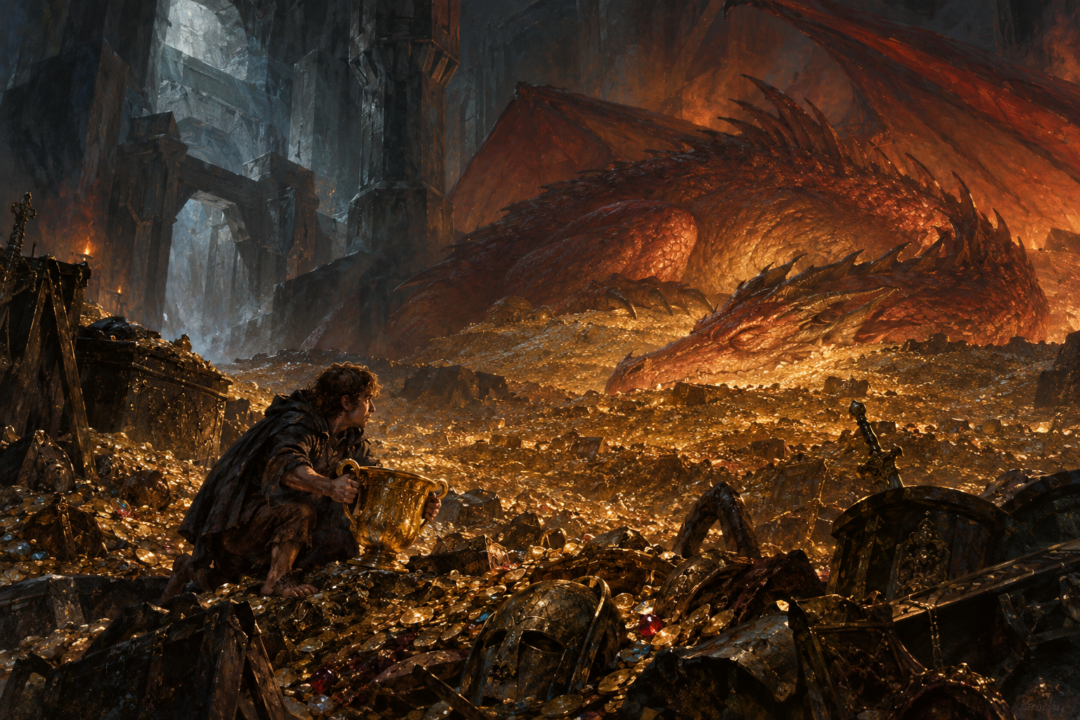
Of all the treasure beneath the Lonely Mountain, Bilbo Baggins chooses something almost absurdly small.
A cup.
He does not recover the Arkenstone. He does not somehow cripple Smaug while the dragon sleeps. He simply creeps across the treasure floor, takes a great two-handled cup, and escapes through the secret passage.
Measured against the wealth of Erebor, the loss is trivial. To Smaug, it is anything but trivial.
When the dragon wakes, he discovers the theft almost immediately. The importance of this moment is easy to miss because Smaug’s spectacular anger dominates the scene. But beneath that anger lies a genuine strategic crisis. For generations, Smaug’s security has rested on an assumption stronger than stone walls: nobody can enter his domain, take something from him, and leave alive.
The missing cup proves that assumption false.
From that point onward, Smaug is no longer merely guarding treasure. He is trying to understand a threat whose route, numbers, intentions, and even species he does not know.
And almost every decision he makes afterward is shaped by that uncertainty.
The Cup Is Proof of Penetration
Before Bilbo enters Erebor, Smaug possesses overwhelming advantages.
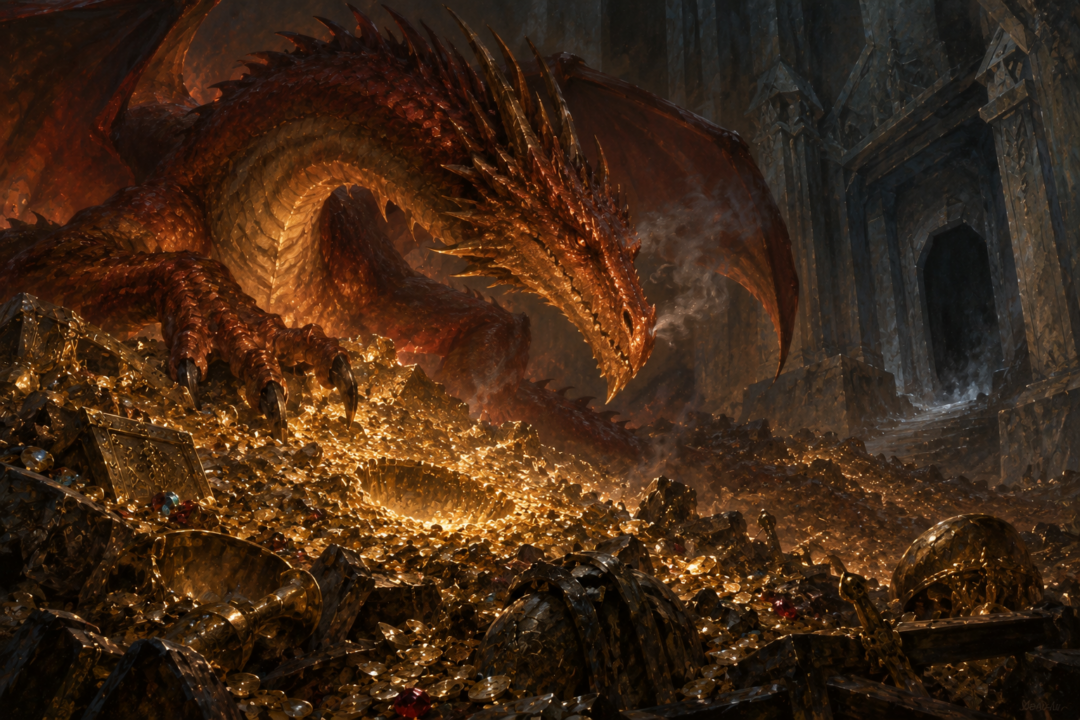
He occupies the heart of the Mountain. The old halls of the Dwarves have become his fortress. His physical power is extraordinary, and the memory of his original assault still hangs over the region. Dale was destroyed, Erebor was lost, and no army has come to dislodge him.
Then something impossible happens.
An object disappears from beneath him.
The text makes clear that dragons remember their possessions with astonishing precision, and Smaug notices the missing cup. That detail matters because the cup is not valuable to him merely as a drinking vessel. Indeed, the story explicitly observes the strange relationship dragons have with treasure: they may have little practical use for it, but they know it and guard it.
The cup therefore functions like evidence at a crime scene.
Someone has penetrated Smaug’s inner chamber.
Someone approached while he slept.
Someone escaped.
Most importantly, Smaug does not know how.
The theft transforms his problem from territorial defense into uncertainty about a hidden access route.
Smaug Immediately Searches for the Intruder
Smaug’s first reaction is rage, but his actions are not completely irrational.
He leaves his chamber and searches the Mountain for the thief. That is a reasonable response to the information available to him. If someone has stolen treasure, the intruder may still be nearby.
What Smaug cannot immediately determine is where the intruder came from.
Bilbo has entered through the secret door on the western side of the Mountain, using the passage discovered by Thorin’s company. Smaug knows something strange has happened within his supposedly secure domain, but he does not possess Bilbo’s map of the situation.
That difference in information is crucial.
Bilbo knows the entrance.
Smaug knows there has been an intrusion.
Neither initially knows everything the other knows.
The mighty dragon has therefore acquired a classic security problem: he can destroy almost any enemy he can reach, but raw strength does not identify an invisible route of entry.
Smaug can burn the mountainside. He can patrol the approaches. He can terrorize anyone exposed outside.
He cannot burn uncertainty itself.
Why One Cup Is More Dangerous Than a Chest of Gold
It might seem strange that the loss of a single vessel provokes such violence when Smaug possesses treasure beyond counting.
But the scale of the theft is almost irrelevant.
Imagine instead that Bilbo had somehow carried away a chest. Smaug would be richer by almost the same unimaginable margin. The material damage would still be negligible compared with the hoard.
The security implications would be identical.
The danger is not what was taken. It is what taking anything proves.
A stolen cup establishes that Smaug’s defenses have already failed once.
And if someone can remove one object, they may return for another.
That is exactly what happens.
Bilbo enters again.
This time Smaug is waiting.
The dragon has adjusted his behavior because the first intrusion has changed his expectations. He no longer assumes that possession of the Mountain is sufficient protection. The unknown thief is now a recurring threat.
That adaptation also creates the circumstances for Smaug’s greatest intelligence-gathering opportunity—and his fatal information leak.
The Second Intrusion Becomes an Interrogation
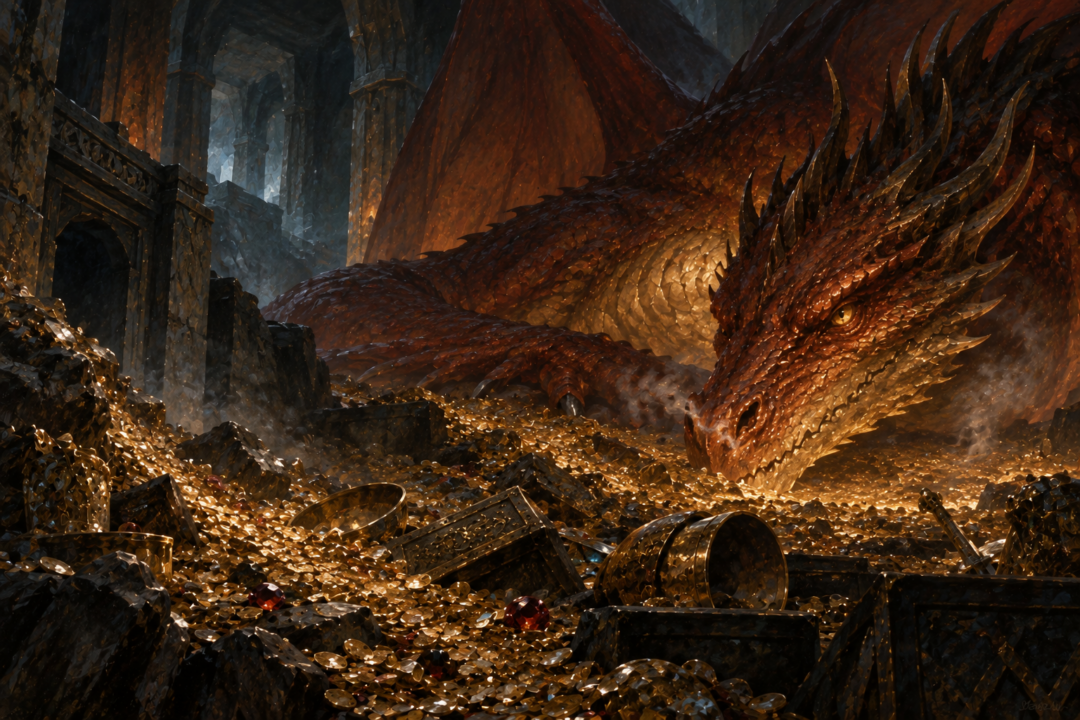
When Bilbo returns, the Ring conceals him from sight, but it does not make him undetectable.
Smaug can smell and hear signs of his presence.
Instead of simply flooding the chamber with fire at once, however, the dragon talks.
This is where Smaug becomes much more dangerous than a monster guarding a cave. He tries to identify his opponent.
Bilbo refuses to give his name and answers with riddling titles drawn from his adventures. Smaug listens and interprets them. The conversation becomes a contest in which each participant tries to extract information without surrendering too much.
Smaug probes Bilbo’s relationship with the Dwarves. He attempts to make the hobbit suspicious of his companions and the promised division of the treasure. Bilbo, meanwhile, deliberately flatters Smaug and maneuvers the dragon into displaying his armored underside.
Neither side leaves the conversation empty-handed.
Bilbo discovers the bare patch in Smaug’s jewel-encrusted protection.
Smaug extracts clues concerning Bilbo’s journey and becomes suspicious of Lake-town’s involvement.
The balance of information has changed again.
The missing cup began the investigation. The conversation gives Smaug a target.
Unfortunately for him, it also gives his enemies the knowledge that eventually kills him.
Smaug Misidentifies the Shape of the Threat
Smaug’s reasoning about Lake-town is not baseless.
Thorin and his companions really have received substantial assistance there. The Master and people of Esgaroth welcomed Thorin’s claim, provisioned the company, and helped them continue toward the Mountain.
Smaug therefore identifies a genuine connection.
The mistake lies in what he does with that information.
The actual threat inside Erebor is unusually small: thirteen Dwarves and a hobbit, with Gandalf no longer accompanying them. They do not possess an army capable of storming the Mountain. Indeed, when they finally confront the practical problem of Smaug, they have no straightforward method of killing him.
Smaug nevertheless begins thinking in terms of wider conspiracy and retaliation.
That reaction fits his experience. He once took Erebor through overwhelming violence. His authority afterward depends largely upon fear and the certainty that challenging him brings destruction.
Once the cup disappears, tolerating the insult would mean tolerating evidence that his deterrence has failed.
So Smaug escalates.
The Secret Door Changes Everything
There is another reason the missing cup is so destabilizing.
Smaug cannot simply solve the problem by guarding the obvious entrance.
The Front Gate is not the only way into Erebor.
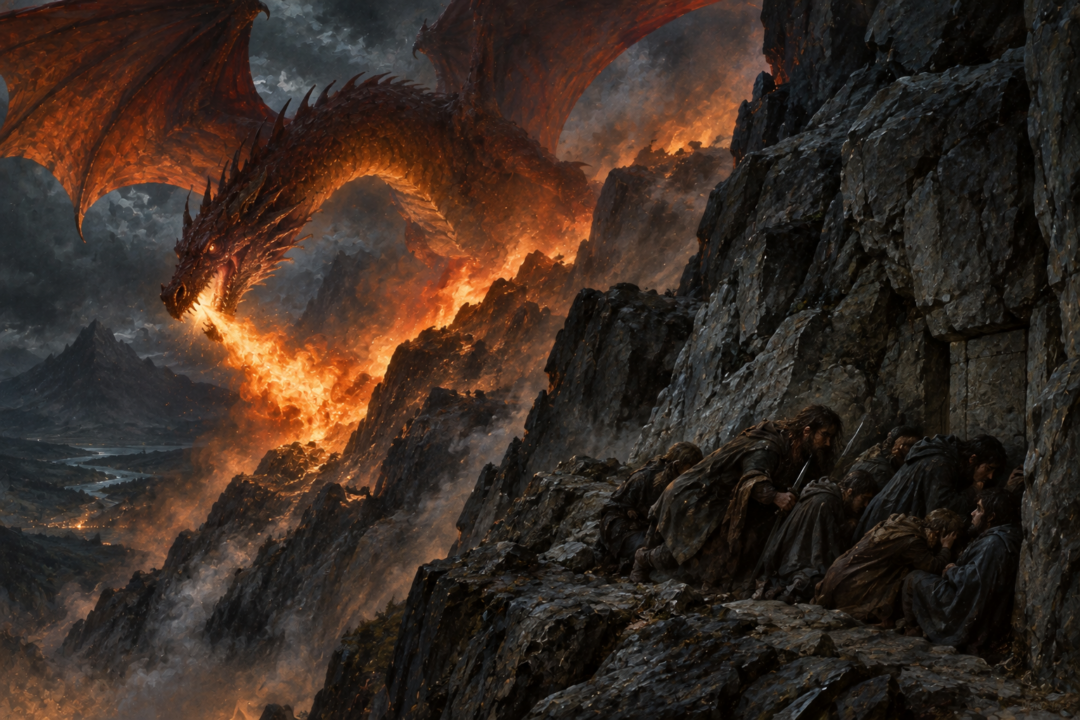
The secret passage is a surviving feature of the old Dwarf-kingdom, and its concealment allows an intruder to reach astonishingly close to Smaug without approaching through the defenses he naturally dominates.
This is an important reversal.
Erebor was originally a Dwarven stronghold. Smaug conquered it and converted its strength into his own security. But he does not perfectly possess all the knowledge embedded in the place.
Thorin’s inherited map and key preserve knowledge that survived the kingdom’s fall.
The old builders, in effect, have left behind a weakness in the dragon’s occupation.
Smaug owns the Mountain by force.
The Dwarves retain part of its memory.
Bilbo turns that memory into access.
The cup is the first physical proof that inherited knowledge can penetrate the dragon’s apparent control.
Terror Becomes Smaug’s Answer to Uncertainty
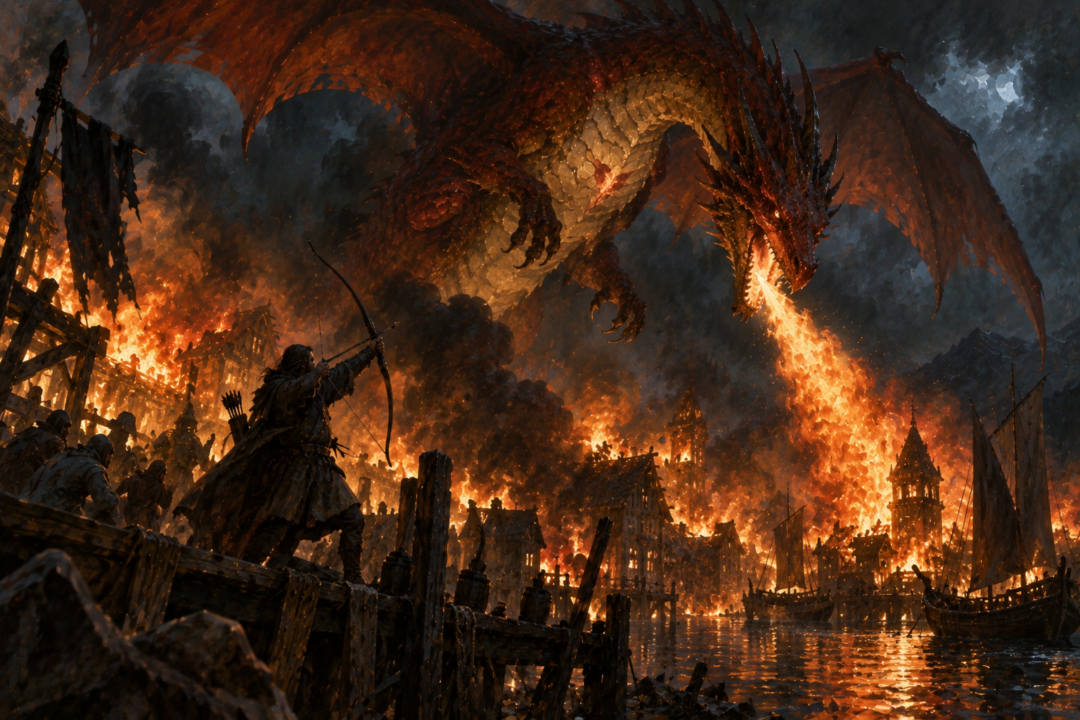
After Bilbo escapes their conversation, Smaug attacks the mountainside and eventually decides to strike Lake-town.
This is where his security calculus becomes catastrophic.
From Smaug’s perspective, destroying Esgaroth can be understood as retaliation against people he believes have assisted his enemies. It also fits the broader logic of terror that has protected his position: punish those connected with challengers so severely that resistance becomes unthinkable.
But leaving Erebor changes the nature of the confrontation.
Inside the Mountain, Smaug controls the environment. His enemies must enter narrow passages and descend toward him.
Outside, Smaug exposes himself.
And during Bilbo’s conversation with the dragon, Bilbo has already observed the unprotected patch on Smaug’s underside. After Bilbo tells the Dwarves what he saw, an old thrush overhears him. Because Bard can understand the bird, that information eventually reaches the one man positioned to use it.
The chain is remarkably delicate:
Bilbo steals the cup.
Smaug realizes his sanctuary has been penetrated.
Bilbo returns.
Smaug questions him.
Bilbo learns the weakness.
Smaug infers Lake-town’s involvement.
Smaug attacks Lake-town.
The thrush tells Bard where to aim.
Bard’s final shot finds the vulnerable place.
The cup does not mechanically cause Smaug’s death. Too many independent choices intervene for such a simple claim.
But it begins the sequence that forces Smaug out of static possession and into active threat response.
Smaug’s Greatest Strength Creates His Blind Spot
There is a final irony in the episode.
Smaug is not foolish.
He notices the theft immediately. He detects Bilbo despite invisibility. He interprets Bilbo’s riddles. He correctly suspects connections between the intruders and Lake-town. He understands manipulation well enough to attempt it himself.
His failure is therefore more interesting than simple stupidity.
Smaug repeatedly interprets uncertainty through the assumptions of overwhelming power.
When something is stolen, he searches violently.
When an intruder returns, he boasts as well as interrogates.
When he suspects outside assistance, he answers with collective destruction.
His responses have worked before because almost nobody can survive them.
Yet Bilbo’s intrusion creates a problem that cannot be solved by strength alone. Smaug needs accurate information more than additional destructive power, and his own pride helps compromise the information contest. By displaying his underside while boasting of his defenses, he allows Bilbo to notice precisely what the dragon should have concealed.
The creature who remembers a single missing cup fails to protect a single missing patch of armor.
A Tiny Theft Breaks the Illusion of Absolute Control
That is why the golden cup matters.
Bilbo has not materially impoverished Smaug. He has done something strategically worse.
He has demonstrated access.
For all his strength, Smaug’s rule over Erebor depends upon more than claws, fire, and armor. It depends upon everyone else accepting that the Mountain is inaccessible and that approaching its master means death.
Bilbo crosses that boundary and comes back.
The first time, he returns carrying a cup.
The second time, he returns carrying information.
And the second prize is infinitely more dangerous.
Smaug responds to the first breach by trying to restore the old equation of fear: find the intruders, punish their helpers, and make resistance impossible again. Instead, his escalation carries him away from the fortress where he has been secure for generations and toward an enemy who now possesses the one piece of information capable of overcoming his armor.
The missing cup is therefore more than a successful burglary.
It is the moment Smaug learns that his fortress has a hole in it.
His tragedy is that, once he learns this, he tries to make the world afraid of him again rather than fully understanding how the breach occurred.
Sources & Notes
- The Encyclopedia of Arda, “Smaug” — https://www.encyclopedia-of-arda.com/s/smaug.html
- The Encyclopedia of Arda, “Your Magnificence” — https://www.encyclopedia-of-arda.com/y/yourmagnificence.html
- The Encyclopedia of Arda, “The Tremendous” — https://www.encyclopedia-of-arda.com/t/tremendous.php
Reference entries document the characters, places, events, and textual details discussed in this article.