Gondolin is remembered as the Hidden City, but its secrecy depended on something more complicated than simply hiding a road.
There really was a road into Tumladen. It could be discovered. It could be followed. People who knew it could even return by it. Yet none of those things meant that a traveller possessed the right to enter Gondolin—or, more ominously, the right to leave again.
That distinction is easy to miss. Gondolin was not merely concealed behind the Encircling Mountains. Turgon's realm operated under a severe security principle: knowledge of the city's location was itself dangerous. The road therefore functioned less like an ordinary mountain pass than a controlled boundary between two worlds.
Aredhel could receive permission to depart because she belonged to Turgon's house. Voronwë could return because the guards knew him. Tuor reached the gates under extraordinary circumstances and with Ulmo's authority behind his mission. Eöl, by contrast, discovered the way without permission—and once he had reached Gondolin, Turgon would not allow him to carry that knowledge back into the outside world.
The hidden road therefore reveals one of Gondolin's central contradictions.
Finding the city was difficult.
Being free after finding it could be harder.
The Road Was Secret, but It Was Not Unguarded
The later and fullest account of Tuor's approach in Unfinished Tales makes clear that Gondolin's entrance was a defensive system, not merely a cleverly concealed trail.
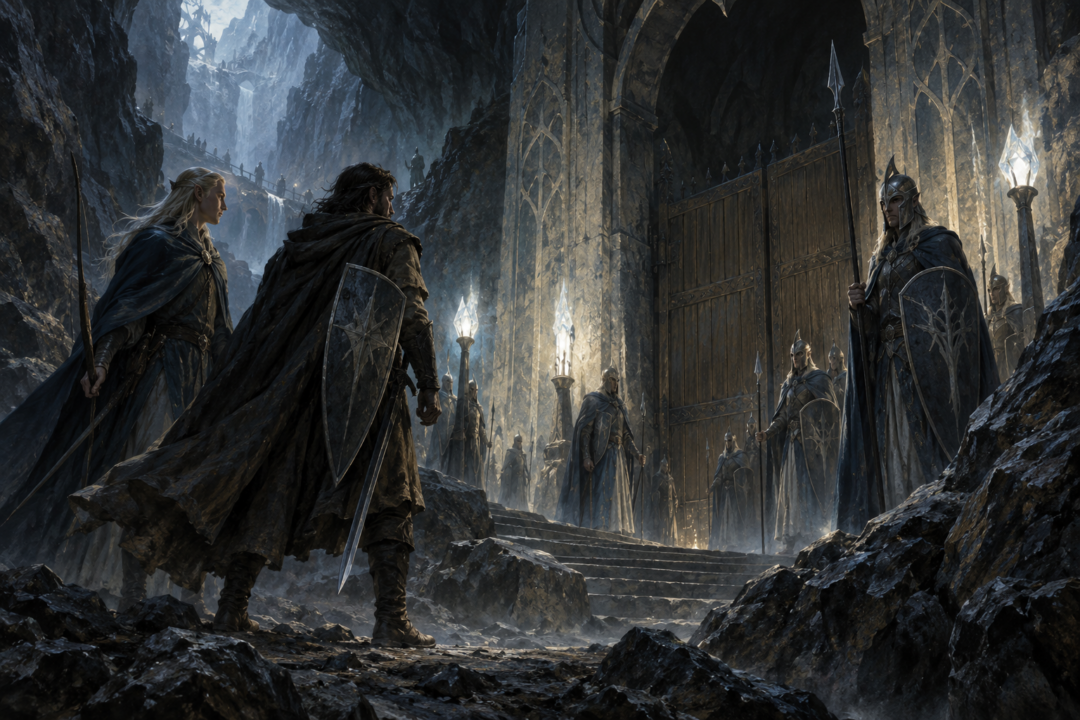
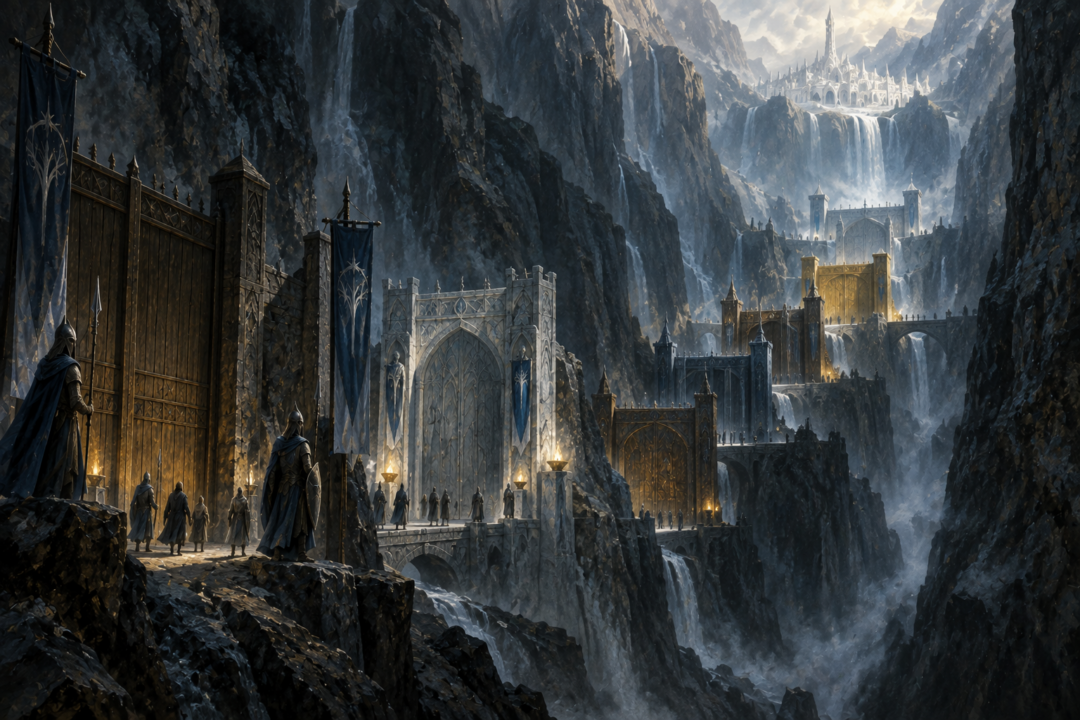
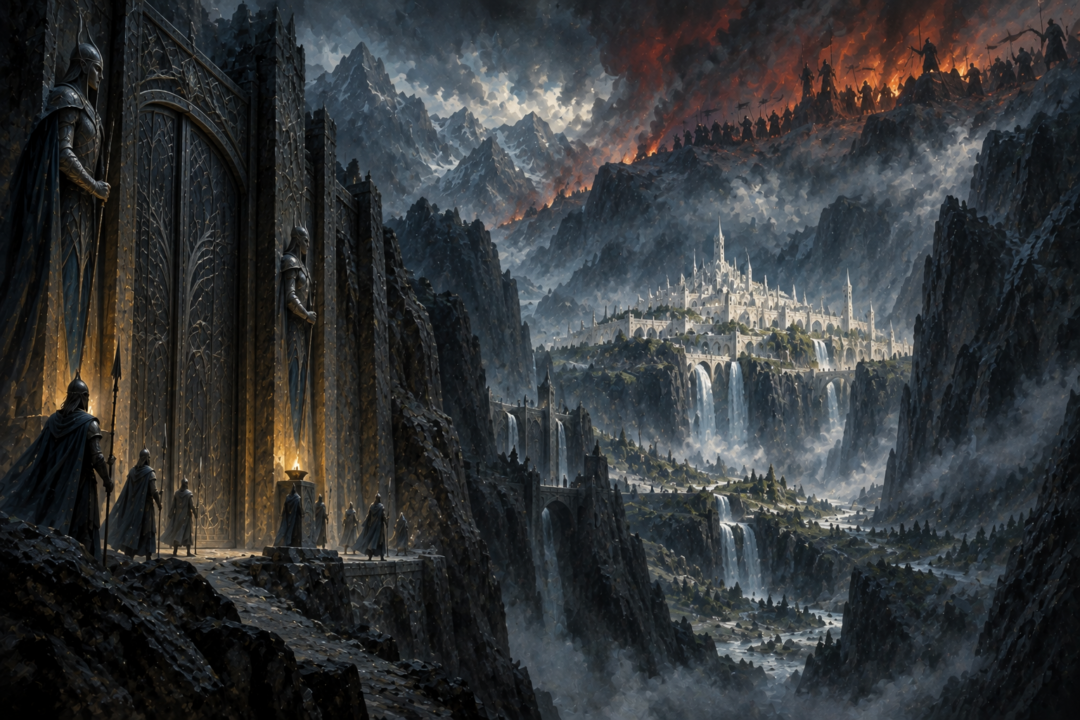
The approach followed the Dry River toward the Encircling Mountains. Beyond the hidden entrance lay the guarded passage into the Orfalch Echor, and Tuor and Voronwë encountered the Outer Guard before they could proceed farther. Beyond them stood the famous sequence of gates leading toward Tumladen.
The surviving account describes gates of different materials—wood, stone, bronze, iron, silver, gold, and finally steel—each making the traveller's progress increasingly controlled.
This changes the meaning of "knowing the way."
A map, memory, or guide might bring someone to the entrance. None of those things neutralized the guards.
When Tuor arrives with Voronwë, the captain Elemmakil does not simply wave them through because Voronwë knows the route. Their appearance creates a crisis precisely because Tuor is an outsider.
Voronwë's presence matters. Tuor's mission matters even more.
The guards still exercise authority over passage.
Gondolin's secrecy therefore had layers: conceal the entrance, restrict knowledge of the route, guard the route itself, and control anyone who nevertheless reached it.
Voronwë Knew the Way—and Still Had to Answer to the Guard
Voronwë provides perhaps the clearest demonstration that familiarity with Gondolin's road did not equal unrestricted access.
He was no stranger trying to penetrate the city. He was one of Turgon's people and had previously departed Gondolin as part of the King's attempt to seek help from the West. After years away, he returned with Tuor.
Yet even Voronwë did not simply walk through the defenses.
At the Outer Guard he was recognized, questioned, and required to explain why he had brought a Man to the secret entrance.
That moment matters because it shows the difference between knowing a secret and possessing authority over it.
Voronwë knows where Gondolin lies. He knows the way. He knows members of its guard.
But the road remains the King's road.
The guardians are not merely there to stop Orcs. Their purpose is to regulate everyone who approaches the city, including Gondolin's own people.
Tuor's arrival makes the problem sharper. According to Elemmakil, the law governing strangers was severe enough that Tuor's presence could have brought death or imprisonment. What prevents the encounter from ending there is the claim that Tuor comes under the command of Ulmo.
That is not ordinary admission.
It is an exceptional case.
Tuor Does Not Enter Because He Solves Gondolin's Secret
This distinction is particularly important because Tuor's journey can superficially resemble the familiar fantasy pattern of a hero discovering a hidden kingdom.
But Tuor does not simply solve a geographical puzzle.
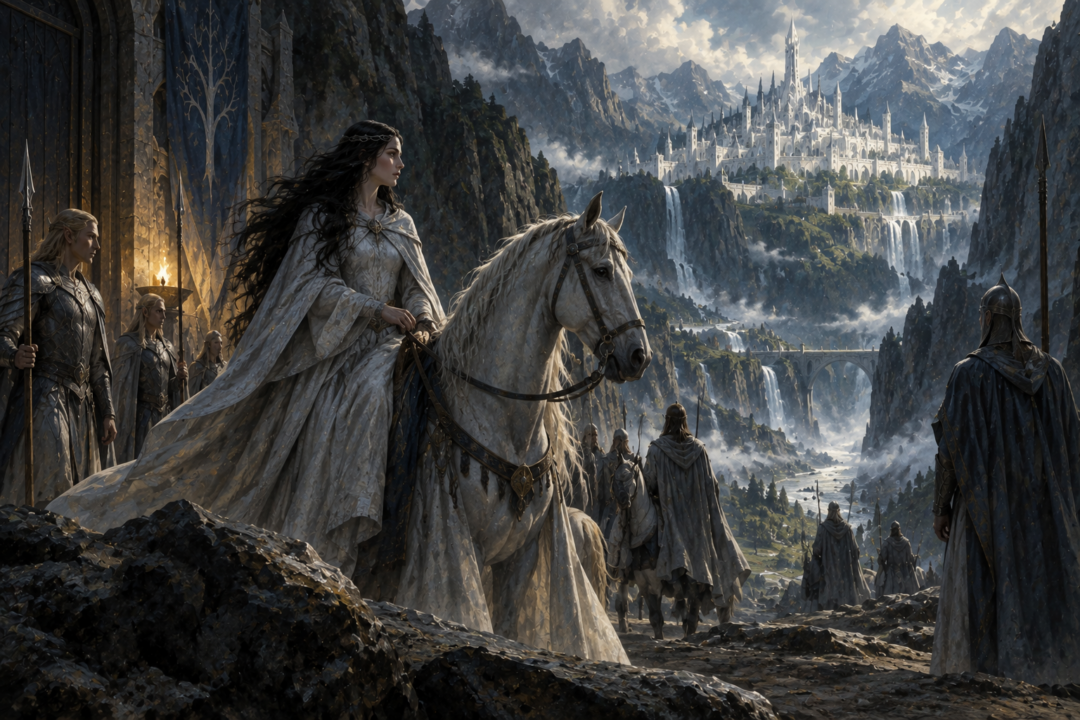
Ulmo has prepared his mission long before Tuor sees Gondolin. At Vinyamar, Tuor finds the arms left there according to Ulmo's design. Ulmo then appears to him and sends him as a messenger to Turgon.
Voronwë becomes his guide.
So when Tuor reaches Gondolin's defenses, his strongest claim is not that he knows where the city is.
His claim is that he has been sent.
Even then, the guards do not immediately surrender their responsibility. Tuor is conducted inward through a chain of guarded positions until he eventually comes before Turgon.
The entire sequence reinforces the same principle: geographical knowledge is not sovereign authority.
Knowing the road gets Tuor to the guards.
It does not abolish them.
Aredhel Shows That Departure Was Controlled Too
The same principle operated in the opposite direction.
Years before Tuor's coming, Aredhel, Turgon's sister, became weary of remaining within Gondolin and wished to depart.
Turgon was reluctant to allow it.
Eventually he yielded, but her departure was not treated as the casual movement of a citizen across an open border. She went with companions and under restrictions concerning where she should travel.
Aredhel's story proves something important: Gondolin was not merely difficult for outsiders to enter. Movement outward could also be subject to the King's authority.
That makes sense within the logic of the hidden realm.
Every person who departed potentially carried Gondolin's greatest military secret—the knowledge that the city existed and, perhaps, enough knowledge to threaten its concealment.
The city was safe partly because information about it did not freely circulate.
Yet Aredhel also reveals the cost of such security. Turgon loves his sister, but his responsibility as king pulls against her desire for freedom. Gondolin's protection depends upon restrictions that become increasingly uncomfortable when applied not to enemies, but to family.
The hidden city's walls protect its inhabitants.
They can also confine them.
Eöl Discovers the Difference Between Entry and Freedom
Eöl's arrival exposes that contradiction in its harshest form.
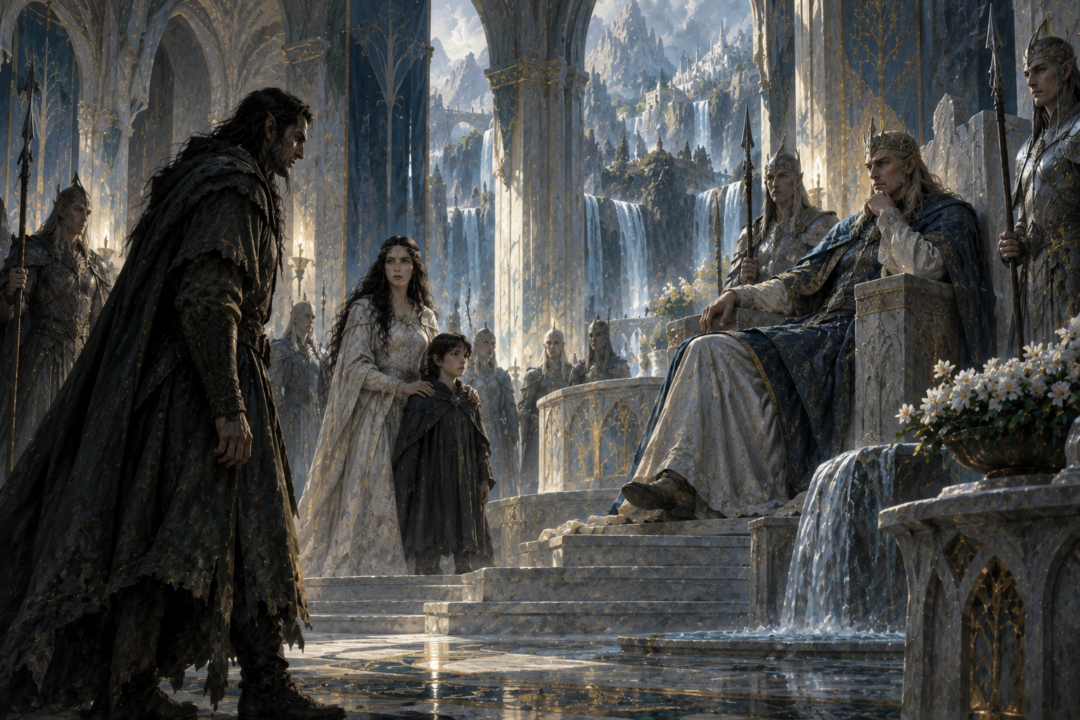
After Aredhel eventually left Nan Elmoth with their son Maeglin and returned to Gondolin, Eöl followed them. By following their trail, he discovered the secret way and reached the hidden realm.
His success did not give him freedom of movement.
Once Eöl had entered Gondolin and its secret was known to him, Turgon would not permit him to depart.
The choice presented to Eöl was terrible: remain in Gondolin or die.
The episode should not be simplified into a general rule that every accidental visitor was automatically executed. The texts give us particular cases rather than a complete constitutional code for Gondolin. But Eöl's case makes the underlying security logic unmistakable.
The dangerous thing was no longer Eöl's ability to find the entrance.
He had already done that.
The danger was what would happen if he left.
If a person who knew Gondolin's location could freely return to Beleriand, the city's concealment could no longer be guaranteed. Turgon's decision therefore treats knowledge almost like an irreversible crossing of a boundary.
Once Eöl knows, the old freedom to come and go cannot simply be restored.
The Seven Gates Were About Authority as Much as Strength
The famous Seven Gates are usually imagined as military fortifications, and rightly so.
But their narrative function is more interesting than their materials.
A traveller passing toward Gondolin moves through repeated stages of controlled access. Guards, captains, gates, passwords or recognition, and ultimately royal authority stand between the outer world and the city.
The road itself therefore does not grant entry.
Permission does.
This helps explain why Gondolin survived hidden for so long despite not being literally unreachable. The Encircling Mountains provided extraordinary natural protection, but mountains alone were not the whole system. Secrecy was maintained socially and politically as well as geographically.
Messengers could leave.
Armies could leave.
Individuals could sometimes receive permission to leave.
But knowledge of the road remained restricted, and the route was guarded.
Gondolin's defense was therefore partly an information-security system long before its walls ever faced Morgoth's armies.
The Tragedy Is That the System Worked—Until the Threat Bypassed It
There is a cruel irony in all this.
Gondolin's guards were correct that knowledge of the city's location was dangerous.
The eventual destruction of Gondolin would prove that fear justified.
But the final betrayal did not occur because an unknown wanderer slipped through the gates and escaped again.
It came through Maeglin.
Captured outside Gondolin by Orcs and brought to Angband, Maeglin revealed the city's location to Morgoth. The exact details differ across Tolkien's developing versions of the story, so they should not be forced into a single overly precise reconstruction. The essential point remains: the secrecy upon which Gondolin depended was finally broken from within its own circle of knowledge.
And Morgoth's assault did not need to conquer the guarded road in the manner the defenses had been designed to resist.
Once the Enemy knew where Gondolin stood, concealment itself had failed.
That is the deeper weakness of the system.
The Seven Gates could control a traveller.
They could not make dangerous knowledge cease to exist.
Gondolin's Greatest Defense Was Also a Kind of Trap
That is why the hidden road is more interesting than a secret entrance on a map.
It exposes the price of Gondolin's survival.
Turgon's city endured for centuries while kingdoms elsewhere in Beleriand were discovered, besieged, and destroyed. Its secrecy preserved beauty, strength, and a remnant of the Eldar while Morgoth's power expanded.
But maintaining that secrecy demanded control.
Who could enter?
Who could leave?
Who could know?
Who could be trusted with knowledge once they possessed it?
Aredhel's departure, Eöl's judgment, Voronwë's return, and Tuor's arrival all touch different parts of that problem.
None suggests that merely memorizing the road gave someone a permanent pass through Gondolin's defenses.
The road could be known.
The entrance could be found.
The gates could be reached.
But freedom of movement remained subject to authority, recognition, purpose, and the terrible burden created by the city's secret.
That may be the most revealing thing about Gondolin's famous hidden way.
The secret was never simply where the road went.
The secret was important enough that reaching its end could change what you were permitted to do ever afterward.
Sources & Notes
- The Encyclopedia of Arda, “Seven Gates of Gondolin” — maps and describes the guarded sequence of gates across the Orfalch Echor, including Tuor’s passage and Turgon’s later closure of the way. https://www.encyclopedia-of-arda.com/s/sevengates.html
- The Encyclopedia of Arda, “Hidden Way” — explains the concealed Dry River tunnel, its guarded terminus at the Dark Gate, and Turgon’s order to seal the route after the Nirnaeth. https://www.encyclopedia-of-arda.com/h/hiddenway.html
- The Encyclopedia of Arda, “Elemmakil” — identifies the captain of the Outer Guard and recounts his interception of Tuor and Voronwë before guiding them through Gondolin’s gates. https://www.encyclopedia-of-arda.com/e/elemmakil.html
- The Encyclopedia of Arda, “Eöl” — recounts Eöl’s discovery of the Dry River route and the law forbidding one who found Gondolin from leaving on pain of death. https://www.encyclopedia-of-arda.com/e/eol.html
- The Encyclopedia of Arda, “Aredhel Ar-Feiniel” — covers Aredhel’s permitted departure, her return with Maeglin, and the application of Turgon’s no-departure law to Eöl. https://www.encyclopedia-of-arda.com/a/aredhel.html
Sources document Gondolin’s layered gate defenses, the guarded reception of Tuor and Voronwë, Aredhel’s authorized movement, and the law that prevented Eöl from departing after discovering the city.