How Morgoth Opens the Bragollach with Fire to Break the Land Before His Armies Advance
The most frightening weapon Morgoth unleashes at the beginning of the Dagor Bragollach is not an Orc-host, a Balrog, or even Glaurung.
It is the land itself being destroyed.
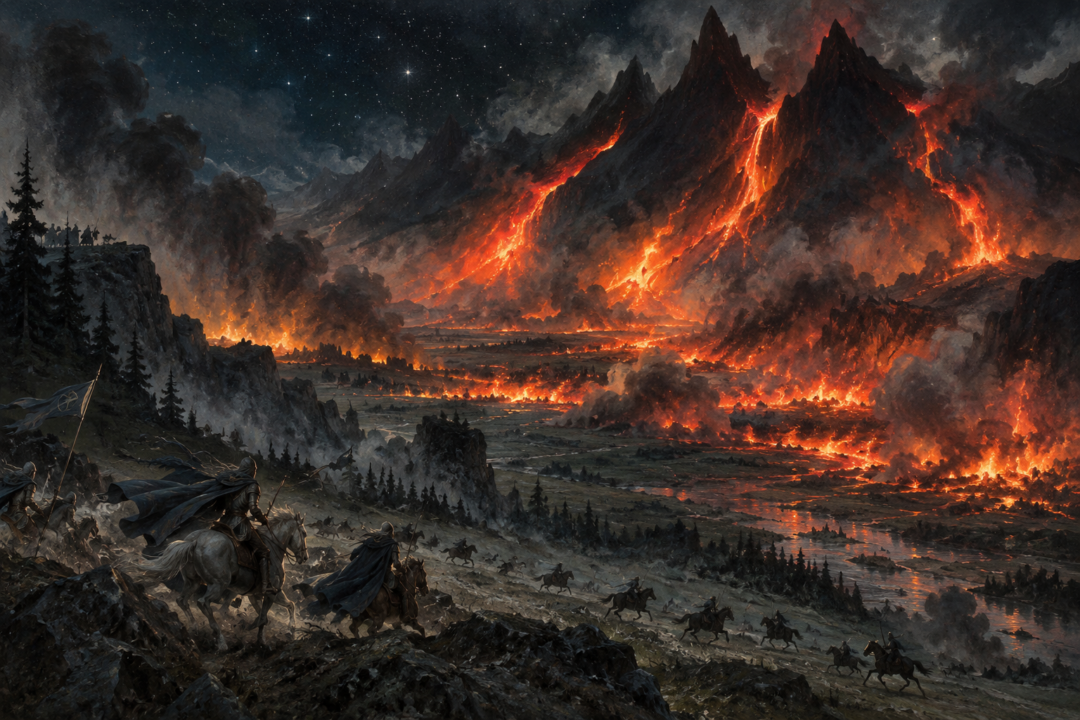
For centuries, the Noldor had maintained the Siege of Angband. Between their northern strongholds and Morgoth's fortress stretched Ard-galen, the broad green plain beneath Thangorodrim. Then, in the winter of the year 455 of the First Age, that familiar landscape abruptly ceased to protect the people who watched Angband.
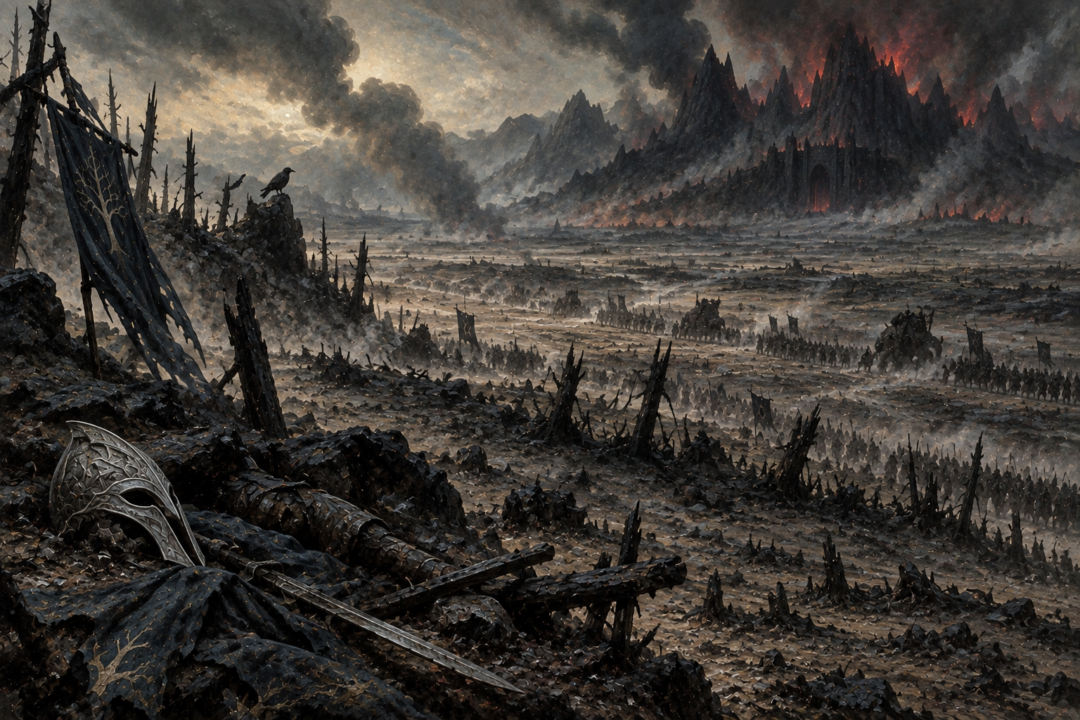
Morgoth sent great rivers of flame from Thangorodrim across Ard-galen. The Iron Mountains poured out fires and poisonous fumes. Grass burned. Smoke confused the defenders. Elves caught upon the plain died before they could reach the surrounding heights.
Only after this devastation does the narrative describe the full advance of Morgoth's forces, with Glaurung at their forefront and Balrogs and Orcs following.
That sequence matters.
The texts never present Morgoth giving a modern military order to "prepare the battlefield with fire." Nor do they explain the exact physical mechanism by which the torrents were produced. But the account of the Dagor Bragollach clearly shows fire and poisonous fumes devastating the battlefield immediately as Morgoth's great offensive begins. His enemies are forced to confront catastrophe before they can properly confront his armies.
The Siege Had Turned Geography into a Defensive System
The Siege of Angband was never a literal wall surrounding Morgoth.
After the Dagor Aglareb, the Noldor maintained a long watch over the approaches from the north. Their realms and fortifications formed a broad containment system around Angband: Fingolfin and Fingon held the west; Angrod and Aegnor watched from Dorthonion; the sons of Fëanor guarded the eastern approaches.
Ard-galen lay between much of this defensive arc and Thangorodrim.
That geography mattered because armies needed space through which to move. A great host emerging from Angband could be seen, opposed, pursued, or attacked while crossing open country. Earlier in the First Age, the forces of Morgoth had repeatedly suffered disastrous defeats when the Noldor were able to respond effectively in the field.
By the time of the Bragollach, however, the Siege had endured for roughly four centuries. Morgoth had been preparing his strength in secret.
The long containment of Angband had created its own danger: familiarity.
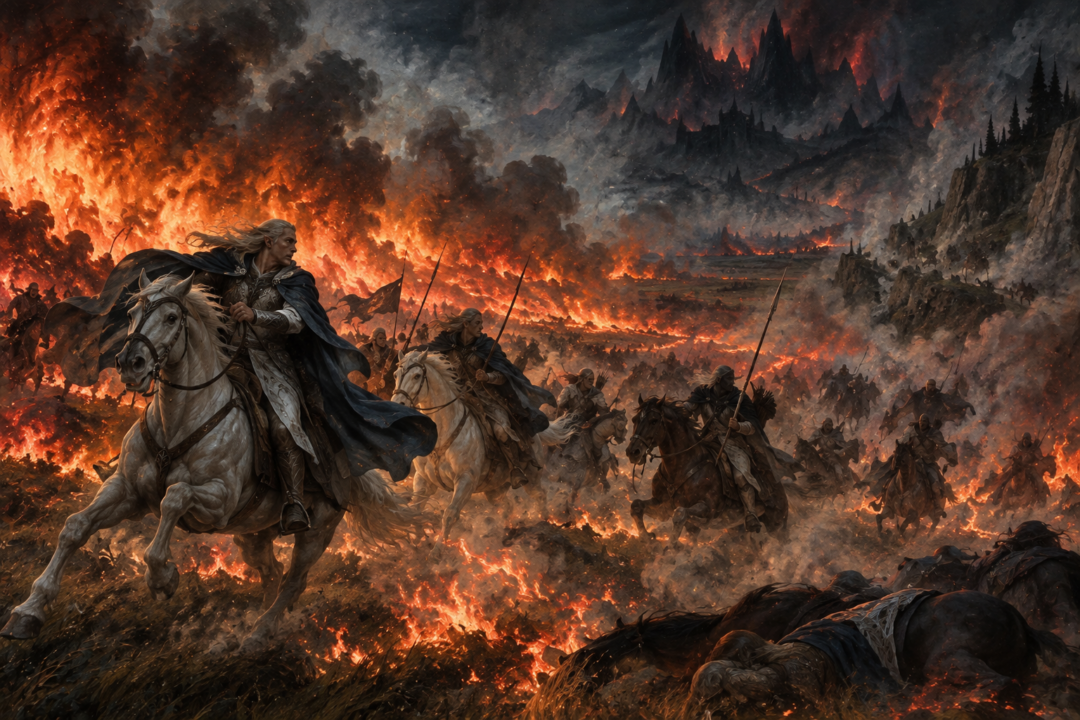
On the winter night when the attack came, the plain lay beneath cold stars, the watch-fires were low, and few guards were awake among the horsemen stationed there. The opening attack therefore struck not merely against soldiers but against the assumptions upon which the northern watch depended.
The enemy did not begin by marching conventionally across Ard-galen.
He transformed Ard-galen.
Fire Comes Before the Main Host
The opening of the Dagor Bragollach is unusually explicit about sequence.
First come the rivers of flame from Thangorodrim and the eruptions of deadly fumes from the Iron Mountains.
Ard-galen burns.
Many of the Noldor caught upon the plain cannot escape to higher ground. Dorthonion and Ered Wethrin stop the torrents themselves, but the woods on their northern slopes ignite, while smoke spreads confusion among the defenders.
Then the armies of Angband advance.
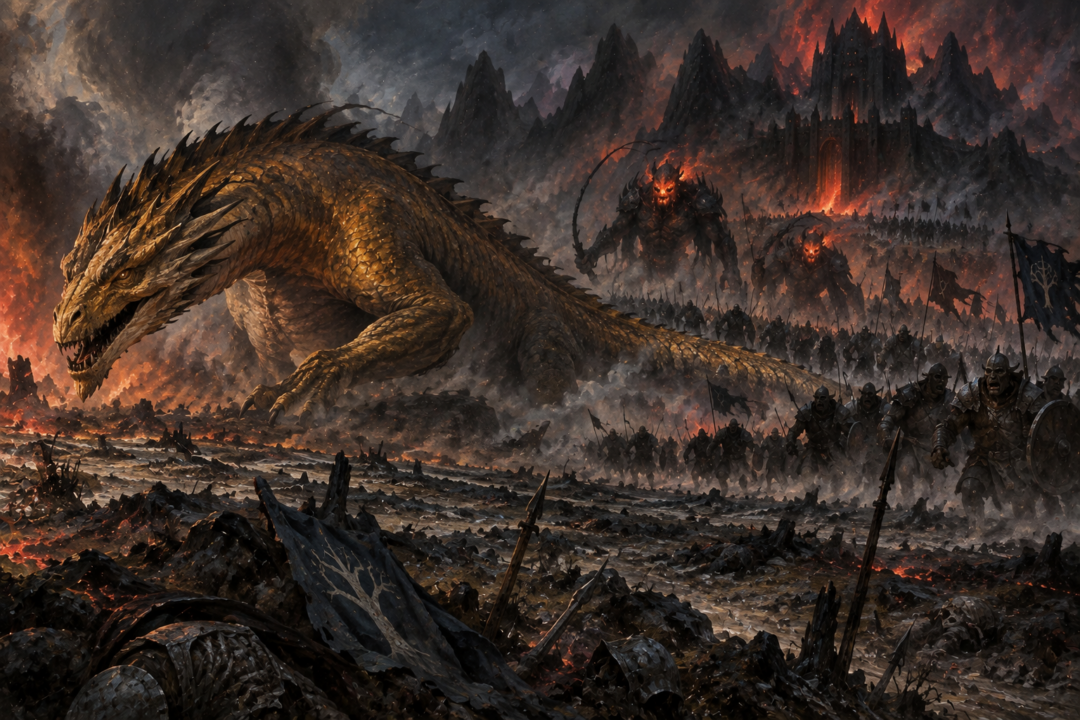
At their front is Glaurung, now grown to his full strength. Behind him come Balrogs, and behind them the hosts of Orcs.
It would go beyond the text to claim that every movement had been calculated according to a detailed doctrine of terrain preparation. But the tactical effect described in the narrative is unmistakable. Morgoth's enemies face fire, fumes, smoke, death, and disorientation at the very moment his great host comes against them.
The defenders are not receiving the assault from the same battlefield they occupied the previous day.
Their battlefield has already been ruined.
Ard-galen Becomes Anfauglith
The destruction is so complete that the plain receives another name.
Ard-galen, the green region, becomes Anfauglith, the Gasping Dust.
This is more than a dramatic change of scenery. The new name records a permanent consequence of the offensive. Grassland becomes a burned, barren waste covered in choking dust, and the dead remain upon it.
Morgoth's hatred repeatedly expresses itself through corruption and defilement, not simply conquest. Immediately before the account of the Bragollach, the narrative emphasizes that he wished not only to defeat his enemies but also to destroy and defile the lands they had made fair.
Ard-galen becomes the clearest possible expression of that desire.
He does not merely cross the territory separating Angband from the Elven realms.
He annihilates what it was.
That destruction also creates a terrible psychological reversal. For centuries the plain beneath Angband had represented the space across which Morgoth was contained. After the Bragollach, the same ground becomes physical evidence that the containment has failed.
The geography remembers the victory.
The Mountains Stop the Fire — but Not the Offensive
One revealing detail prevents the opening attack from being misunderstood as an unstoppable supernatural wave consuming everything in its path.
The heights of Dorthonion and Ered Wethrin hold back the fiery torrents.
Terrain still matters.
But stopping the flames is not the same as stopping Morgoth.
The northern slopes burn. Smoke confuses the defenders. Then his armies press outward against positions that had survived the initial catastrophe.
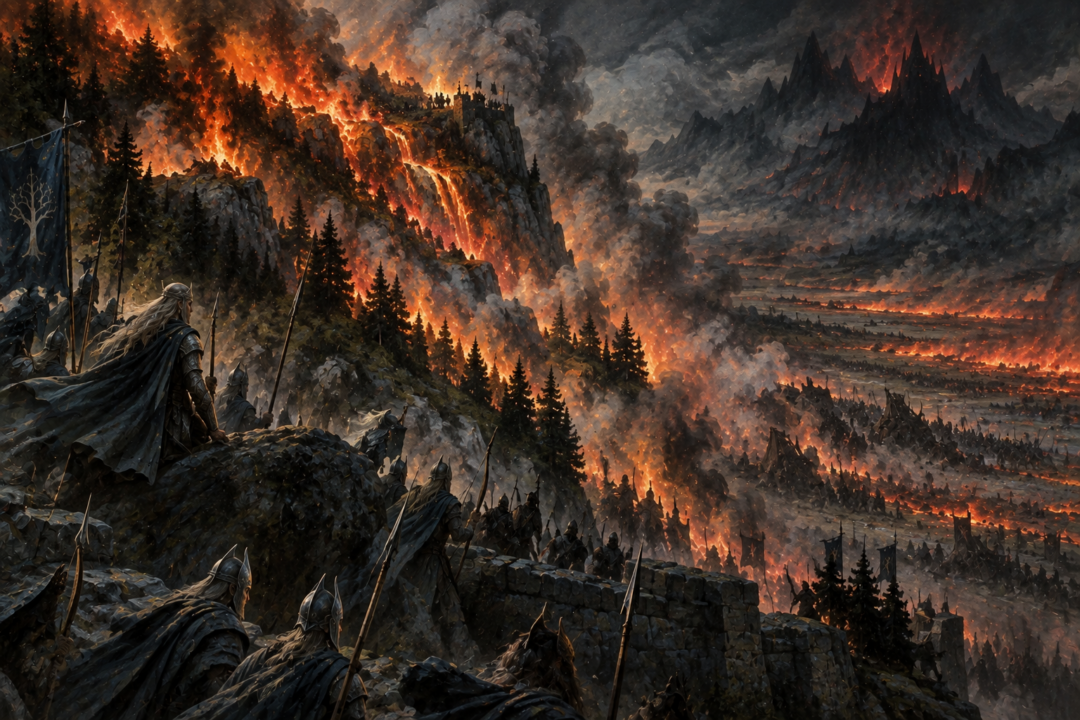
Dorthonion suffers terribly. Angrod and Aegnor are slain, along with many of their people. Much of the highland eventually falls under Morgoth's power, although resistance continues there under Barahir and his companions for a time.
In the east, the assault also tears open the defensive system. Maglor's Gap is forced, and Caranthir is driven from his lands around Mount Rerir. The sons of Fëanor are scattered from several of their former positions.
Yet Morgoth does not take everything.
Maedhros holds Himring. Hithlum withstands the main assault, and Morgoth's forces cannot simply sweep through every fortified position.
The Bragollach is therefore not best understood as a magical firestorm that automatically wins the war. Its significance lies in how effectively the opening devastation disrupts the defensive order before and during a massive conventional assault.
Glaurung Is the Second Terror
The placement of Glaurung at the front of Morgoth's advancing power deepens the pattern.
Glaurung had appeared before.
Roughly two centuries earlier, he emerged from Angband before he had reached his full growth. Fingon confronted him with mounted archers, whose speed and missiles drove the young dragon back.
Morgoth had revealed him too soon.
At the Bragollach, that mistake is not repeated.
Glaurung now comes forth in his full might, and the circumstances are entirely different. The open green plain has been burned. Defenders have already been killed or disordered. Smoke and poisonous fumes have accompanied the catastrophe.
Then the dragon advances.
It is difficult to miss the contrast. Earlier, mounted warriors could exploit open terrain against the immature dragon. At the Bragollach, the narrative specifically tells us that horsemen upon Ard-galen are among those surprised by the opening disaster.
The text does not explicitly say Morgoth burned the plain specifically to neutralize cavalry, so that should not be asserted as his stated intention. Yet the contrast shows how radically the conditions of battle have changed.
Glaurung is no longer entering an intact defensive landscape.
He advances through one Morgoth has just devastated.
Morgoth's Victory Also Reveals His Weakness
There is a dark irony at the heart of the Bragollach.
Morgoth wins one of his greatest victories because he has prepared for a very long time.
Yet the account also says that he attacks too soon.
His hatred has grown so intense that it overcomes his counsel. Had he waited longer, the narrative suggests, his designs might have become so complete that the Noldor would have been utterly destroyed.
He also underestimates his enemies.
He reckons too lightly the courage of the Elves and does not yet properly account for Men.
That miscalculation matters almost immediately. Finrod Felagund becomes surrounded near the Fen of Serech, but Barahir comes to his aid with his warriors. They form a defensive ring around Finrod and enable him to escape, though at heavy cost.
From that act comes the friendship and oath between Finrod and the House of Barahir, whose consequences eventually reach the Quest for the Silmaril.
Even at the moment when Morgoth's plan seems overwhelming, courage produces consequences he has not foreseen.
The Bragollach Breaks More Than an Army
The deepest achievement of the Dagor Bragollach is not the number of enemies Morgoth kills.
It is the destruction of the political and military arrangement that had kept him contained.
The Siege of Angband is broken. Dorthonion is overrun. Eastern defenses are breached. The sons of Fëanor lose important territories. The northern realms can no longer maintain the old continuous pressure around Angband.
The consequences continue after the initial battle. Two years later Sauron captures Minas Tirith on Tol Sirion, turning control of that strategic passage against Morgoth's enemies.
Beleriand has entered a different phase of the war.
That is why the opening fire is so important. The flames do not merely provide spectacle before the "real" battle begins.
They are part of the battle's decisive transformation.
Morgoth begins by making the old battlefield impossible.
Why the Sudden Flame Is So Terrifying
The Dagor Bragollach reveals something fundamental about Morgoth's kind of warfare.
He does not need to preserve the world he conquers.
That gives him a terrible freedom.
The Noldor defend realms, forests, roads, fortresses, horses, settlements, and peoples. Their military geography is also their home. Morgoth can treat that same geography as material to be poisoned, burned, and ruined.
The opening of the Bragollach turns this difference into strategy.
A winter night becomes an inferno. A green plain becomes choking dust. Forested slopes become smoke. Survivors who escape the first catastrophe discover that Glaurung, Balrogs, and Orc-hosts are still coming.
The texts never tell us precisely how Morgoth created those immense rivers of fire, and there is no need to invent an explanation.
What they tell us is worse enough.
After centuries of siege, Morgoth did not simply send another army against the line surrounding Angband.
He changed the ground beneath that army's enemies.
And when the defenders looked through the smoke, the armies of Angband were already advancing.
Sources & Notes
- Tolkien Gateway, “Dagor Bragollach” — https://tolkiengateway.net/wiki/Dagor_Bragollach
- Tolkien Gateway, “Ard-galen” — https://tolkiengateway.net/wiki/Ard-galen
- Tolkien Gateway, “Glaurung” — https://tolkiengateway.net/wiki/Glaurung
These secondary reference entries identify the relevant Tolkien texts and document the characters, events, and objects discussed. Explanations of motives and practical consequences remain interpretation unless explicitly stated in the cited texts.