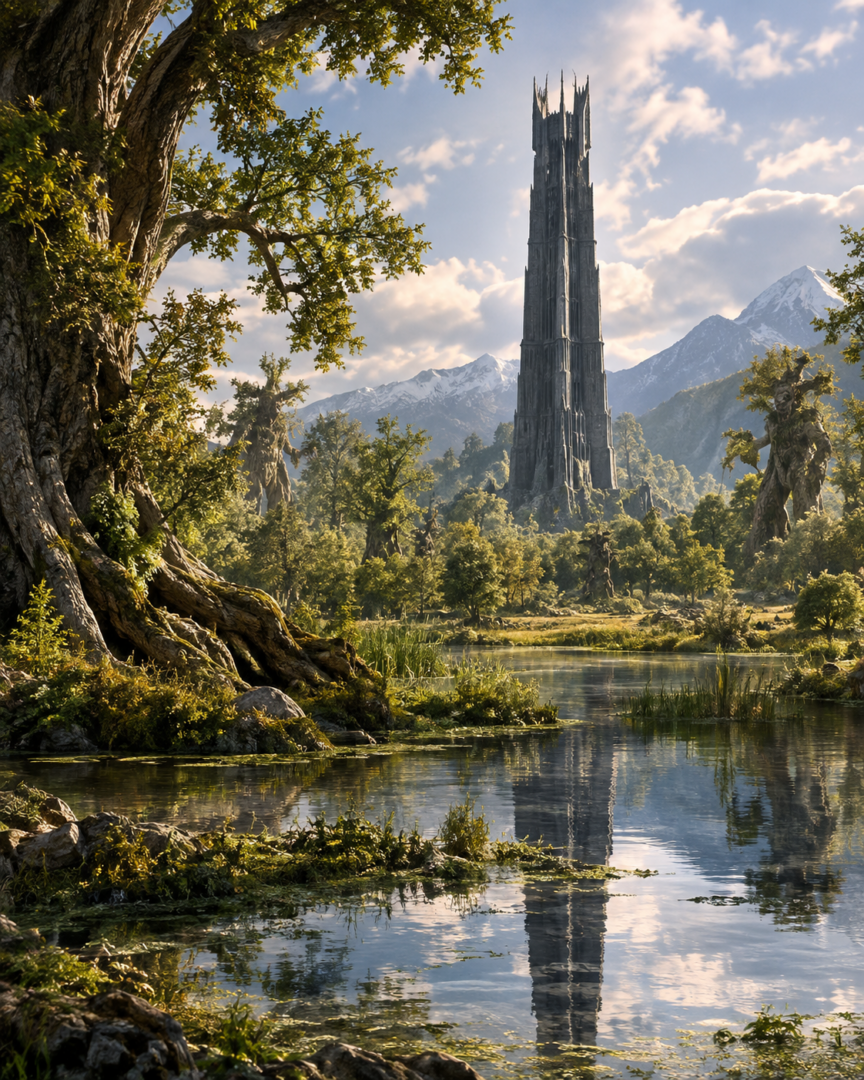
At the end of the War of the Ring, one of Middle-earth’s strangest transfers of power took place beneath the black tower of Orthanc.
Saruman was gone. The Ring of Isengard had been broken. Trees stood where furnaces, pits, roads, and workshops had scarred the earth. Yet Orthanc itself remained almost untouched: an ancient tower so strong that even the Ents had been unable to tear it down.
Then King Elessar came north.
What happened next was not simply the redistribution of Saruman’s defeated territory. The settlement preserved two very different claims at once. Orthanc, an ancient work of Gondor, returned to the authority of its restored King. But the surrounding valley was entrusted to Treebeard and the Ents, who had destroyed Saruman’s industrial stronghold and begun healing the land.
It was a remarkably fitting end for Isengard: the tower went back to the kingdom that had built it, while the earth around it passed into the keeping of the beings who had saved it.
Orthanc Had Never Truly Been Saruman’s
Saruman ruled Isengard for centuries, but that long occupation can obscure an important fact: Orthanc was not originally his fortress.
The tower and the fortified Ring of Isengard were works of the Númenórean realm of Gondor. Orthanc stood at the northern edge of Gondor’s old territory, guarding the approaches near the Gap of Rohan. One of the palantíri was also kept there, making the tower part of the network of seeing-stones established by the Dúnedain.
As Gondor declined and its population withdrew from Calenardhon, Orthanc became increasingly remote. When Steward Cirion gave Calenardhon to Eorl and his people after the Battle of the Field of Celebrant, the territory became Rohan—but Isengard was specifically retained by Gondor.
That distinction matters.
Rohan surrounded Isengard, but Orthanc remained a Gondorian stronghold. Its keys were kept by the Stewards.
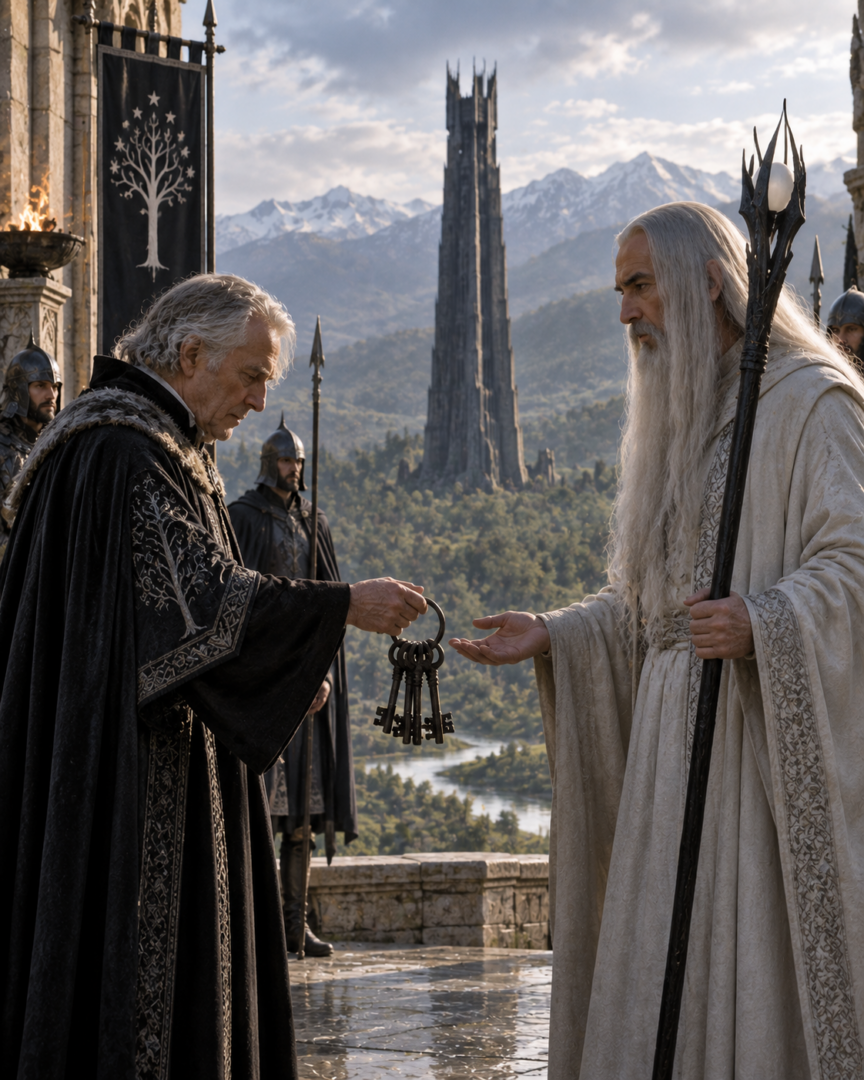
Only centuries later, after Isengard had fallen into troubled circumstances and the Dunlendings who occupied it had been driven out, did Saruman enter the story. In Third Age 2759, Steward Beren gave him the keys of Orthanc.
Saruman therefore received an ancient Gondorian fortress from Gondor’s ruling Steward. He did not build it, conquer it from Gondor, or inherit it as an independent kingdom.
For a long time, that arrangement seemed advantageous. A powerful member of the Istari occupied a strategically important fortress on Rohan’s western border.
But Saruman gradually transformed stewardship into domination.
The Fortress Became the Opposite of What It Had Been
By the War of the Ring, Isengard had ceased to resemble a remote Gondorian stronghold.
Saruman had filled its circle with workshops, machinery, underground chambers, furnaces, Orcs, and armed Men. Trees had been cut down. The once-green interior was converted into the infrastructure of war.
That destruction created his fatal conflict with Fangorn.
The Ents were not marching to restore Gondor’s property rights. Their grievance was more ancient and elemental. Saruman had been destroying trees, including trees from the borders of Fangorn, and Treebeard finally recognized him as an enemy.
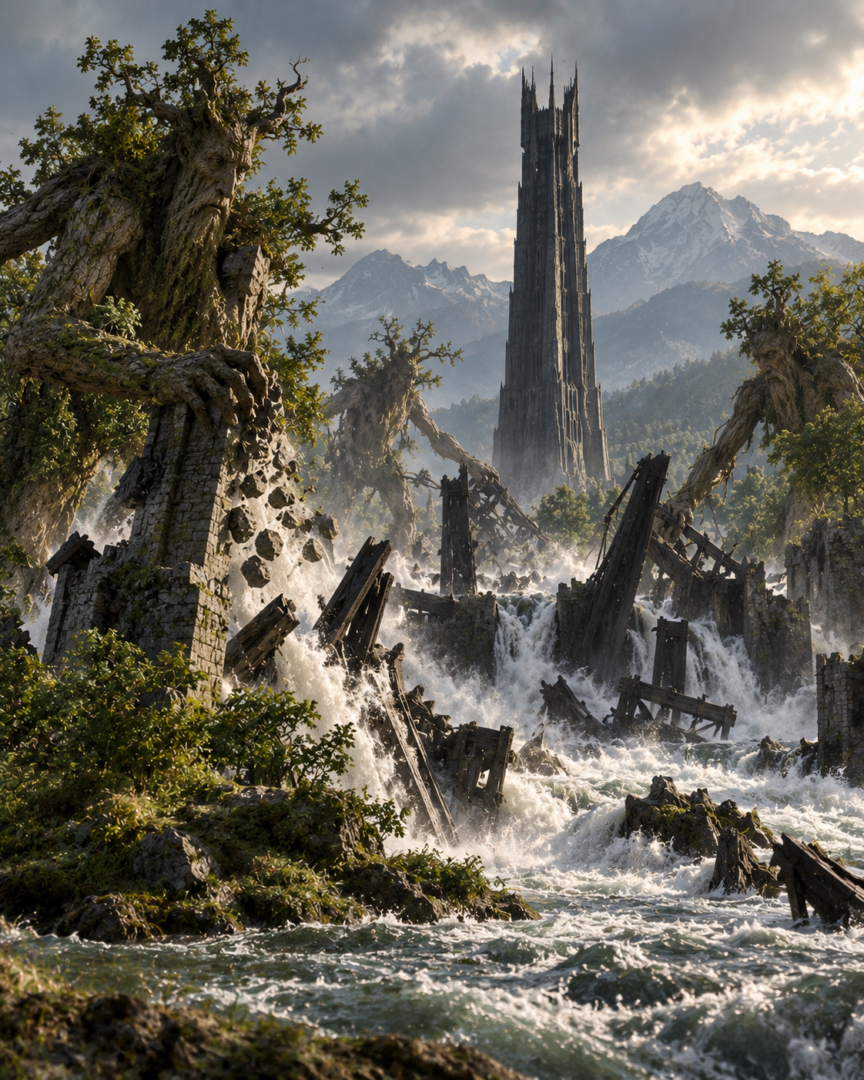
When the Ents marched on Isengard, Saruman’s great defensive Ring proved almost useless against attackers capable of tearing stone apart.
Walls and gates fell.
Orthanc did not.
The tower had been fashioned with such extraordinary skill that the Ents could damage neither its stone nor its doors by brute force. Saruman retreated inside, while the Ents redirected water through Isengard and flooded the devastated circle around him.
The irony was severe. Saruman had turned an ancient stronghold into a machine for dominating the natural world. In the end, the machine was destroyed by the very forces he had treated as expendable.
Only Orthanc—the oldest Gondorian element of the fortress—survived.
Treebeard Did Not Become Lord of Orthanc
After Saruman’s defeat, Gandalf left him confined in Orthanc under Treebeard’s watch.
But Treebeard was not naturally suited to keeping prisoners indefinitely.
By the time the returning companions passed through Isengard after the fall of Sauron, Treebeard had allowed Saruman and Gríma Wormtongue to depart. Saruman had surrendered the keys after locking Orthanc behind him.
This produced an unusual situation.
The Ents physically controlled Isengard. They had defeated its master, destroyed its military infrastructure, and transformed its surroundings. But Treebeard did not claim Orthanc as his personal possession.
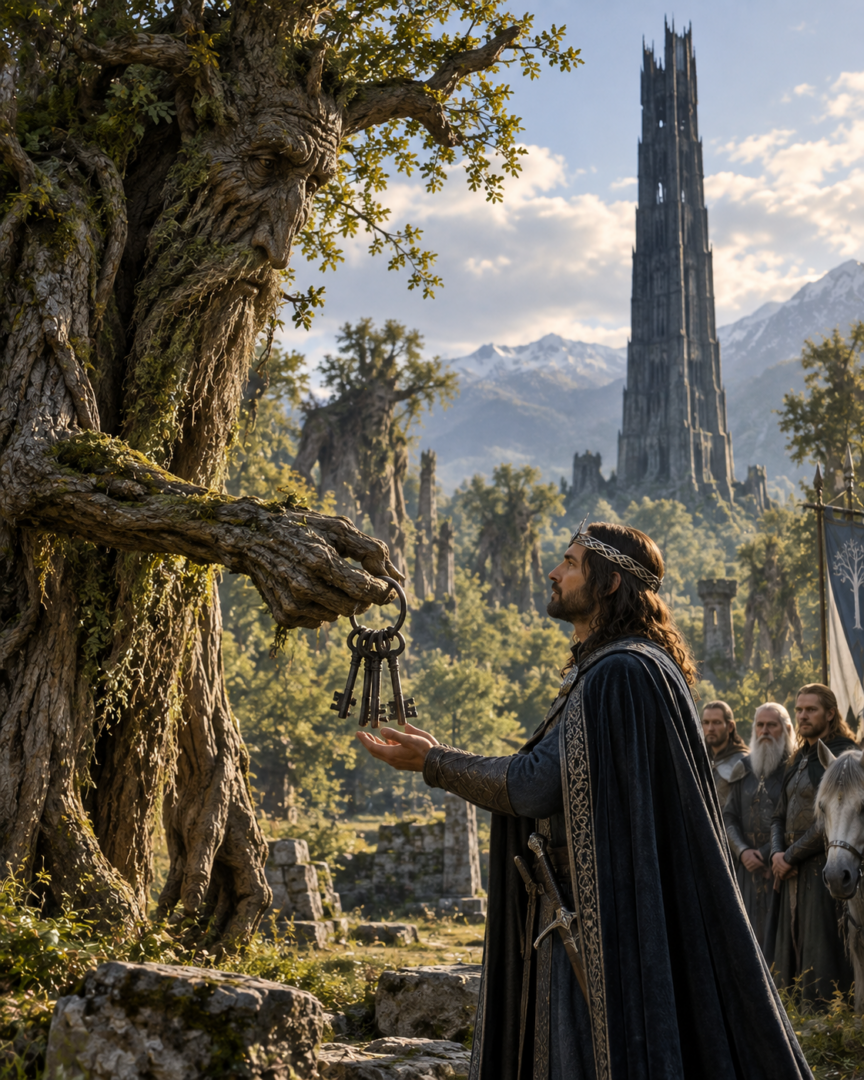
Instead, when Elessar arrived, the keys passed to the King.
That act closed a historical circle.
The keys had once belonged to the rulers of Gondor. A Steward had entrusted them to Saruman. Saruman had eventually surrendered them after his defeat. Treebeard held them temporarily. Now they passed to Aragorn, who had been crowned King Elessar and had restored the kingship of the Dúnedain realms.
Orthanc had effectively come home.
But Elessar Did Not Simply Rebuild Isengard
A conquering king might have restored the entire fortress.
Elessar did something more interesting.
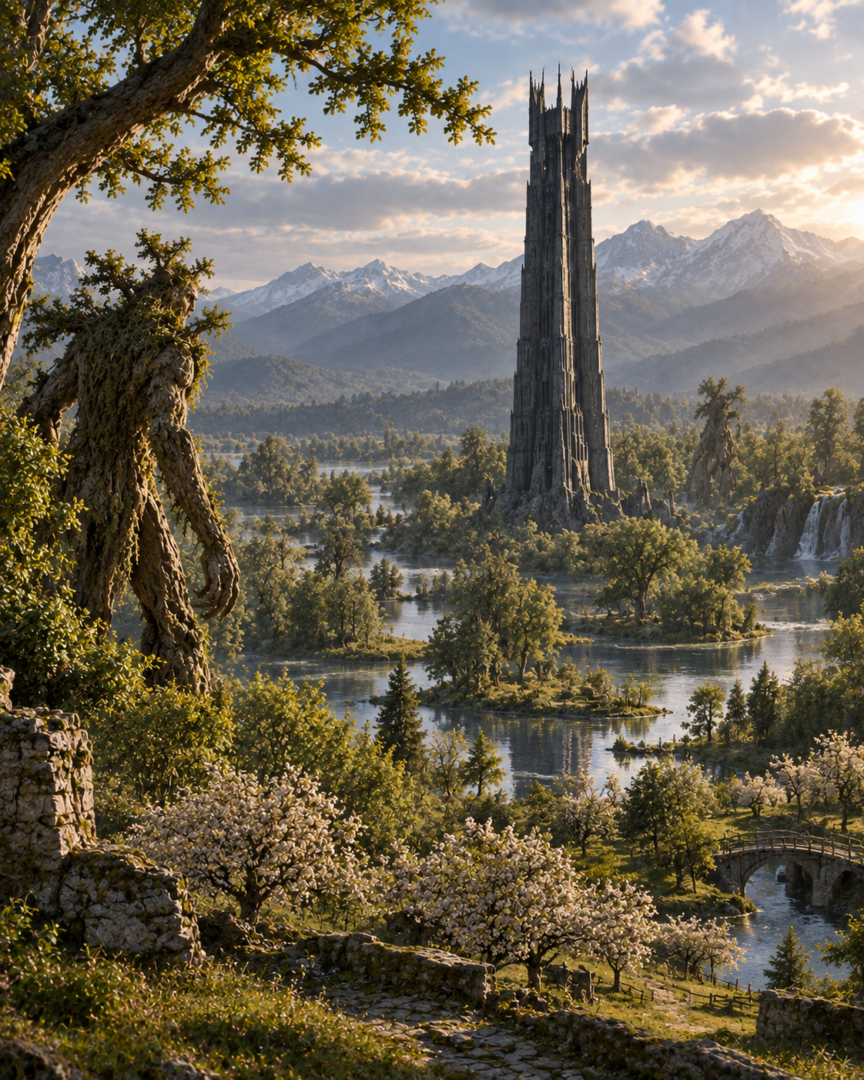
The Ents had already begun changing the devastated Ring into something entirely different. Saruman’s old works were disappearing beneath water, greenery, orchards, and trees. The former fortress became known as the Treegarth of Orthanc.
The king recognized that transformation rather than reversing it.
In “Many Partings,” Treebeard receives authority over the valley from Elessar. The exact political terminology should not be stretched beyond what the texts provide, but the meaning is clear: the Ents were to possess and govern the valley, while Orthanc itself remained under the King’s authority.
So Isengard was effectively divided according to what each part represented.
The tower belonged to the history of Gondor.
The renewed land belonged in the keeping of the Ents.
It was not merely a reward for military service. It also prevented the restoration of Saruman’s old model of Isengard.
The fortress would never again be what he had made it.
The Ents Turned a War Machine Into a Garden
The physical transformation was dramatic.
When Aragorn, Gandalf, the hobbits, and their companions returned north, they did not find the industrial wasteland they had seen months earlier.
The Ring had been broken down. Trees and orchards filled the enclosure. Water flowed through the renewed landscape, and Orthanc stood isolated amid the greenery.
The name “Treegarth of Orthanc” captured the reversal.
Saruman had stripped away living things to create an ordered military-industrial domain. The Ents imposed another kind of order: growth, water, trees, and cultivated living space.
This should not be mistaken for simple wilderness reclaiming civilization. Treebeard and the Ents were themselves gardeners and shepherds in their own ancient fashion. What replaced Saruman’s Isengard was not neglect but stewardship of a completely different kind.
Orthanc therefore became almost a monument inside the land Saruman had failed to master.
The black tower remained.
Everything around it changed.
Why Orthanc Still Mattered to Gondor
Elessar’s recovery of Orthanc was more than symbolic.
The tower was connected to the history of the Dúnedain, and the Orthanc-stone belonged to the royal system of palantíri. During the War, that stone had become one of the instruments through which Saruman was ensnared in his dangerous relationship with Sauron.
After the war, the palantír was to be returned to Orthanc.
Unfinished Tales also preserves an important later tradition concerning the search of the tower. Among Saruman’s hidden possessions were objects connected with Isildur, including the Elendilmir that had been lost when Isildur was slain at the Disaster of the Gladden Fields, as well as the small golden case associated with his keeping of the Ring.
These discoveries gave Orthanc an even darker historical significance.
Saruman had not merely occupied a Gondorian tower. He had spent years searching the history of the Ring and the fate of Isildur.
Under Elessar, the tower could finally be reclaimed from that secrecy.
Yet the King did not need to reclaim the entire valley in the same fashion.
The Settlement Revealed Elessar’s Kind of Kingship
The arrangement at Isengard fits a wider pattern in Elessar’s rule.
Restoration did not always mean turning Middle-earth back into what it had once been.
The old kingdom could be renewed without erasing everything that had changed during its decline.
Orthanc returned to royal authority because its history and function belonged to Gondor. But the Ents had acquired a genuine place in Nan Curunír through sacrifice, victory, and restoration. Elessar acknowledged that reality.
The result was neither Saruman’s centralized domination nor a simple reconstruction of the old Gondorian fortress.
It was a settlement between different forms of stewardship.
Men guarded the ancient tower.
Ents guarded the living valley.
And neither needed to possess everything.
Saruman Lost Exactly What He Tried to Control
There is a final irony in the fate of Isengard.
Saruman sought power through possession, machinery, secrecy, and control. He took a fortress entrusted to him and increasingly treated it as the center of his own independent power. He cut down trees, bred armies, fortified the valley, and attempted to bend both Rohan and the wider war to his designs.
At the end, he possessed none of it.
The military Ring was destroyed.
The pits and machinery vanished.
The trees returned.
The keys of Orthanc passed back into the hands of the King.
And the valley became the Treegarth of the Ents.
Orthanc survived because Saruman had not made it. The living land recovered because Saruman had never truly mastered it.
That may be the most fitting image of Isengard after the War of the Ring: an indestructible black tower of the ancient Dúnedain rising from a landscape that no longer belonged to a wizard’s machinery, surrounded instead by water and trees.
Gondor recovered its inheritance.
The Ents received a place to heal.
And Saruman’s kingdom disappeared between them.
Sources & Notes
- The Encyclopedia of Arda, “Orthanc” — https://www.encyclopedia-of-arda.com/o/orthanc.php
- The Encyclopedia of Arda, “Isengard” — https://www.encyclopedia-of-arda.com/i/isengard.php
- The Encyclopedia of Arda, “Treegarth of Orthanc” — https://www.encyclopedia-of-arda.com/t/treegarthoforthanc.php
- The Encyclopedia of Arda, “Ents” — https://www.encyclopedia-of-arda.com/e/ents.php
These reference entries document Orthanc’s Gondorian origin, Isengard’s history, the Ents’ role, and the postwar Treegarth. Interpretive conclusions in the article remain the author’s.