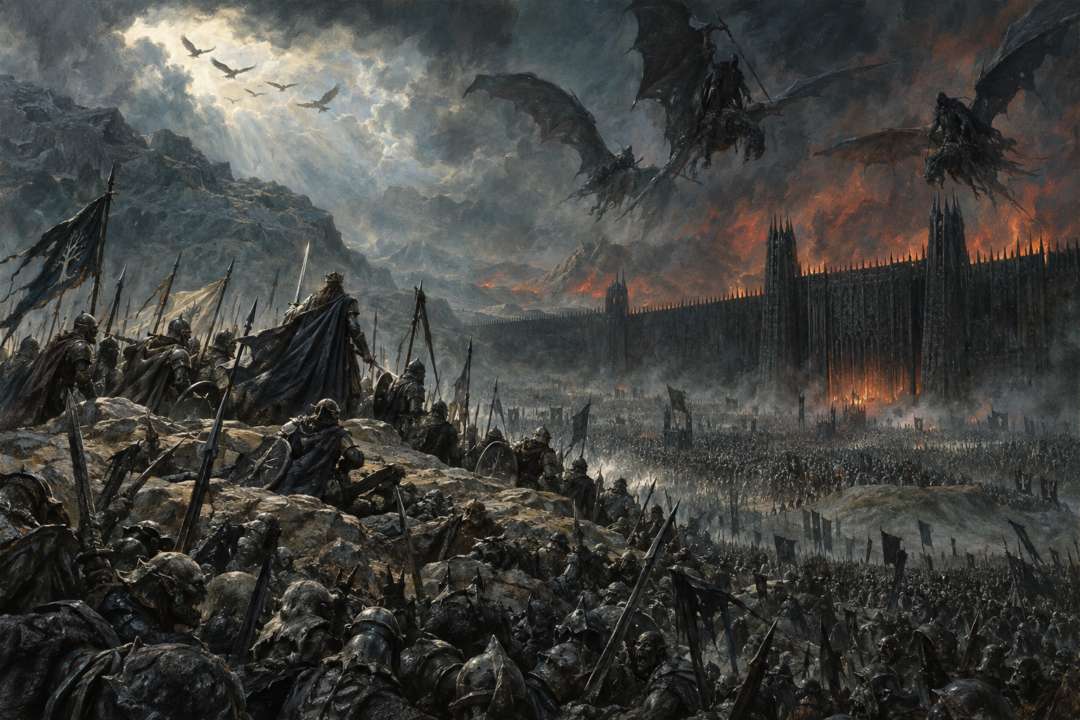
At the Black Gate of Mordor, the armies of the West are not waiting for rescue. They are waiting to die.
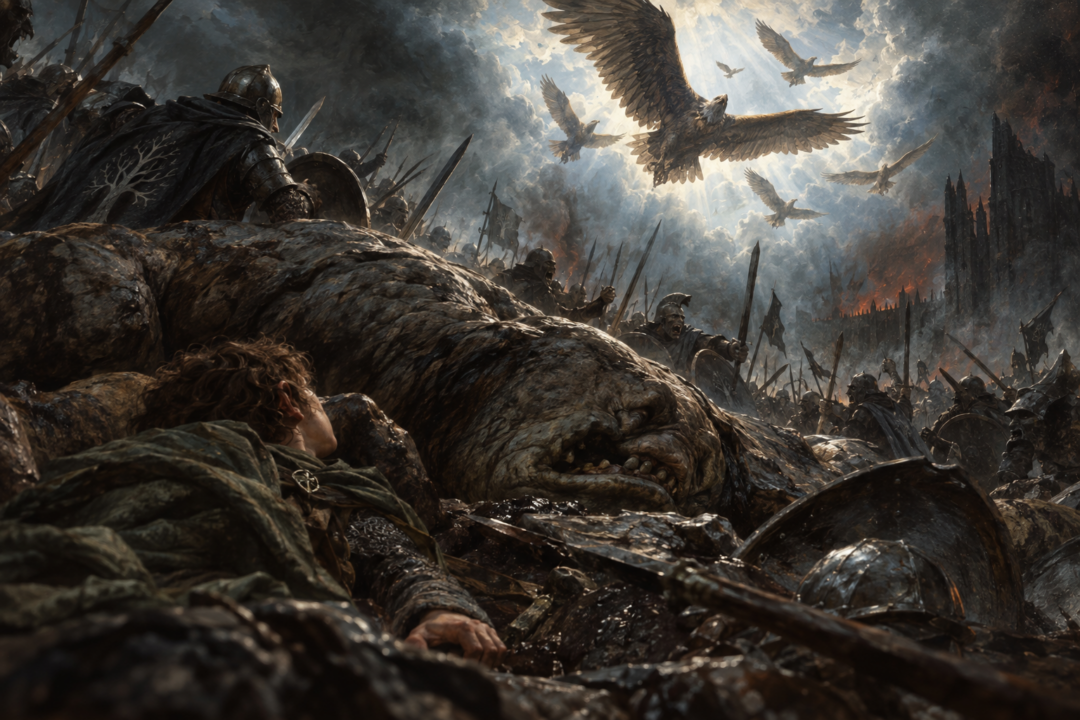
Aragorn has brought only a fraction of the strength that Sauron can command. The Black Gate opens, Mordor’s forces pour out, and the Men of the West are surrounded. Trolls smash into their lines. The Nazgûl circle overhead. Pippin, trapped beneath a fallen troll, begins to lose consciousness.
Then he hears a cry that belongs to another story: the Eagles are coming.
It is tempting to read their arrival as a last-minute reinforcement—the final reserve appearing just in time to reverse a losing battle. But that misses what is actually happening at the Morannon.
The Eagles do not arrive because the West has finally assembled enough military strength to defeat Sauron. They arrive at the exact moment when military strength has ceased to matter.
The Battle of the Morannon was designed to be unwinnable. Its real purpose was elsewhere.
Aragorn Never Expected to Win at the Black Gate
After the victory at the Pelennor Fields, the Captains of the West face a brutal strategic reality.
Minas Tirith has survived, but Sauron has not spent anything close to his full strength. Mordor still contains enormous reserves. Waiting for another attack will eventually favor the Enemy.
Gandalf therefore argues for a move that looks almost suicidal: march directly toward the Black Gate.
The force that ultimately approaches the Morannon numbers about seven thousand when it begins the march, and it becomes smaller before reaching the Gate. Against the forces Sauron can deploy, it is hopelessly inadequate for conquering Mordor.
That is intentional.
In “The Last Debate,” Gandalf explains the central logic. Sauron believes his enemies may possess the One Ring. Because Sauron himself would use such power to dominate, he is inclined to imagine that his opponents will do the same. The Captains can exploit that expectation.
Aragorn has already challenged Sauron through the palantír and revealed himself as Isildur’s heir. Now he advances openly upon Mordor.
To Sauron, this can look like arrogance born from new power.
The West is not trying to defeat Mordor by force. It is trying to make Sauron look in the wrong direction.
The Army Is Bait
Frodo and Sam are inside Mordor.
Almost nobody at the Black Gate knows whether they are alive, whether they have reached Mount Doom, or whether the Ring has already been captured. The Captains cannot coordinate with them. They cannot send instructions. They cannot even know whether their sacrifice will achieve anything.
All they can do is create an opportunity.
By marching openly against Mordor, Aragorn and Gandalf encourage Sauron to concentrate his attention and military strength at the Morannon.
The strategy works.
When Frodo and Sam cross the plain of Gorgoroth, they find that troops are being hurried northward. Sauron is responding to the threat outside his Gate.
This is the overlooked strategic achievement of the final battle: the Captains make themselves so visible that two Hobbits become easier to overlook.
Every soldier standing before the Morannon is therefore doing something larger than fighting the enemy immediately in front of him.
He is buying Frodo time.
Why “Lost on Paper” Is Exactly the Point
By conventional military calculation, the battle is catastrophic.
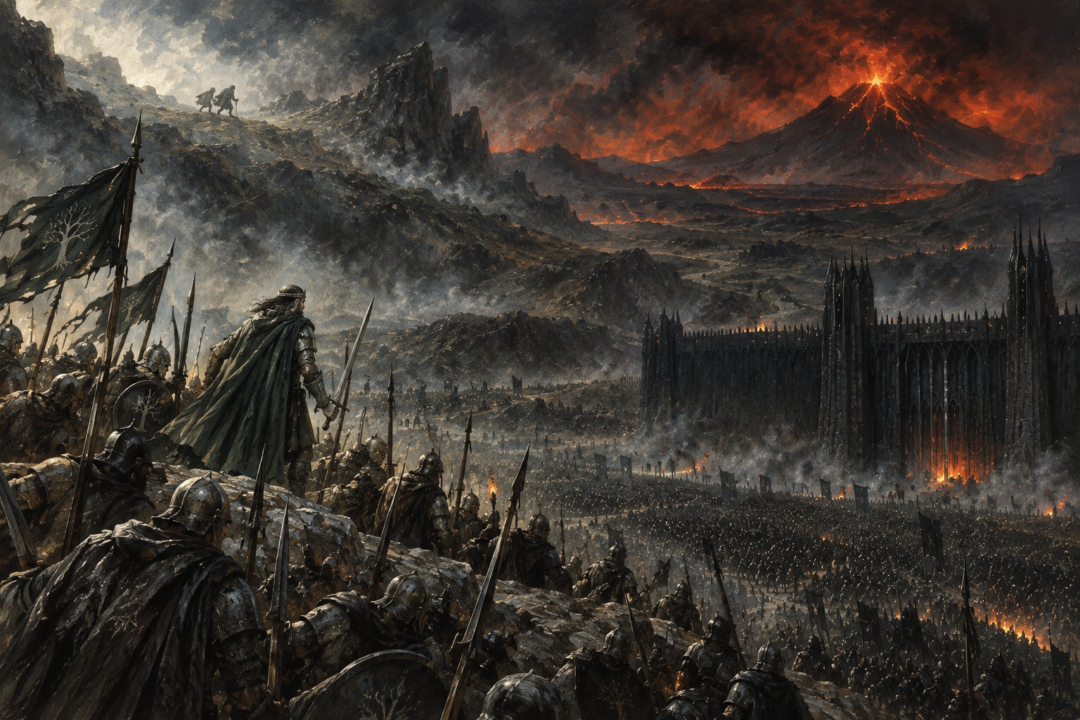
The Host of the West occupies defensive positions on two hills before the Gate, but Sauron’s armies vastly outnumber it. Forces emerge not only from the Morannon but close around the western army.
The Captains have voluntarily entered a trap.
There is no hidden Gondorian host coming behind them. No army of Rohan large enough to restore the balance is waiting beyond the horizon. The West has already committed what it can afford to this desperate move while still leaving some defence behind.
The battle therefore exposes one of the central truths of the War of the Ring: Sauron cannot ultimately be defeated by matching his strength.
That contest has already been lost.
The Free Peoples cannot build a larger army than Mordor. They cannot safely use the Ring as a shortcut to overwhelming power. Their only real hope depends on destroying the foundation of Sauron’s power rather than defeating every soldier who serves him.
That is why the apparent hopelessness of the Morannon is not a flaw in the plan.
It is the plan reaching its logical conclusion.
Then the Eagles Appear
Near the end of “The Black Gate Opens,” Pippin kills a great troll that is attacking Beregond. The troll collapses upon him, and Pippin believes he is dying.
As his senses fade, he hears voices crying that the Eagles are coming.
His mind immediately connects the moment with Bilbo’s story of the Battle of Five Armies.
The parallel is deliberate within Pippin’s experience: once again, Eagles appear over a battlefield at the moment of extreme danger.
But their arrival does not instantly solve the larger strategic problem.
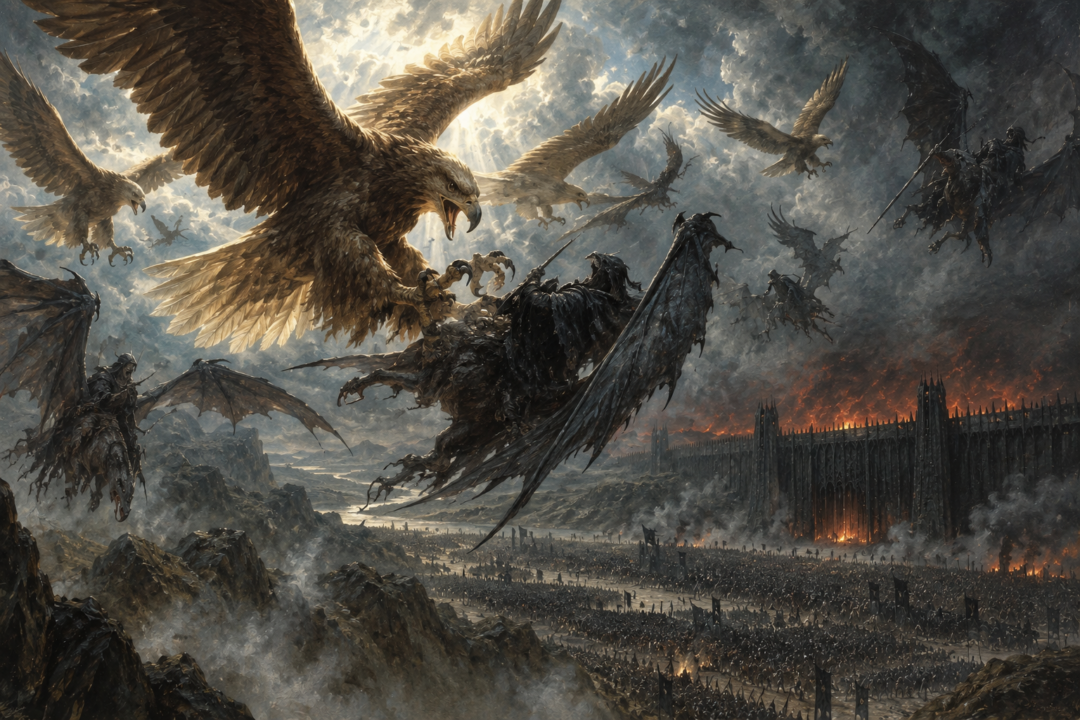
In “The Field of Cormallen,” the Eagles are described coming out of the north, led by Gwaihir the Windlord, with Landroval and other Eagles. They descend against the Nazgûl and their winged steeds.
This is important.
The Eagles provide a powerful answer to Sauron’s airborne terror. But Tolkien does not present them as an army capable of simply destroying the countless forces surrounding Aragorn.
Even after they arrive, the fundamental imbalance on the ground remains.
If nothing else changes, the West is still facing destruction.
And then something else changes.
The Real Turning Point Happens at Mount Doom
While the battle rages at the Morannon, Frodo reaches the Crack of Doom.
There, at the end of the Quest, he does not voluntarily destroy the Ring. He claims it.
That failure matters enormously. The Quest is not completed by Frodo simply overpowering the Ring’s final temptation.
Gollum attacks him, takes the Ring, and falls into the fire with it.
Only then is Sauron’s power broken.
The effects at the Morannon are immediate.
Sauron suddenly understands what has happened. His attention turns toward Mount Doom. The Nazgûl race away, summoned toward the Mountain, but they are too late.
Barad-dûr falls. The foundations of Sauron’s power collapse. His armies lose the dominating will that held them together.
This is the actual reversal of the battle.
Not the arrival of a larger army.
Not Aragorn winning a duel.
Not the Eagles killing enough enemies.
A small object disappears into fire many miles away, and an apparently invincible military system collapses with it.
So Why Do the Eagles Come So Late?
The text does not give a logistical timetable explaining precisely when the Eagles learned of the march or why they could not have appeared earlier. Any claim that they deliberately waited until a predetermined dramatic moment would go beyond what is stated.
What the text does establish is their role.
Gwaihir leads the Eagles from the north to aid the Captains, and they engage the winged Nazgûl. Their intervention belongs to the same pattern seen elsewhere in Middle-earth: the Eagles can bring extraordinary aid at crucial moments, but they do not replace the choices, endurance, and sacrifices of the central characters.
This distinction matters because the Great Eagles are not presented as a standing military transport service under the command of Gondor or Gandalf. They are independent, intelligent beings associated in the wider legendarium with Manwë, and their interventions are exceptional.
At the Morannon, their arrival strengthens a resistance that is already at the edge of destruction.
It does not remove the need for Frodo’s Quest.
In fact, the sequence proves exactly the opposite.
Even with the Eagles overhead, the West still needs the Ring destroyed.
The Nazgûl Reveal the Eagles’ Immediate Purpose
The clearest tactical function of the Eagles at Morannon is their opposition to the Nazgûl.
Sauron’s Ringwraiths are no longer merely riders on black horses. They now operate from terrifying winged creatures and can strike from the air.
Against ordinary soldiers, that is a devastating advantage.
The Eagles contest that advantage.
Yet before their aerial struggle can fully develop, the Ring is destroyed and Sauron summons the Nazgûl toward Orodruin. They race south and perish in the catastrophe surrounding the Mountain.
So the Eagles do not need to win a prolonged aerial war.
The destruction of the Ring ends it.
Once again, battlefield action and the Ring Quest intersect—but the Quest remains decisive.
Their Most Important Mission Comes After Victory
After Sauron falls, Gandalf does something revealing.
He does not send the Eagles to hunt fleeing Orcs.
He goes with Gwaihir into Mordor.
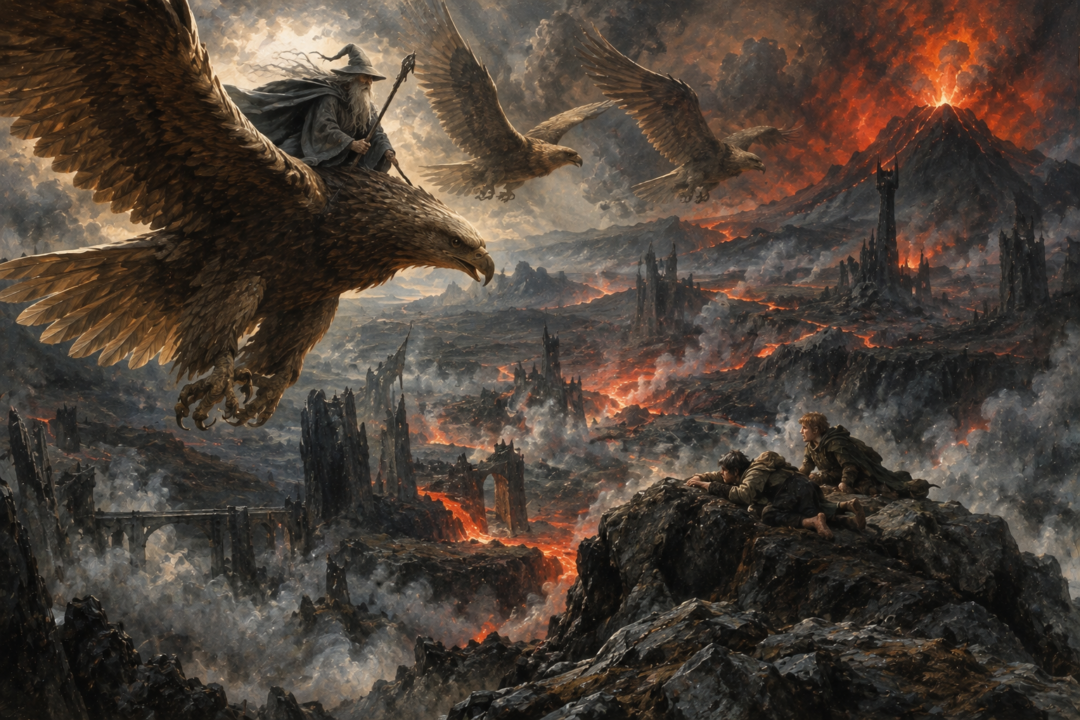
Gwaihir, Landroval, and Meneldor fly toward Mount Doom, where Frodo and Sam are stranded amid the destruction. The Hobbits have accomplished the Quest, but they have no realistic means of escaping the catastrophe around Orodruin.
Here the Eagles can do what no army could.
They can cross the ruined land rapidly, find the Ring-bearers, and carry them away.
Their role shifts from battlefield intervention to rescue.
And that rescue comes only after Frodo and Sam have gone as far as they possibly can.
The Eagles do not carry them past the dangers that make the Quest meaningful. They carry them home from a place they could never have escaped after completing it.
The Morannon Is a Battle Won Somewhere Else
That is the deeper reason the timing feels so powerful.
When the Eagles appear, the visible war still looks hopeless.
Aragorn’s army is surrounded. Pippin is beneath a troll. Mordor’s forces remain overwhelming.
Then, almost immediately on the larger narrative scale, the hidden struggle determines everything.
The Ring is destroyed.
Sauron falls.
His armies break.
Only afterward can the surviving warriors fully understand that the desperate march to the Black Gate succeeded.
They did not conquer Mordor.
They made Sauron believe they were trying to.
That distinction is the heart of the strategy.
The Eagles arrive when the battle appears lost because the battle was never supposed to be won by ordinary arithmetic. Their presence gives the West aid against the Nazgûl and becomes part of the sudden reversal, but they are not the cause of Sauron’s defeat.
The decisive act occurs far away, carried out by people Sauron considered too insignificant to fear until it was too late.
At the Morannon, thousands stand beneath the Shadow.
At Mount Doom, two exhausted Hobbits reach the end of the road.
And Middle-earth is saved not because the West finally becomes stronger than Sauron, but because Sauron is persuaded to watch the army while the real danger walks quietly behind him.
Sources & Notes
- Tolkien Gateway, “Battle of the Morannon” — https://tolkiengateway.net/wiki/Battle_of_the_Morannon
- Tolkien Gateway, “Great Eagles” — https://tolkiengateway.net/wiki/Great_Eagles
- Tolkien Gateway, “Quest of the Ring” — https://tolkiengateway.net/wiki/Quest_of_the_Ring
- Tolkien Gateway, “Mount Doom” — https://tolkiengateway.net/wiki/Mount_Doom
Reference entries document the characters, places, events, and textual details discussed in this article.