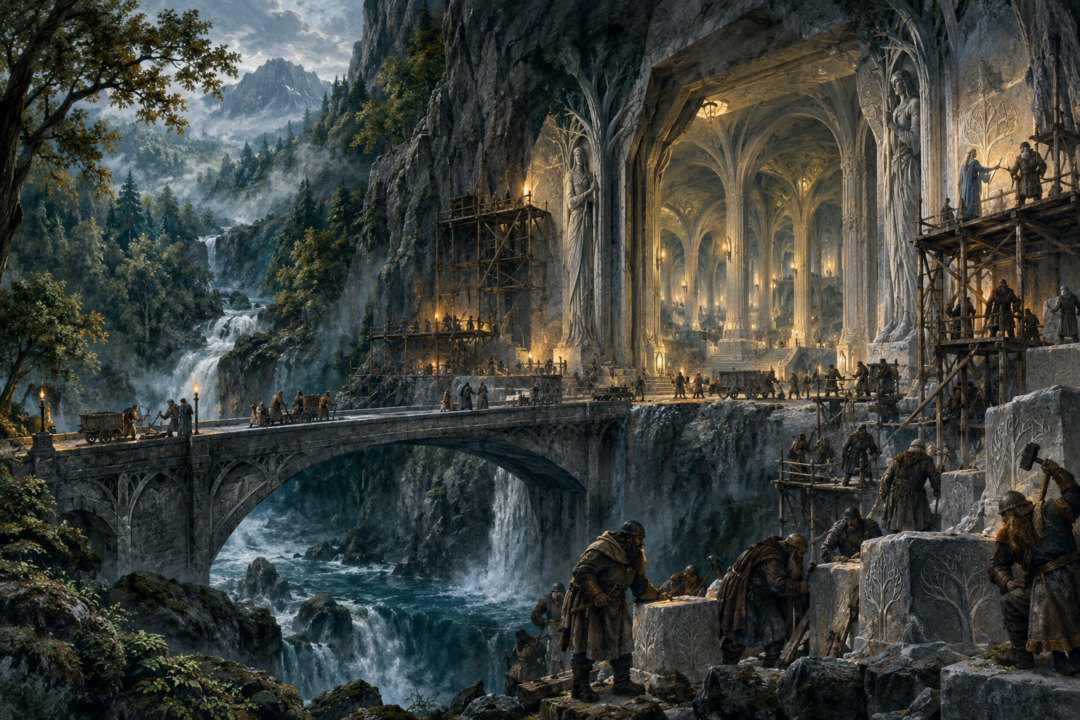
The doors of a kingdom can survive the kingdom itself.
That is one of the stranger patterns running through the history of Middle-earth. Kings raise strongholds because they fear enemies. They commission halls because they expect dynasties to endure. Yet rulers die, peoples scatter, borders vanish, and sometimes the stone remains—empty, captured, repurposed, or waiting for someone else to walk through it.
Few peoples understood that imbalance between political time and geological time better than the Dwarves.
Their reputation for masonry is not merely a matter of building things “stronger.” Dwarvish work repeatedly becomes entangled with realms that prove far less permanent than the structures made for them. Menegroth and Nargothrond are the clearest First Age examples. Khazad-dûm and Erebor reveal the same principle inside Dwarvish civilization itself. And after the War of the Ring, Gimli’s people once again put their craft at the service of other kingdoms.
The result is an overlooked theme of Middle-earth: rulers build for permanence, but stone exposes how temporary rulers really are.
Menegroth Was Built Because Peace Would End
The Thousand Caves began with an expectation of disaster.
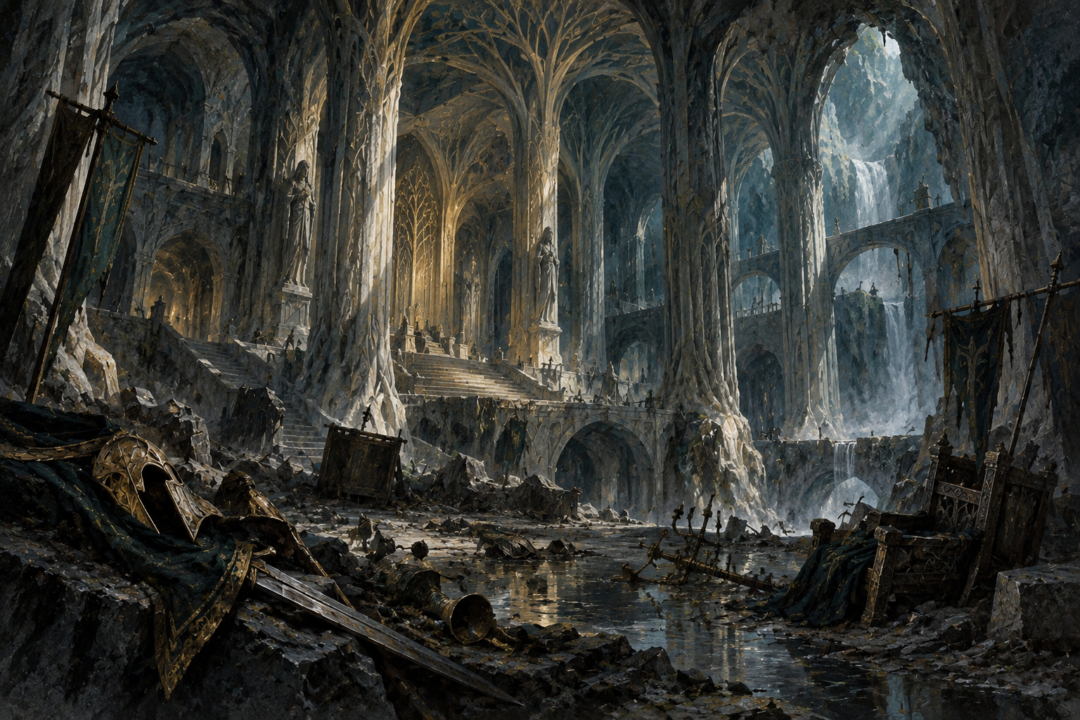
During the long peace before Morgoth’s return, Melian foresaw that Middle-earth would not remain safe forever. Thingol therefore wanted not merely a royal residence but a dwelling that could also be strong against future evil.
For that task he turned to the Dwarves of Belegost.
The Silmarillion describes the Dwarves as already possessing extraordinary skill in stone and metal. They laboured for Thingol in return for knowledge from Melian and treasures from the Sindarin king, including pearls. What emerged beside the River Esgalduin was not simply an enlarged natural cave.
The Dwarves created gates and a stone bridge, while passages descended into halls and chambers cut into the living rock. Elves and Dwarves then combined their different arts within the complex. Pillars resembled the beeches of Oromë, and the underground kingdom was filled with carved and crafted beauty.
Menegroth therefore represented something unusual: Dwarvish engineering serving an Elvish vision.
And for a long time it worked.
Doriath became one of the great protected realms of the First Age. Yet its ultimate destruction did not come because its stonework proved inadequate.
It came because the political and moral order surrounding that stone collapsed.
The Fortress Survived Longer Than the Trust That Created It
There is a bitter irony in Menegroth’s fate.
Dwarves had helped create Thingol’s underground capital. Much later, after the Nauglamír was brought from ruined Nargothrond, Thingol employed Dwarven craftsmen to set the Silmaril into it. The resulting dispute ended with Thingol’s death at the hands of the craftsmen.
The later Dwarven attack on Doriath followed after Melian departed and her protective power was withdrawn.
Menegroth became a battlefield.
That distinction matters. The Thousand Caves did not simply crumble because their builders had failed to make them durable enough. The civilization inhabiting them was destroyed through violence, greed, vengeance, and the unraveling of alliances.
The halls remained capable of sheltering people even after Thingol’s reign ended. Dior later dwelt in Menegroth before the sons of Fëanor attacked Doriath in the Second Kinslaying.
The architecture had outlived one political order and passed into another.
Only the later destruction of Beleriand at the end of the First Age finally removed Menegroth from the surviving geography of Middle-earth.
Dwarvish craft had endured until the land containing it was itself overwhelmed.
Nargothrond Repeated the Pattern
Finrod saw Menegroth and understood immediately what its architecture offered.
He admired its strength, its treasuries, armouries, stone halls, and guarded depths. When Thingol told him about the caves beneath the High Faroth beside the River Narog, Finrod began establishing his own hidden stronghold there.
Again, Dwarves were involved.
The Dwarves of the Blue Mountains aided the work and were richly rewarded from Finrod’s treasures. Their relationship with him left a permanent mark even on his identity: the name Felagund was associated with his cave-building and came to him through the Dwarves.
Nargothrond became one of the great hidden realms resisting Morgoth.
But once again, engineering could not solve the deeper problem.
The kingdom’s fate turned on strategy, pride, and war. Under Orodreth, and heavily influenced by Túrin, Nargothrond abandoned the secrecy that had long protected it and openly challenged Morgoth’s forces. A great bridge was built across the Narog to facilitate the movement of the kingdom’s armies.
Ulmo’s warning, delivered through messengers from Círdan, urged that the bridge be cast down and the stronghold return to secrecy.
The warning was rejected.
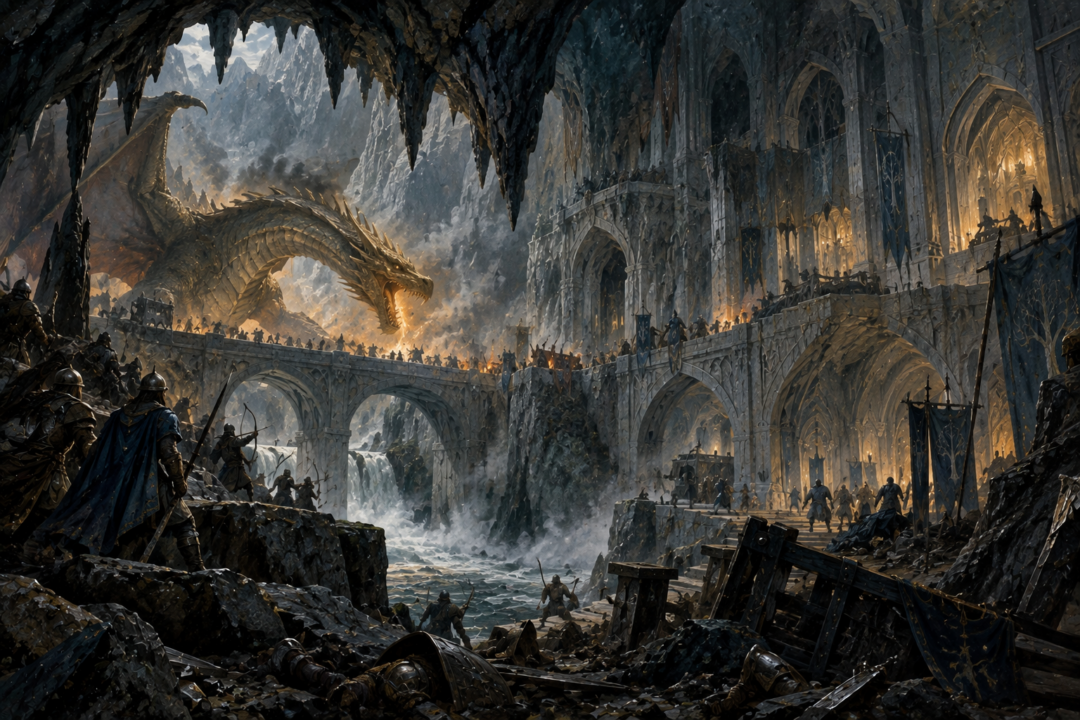
Glaurung and the forces of Morgoth eventually crossed that bridge, defeated Nargothrond’s army and entered the fortress.
The hidden kingdom fell.
The caves did not.
Glaurung Inherited a Dead Kingdom
Perhaps the starkest proof of Nargothrond’s physical endurance is what happened next.
After its people were killed, enslaved, or scattered, Glaurung occupied Nargothrond and gathered its treasures around himself.
The political state was gone. Its king was dead. Its population had been destroyed as an organized power.
Yet its chambers remained useful enough for a dragon to make them his lair.
Later, Mîm the Petty-dwarf also returned there after Glaurung’s death. Húrin eventually came to the ruined stronghold and found him.
Nargothrond had therefore passed through several completely different phases: ancient caves associated with the Petty-dwarves, Finrod’s fortified Elven kingdom enlarged with Dwarven aid, Glaurung’s treasure-house, and finally a haunted ruin containing the wealth of a vanished realm.
Its builders had created infrastructure more durable than the government that controlled it.
That is not evidence that Dwarvish construction was literally indestructible. Tolkien gives no universal rule that Dwarf-made masonry cannot fail.
The pattern is subtler.
Dwarves worked in geological materials and enclosed spaces where strength, permanence, and the nature of the rock itself mattered. Their greatest works often belonged to timescales very different from those of kings and wars.
Khazad-dûm Shows the Same Truth From the Other Side
The greatest example was not commissioned by another people at all.
Khazad-dûm was the great mansion of Durin’s Folk, expanded through immense stretches of time beneath the Misty Mountains. By the end of the Third Age, the kingdom that created it had been gone for more than a thousand years.
Yet Moria remained.
This is the crucial distinction between the death of a state and the destruction of its infrastructure.
Durin’s Bane drove the Dwarves from Khazad-dûm in the Third Age 1981. Orcs later occupied parts of the abandoned realm. Balin attempted to establish a new Dwarven colony there near the end of the Third Age. That colony failed.
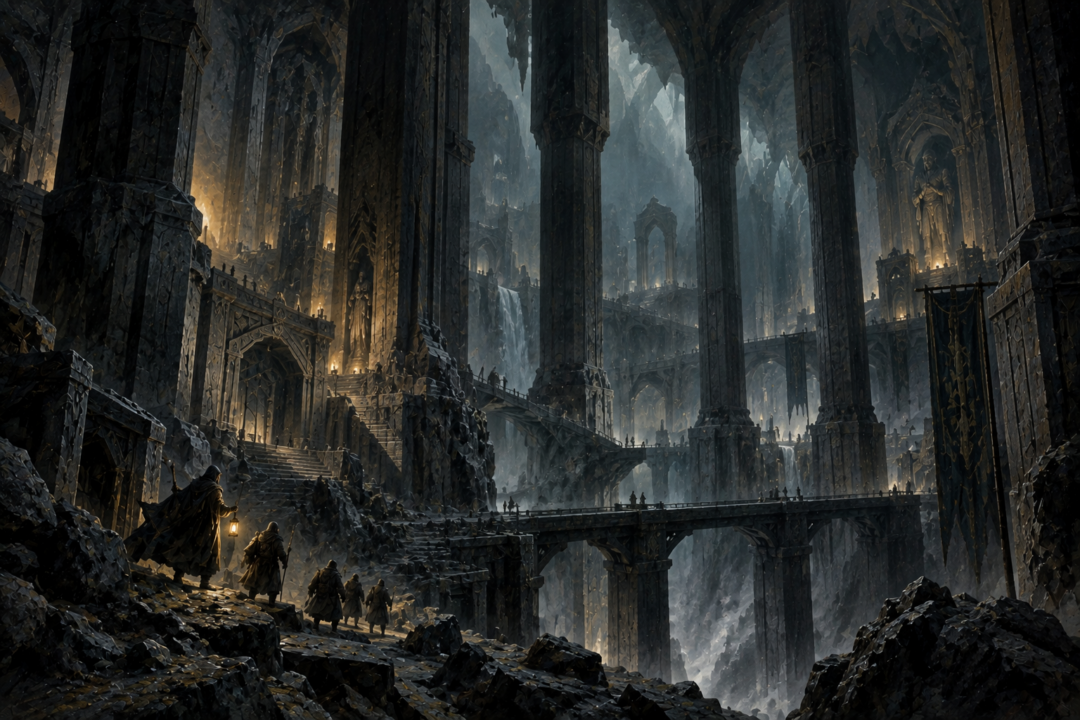
But when the Fellowship entered Moria, the enormous architectural skeleton of Khazad-dûm was still present.
They walked its passages, chambers, stairs, bridges, and halls generations after its original society had disappeared from them.
The realm was dead.
The mountain had remembered its makers.
Erebor Was Strong Enough to Be Reclaimed
The Lonely Mountain offers a less tragic variation.
Smaug’s attack destroyed the Kingdom under the Mountain as a functioning Dwarven realm. Thrór’s people were killed or driven into exile, and for generations the halls belonged to the dragon.
But Smaug did not erase Erebor.
He occupied it.
That difference made Thorin’s quest possible. The Dwarves were not trying to construct a replacement homeland somewhere else. They were trying to recover the physical homeland their ancestors had already made.
After Smaug’s death and the Battle of Five Armies, the kingdom was restored under Dáin Ironfoot.
Stone had become a form of continuity.
The government could disappear while the place remained capable of becoming a kingdom again.
Gimli Turned Dwarvish Craft Outward Again
After Sauron’s defeat, the old relationship between Dwarvish craftsmanship and other realms appeared once more.
Gimli brought Dwarves from Erebor south and became Lord of the Glittering Caves of Aglarond. The appendices state that his people performed great works in Gondor and Rohan.
Their most famous commission was symbolic.
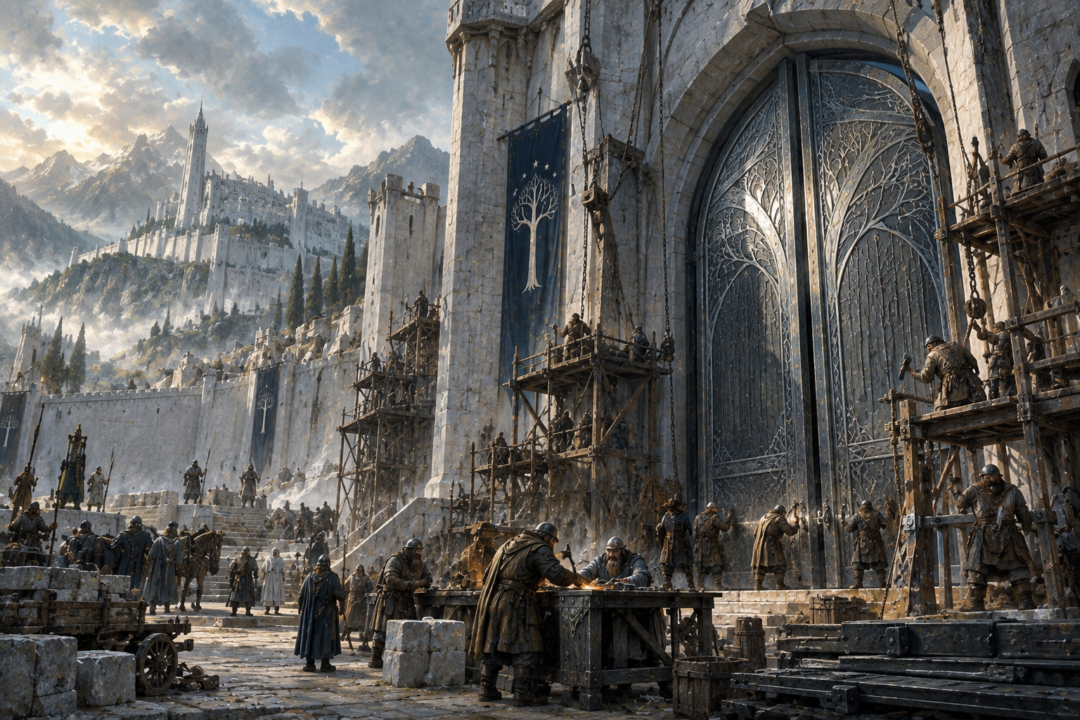
The Great Gate of Minas Tirith had been shattered during the siege by Grond, aided by the power of the Witch-king. After the war, Gimli’s people replaced it with gates of mithril and steel.
The restored kingdom of Gondor therefore began its new age with Dwarvish craftsmanship literally guarding its entrance.
We are not told how many centuries those gates endured, so it would go beyond the texts to claim a specific lifespan for them. But their purpose fits the older pattern perfectly.
Human political history had reached another turning point. A Steward’s age had ended. A king had returned. The city was being healed.
And Dwarves were called to make something intended to last.
Stone Cannot Save a Kingdom
That may be the most important lesson hidden in these works.
Menegroth was extraordinarily strong, yet strength could not prevent betrayal and vengeance.
Nargothrond was hidden and fortified, yet architecture could not compensate for disastrous strategic choices.
Khazad-dûm possessed works on a scale that astonished the Fellowship centuries later, yet even that kingdom could be emptied.
Erebor’s halls survived Smaug, but they could not stop him from destroying the society living inside them.
Dwarvish craft could resist time remarkably well.
It could not resist every consequence of pride, greed, war, fear, or bad judgment.
That contradiction gives the ruins of Middle-earth much of their power. A surviving wall does not prove that the civilization behind it was invulnerable. Sometimes it proves precisely the opposite.
The builders planned for centuries.
History needed only a day to remove the king.
And afterward, deep beneath forest, mountain, or ruined realm, the stone remained.
Sources & Notes
- Tolkien Gateway, “Menegroth” — https://tolkiengateway.net/wiki/Menegroth
- Tolkien Gateway, “Nargothrond” — https://tolkiengateway.net/wiki/Nargothrond
- Tolkien Gateway, “Khazad-dûm” — https://tolkiengateway.net/wiki/Khazad-d%C3%BBm
- Tolkien Gateway, “Erebor” — https://tolkiengateway.net/wiki/Erebor
Reference entries document the characters, places, events, and textual details discussed in this article.