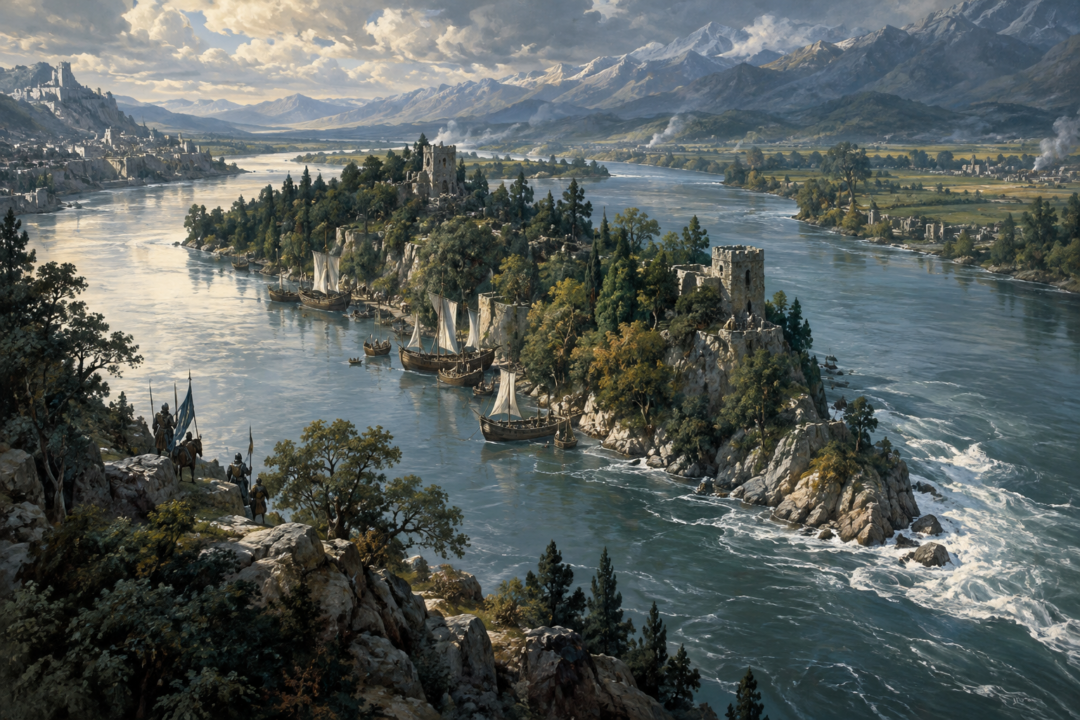
Cair Andros is easy to remember as a fortress. During the War of the Ring, that is exactly how Gondor had to think about it: a long island in the Anduin north of Minas Tirith, fortified because an enemy crossing there could threaten Anórien and the approaches to the City. When Sauron launched his final war, Cair Andros fell, and enemy forces crossed into the western lands.
Yet the island’s story does not end as a battlefield.
After Sauron’s defeat, the Anduin becomes something it had scarcely been for generations: a river running through a realm no longer organized around permanent war with Mordor. Cair Andros still occupies the same water, commands the same crossing region, and lies on the same route north from Osgiliath. But the strategic problem has changed.
The texts never provide a Fourth Age commercial history of Cair Andros, nor do they explicitly describe it becoming a trading settlement. Any claim that it became a major merchant port would therefore go beyond the evidence. What they do provide is enough to reveal something subtler.
Once Gondor begins recovering, Cair Andros no longer matters only because armies might cross the Anduin there. Its position also makes it potentially important to the movement that peace restores.
The Fortress That Existed Because Gondor Was Vulnerable
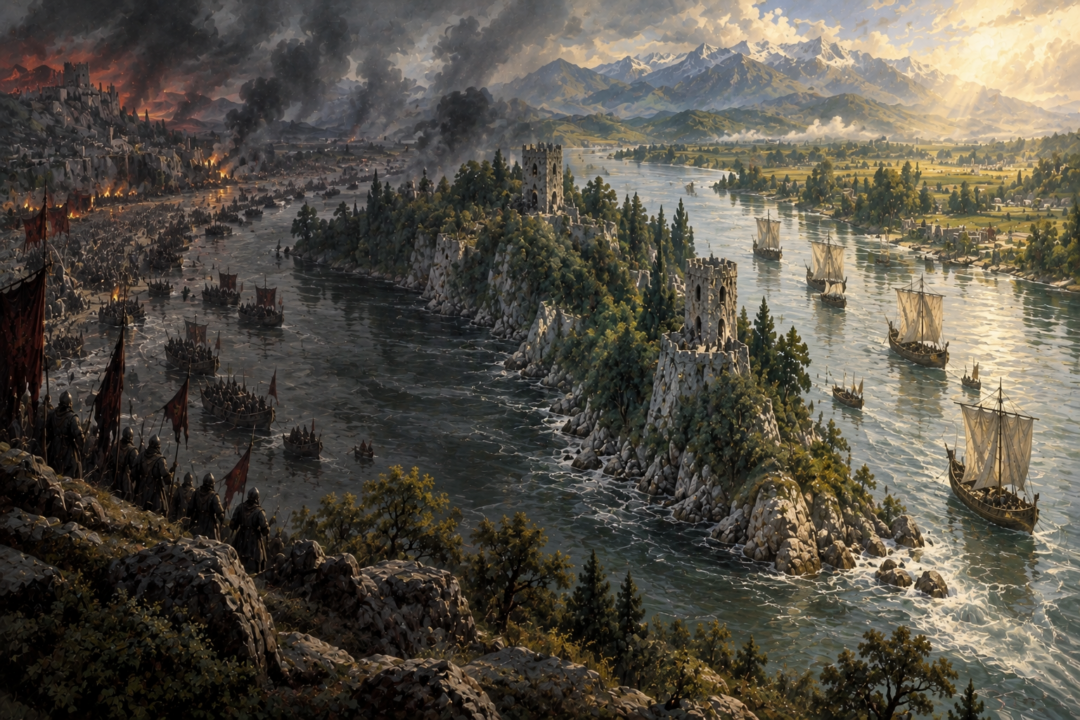
Cair Andros was no insignificant river island. Its name, commonly rendered “Ship of Long-foam,” reflects its distinctive shape: the northern end rose like the prow of a ship, dividing the waters of the Anduin around it.
Its military significance was geographic.
The island lay roughly fifty miles north of Minas Tirith, with Anórien to the west and Ithilien across the river to the east. In The Return of the King, when Gandalf discusses Gondor’s defenses, Cair Andros appears alongside Osgiliath as one of the places where the Anduin could be crossed by an attacking army.
That fact explains centuries of concern.
Appendix A records that Steward Túrin II, faced with renewed attacks from Mordor in the late Third Age, strengthened Gondor’s defenses and “fortified again the isle of Cair Andros to defend Anórien.” Unfinished Tales likewise shows the broader northern approaches of Gondor being watched against dangers coming either from Calenardhon or across the Anduin around Cair Andros.
The island therefore belonged to a defensive system, not merely an isolated castle.
An enemy who forced the river there could enter Anórien north of Minas Tirith. From there, Gondor’s communications with Rohan and its northern territories could be endangered.
That is precisely what happened in March 3019.
What Sauron Understood About the Island
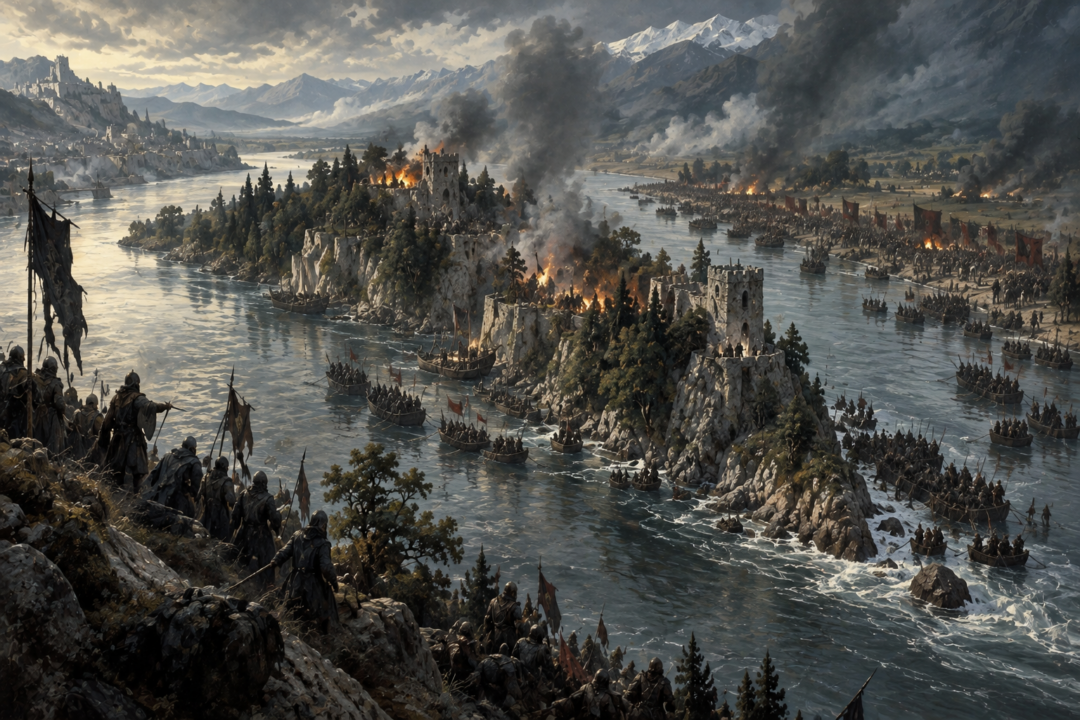
The attack on Cair Andros during the War of the Ring demonstrates its strategic importance more clearly than any map can.
As the main assault moved against Gondor, a force from the Morannon attacked Cair Andros. The island was taken, and enemies crossed into Anórien. Their presence helped threaten the route by which the Rohirrim were approaching Minas Tirith.
The Rohirrim ultimately avoided that danger through the hidden road revealed by Ghân-buri-Ghân and the Drúedain.
But the episode exposes the real value of Cair Andros.
The island did not need to be the objective of a war to matter. Control of it affected movement elsewhere.
That principle remains important after the war.
Under Sauron, strategic movement meant Orcs, soldiers, messengers, reinforcements, horses, and supplies. Under the restored kingdom, movement could increasingly mean officials, settlers, craftsmen, provisions, ships, and goods.
The geography had not changed.
Only the purpose of movement had.
The Anduin Becomes a Road Again
The strongest evidence for imagining Cair Andros differently after the war comes from the final chapters of The Return of the King.
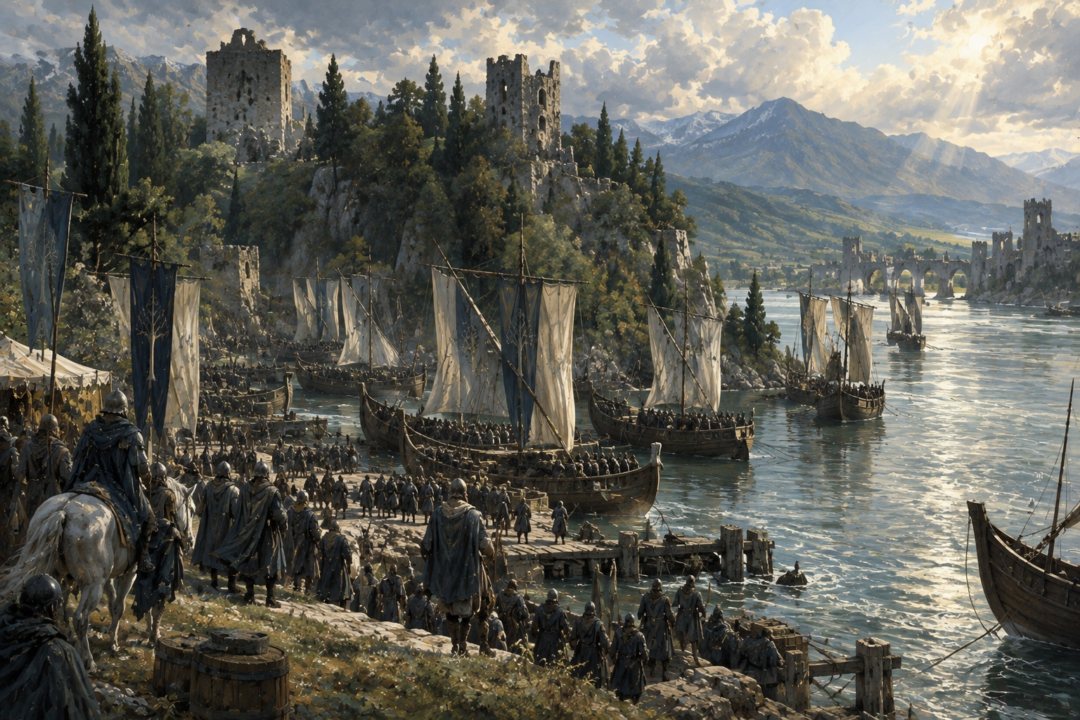
After the victory over Sauron, Frodo and Sam recover at the Field of Cormallen in Ithilien. The narrative describes ships lying at Cair Andros. Later, when the Captains of the West finally return toward Minas Tirith, they go aboard ships there and sail down the Anduin to Osgiliath.
That is a crucial detail.
Cair Andros is already functioning as more than a defensive barrier. It is a point connected to river transport.
This does not prove that the island later became a commercial harbor. The text never says so. But it demonstrates that ships could gather there and that large-scale organized movement downriver from Cair Andros was practical.
In wartime, rivers are obstacles when an enemy controls the opposite bank.
In peace, rivers are roads.
And the Anduin is the greatest road of water in western Middle-earth.
Why Osgiliath Does Not Make Cair Andros Irrelevant
The restoration of Gondor creates an obvious objection: if Osgiliath was rebuilt, why would Cair Andros matter economically at all?
Osgiliath occupied the more important position for Minas Tirith. It stood directly astride the Anduin and had historically been Gondor’s capital. Aragorn’s reign brought renewed life to the kingdom, and the city’s position naturally made it central to the reconnection of eastern and western Gondor.
Cair Andros should therefore not be imagined as replacing Osgiliath.
Its value is different.
Cair Andros lies farther north. Anyone moving between the central regions of Gondor and the northern reaches of the Anduin encounters a different geography there than at Osgiliath. The island sits near the transition between Anórien, northern Ithilien, and the routes toward the Emyn Muil and lands beyond.
In military terms, this made Cair Andros a flank position.
In peaceful terms, the same geography could make it a useful intermediate point.
That is interpretation rather than stated Fourth Age history, but it follows directly from the location that had made the island strategically important for centuries.
Ithilien Changes Everything
Perhaps the greatest transformation is not on Cair Andros itself but across the river.
For much of the late Third Age, Ithilien was a beautiful but dangerous frontier. Its people had largely withdrawn westward as Mordor’s power increased. Rangers operated there, but normal settlement had been devastated by centuries of war.
After Sauron’s defeat, that changes.
Faramir becomes Prince of Ithilien, and Aragorn grants him authority there. The king also tells Beregond that he is to serve Faramir as captain of the White Company and guard him in his new land.
The implication is restoration, not abandonment.
Even more significantly, Legolas later brings Elves from Greenwood to Ithilien, and Appendix B says that the land became once again the fairest country in the westlands.
This renewed Ithilien changes the logic of Cair Andros.
A fortress facing a hostile eastern shore is a frontier post.
An island beside a recovering province is something else.
The river still separates Anórien and Ithilien, but it no longer separates Gondor from an enemy-controlled wilderness. Both banks can now belong to the political and economic life of the Reunited Kingdom.
That creates possibilities for crossings, communications, patrols, settlement, and river traffic that scarcely existed while Mordor dominated the East.
From Chokepoint to Junction
There is an important strategic distinction between controlling a chokepoint and controlling a junction.
Late Third Age Gondor needed Cair Andros because hostile forces might cross there. Its value was primarily negative: prevent the enemy from using the route.
Peace reverses that logic.
A restored kingdom benefits from movement.
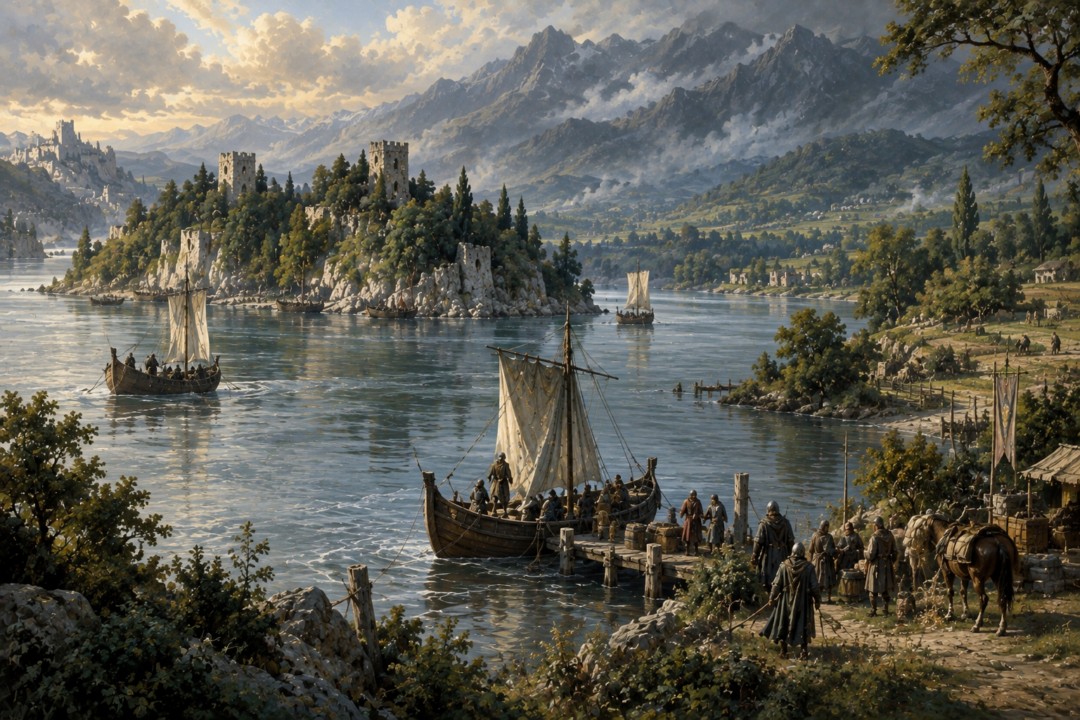
The same position that once had to deny passage can potentially facilitate it.
Nothing in the texts confirms the construction of markets, quays, warehouses, bridges, or a permanent Fourth Age trading town on Cair Andros. Those details should remain in the realm of reconstruction rather than canon.
But some broader conclusions are safer.
Gondor and Arnor are reunited under Aragorn. Ithilien is restored under Faramir. The threat from Mordor collapses. Travel along the Anduin becomes demonstrably possible immediately after the war. Cair Andros remains positioned between important regions of the kingdom.
Its strategic value therefore does not disappear with peace. The nature of that value changes.
The Northern Dimension
The restoration of the northern kingdom adds another layer.
Aragorn is not merely King of Gondor. He restores the kingship of Arnor as well, creating a political order stretching across regions that had been divided for many centuries.
The texts do not describe a regular commercial route from Minas Tirith through Cair Andros to Arnor, and it would be too strong to claim one existed.
Nevertheless, the reunification makes north-south communication more important than it had been under the Stewards.
Cair Andros stands north of Gondor’s capital, on the great river and near the northern edge of the kingdom’s densely documented heartland. Even where travelers continued primarily by road, control of the river and its crossings would remain strategically useful.
The island’s old military purpose therefore acquires a peacetime counterpart: securing the internal communications of a larger realm.
Why the Fortress Would Still Matter
Peace does not make fortifications meaningless.
Aragorn’s victory destroys Sauron’s organized power, but Middle-earth does not instantly become free of danger. Appendix A records that Aragorn and Éomer later fought beyond their own borders, subduing enemies and establishing peace in the restored realms.
A sensible reading, therefore, is not that Cair Andros ceased to have military importance.
Rather, its functions could overlap.
A defended river position can protect shipping. A garrison can police a crossing as well as deny it to an invading army. A secure stopping point can serve messengers and soldiers alongside civilians. The infrastructure required to control movement during war can become useful to organize movement during peace.
Again, Tolkien does not explicitly describe such an administrative transformation at Cair Andros. But strategically, this is the most conservative inference from the island’s established geography and the changed political conditions around it.
The Deeper Meaning of Cair Andros After Sauron
Cair Andros embodies one of the quiet consequences of victory.
Sauron’s defeat does not move mountains or alter the course of the Anduin. What changes is the meaning of the landscape.
For generations, Gondor looked east across the river and saw danger. Ithilien became a battlefield. Osgiliath became a ruin. Cair Andros became a shield protecting Anórien.
Then the Shadow falls.
The river remains.
The island remains.
But ships can move through waters once dominated by war. Ithilien can be inhabited again. Osgiliath can cease to be merely a contested ruin. Roads and crossings that once measured how quickly an enemy might reach Minas Tirith can instead measure how effectively the kingdom can reconnect its lands.
That is why the return of trade—or, more cautiously, the return of peaceful movement and economic life—does not reduce Cair Andros’s strategic importance.
It transforms it.
The Ship of Long-foam was valuable because it controlled passage across the Anduin. Under the Shadow, that meant stopping armies.
In the restored kingdom, the same geography could help connect what war had spent centuries tearing apart.
Sources & Notes
- Tolkien Gateway, “Cair Andros” — https://tolkiengateway.net/wiki/Cair_Andros
- Tolkien Gateway, “Anduin” — https://tolkiengateway.net/wiki/Anduin
- Tolkien Gateway, “Reunited Kingdom” — https://tolkiengateway.net/wiki/Reunited_Kingdom
Reference entries document the characters, places, events, and textual details discussed in this article.