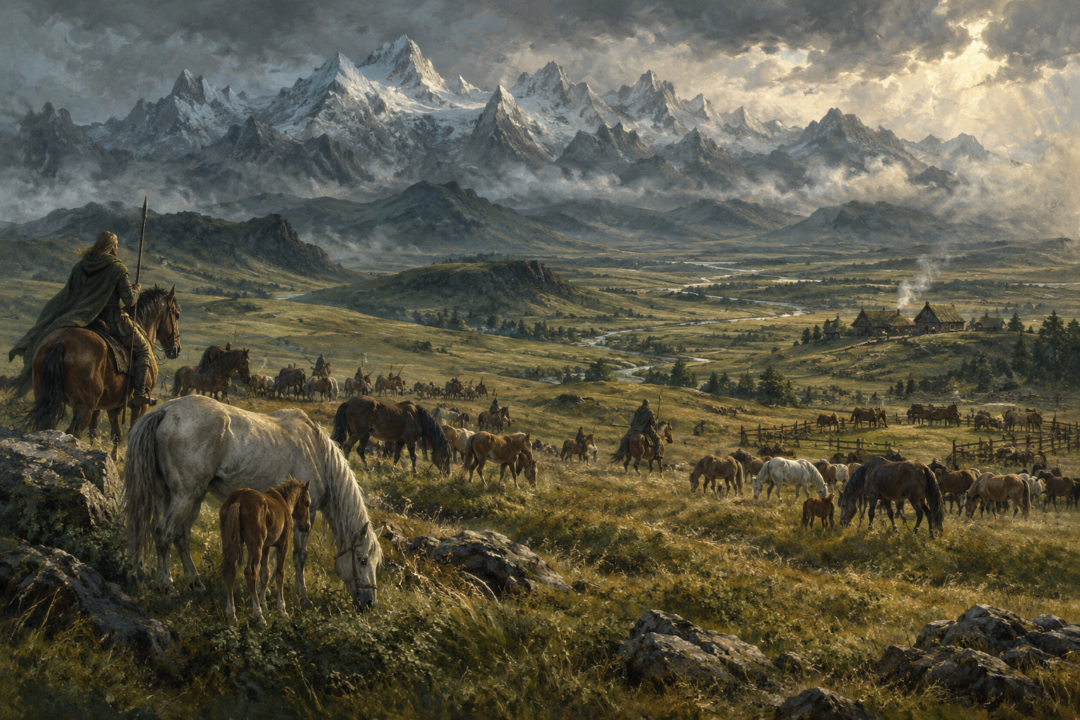
When Gandalf asks for a horse in Rohan, he does not simply receive a convenient mount. He eventually wins the allegiance of Shadowfax, greatest of the horses of the Mark and one of the Mearas, the extraordinary line traditionally descended from Felaróf.
It is easy to look at horses like Shadowfax and imagine that Rohan’s greatness rested primarily on breeding: exceptional bloodlines producing exceptional animals.
But the geography of Rohan suggests something larger.
A kingdom capable of maintaining great herds, supplying mounted warriors, preserving prized lines of horses, and making cavalry central to its military power needed more than skilled breeders. It needed land.
More precisely, it needed grass.
The texts never give us a Rohirric law code regulating grazing rights, seasonal pasture, or breeding grounds. Any detailed system of that kind would be speculation. Yet the political geography of Rohan makes one conclusion difficult to avoid: its horse culture depended on protecting and controlling enormous areas of productive pasture.
The Rohirrim were not merely people who bred excellent horses.
They had inherited a landscape capable of sustaining a horse-based society.
Rohan Began With a Gift of Land
The foundation of Rohan is usually remembered as a political reward.
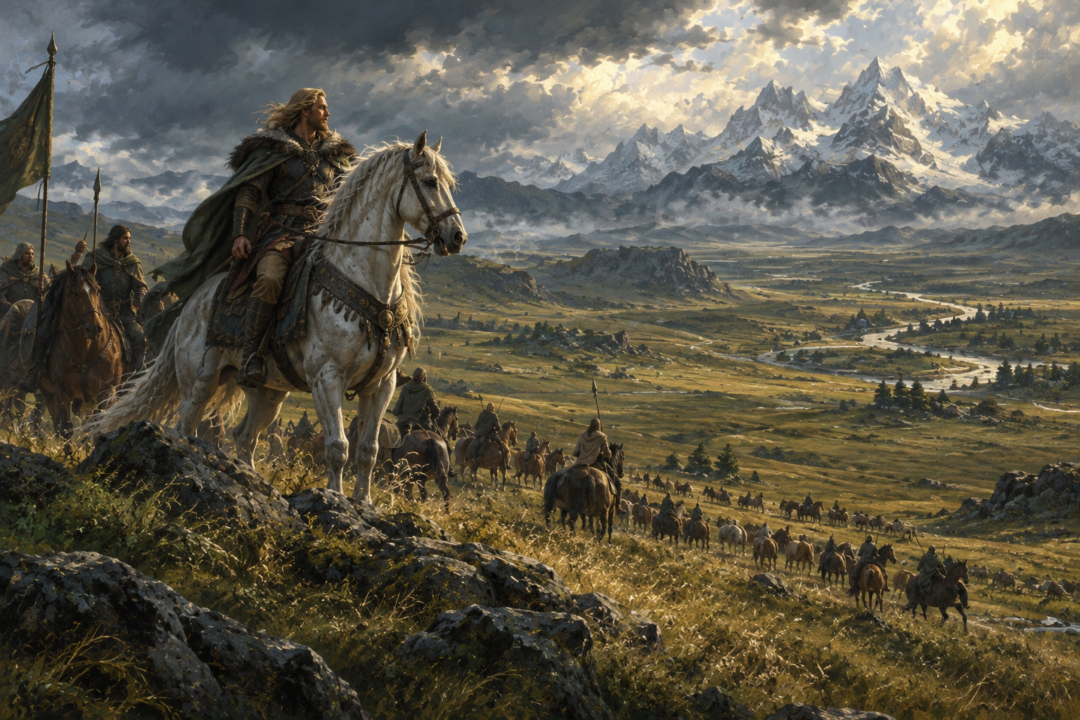
In the Third Age 2510, Eorl the Young rode south with the Éothéod to Gondor’s aid at the Field of Celebrant. After the victory, Steward Cirion granted Eorl the largely depopulated province of Calenardhon.
That gift transformed the future of Eorl’s people.
The Éothéod already possessed a powerful equestrian tradition. Eorl’s father, Léod, was renowned as a tamer of horses, and Eorl himself rode Felaróf, from whom the Mearas were said to descend. Rohan therefore did not create the horse culture of Eorl’s people from nothing.
What Calenardhon gave them was scale.
The country that became Rohan stretched across broad grasslands north of the White Mountains, between the regions toward the Isen in the west and the Anduin in the east. Much of the land encountered by characters in The Lord of the Rings is open country: downs, plains, valleys, and long expanses over which riders can travel swiftly.
For a people whose military strength and cultural identity were already bound to horses, this was extraordinarily valuable territory.
Cirion had not simply given Eorl somewhere to build houses.
He had given the Éothéod the ecological foundation on which their existing way of life could expand.
A Great Horse Is Also a Product of Acres
Breeding matters enormously.
The House of Eorl preserved a special association with the Mearas, whose most famous representatives include Felaróf and Shadowfax. These horses were distinguished from ordinary animals by extraordinary strength, speed, understanding, and longevity.
But even the finest bloodline cannot substitute for food.
Horses require substantial grazing land, and a society maintaining large numbers of them must balance the needs of breeding animals, young stock, working horses, and military mounts against the needs of its human population and other livestock.
Tolkien never provides figures for Rohan’s horse population or describes a formal pasture administration. We therefore cannot claim that the kings maintained particular grazing quotas, rotational systems, or legally defined horse reserves.
What the texts do establish is the combination that matters: extensive grasslands, famous horse breeding, large bodies of mounted warriors, and a ruling culture intensely concerned with horses.
The safest conclusion is not that Rohan possessed some specific undocumented bureaucracy.
It is that control of pasture must have been economically important.
The horse wealth of the Mark was inseparable from the land that fed it.
The Rohirrim Needed Herds, Not Just War-Horses
The horses we remember are usually individual heroes.
Shadowfax carries Gandalf. Snowmane bears Théoden. Hasufel and Arod carry Aragorn and Legolas after the meeting with Éomer.
Yet famous mounts can distort our picture of Rohan.
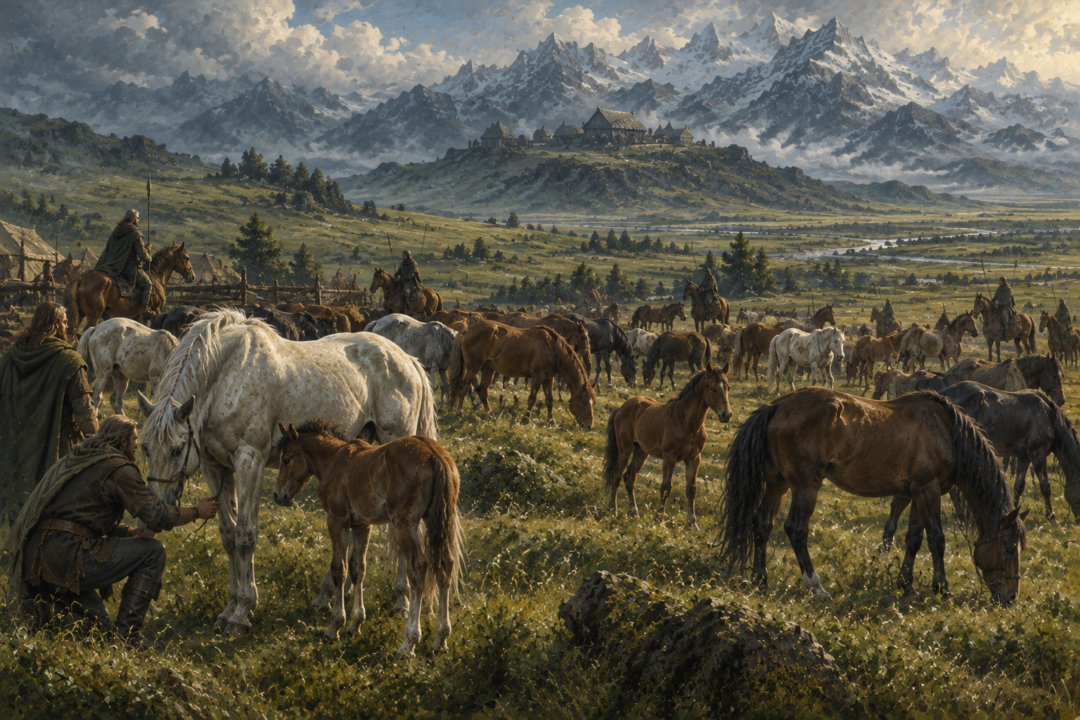
A cavalry society cannot be sustained by a handful of magnificent stallions. Behind every celebrated war-horse must stand a much broader population of animals: mares, foals, younger horses, breeding stock, ordinary riding horses, and replacements for animals lost through injury, age, hardship, or war.
The narrative occasionally lets us glimpse this larger horse economy. Rohan possesses herds and valuable stock beyond the personal mounts of its lords. Saruman’s hostility toward the Mark includes the taking of horses, and his servants become a direct threat to the resources on which Rohirric mobility depends.
That matters because a horse is not instantly replaceable.
Losing a sword means losing an object that can, given materials and craftsmen, be replaced.
Losing breeding animals damages the future.
A stolen or slaughtered mare may mean not only one fewer horse today but fewer horses in later years. Pressure on herds therefore has consequences extending beyond the immediate raid.
For Rohan, attacks on horses were attacks on military capacity, wealth, and continuity at once.
Pasture Was Part of Rohan’s Strategic Geography
This changes how we can read the landscape of the Riddermark.
Open country is not empty country.
A broad grassy plain may appear economically blank to someone looking for towns, mines, walls, or fields of grain. To pastoral people, however, usable grazing territory is productive land.
That makes the security of the Mark especially important.
Rohan faced dangers from several directions during its history: Easterlings, Orcs, Dunlendings, and eventually the forces controlled by Saruman. Raiding did not have to capture Edoras to hurt the kingdom. Enemies moving through inhabited and grazing country could threaten settlements, livestock, horses, and the people tending them.
The War of the Ring demonstrates how closely Rohan’s military system depended upon being able to gather riders and mounts from across a wide realm.
Its cavalry strength was therefore rooted in something less glamorous than the charge itself.
Before thousands of riders could assemble, thousands of horses had to exist, mature, remain healthy, and be available.
The charge began years earlier in the grass.
Why the King’s Authority Mattered
This is where pasture becomes political.
The texts tell us that the Rohirrim governed their new realm under their own rulers and laws, but they do not preserve detailed regulations concerning grazing. We should therefore resist inventing a royal pasture code.
Still, land use in a horse-rich kingdom could hardly be irrelevant to rulership.
Someone had to possess recognized authority over territory. Borders had to be defended. Communities needed secure access to the country from which they drew their livelihood. Herds had to survive both ordinary years and periods of war.
The kings of Rohan ruled not merely warriors but a territorial kingdom whose military identity depended heavily upon animals raised from that territory.
This helps explain why the Gift of Cirion was so consequential. The Éothéod did not become powerful simply because Eorl possessed Felaróf. They gained a large homeland in which an equestrian people could reproduce its entire way of life on a greater scale.
Bloodlines provided quality.
Land provided quantity and continuity.
Rohan required both.
The Mearas Can Mislead Us About Rohan
The Mearas are so extraordinary that they almost invite the wrong explanation for Rohirric power.
Felaróf could understand the speech of Men, according to the tradition preserved in the House of Eorl. His descendants were said to allow only the King of the Mark or his sons to ride them until Shadowfax accepted Gandalf.
These are not ordinary horses produced by routine selective breeding.
They belong to the legendary dimension of Rohan’s history.
But the military power of the Rohirrim cannot be explained by the Mearas.
Most Riders were not mounted on Shadowfax’s kin. The éoreds of the Mark depended on ordinary horses, however excellent Rohirric horsemanship and breeding may have made them.
That distinction is crucial.
A legendary bloodline could give Rohan prestige. A large population of sound horses gave it cavalry.
The first could be preserved within a royal tradition.
The second required countryside.
Saruman Threatened More Than Riders
This also adds another layer to Saruman’s war against Rohan.
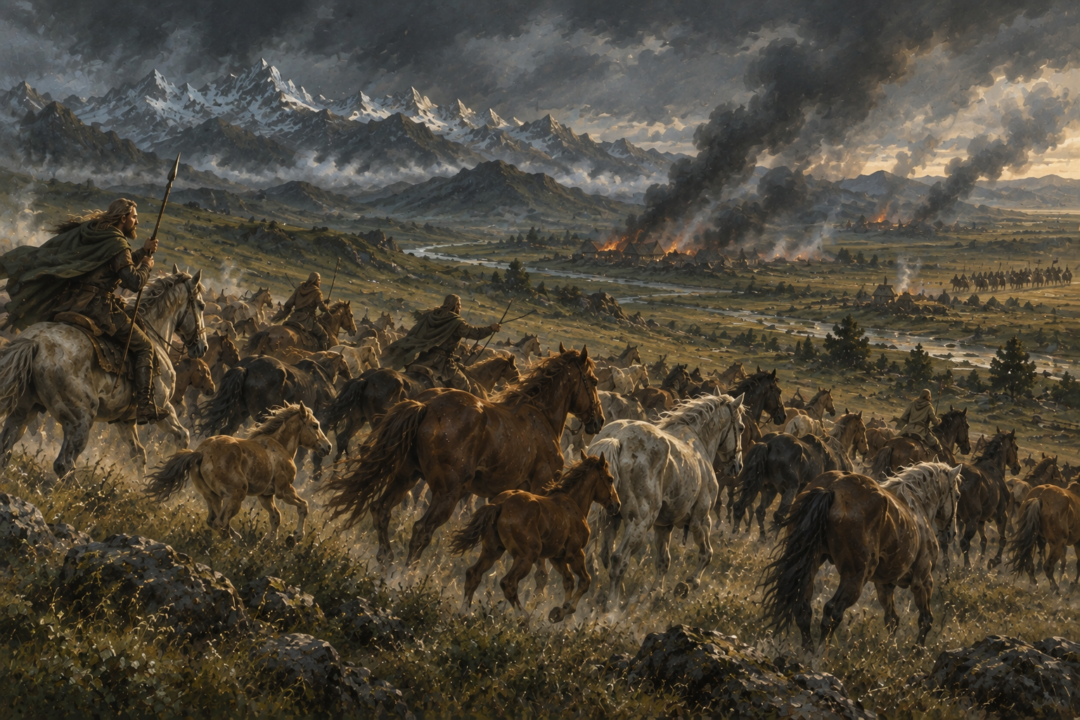
His strategy did not merely confront Théoden’s warriors in battle. The conflict spread through the Westfold and other parts of the kingdom, displacing people and exposing the productive landscape itself to violence.
That is dangerous for any agrarian society, but particularly serious for one whose military system depends heavily on livestock.
Armies can be mustered quickly only because societies spend years creating the resources those armies consume.
Rohan’s horses needed to be born long before the beacons of Gondor burned.
They needed mares that survived previous years, grazing country that remained usable, people capable of handling them, and enough political stability for the system to continue.
Saruman sought to destroy the military power of Rohan. Warfare against its countryside therefore threatened the foundations beneath that power, even where the narrative does not pause to describe the economic consequences in detail.
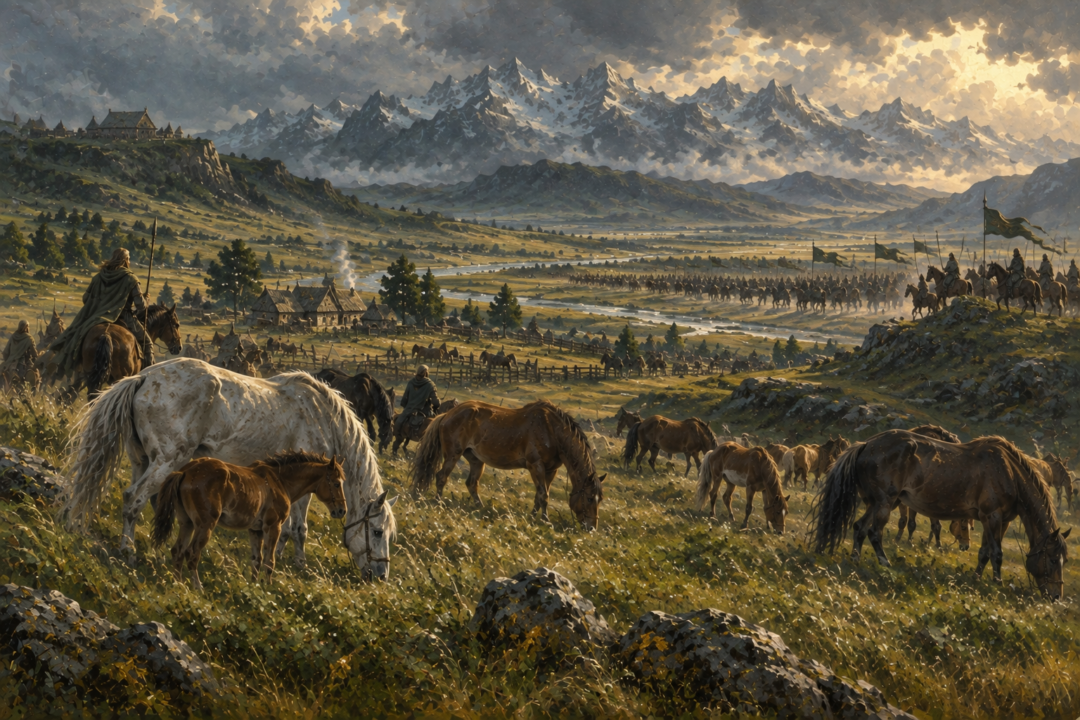
Rohan’s Real Weapon Was a Landscape
When Théoden finally rides from Dunharrow toward Gondor, the spectacle is military: spearheads, shields, horns, disciplined riders, and horses moving south toward war.
But the deeper machinery behind that moment is ecological.
The Rohirrim could become the great cavalry power of their age because history placed a horse-loving people in possession of a wide grassland realm.
Their breeding traditions mattered. Their horsemanship mattered. Their courage mattered.
Yet none of those things could create pasture.
Tolkien never explicitly describes a Rohirric pasture policy, and we should not pretend that he does. What the geography and economy of the Mark imply is simpler and stronger: preserving horse wealth required preserving the conditions in which horses could multiply and thrive.
Rohan’s rulers therefore inherited more than borders when Eorl accepted Calenardhon.
They inherited grasslands whose security was inseparable from the strength of the kingdom.
Shadowfax may be the horse everyone remembers.
But behind him lies the greater source of Rohan’s power: mile after mile of the Riddermark itself.
Sources & Notes
- Tolkien Gateway, “Rohan” — https://tolkiengateway.net/wiki/Rohan
- Tolkien Gateway, “Mearas” — https://tolkiengateway.net/wiki/Mearas
- Tolkien Gateway, “Westfold” — https://tolkiengateway.net/wiki/Westfold
- Tolkien Gateway, “Eastfold” — https://tolkiengateway.net/wiki/Eastfold
Reference entries document the characters, places, events, and textual details discussed in this article.