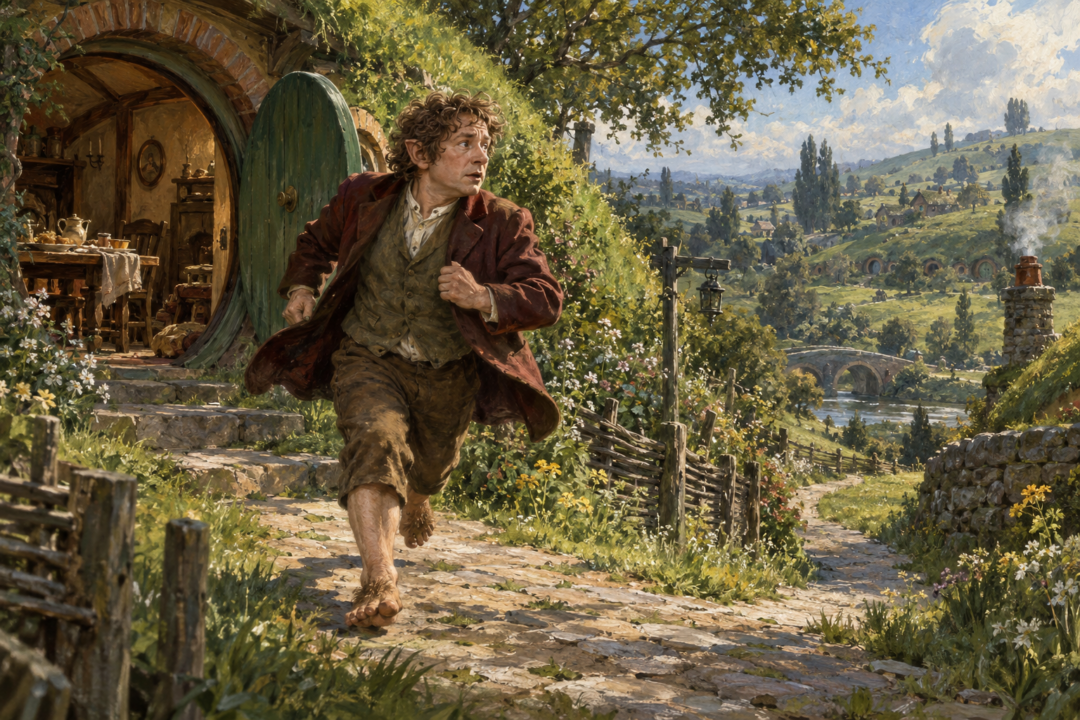
Bilbo Baggins leaves Bag End without a sword, without provisions of his own, without money, and even without his hat. Yet when he reaches Bywater and realizes what he has forgotten, one absence receives special attention: his pocket-handkerchief.
It is a wonderfully small problem for someone about to cross the Wild, encounter trolls and goblins, enter Mirkwood, and eventually walk alone toward a dragon.
That smallness is precisely why the moment matters.
The pocket-handkerchief belongs to Bilbo’s ordinary world. It is part of the collection of habits, possessions, meals, schedules, and expectations that make him recognizably Bilbo Baggins of Bag End. Losing access to it is not a heroic sacrifice. Gandalf soon brings pocket-handkerchiefs after the company has departed. But the text deliberately returns to the image much later, when Bilbo is approaching Smaug.
By then, he has been without one for ages.
The joke has become a measure of distance.
Bilbo’s first cost of adventure is not treasure, blood, or glory. It is the discovery that the comfortable life he expects to carry with him cannot remain intact once the road truly begins.
Bilbo Leaves Before He Is Ready
Bilbo does not depart Bag End like a conventional hero.
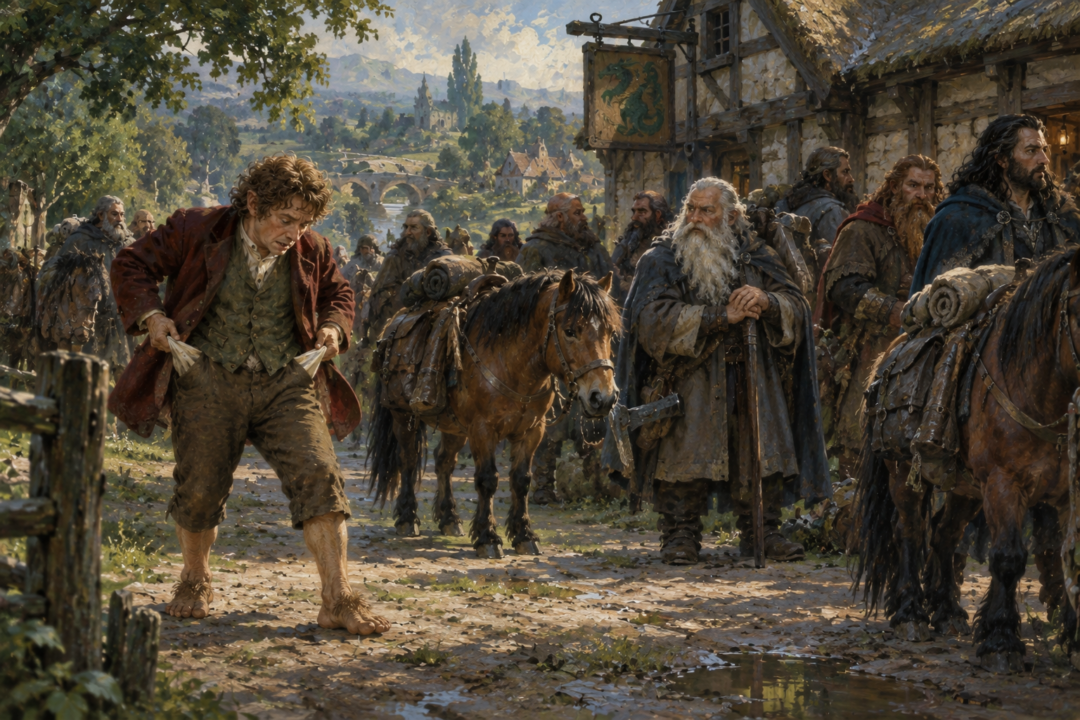
Thorin and Company have already gone ahead, leaving instructions that they will wait for him at the Green Dragon in Bywater at eleven. Gandalf points out that Bilbo has only minutes to reach them. The result is chaos.
Bilbo runs out while his second breakfast remains unfinished and the washing-up undone. He hands his keys to Gandalf. He leaves without his hat, walking-stick, money, and other things he would ordinarily take outside.
Then, arriving breathless at Bywater, he discovers that he has also forgotten his pocket-handkerchief.
This is comic, but it establishes something important about the nature of Bilbo’s departure. He has not transformed himself into an adventurer before leaving home. He has barely prepared at all.
His body has left Bag End before his habits have caught up with him.
Even his apology reveals the old Bilbo. He worries about his missing possessions and explains precisely when he received the dwarves’ note. Dwalin’s response is effectively a warning about the entire journey: Bilbo will have to manage without pocket-handkerchiefs and many other things before the end.
That prediction proves more serious than its humorous setting suggests.
Why a Pocket-Handkerchief Matters
There is nothing magical about Bilbo’s handkerchief. The text gives it no special history or supernatural importance.
Its significance is ordinary.
Bilbo begins The Hobbit as someone deeply attached to an ordered domestic existence. Bag End has bedrooms, bathrooms, dining rooms, parlours, wardrobes, kitchens, and rooms devoted to clothes. Bilbo likes food, comfort, predictable social customs, and a well-managed household.
A pocket-handkerchief belongs perfectly in that world.
It is a minor object of personal readiness: something a respectable hobbit expects to have when he goes out. That is why Bilbo notices its absence even while something vastly larger is happening. He has just crossed the invisible boundary between his old life and an expedition toward a dragon, yet part of his mind is still conducting an inventory of what a proper outing requires.
The comedy depends on the mismatch.
Thorin is thinking about Erebor.
Gandalf is pushing the quest into motion.
The dwarves have ponies loaded with baggage.
Bilbo is worried about his handkerchief.
But this does not make Bilbo foolish. It shows how radically unprepared he is for the world he has entered.
Gandalf Softens the First Loss
The handkerchief is not permanently lost at this point.
After the company sets out, Gandalf catches up with them on a white horse. He has brought Bilbo’s pipe and tobacco, along with a supply of pocket-handkerchiefs.
This detail matters because it prevents us from overstating the symbolism. Bilbo does not heroically renounce his handkerchief at Bywater, nor does the forgotten object itself represent an irreversible sacrifice.
Gandalf temporarily brings pieces of home onto the road.
For a while, that works.
The company is still travelling through hobbit-lands, described as respectable country with good roads and occasional inns. They tell stories and sing. They stop for meals, though not as frequently as Bilbo would prefer. Bilbo even begins to think adventures may not be so bad.
Then the landscape changes.
The comfortable infrastructure of ordinary life starts disappearing. The company passes beyond familiar settled country into harsher places where roads worsen, weather becomes dangerous, and dependable hospitality cannot be assumed.
Gandalf can bring Bilbo his tobacco.
He cannot make the Wild behave like the Shire.
That is the deeper warning contained in Dwalin’s remark.
Bilbo is going to manage without far more than handkerchiefs.
Adventure Strips Away Bilbo’s Assumptions
The journey repeatedly removes the protections on which Bilbo has relied.
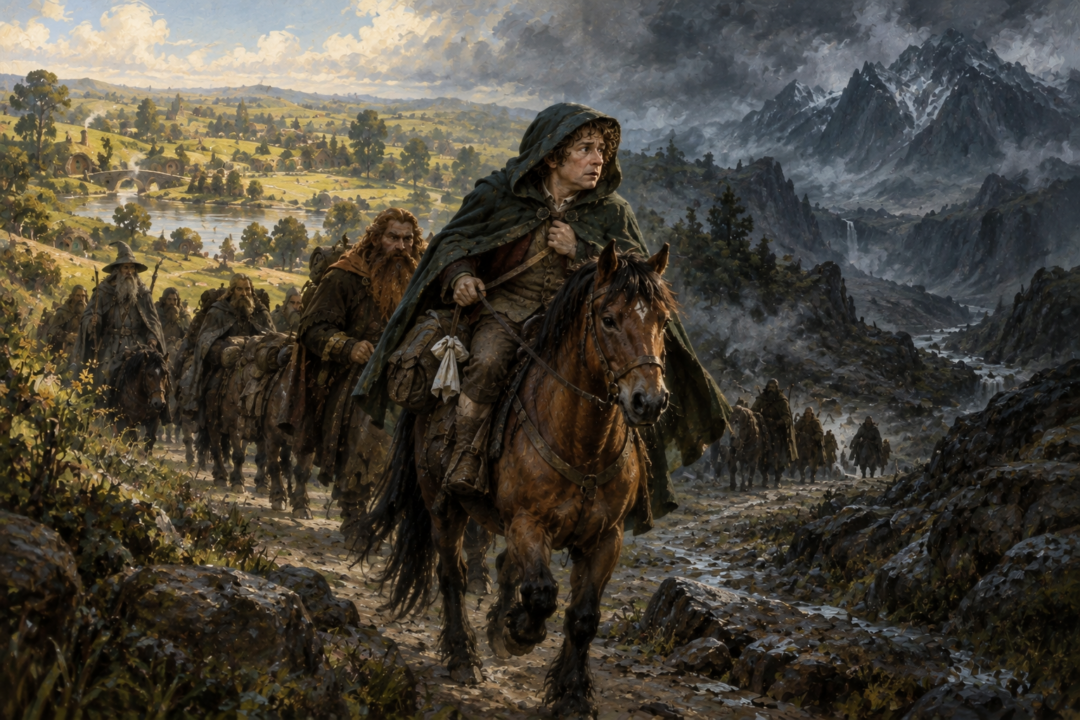
The company is captured by trolls. In the Misty Mountains they are seized by goblins. Bilbo becomes separated from his companions underground and awakens alone in darkness. He encounters Gollum without Gandalf or the dwarves beside him. Later, in Mirkwood, he increasingly becomes the person who must rescue others.
The change is gradual.
Bilbo does not stop loving comfort. He does not become a warrior who despises domestic life. He continues to remember food, home, his hobbit-hole, and the pleasures of the Shire.
That continuity is essential.
His development is not the destruction of Bilbo Baggins. It is the discovery that the supposedly unadventurous Bilbo can act when the comforts associated with Bilbo Baggins are unavailable.
The pocket-handkerchief therefore works as an unusually effective marker.
At first, its absence is an emergency.
Later, Bilbo survives situations in which remembering a handkerchief would be absurdly irrelevant.
The scale of what matters has changed.
The Handkerchief Returns at the Door of Smaug
The most important use of the image comes much later, beneath the Lonely Mountain.
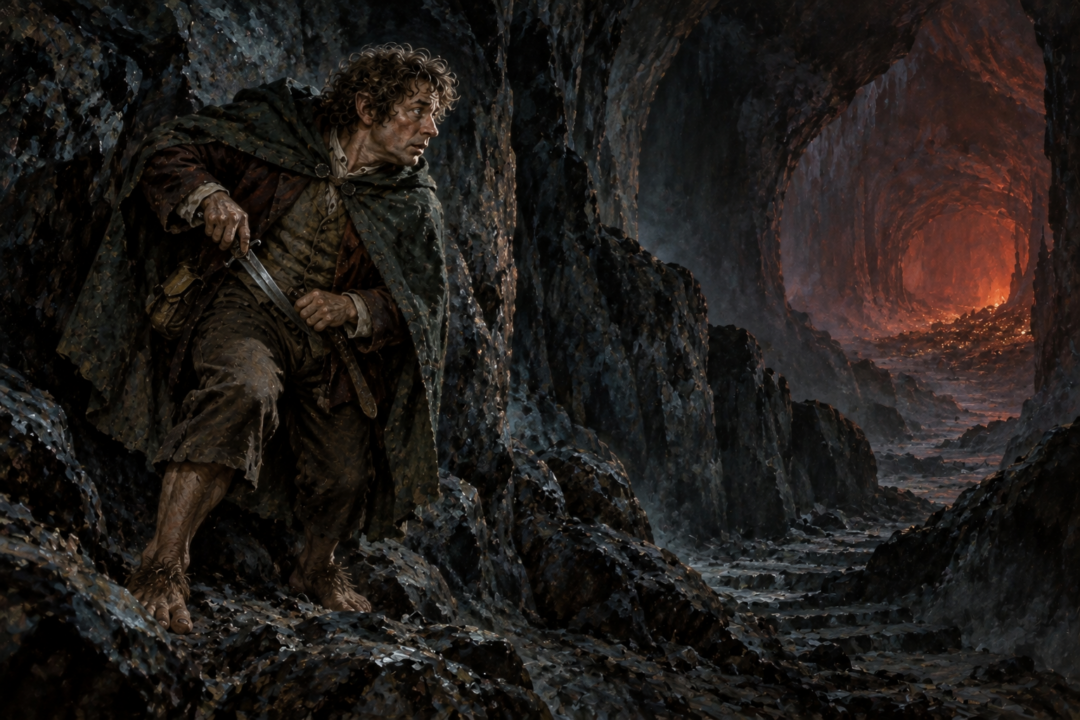
Bilbo has agreed to enter the secret passage and investigate the dragon’s lair. The dwarves remain outside while he descends alone.
He is frightened.
Yet the narration pauses to compare him with the hobbit who left Bag End long before. Bilbo is now described as very different from the figure who ran away from home without his pocket-handkerchief. The text adds that he has not had one for ages.
This callback makes the earlier joke part of Bilbo’s character arc.
The contrast could hardly be sharper.
At Bywater, Bilbo is distressed because he lacks the equipment of an ordinary outing.
At Erebor, he is voluntarily moving down a dark tunnel toward Smaug.
He still fears what is ahead. His courage is not fearlessness. Indeed, Bilbo’s thoughts reveal that part of him desperately wishes he could wake and discover that the terrible tunnel was merely his own front hall.
The old Bilbo is still present.
But he keeps walking.
That is the transformation.
Courage Does Not Require Bilbo to Stop Wanting Home
Bilbo’s relationship with comfort is sometimes easy to misunderstand.
His growth does not mean that Bag End was a moral weakness he needed to overcome.
The story never requires him to decide that warm fires, plentiful meals, friendship, peace, and home are worthless. On the contrary, his longing for ordinary goodness helps distinguish him from characters consumed by treasure and possession.
What changes is his dependence on comfort.
At the beginning, disruption itself seems dreadful. An unexpected party is enough to throw his household into disorder. The prospect of adventure produces thoughts of inconvenience, lateness, missing meals, and forgotten belongings.
By the Lonely Mountain, Bilbo can be frightened, uncomfortable, isolated, and still choose to continue.
He has learned that courage can coexist with wanting to be somewhere safer.
That distinction becomes one of the most appealing features of his heroism.
Bilbo does not become great because danger begins to please him.
He becomes capable of greatness because danger no longer has to please him before he acts.
From Handkerchief to Sting
There is a revealing contrast between what Bilbo notices when he leaves the Shire and what he prepares before entering Smaug’s tunnel.
At Bywater, the missing handkerchief occupies his thoughts.
Before approaching the dragon, he checks himself for danger. He loosens his dagger in its sheath, tightens his belt, and continues downward.
That dagger is the Elvish blade he found in the trolls’ hoard and later named Sting after fighting the spiders of Mirkwood.
The contrast should not be treated as a literal exchange—as though the story establishes a formal rule that the handkerchief has been replaced by the sword. It does not.
But as an image of Bilbo’s development, the difference is striking.
The hobbit who once wanted the familiar accessories of a respectable excursion now carries the tools and experience acquired on the road.
More importantly, he carries something that cannot be packed into luggage at all: tested courage.
The First Cost Is Small Because Greater Costs Are Coming
The forgotten pocket-handkerchief is funny partly because the reader can already sense how inadequate Bilbo’s expectations are.
He worries about a small domestic object because he does not yet understand the scale of the journey.
Before he returns home, he will experience terror, hunger, imprisonment, loneliness, battle, and grief. He will see the consequences of greed surrounding the treasure of Erebor. He will lose companions he has travelled beside for months.
Against those things, a forgotten handkerchief is almost nothing.
Yet narratively it comes first.
Adventure initially takes from Bilbo not something precious, but something familiar.
Then it keeps asking more.
The road moves him farther from the conditions in which he has always understood himself. Inns disappear. Meals become uncertain. companions are separated. Gandalf is not always present. Eventually Bilbo must make consequential decisions without anyone else being able to make them for him.
The missing handkerchief is therefore less important as a possession than as a threshold.
It marks the moment when Bilbo discovers that the world beyond his door will not reorganize itself around his habits.
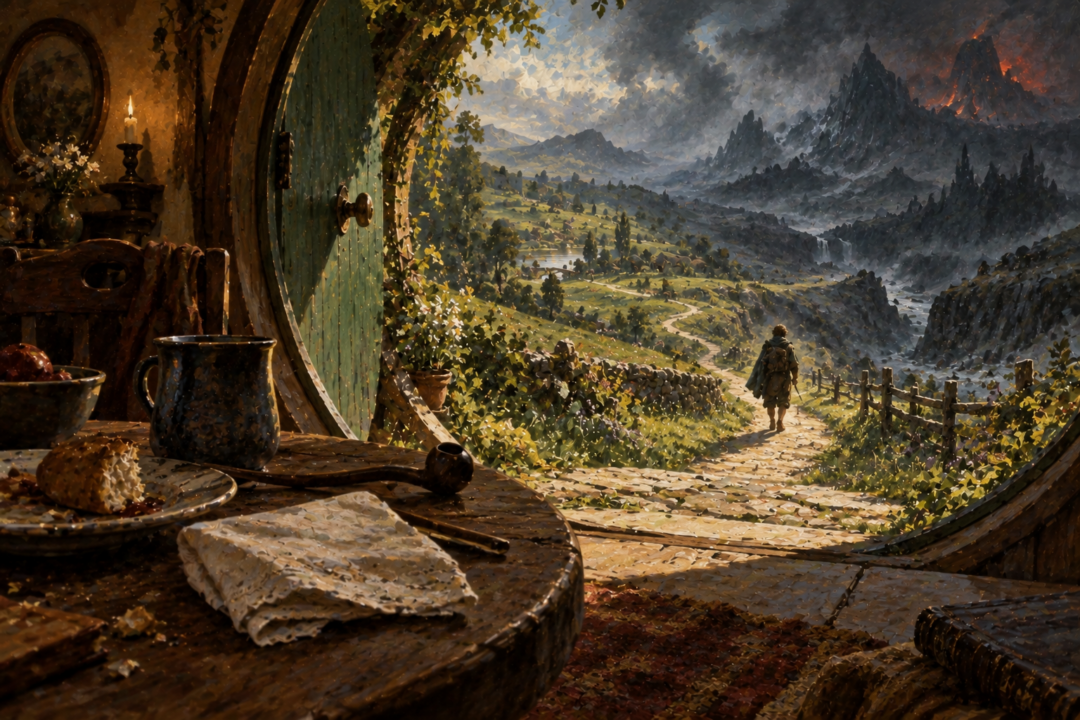
Why the Tiny Detail Matters
Near the beginning of The Hobbit, Bilbo seems almost comically unsuited to the company he has joined.
Near Smaug’s chamber, the story itself remembers that earlier hobbit.
That deliberate return gives the pocket-handkerchief its real weight.
Bilbo has travelled so far that something once important enough to announce at the beginning of the expedition has quietly vanished from his life. He has adapted without noticing the exact moment when adaptation occurred.
And that may be the most convincing kind of transformation.
Bilbo does not wake one morning and declare himself courageous. There is no ceremony in which the timid hobbit disappears and the hero takes his place.
Instead, he repeatedly does the next difficult thing.
He runs to Bywater.
He survives beneath the mountains.
He faces the spiders.
He enters the Lonely Mountain.
And eventually, while standing before one of the greatest dangers of his journey, the story looks back toward Bag End and reminds us of the pocket-handkerchief.
The object itself was never the true cost.
The cost was leaving behind the assumption that Bilbo could enter adventure while keeping every condition of home around him.
He could not.
What he discovered was better: he could lose those conditions, remain unmistakably Bilbo Baggins, and keep going.
Sources & Notes
- Tolkien Gateway, “Bilbo Baggins” — https://tolkiengateway.net/wiki/Bilbo_Baggins
- Tolkien Gateway, “An Unexpected Party” — https://tolkiengateway.net/wiki/An_Unexpected_Party
- Tolkien Gateway, “Quest of Erebor” — https://tolkiengateway.net/wiki/Quest_of_Erebor
Reference entries document the characters, places, events, and textual details discussed in this article.