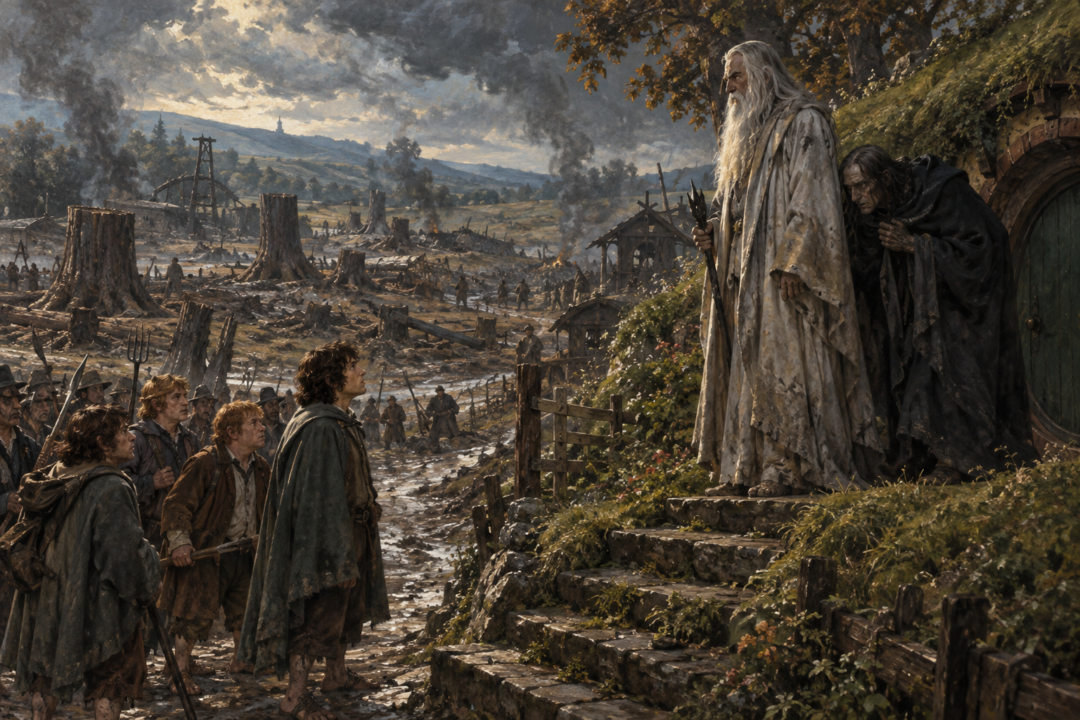
By the time Frodo returns to Bag End, Saruman has already lost almost everything that once made him formidable.
Isengard has fallen. Orthanc is no longer the center of a military power. His staff has been broken by Gandalf. His great schemes have failed, Sauron has been overthrown, and even the shabby tyranny Saruman establishes in the Shire is collapsing around him.
Yet one servant remains beside him: Gríma Wormtongue.
That detail matters. Gríma is not merely Saruman’s companion in defeat. He is the last recognizable survivor of the personal system of obedience, intimidation, manipulation, and delegated corruption through which Saruman has repeatedly exercised power. When Gríma finally turns on his master outside Bag End, therefore, the moment is larger than the death of a fallen wizard.
Saruman’s last subordinate destroys Saruman himself.
The chain does not merely break. It consumes its final link.
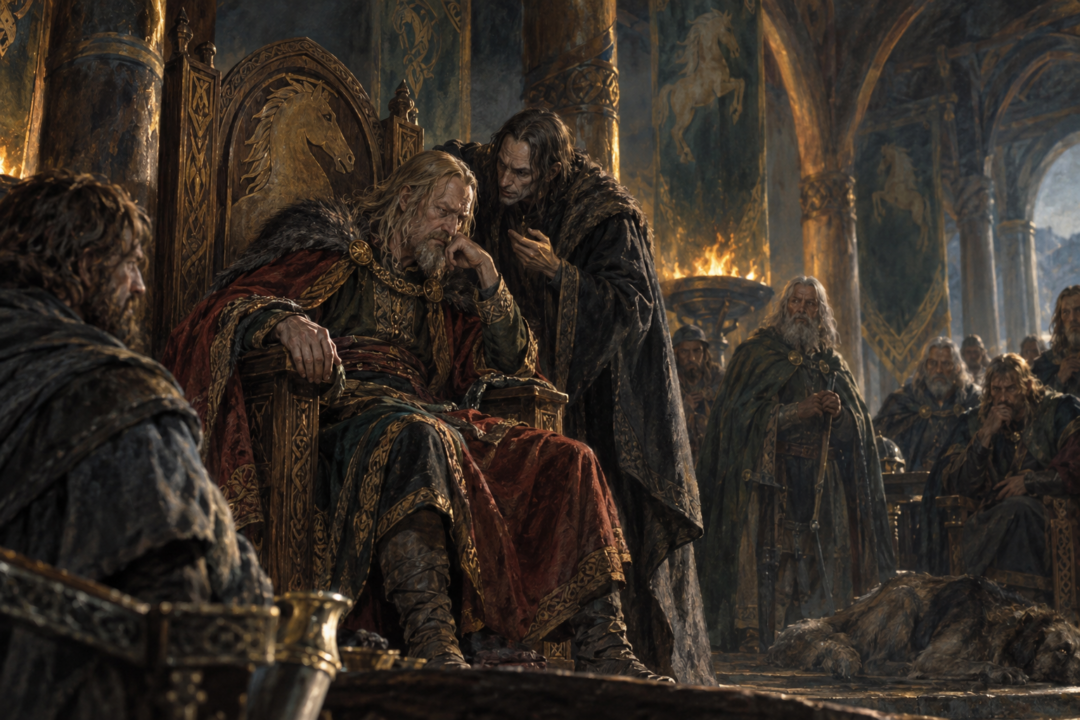
Saruman’s Power Had Always Worked Through Other People
Saruman possesses considerable power in his own right, but much of his political effectiveness comes from making others carry out his purposes.
Gríma is the clearest example.
In Rohan, Wormtongue operates close to King Théoden while secretly serving Saruman. He discourages resistance, undermines those who might oppose his influence, and helps keep the king isolated and diminished. Saruman does not need to sit personally in Meduseld because Gríma allows his influence to reach inside Théoden’s hall.
This pattern appears elsewhere in different forms. Saruman commands Orcs and Men from Isengard. He bargains, threatens, recruits, spies, and manipulates. His power is organizational as well as personal.
Even after Isengard is destroyed as a functioning military base, that habit survives.
The Shire becomes its final, degraded expression.
There Saruman is no longer commanding an army capable of challenging Rohan. Instead, “Sharkey” presides over ruffians who enforce rules, seize goods, intimidate hobbits, imprison opponents, destroy trees, and transform parts of the Shire according to the ugly order imposed upon it.
It is a grotesque miniature of his former ambitions.
The scale has shrunk. The instinct has not.
The Shire Shows How Far Saruman Has Fallen
Saruman’s presence in the Shire is deliberately humiliating.
This is the former head of the White Council, a being who once studied the devices of Sauron and dreamed of becoming a great power in Middle-earth. Yet his final domain is a wounded corner of the Shire where frightened Men bully hobbits.
His objectives have diminished with his circumstances.
When the returning Travellers discover what has happened, they find regulations, confiscations, locked gates, destruction, and ruffians claiming authority in the name of the Chief. Lotho Sackville-Baggins had been involved in the changes that preceded the full takeover, but by the end Saruman is the real power behind the occupation.
The Battle of Bywater destroys the military foundation of that power.
Merry and Pippin organize the resistance. The ruffians are defeated, killed, captured, or scattered. The hobbits have learned enough during the War of the Ring to defend their own country without waiting for an outside savior.
That leaves Saruman in an extraordinary position.
He still possesses his voice and his capacity for malice, but his effective apparatus of coercion has collapsed.
There is no army waiting behind him at Bag End.
There is only Gríma.
Gríma Is the Last Remnant of an Older System
Gríma’s presence beside Saruman connects the end of the story directly back to Rohan.
Long before the Shire is occupied, Gríma has already demonstrated what Saruman’s method does to servants. He serves a stronger master while seeking power and advantage beneath him, but service to Saruman never produces genuine dignity or independence.
By the time the two are encountered after leaving Isengard, their relationship has become openly degrading.
Saruman treats Gríma with contempt. Gríma nevertheless continues with him.
It would be too simple to describe Gríma only as an innocent victim. He betrayed Théoden, worked against Rohan, and participated willingly in evil. The narrative never erases his responsibility.
But neither does it present his relationship with Saruman as one between equals.
Gríma has become trapped inside the consequences of his own choices, attached to a master who despises him and uses that degradation as another instrument of control.
This becomes crucial at Bag End because Frodo offers Gríma something Saruman never does.
A way out.
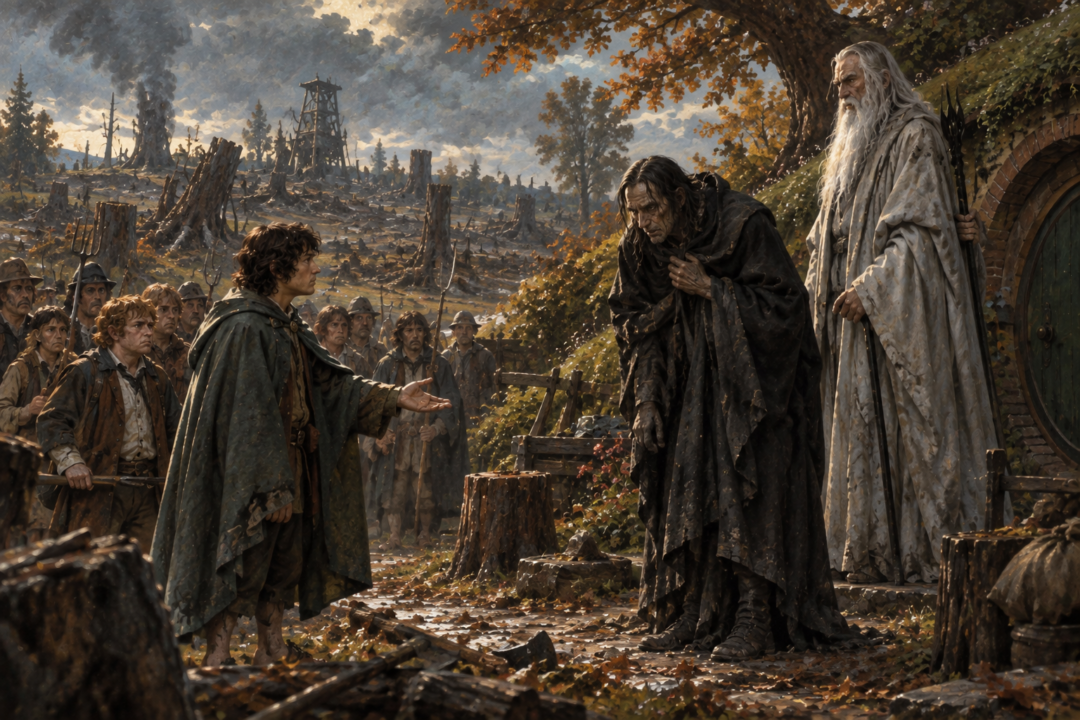
Frodo Tries to Break the Chain Without Killing Anyone
After the victory over the ruffians, Frodo refuses to let the hobbits simply murder Saruman.
That restraint is one of the most important aspects of the scene.
Saruman has harmed the Shire deliberately. He has overseen destruction that strikes directly at Frodo’s home. He even attempts to stab Frodo during their confrontation, though Frodo’s hidden mail protects him.
Still Frodo spares him.
Frodo also turns his attention to Gríma.
He tells Wormtongue that he does not have to follow Saruman. Gríma can remain and receive food and rest until he is strong enough to leave.
This is not merely pity. Structurally, it offers Gríma the possibility of stepping outside Saruman’s authority.
For perhaps the last time, the chain can be broken peacefully.
Saruman immediately tries to prevent that.
Saruman’s Final Weapon Is Humiliation
Saruman no longer has Isengard. He no longer has his staff. His ruffians have been defeated.
But he can still wound with words.
When Gríma hesitates, Saruman turns on him with contempt and reveals that Wormtongue killed Lotho.
The precise circumstances of Lotho’s death are not narrated directly. Saruman states that Gríma killed him, and his taunting implication that Wormtongue may have eaten the body horrifies the hobbits. The text does not independently confirm that latter insinuation, so it should not be treated as established fact.
What matters beyond dispute is Saruman’s purpose in the moment.
He humiliates Gríma publicly.
Then, as they leave, Saruman kicks him.
It is a remarkably small act compared with the wars and betrayals that have filled the story. Yet that smallness is exactly what makes the scene so revealing.
Saruman has been reduced to cruelty almost stripped of strategic purpose. There is no kingdom to gain by abusing Gríma. No fortress will be captured. No alliance will be secured.
He hurts his servant because domination is virtually all he has left.
And this time Gríma does not endure it.
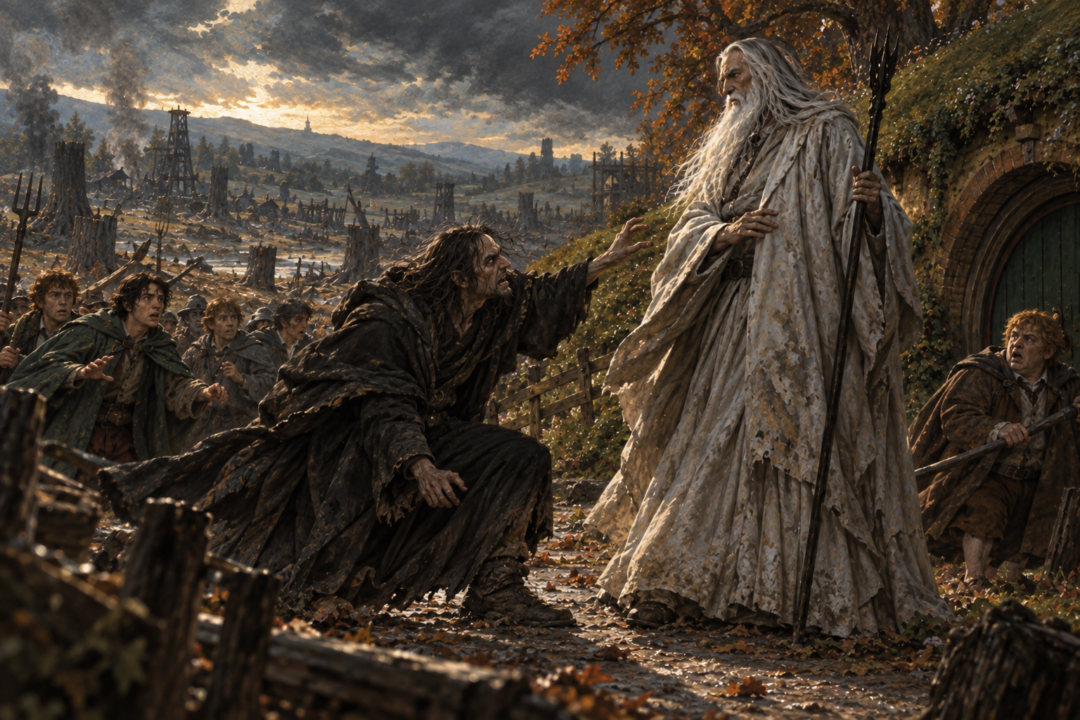
Wormtongue Turns on His Master
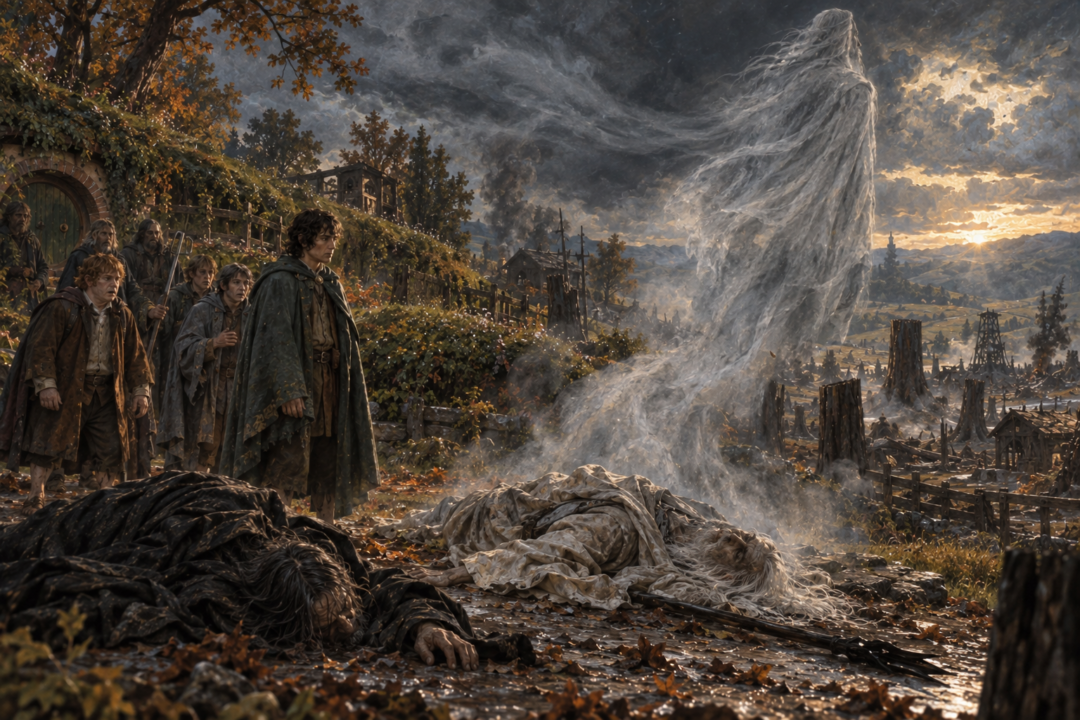
Gríma suddenly attacks Saruman.
He springs upon him and cuts his throat.
The former lord of Isengard dies not before the walls of a fortress, nor in battle against Gandalf, Aragorn, or the Rohirrim, but outside Bag End at the hands of the servant he has spent years degrading.
Then the tragedy completes itself almost immediately.
Gríma attempts to flee and is shot by hobbit archers before Frodo can stop them.
Master and servant die within moments of each other.
This is why Gríma’s act can be read as the destruction of Saruman’s last personal chain of command, though “chain of command” is an analytical description rather than terminology used in the text.
The ruffian organization has already been militarily broken. Lotho is dead. Saruman is being expelled. Gríma is the final named subordinate still physically attached to him.
Then Gríma kills Saruman and is himself killed.
Nothing remains to receive Saruman’s orders.
Saruman’s System Finally Turns Inward
There is a grim symmetry here.
Saruman repeatedly seeks control by weakening the independence of others.
In Rohan, his influence works through Wormtongue against Théoden.
At Isengard, his servants and armies execute his designs.
In the Shire, lesser Men impose his rules upon a population he despises.
But coercive systems contain a weakness: obedience maintained through fear and degradation may survive only while the subordinate believes resistance is impossible or useless.
At Bag End, Saruman pushes Gríma beyond that point.
Gríma’s violence should not be mistaken for moral redemption. He does not suddenly become heroic, and the murder does not erase his earlier crimes.
But his final act demonstrates that Saruman can no longer reliably command even the person most thoroughly bound to him.
The instrument turns against the hand that wielded it.
That is a fitting political end for Saruman.
The Death of Saruman Is More Than a Murder
After Saruman falls, something stranger occurs.
A grey mist gathers above his body and seems to take the form of a pale, shrouded figure. It looks toward the West, but a cold wind comes from that direction and disperses it. His corpse then withers horribly, revealing the physical ruin concealed beneath his appearance.
The scene gives Saruman’s death a significance beyond ordinary political defeat.
Interpretation should remain cautious here. The imagery strongly suggests rejection and the final exposure of what Saruman has become, but the narrative does not stop to provide a technical explanation of every metaphysical detail.
What is unmistakable is the contrast.
Once, Saruman sought mastery through knowledge, machinery, armies, persuasion, and imitation of the Enemy.
At the end, none of these remain.
His voice cannot save him.
His servant will not obey him.
His body collapses.
Even the shape that rises above him cannot pass westward.
The dismantling is complete.
Gríma’s Last Choice Reveals Saruman’s Greatest Failure
The tragedy is that another ending had been offered only moments earlier.
Frodo offers mercy to both Saruman and Gríma.
Saruman rejects it through pride and malice.
Gríma appears, at least briefly, capable of accepting another path. But Saruman cannot tolerate even the possibility that his servant might escape his control. He reaches for the tool he has left: humiliation.
That choice destroys him.
Saruman survives the Ents. He survives the destruction of his military power. He survives Gandalf’s judgment at Orthanc. He survives Sauron’s downfall and travels all the way to the Shire.
What he cannot survive is the final consequence of his own manner of ruling.
He has taught Gríma a world governed by treachery, fear, contempt, and domination. At Bag End, that logic comes home to its maker.
Gríma breaks free—but in the worst possible way.
And because Gríma himself dies seconds later, Saruman leaves behind no successor, no functioning organization, and no servant capable of continuing his petty regime.
The Shire still has wounds to heal. Trees must be replanted. Homes must be repaired. Prisoners must recover. The social damage caused by the occupation cannot vanish instantly.
But Saruman’s command structure is finished.
Its final order is never given.
Its final servant has turned.
And the last act of Wormtongue is to ensure that the voice which ruled him will never command anyone again.
Sources & Notes
- Tolkien Gateway, “Gríma” — https://tolkiengateway.net/wiki/Gr%C3%ADma
- Tolkien Gateway, “Saruman” — https://tolkiengateway.net/wiki/Saruman
- Tolkien Gateway, “Scouring of the Shire” — https://tolkiengateway.net/wiki/Scouring_of_the_Shire
Reference entries document the characters, places, events, and textual details discussed in this article.