The Houses of Healing Reveal What Happens After the Battle Is Won
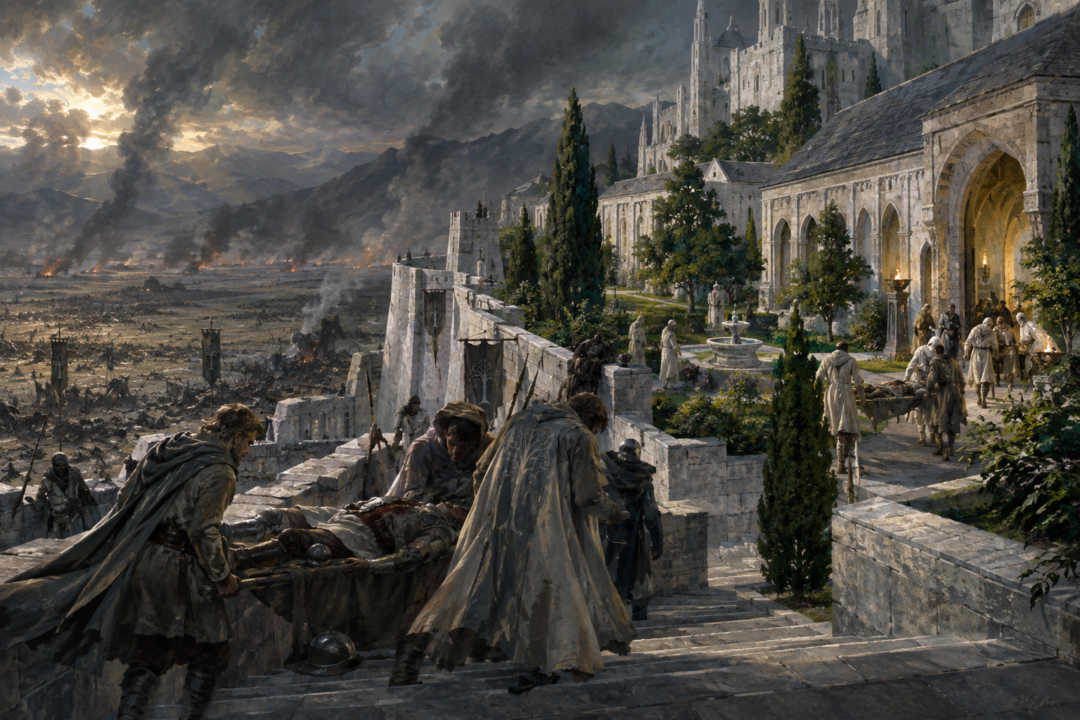
When Merry Brandybuck finally reaches the Houses of Healing, the great battle outside Minas Tirith is already ending. Théoden is dead. The Witch-king has fallen. Éowyn has been carried from the field. Faramir lies within the City, burning with fever. Merry himself can barely walk.
This is where the story quietly changes its definition of survival.
On the Pelennor Fields, the urgent question is brutally simple: who is still alive? But the Houses of Healing deal with a harder question. Once someone has been carried away from the battlefield, what does it actually mean for that person to recover?
The distinction matters because the Houses are not presented merely as a place where wounded soldiers are patched up. They are established institutions for the care of the seriously sick, suddenly forced by siege and battle to receive the wounded and dying in great numbers. And in the stories of Faramir, Éowyn, and Merry, physical rescue is only the beginning.
The battlefield saves bodies from immediate death. The Houses must somehow return people to life.
The Houses Existed Before the Battle
The Houses of Healing are not improvised field hospitals created because Mordor has attacked Minas Tirith.
They already belong to the City.
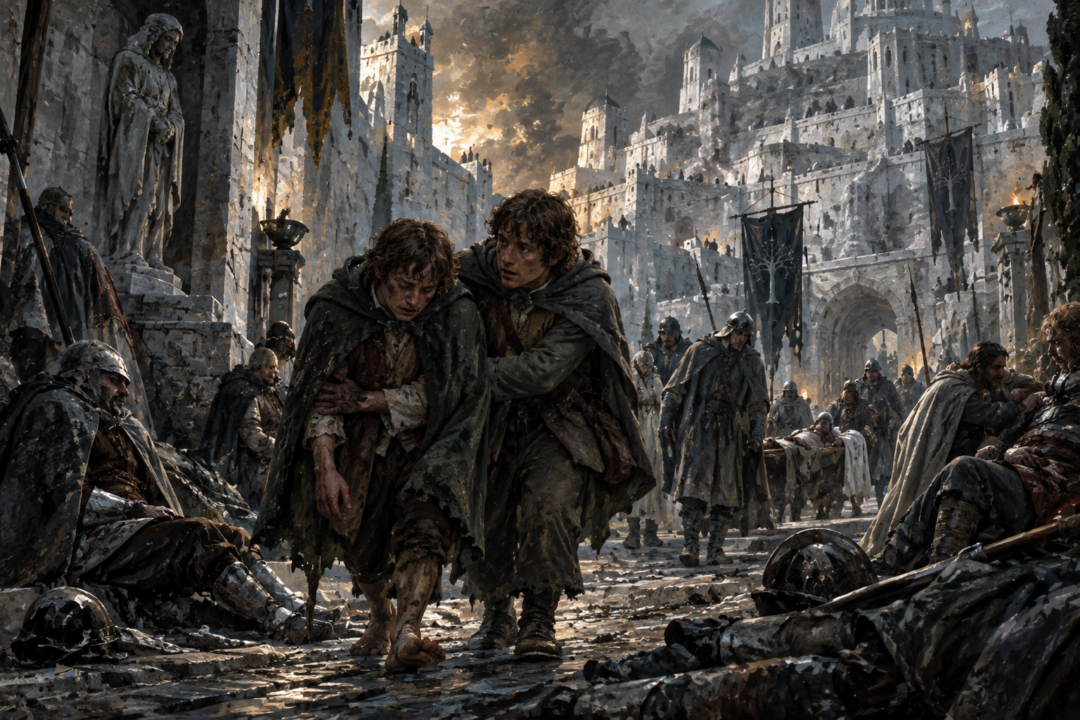
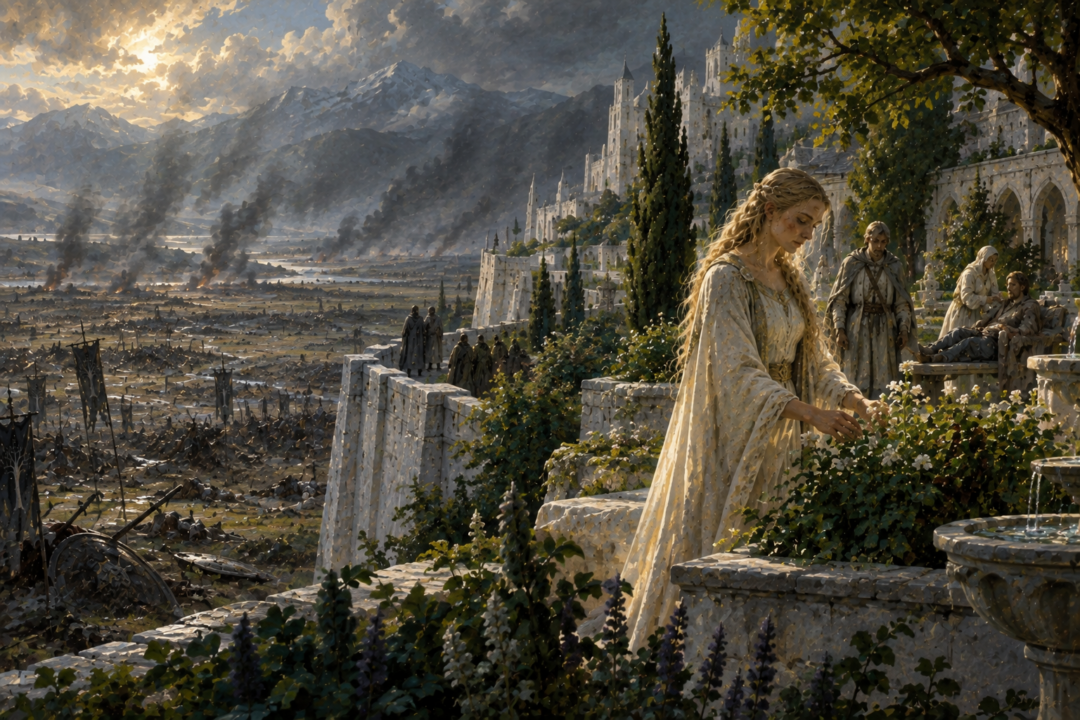
They stand in the sixth circle, near the Citadel, surrounded by lawns and trees. They are described as beautiful houses set apart for the care of those who are gravely sick. During the crisis of the Pelennor, however, their normal purpose expands: they must receive wounded and dying people from the fighting.
That detail establishes an important distinction.
The first work of survival happens elsewhere. Men are found on the battlefield, carried from danger, examined, transported, and brought within the walls. Prince Imrahil famously discovers that Éowyn is still alive when others have taken her for dead. Merry, after striking the Witch-king, struggles into the City until Pippin recognizes how badly he has been hurt.
Faramir has already passed through another kind of rescue. He is saved from Denethor's pyre and carried to the Houses.
Different roads therefore lead to the same place.
The Houses begin where immediate rescue ends.
Tolkien Does Not Describe a Modern Triage System
It would be too strong to claim that Minas Tirith possesses battlefield triage in the precise modern medical sense. The text does not provide a formal system of categories, evacuation protocols, or medical ranks comparable to a modern military hospital.
But it clearly distinguishes urgent battlefield action from sustained treatment.
On the Pelennor, the living must first be distinguished from the dead. Wounded people have to be removed from the field. Immediate injuries demand attention. Only afterward can they be placed under the continuing care of the healers.
The Houses represent that second stage.
They have a Warden with authority over patients. They have healers and attendants. They possess specialized herb-lore, even if that lore proves incomplete when Aragorn asks for athelas. Patients remain there for days rather than merely receiving emergency treatment and departing.
Most importantly, recovery is treated as a process.
Éowyn demonstrates this better than anyone.
Éowyn Is Alive Long Before She Is Healed
Éowyn's survival on the Pelennor is dramatic.
Her recovery is not.
After confronting the Lord of the Nazgûl, she is found apparently lifeless. Imrahil detects breath and ensures that she is carried to the City. Aragorn later succeeds in calling her back from the Black Shadow.
Yet even after this extraordinary intervention, she is not simply restored to her former condition.
Her body remains weak enough that the Warden insists she should rest. When she demands permission to leave the Houses and ride to war, he refuses to treat renewed consciousness as proof of complete recovery.
That is medically sensible within the story, but it is also thematically crucial.
Éowyn's deepest wound did not begin on the Pelennor.
Aragorn recognizes that her despair has older roots: isolation, hopelessness, the decline of Théoden under Wormtongue's influence, and her feeling that she has been trapped while others are permitted to seek deeds and honour. Her desire for death in battle is therefore not merely a sudden response to war.
The Witch-king nearly kills her body.
Despair has been working on her for much longer.
No battlefield rescue can solve that in an afternoon.
Faramir's Recovery Also Continues After Aragorn Leaves
Faramir appears to provide the simpler case.
He is struck by a dart during the retreat from the outer defences and becomes dangerously ill. The Black Shadow lies upon him, and Denethor's despair nearly results in his being burned alive.
Aragorn reaches him in time.
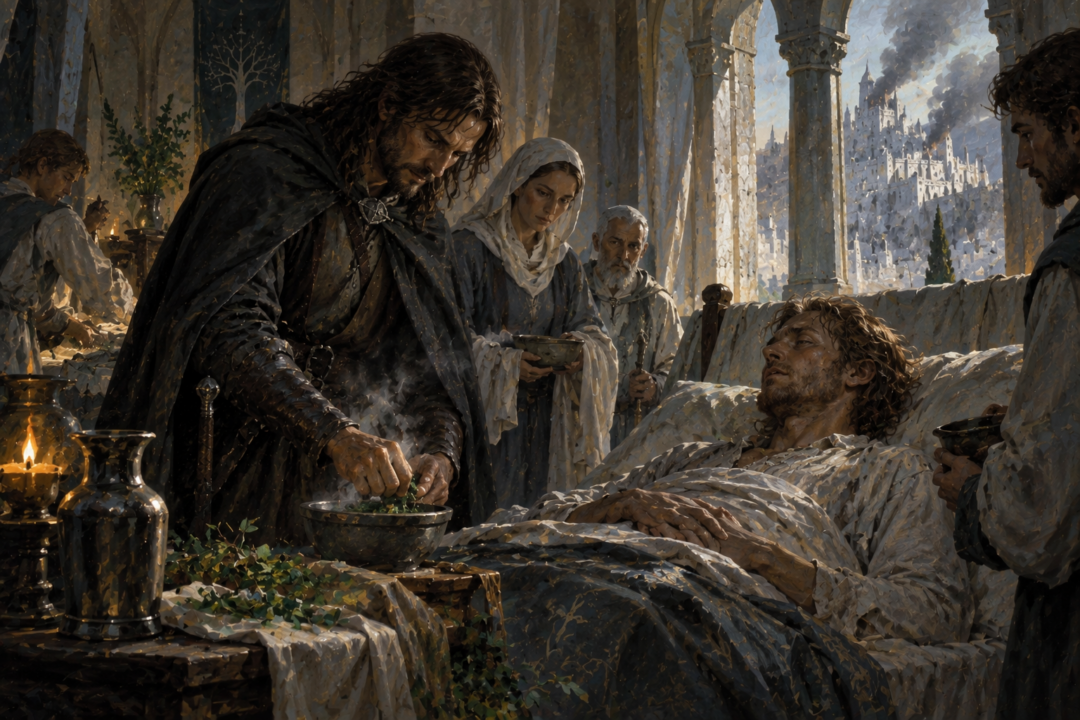
Using athelas and calling to Faramir, he brings him back to consciousness. The moment is one of the clearest demonstrations of Aragorn's healing power and contributes to the spreading recognition in Minas Tirith that the returning king is also a healer.
But Aragorn does not instantly make Faramir ready for battle.
Faramir remains in the Houses.
That matters because the narrative refuses to confuse miraculous awakening with total restoration. Aragorn breaks the immediate danger, but ordinary recovery continues under the care of the Houses.
By the time Faramir meets Éowyn in the gardens, he is able to walk, speak, observe, and slowly return to public responsibility. His healing is measured not simply by whether he breathes, but by whether he can resume a meaningful place among the living.
The Houses give him the time required for that transition.
Merry Shows the Cost Hidden Inside Heroism
Merry's wound is especially revealing because it is easy to overlook.
He has helped Éowyn destroy the Witch-king.
In almost any simpler heroic story, that achievement would complete his part in the battle. The small warrior performs the impossible deed, survives, and emerges triumphant.
Instead, Merry wanders into Minas Tirith increasingly overcome by the effects of his encounter with the Nazgûl.
His arm is cold and useless. He is exhausted and confused. Pippin has to help him onward.
The consequences of touching the supernatural terror of the Nazgûl cannot simply be walked off.
Aragorn heals him with athelas, and Merry wakes. Yet Merry too remains behind when the Captains of the West march toward the Black Gate.
That absence is significant.
He has survived the battle, but survival has imposed limits. The next heroic action belongs to others because Merry's body has reached the point where courage cannot substitute for recovery.
The Houses protect the wounded even from the expectation that they must immediately become warriors again.
The Healers Have Knowledge — and Limits
The episode also avoids presenting Gondor's medicine as either primitive or all-knowing.
The Houses are an organized institution staffed by people who clearly possess genuine healing knowledge. The Warden can make judgments about Éowyn's condition. The herb-master possesses considerable learning about plants and their names.
Yet when Aragorn asks for athelas, institutional knowledge fails him.
The herb-master knows the plant but does not understand the virtue Aragorn seeks in it, and none is available in the Houses. The scene is partly comic, especially because learned discussion of names proves less useful than actually finding the herb.
But the implication should not be exaggerated.
The healers are not portrayed as frauds. Aragorn possesses knowledge they have lost or never fully retained, especially concerning the Black Shadow. His intervention supplements the Houses rather than making them unnecessary.
After he awakens Faramir, Éowyn, and Merry, they still need the Houses.
Extraordinary healing and ordinary care are not competitors.
They work at different stages.
Aragorn Does Not Only Heal Three Famous Patients
Faramir, Éowyn, and Merry receive the narrative's attention because readers know them.
But Aragorn's work does not stop with them.
Word spreads through Minas Tirith that the king has returned and that healing is in his hands. Other wounded people are brought or call for him, and Aragorn continues tending the sick deep into the night.
This broadens the meaning of the episode.
Kingship is not demonstrated only by command in battle.
Aragorn has already led armies, crossed the Paths of the Dead, unfurled the standard of Elendil, and helped turn the Battle of the Pelennor. Yet when he enters Minas Tirith before formally claiming its throne, one of his defining acts is not issuing an order.
It is kneeling beside beds.
The returning king is recognized partly because he can restore what war has damaged.
The Gardens Matter as Much as the Sickrooms
The later scenes in the Houses move away from beds and fever.
They move into gardens.
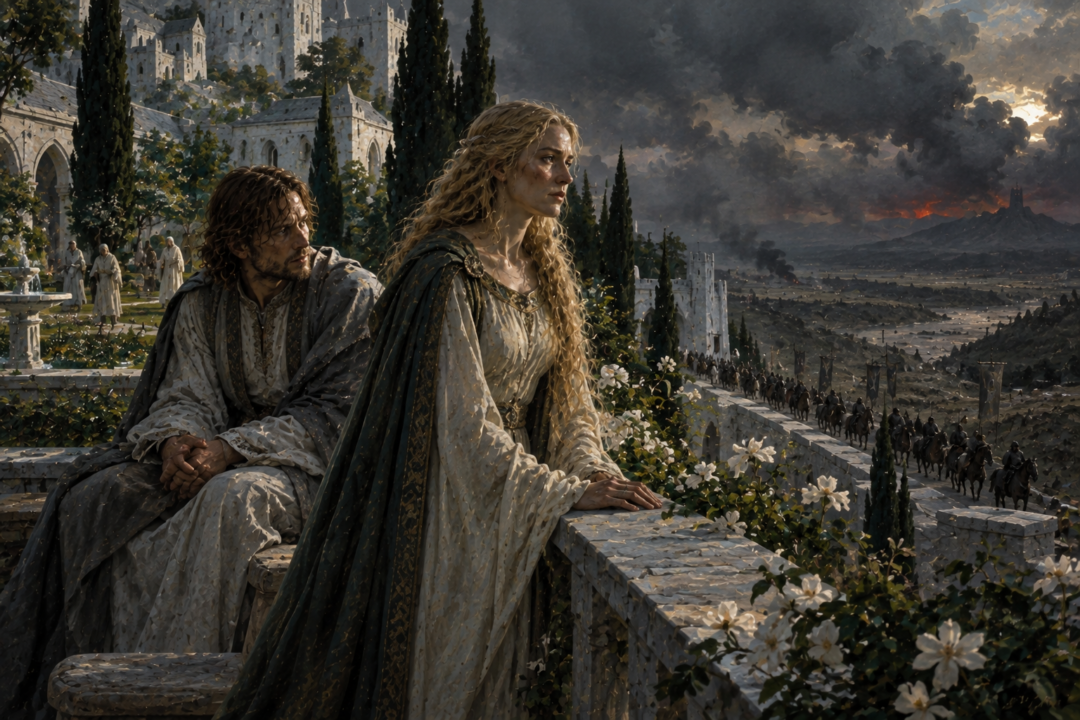
While Aragorn and the armies march east toward what may be their deaths, Faramir and Éowyn remain behind. They watch. They wait for news. They speak.
Nothing about this resembles battlefield glory.
Yet it is here that Éowyn's deeper recovery finally becomes visible.
Faramir does not simply cure her sadness, and the text should not be reduced to the idea that romance magically heals trauma. Rather, their conversations reveal a gradual transformation in what Éowyn desires.
She had sought greatness partly through death.
Eventually she chooses life.
Her declaration that she will become a healer is especially powerful in this setting. The woman who rode secretly to battle because she feared confinement and obscurity now imagines a future defined not by destroying enemies but by preserving and nurturing life.
The Houses have therefore become more than a hospital.
They are the landscape in which her understanding of heroism changes.
Victory Requires Somewhere for the Wounded to Go
The Battle of the Pelennor Fields is one of the greatest military victories of the Third Age.
But the Houses of Healing expose the cost concealed inside the word "victory."
Théoden cannot be healed.
Many unnamed soldiers cannot be healed.
Others survive but need time, skill, rest, protection, and care. Some wounds are physical. Some come from contact with the Nazgûl. Some, as Éowyn's story strongly suggests, cannot be understood apart from despair that existed before the battle began.
The Houses make room for all of this without pretending that every hurt has the same cure.
That may be their most important function in the story.
The Pelennor decides who holds the field.
The Houses deal with what the field has done to those who survived it.
And by placing Faramir and Éowyn's future there, the story makes a quiet argument about what the wars of Middle-earth are ultimately fought to preserve. The goal is not endless courage under arms. It is the possibility of laying arms aside.
A battlefield can produce heroes.
Only peace can give those heroes somewhere to live afterward.
Sources & Notes
- Tolkien Gateway, “Houses of Healing” — https://tolkiengateway.net/wiki/Houses_of_Healing
- Tolkien Gateway, “Athelas” — https://tolkiengateway.net/wiki/Athelas
- Tolkien Gateway, “Aragorn” — https://tolkiengateway.net/wiki/Aragorn
- Tolkien Gateway, “Siege of Gondor” — https://tolkiengateway.net/wiki/Siege_of_Gondor
Reference entries document the characters, places, events, and textual details discussed in this article.