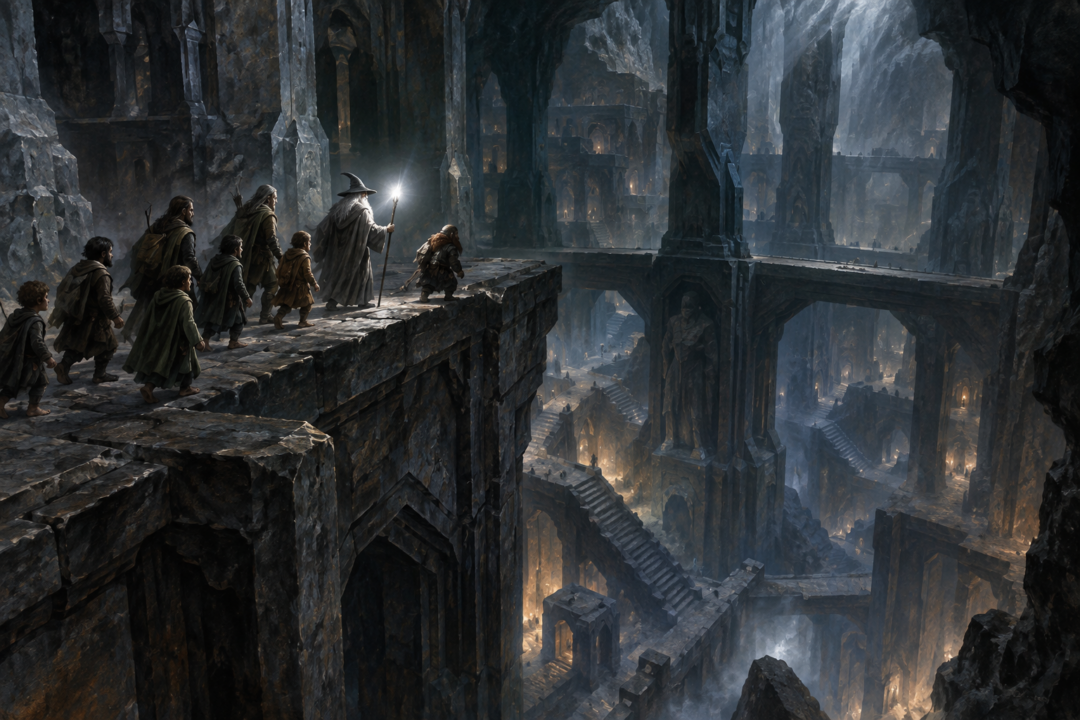
The East-gate of Moria is already close. Somewhere beyond the stone, daylight and the valley of Dimrill Dale are waiting. Yet when the Fellowship reaches the last stage of its journey through Khazad-dûm, the road to freedom does not simply run forward.
It runs down.
After the discovery of Balin’s tomb and the desperate fighting in the Chamber of Mazarbul, Gandalf leads the Company onto a long stair descending through the mountain. The apparent contradiction is easy to miss. They have crossed beneath the Misty Mountains from west to east. Why, when they are finally near the eastern exit, must they plunge deeper into Moria?
The answer reveals something important about Khazad-dûm. It was never merely a tunnel driven horizontally through a mountain. It was a vast, vertically layered city. By the time the Fellowship nears its eastern side, they are actually far above the level of the East-gate.
Their escape therefore requires a descent before it can become an exit.
Moria Is a City, Not a Passage Through the Mountains
The Fellowship enters Moria through the West-gate beside the darkened waters outside the Doors of Durin. From there, Gandalf attempts to guide them eastward through an enormous underground complex whose roads, halls, shafts, stairs, and chambers had been built over many generations of Dwarven habitation.
That distinction matters.
A reader can easily picture Moria as a gigantic tunnel under the mountains: enter on one side, walk more or less straight across, emerge on the other. The text describes something far more complicated.
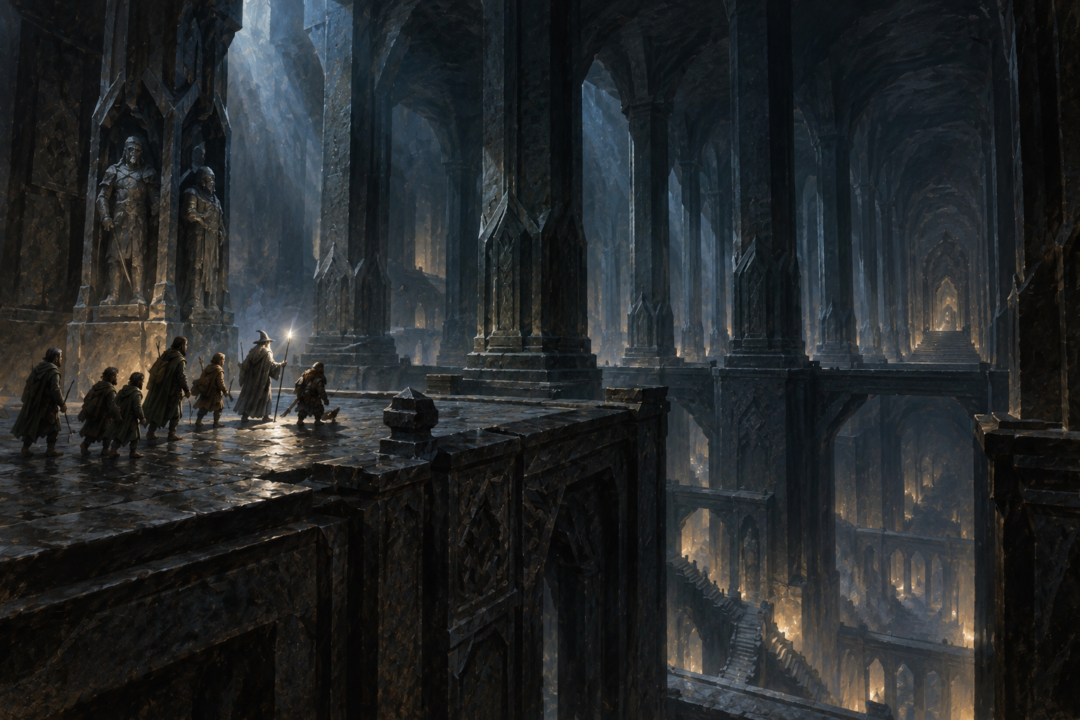
Khazad-dûm possesses different levels and deeps. Roads climb and descend. Stairways connect halls separated vertically as well as horizontally. Shafts disappear into darkness. Vast chambers are cut at different heights within the mountain.
Even Gandalf does not possess perfect knowledge of every passage. He had travelled through Moria before, but navigating the abandoned city still requires judgment, memory, and sometimes uncertainty.
The Fellowship is therefore not following a simple eastward line. They are moving through the remains of an underground metropolis.
And near the eastern end of that metropolis, their route has carried them surprisingly high.
The Fellowship Reaches the Seventh Level
The crucial geographical clue comes shortly before the discovery of Balin’s tomb.
The Company reaches the Twenty-first Hall of the North-end. Gandalf identifies their position as being on the Seventh Level of Moria.
More importantly, he explains that the Great Gates—the eastern entrance toward Dimrill Dale—lie several levels below them.
In other words, the Fellowship has successfully travelled eastward across much of Khazad-dûm, but they have not arrived at the elevation of the exit.
They are above it.
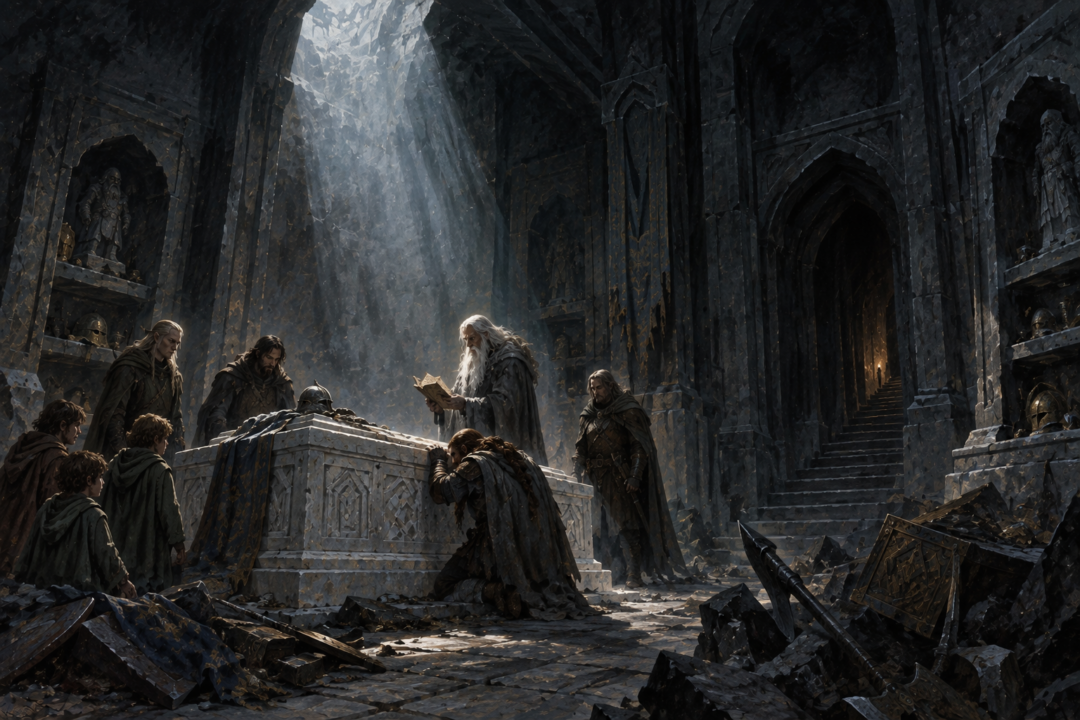
The Chamber of Mazarbul, where they find Balin’s tomb and the Book of Mazarbul, lies in this same high eastern region of the city. Geographically, therefore, the Company is tantalizingly near freedom while still being vertically separated from it.
This creates one of Moria’s most effective pieces of tension.
Outside may be only a comparatively short distance away in one sense. Yet thousands of feet of architecture, stairs, halls, and unknown dangers may still lie between the Fellowship and the gate.
Near does not mean accessible.
Balin’s Tomb Stands Almost Above the Road to Freedom
The tragedy of the Chamber of Mazarbul becomes sharper when its position is understood.
Balin’s colony had established itself in the Twenty-first Hall and nearby chambers. Balin himself was buried in the Chamber of Mazarbul after being killed outside near the Mirrormere. The surviving Dwarves were eventually driven back and trapped as Orcs took control of crucial parts of Moria.
The Fellowship finds the final record of that disaster while occupying almost the same geographical predicament.
They too are now in the eastern reaches of the city. They too know that the way out lies below. And they too suddenly discover that enemies control the routes between them and the gate.
The Book of Mazarbul records the destruction of Balin’s people in broken, increasingly desperate fragments. The Fellowship barely has time to understand what it has found before the same danger closes around them.
The dead Dwarves therefore provide more than historical background. Their fate shows what happens when a force becomes trapped inside a layered fortress whose passages can be seized one by one.
The Fellowship has reached the right part of Moria.
It has not yet reached safety.
The Stair from the Chamber Is Their Lifeline
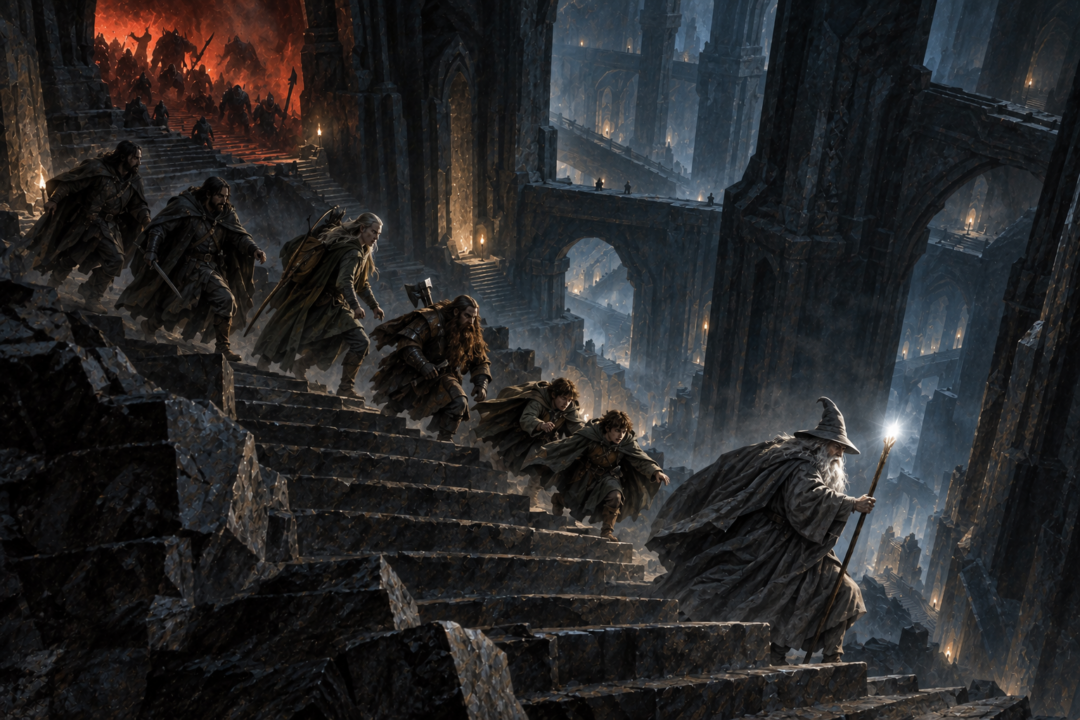
When Orcs attack the Chamber of Mazarbul, retreating by the route they entered would risk carrying the Company away from the East-gate. Their hope lies instead through the eastern side of the chamber and the stairs beyond.
There Gandalf finds the descending route they need.
The staircase runs downward with remarkable persistence. The Company descends flight after flight while pursuit gathers behind them. The exact architectural relationship of every stair, turning, and chamber cannot be reconstructed with absolute certainty from the narrative, and attempts to map Moria necessarily involve some inference.
But the essential geography is explicit: they must descend from the higher levels toward the great halls associated with the eastern entrance.
The downward flight is therefore not an accidental detour.
It is the escape route.
This also transforms the emotional meaning of descent. Ordinarily in Moria, going downward feels like going deeper into danger. Darkness lies beneath them. Unmeasured abysses open below. Gandalf himself later pursues the Balrog into depths far beneath the known Dwarven works.
Yet here the opposite is temporarily true.
Down means eastward escape.
The Company must go lower in order to get out.
The Second Hall Lies Below the Chamber of Mazarbul
Eventually the descent brings the Fellowship toward the Second Hall.
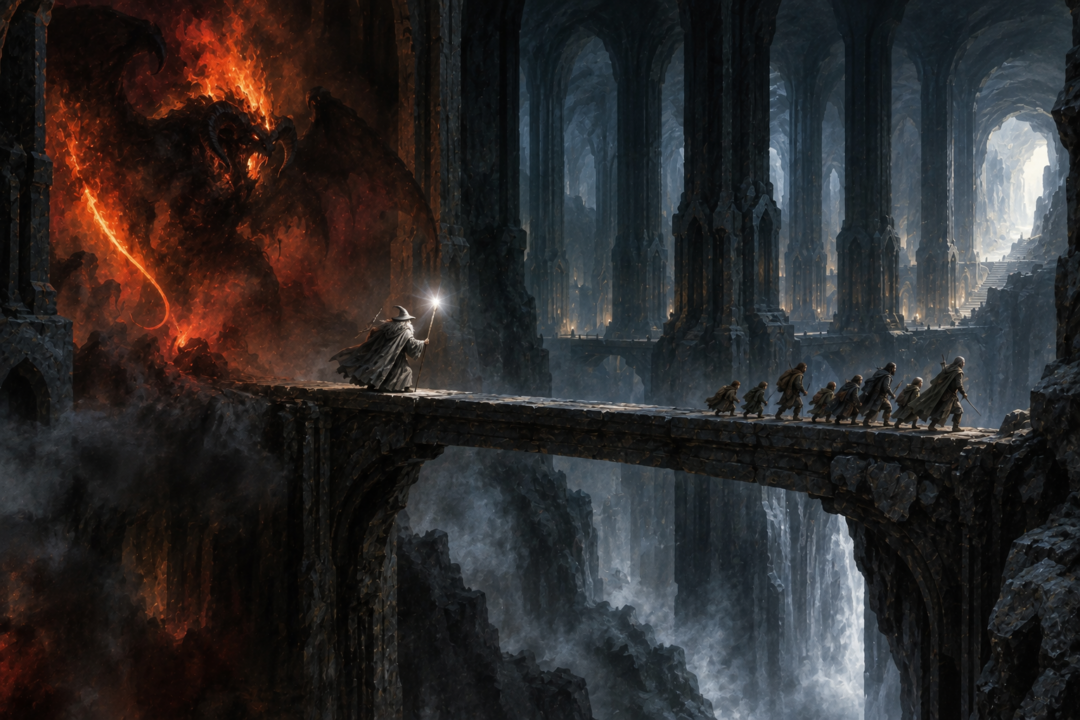
This is one of the enormous spaces near Moria’s eastern entrance. It belongs to the First Deep, below the level of the gates. At its eastern end stands one of Khazad-dûm’s most remarkable defensive features: the narrow Bridge of Khazad-dûm spanning a deep chasm.
Beyond that bridge lies the final approach toward the First Hall and the East-gate.
The layout makes military sense.
Someone entering Moria from the east would first pass into the First Hall. To penetrate farther into the city, an attacker would eventually be forced toward the narrow bridge, where movement could be restricted to a tiny frontage over an abyss.
The Fellowship approaches this defensive system from the opposite direction.
For them, the bridge is not protecting Moria from intruders.
It is blocking the last road out.
And behind them is something far worse than Orcs.
The Architecture Turns Against Its Escaping Guests
The beauty of the sequence lies partly in how Dwarven architecture changes meaning depending on which direction a traveller moves.
To Khazad-dûm’s builders, the eastern approaches could function as a defence. The narrow bridge made an attacking army vulnerable. Immense halls, controlled passages, and elevation changes could make the city extraordinarily difficult to penetrate.
But the Fellowship is fleeing outward.
Every defensive obstacle now works against them.
A narrow bridge that could stop an invading host also prevents nine fugitives from simply scattering or bypassing an enemy.
A stair designed to connect levels becomes a deadly funnel.
A vast hall provides no easy refuge when enemies are closing from behind.
Moria’s architecture has not changed. Its meaning has.
The Company is experiencing the defensive structure from the wrong side.
Why the Balrog Appears at the Worst Possible Place
The confrontation at the Bridge of Khazad-dûm becomes even more terrifying when viewed through this geography.
The Fellowship has already accomplished the difficult part of the descent. They have reached the lower eastern halls. The First Hall and the East-gate are close.
Then Durin’s Bane arrives.
There is nowhere else to go.
The bridge is narrow. The abyss beneath it is immeasurable from the Company’s perspective. The enemy is behind them, while freedom lies beyond the span.
Gandalf’s decision to hold the bridge is therefore not merely dramatic symbolism. The location itself forces the crisis.
If the Balrog crosses, the Fellowship may be overtaken before reaching the gate. If the bridge can be denied to it, the others can continue toward daylight.
The ancient defensive bottleneck of Khazad-dûm becomes the place where one defender can hold back a far greater terror.
That is exactly what such a bridge was built to make possible.
The tragic irony is that Gandalf is using a Dwarven defence not to protect Khazad-dûm, but to escape its ruin.
After the Descent, the World Suddenly Opens
Once the bridge is crossed and Gandalf is lost, the surviving Company continues through the First Hall and reaches the Great Gates.
Then the entire character of the journey changes.
After days of stone roofs, torchlight, uncertain passages, and enormous darkness, they emerge into daylight beneath the eastern mountains. Before them lies Dimrill Dale, the Mirrormere, and eventually the road toward Lothlórien.
The contrast works because the escape has been so vertical as well as horizontal.
They have not simply walked through a mountain.
They have crossed a buried civilization, risen through its abandoned spaces, reached high halls near its eastern end, discovered the grave of its last would-be lord, and then raced downward through its defensive levels before finally breaking into open air.
Their descent is what makes that emergence possible.
Moria’s Geography Mirrors the Fellowship’s Ordeal
There is also a broader pattern in the sequence, though this is interpretation rather than an explicit rule stated in the text.
The Fellowship reaches what seems like progress only to discover that progress requires going lower first.
They come close to the eastern edge of Moria, but must descend.
They find the history of Balin’s colony, but that knowledge reveals catastrophe rather than reassurance.
They approach daylight, but encounter the Balrog.
They escape the mountain, but lose Gandalf.
Moria repeatedly denies the Company a clean victory.
Every advance carries a cost.
That is why the downward route matters beyond mere geography. Khazad-dûm turns escape into something that must be earned through darkness, fear, and loss.
The Fellowship does eventually emerge beneath the open sky.
But first it has to descend through the dead city’s final levels, cross the narrow bridge built to stop enemies, and leave one of its own behind in the abyss.
Moria does not allow them simply to walk out.
It makes them go down before they can rise again.
Sources & Notes
- Tolkien Gateway, “Moria” — describes Khazad-dûm as a city of levels and deeps and locates the eastern halls and gate. https://tolkiengateway.net/wiki/Moria
- Tolkien Gateway, “Chamber of Mazarbul” — locates Balin’s tomb and records the Fellowship’s discovery and battle in the chamber. https://tolkiengateway.net/wiki/Chamber_of_Mazarbul
- Tolkien Gateway, “The Bridge of Khazad-dûm” — summarizes the Fellowship’s retreat downward from the chamber toward the bridge and exit. https://tolkiengateway.net/wiki/The_Bridge_of_Khazad-d%C3%BBm
- Tolkien Gateway, “Bridge of Khazad-dûm” — describes the bridge near the eastern gates and the stairs leading onward to the First Hall. https://tolkiengateway.net/wiki/Bridge_of_Khazad-d%C3%BBm
Sources document Moria’s vertically layered layout, the Seventh Level position of the Twenty-first Hall and Chamber of Mazarbul, the Fellowship’s downward flight, and the bridge, First Hall, and East-gate sequence.