Elwing Did Not Simply Turn Into a Bird — Ulmo Saved Her From the Sea
Few images from the end of the First Age are stranger or more beautiful than Elwing flying over the Great Sea.
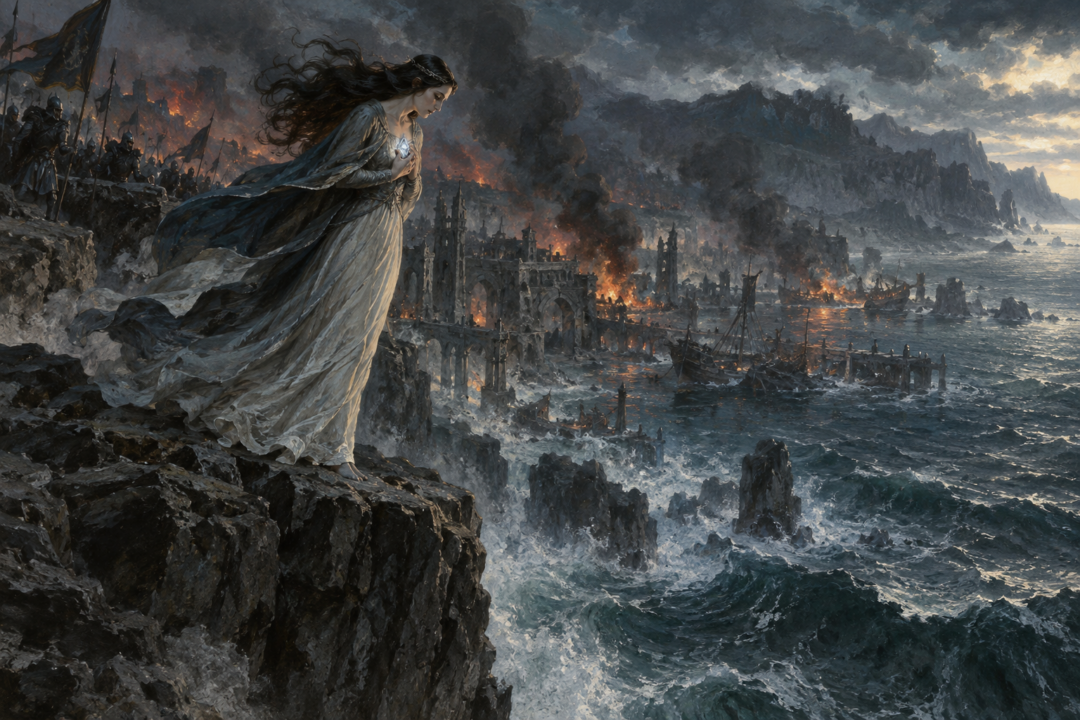
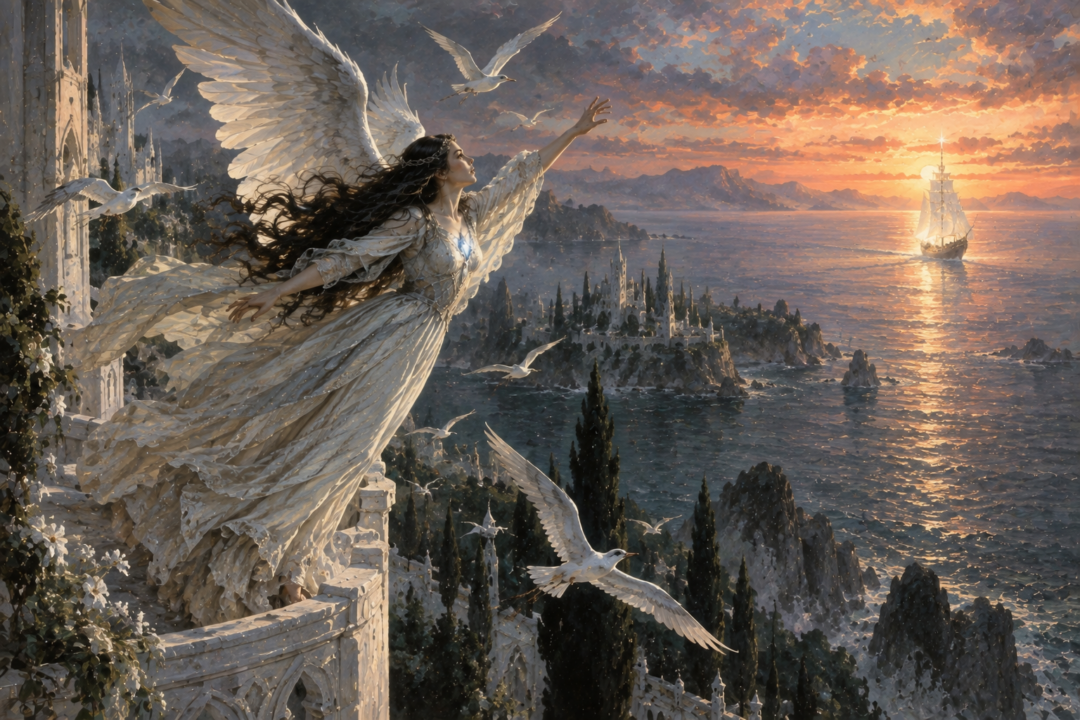
The Havens of Sirion have been destroyed. The surviving sons of Fëanor have attacked yet another Elven refuge in pursuit of the Silmaril. Elwing, rather than surrender the jewel, casts herself into the sea. Yet she does not drown. A great white bird rises above the waves, the Silmaril shining upon its breast, and flies through the night toward Eärendil.
Read quickly, the episode can leave a misleading impression: Elwing jumps, transforms, and escapes.
But the text makes the sequence much more precise.
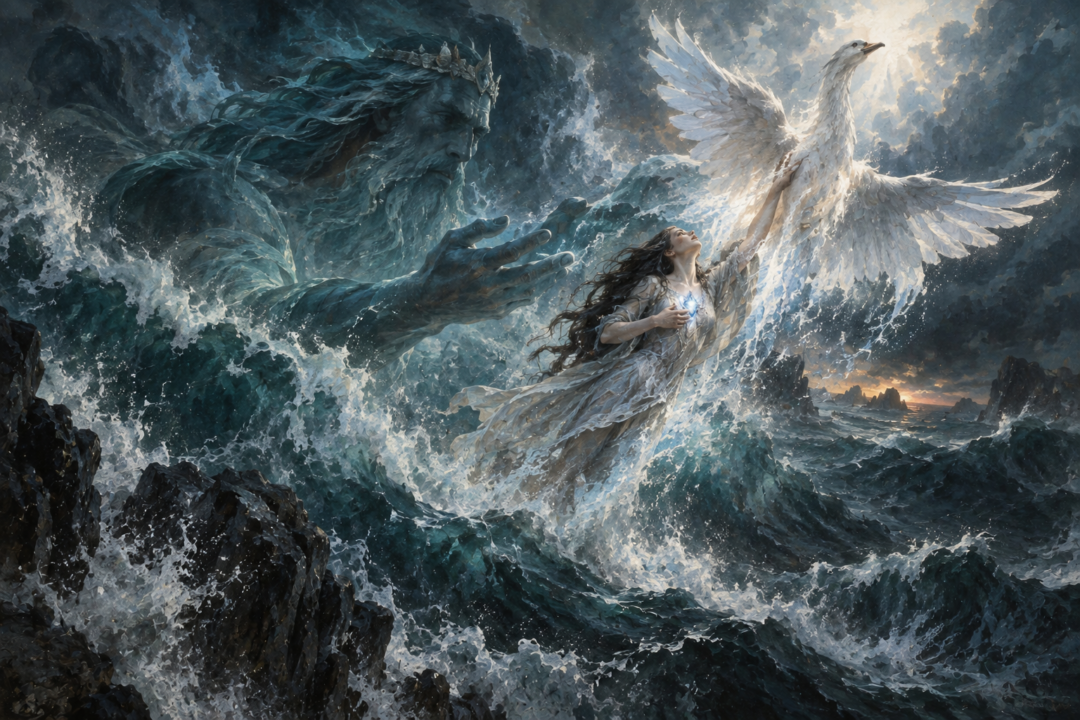
Elwing does not reveal an established power to change her shape. She survives because Ulmo intervenes. The Vala of the Waters bears her up from the waves and gives her the likeness of a great white bird.
That distinction matters. It changes the scene from an exhibition of Elwing's supernatural abilities into something far more characteristic of the final years of the First Age: a moment when almost everything has failed, yet unexpected aid still enters the story.
The Leap Comes Before the Miracle
The immediate cause of Elwing's leap is the Third Kinslaying.
After the destruction of Doriath and Gondolin, refugees from those ruined realms gathered near the Mouths of Sirion. Elwing possessed the Silmaril recovered by Beren and Lúthien from Morgoth's crown and later inherited through her family.
That jewel remained subject to the terrible Oath of Fëanor.
The surviving sons of Fëanor demanded it. The people at Sirion would not surrender it while Eärendil was away at sea, and the oath once again drove Fëanor's sons into violence against other Elves.
The resulting assault is described as the last and cruellest of the three Kinslayings. Some followers of the sons of Fëanor even refused to participate or turned against their own lords.
Elwing's position was desperate.
Her refuge was being destroyed, and the Silmaril was the object for which the attackers had come. She cast herself into the sea with the jewel rather than allow them to take it.
Nothing in that action, by itself, guarantees her survival.
The rescue comes afterward.
The Text Explicitly Gives the Power to Ulmo
The crucial wording in The Silmarillion, in “Of the Voyage of Eärendil and the War of Wrath,” leaves remarkably little ambiguity about what happens next.
Ulmo bears Elwing out of the waves and gives her the likeness of a great white bird.
Those are two connected acts of intervention: she is lifted from the water, and her form is changed.
The text does not say that Elwing remembered how to become a bird. It does not describe her deliberately assuming another form. Nor does it establish earlier that she possesses a general shape-changing ability.
Her extraordinary escape is attributed directly to Ulmo.
This is especially important because Elwing has remarkable ancestry. She descends from Melian, a Maia, through Lúthien and Dior. That heritage makes Elwing one of the most unusual figures among the Half-elven, but the narrative does not use it to explain her transformation at Sirion.
Whatever possibilities readers might imagine from her ancestry, this particular event already has an explicitly named cause.
Ulmo saves her.
Why Ulmo's Presence Makes Sense
Ulmo's intervention is not a random appearance by a Vala who has previously had little connection with the story.
Throughout the First Age, Ulmo is unusually active in the affairs of Middle-earth.
He communicates through waters. He guides Tuor toward Gondolin. He warns Turgon through Tuor that the hidden city's safety will not endure forever. His influence repeatedly reaches people whom the other Powers cannot easily reach because Ulmo does not dwell permanently in Valinor.
Water is his realm, and the sea is not outside his concern.
There is also a striking connection through Eärendil's family. Tuor, Eärendil's father, had been chosen as Ulmo's messenger to Gondolin. Now Eärendil's wife falls into the sea during another catastrophe, and Ulmo intervenes again.
The text does not state that Ulmo saved Elwing because she was Tuor's daughter-in-law, so that should not be treated as a stated motive. But the thematic continuity is difficult to miss. Ulmo repeatedly acts at moments when the surviving hope of the Eldar and Edain is passing through disaster.
At Sirion, that hope is almost extinguished.
Instead, it takes wing.
The White Bird Is a Temporary Form
What happens when Elwing reaches Eärendil makes the nature of the transformation even clearer.
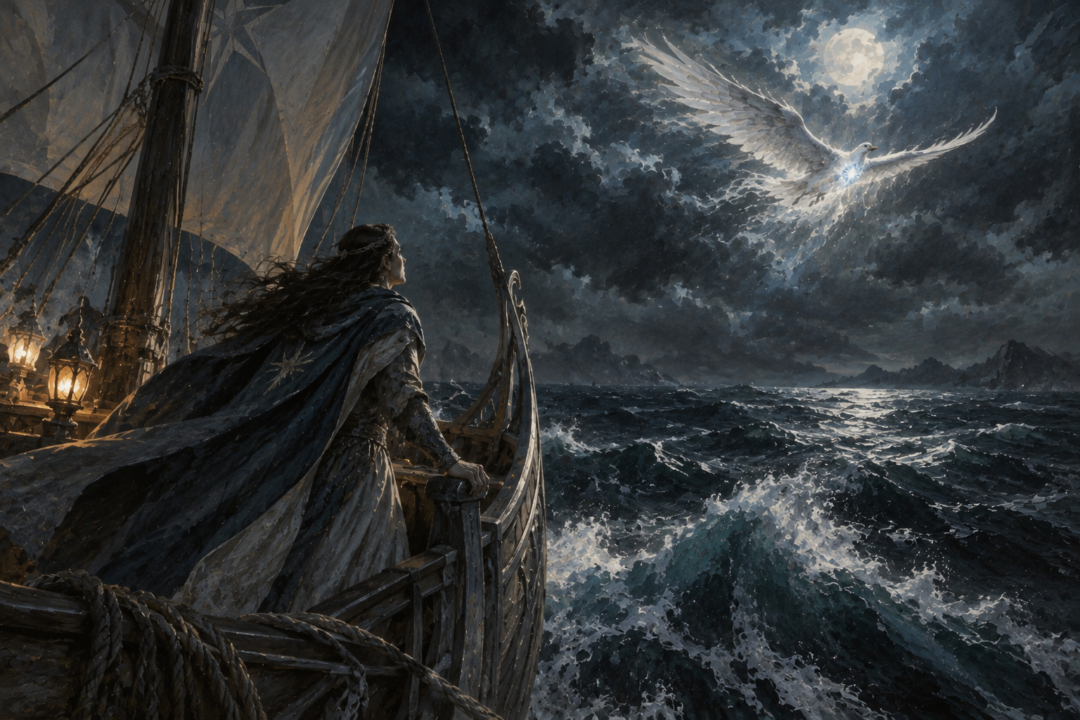
Eärendil is aboard Vingilot when he sees something extraordinary approaching through the night: a brilliant white shape moving over the sea, illuminated by the Silmaril.
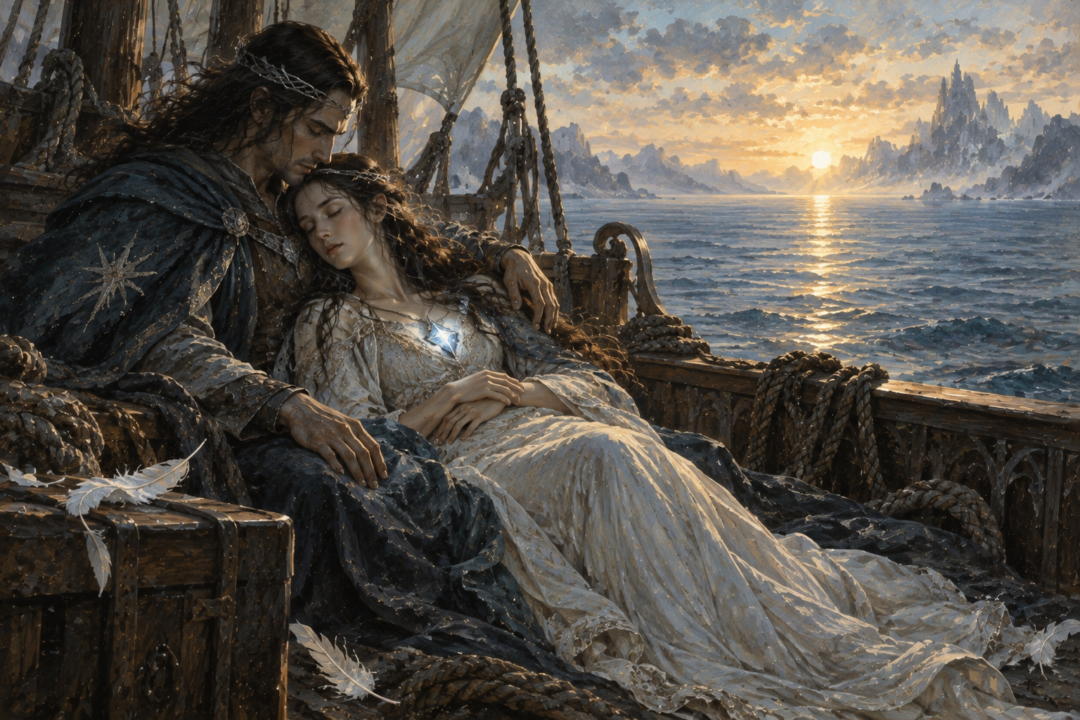
Elwing reaches the ship exhausted. The flight has pushed her nearly to death, and she collapses upon Vingilot.
By morning, Eärendil finds his wife beside him in her own form.
That detail matters enormously.
The bird-shape bestowed during the rescue is not presented as Elwing's permanent physical state. Ulmo gives her the likeness needed to cross the sea and reach Eärendil; afterward she is again Elwing.
The transformation therefore functions as deliverance rather than as evidence of a previously established personal talent.
It also preserves an important element of cost. Elwing may have been miraculously given wings, but the flight is not effortless. Divine intervention does not turn her ordeal into something painless. She reaches Vingilot in a swoon after the desperate speed of her journey.
She has been saved, not made invulnerable.
But Elwing Really Does Fly Later
There is a complication, and it is probably one reason the misconception is so easy to make.
Later, Elwing becomes deeply associated with birds.
After Eärendil reaches Aman and makes his plea before the Powers, he and Elwing are given a choice concerning which of the two Kindreds they will ultimately belong to. Elwing chooses the fate of the Elves, in part because of Lúthien, and Eärendil chooses likewise for her sake.
Elwing eventually dwells in a white tower near the sea. There, according to The Silmarillion, seabirds come to her, and she learns their language.
More remarkably, she is later given wings and flies out to meet Eärendil when his shining ship returns from its voyages.
So the association between Elwing and avian transformation is absolutely real.
But the chronology is important.
The later Elwing who flies from her tower should not be retroactively used to explain the leap at Sirion as though she already possessed an innate, freely usable bird-form.
At Sirion, the text names Ulmo as the agent.
Later, after her fate has been transformed by the judgement of the Valar, Elwing's connection with white birds becomes an enduring part of her existence.
The two images echo one another, but they are not described in exactly the same way.
The Silmaril Survives Because Elwing Survives
Ulmo's intervention also changes the fate of far more than Elwing herself.
The sons of Fëanor destroy the Havens but fail in the very purpose for which they attacked them.
They do not recover the Silmaril.
Instead, Elwing carries it across the sea to Eärendil.
That reversal is one of the bitterest ironies of the Oath. Violence meant to regain the jewel only pushes it farther beyond the reach of Fëanor's surviving sons.
And once the Silmaril reaches Eärendil, the entire direction of the story changes.
Eärendil and Elwing turn again toward the West. Bearing the Silmaril, they finally pass the barriers that had frustrated earlier attempts to reach Aman. Eärendil comes before the Valar as a representative of both Elves and Men and asks for mercy and aid against Morgoth.
The plea is heard.
The Host of the West eventually comes to Middle-earth, and the War of Wrath brings Morgoth's dominion to an end.
It would be too strong to claim that Ulmo's rescue alone “causes” every later event. The story contains many choices, powers, and providential turns. But the chain is unmistakable: without Elwing reaching Eärendil with the Silmaril, the voyage that follows could not have happened in the form recorded in the text.
The apparent end at Sirion becomes the beginning of the final deliverance of Beleriand.
Elwing's Leap Is Still Her Choice
Emphasizing Ulmo's role should not erase Elwing's agency.
Ulmo saves her from the consequences of the leap; he does not make the decision for her.
Elwing chooses not to surrender the Silmaril. She chooses the sea when the Havens fall. Later, after reaching Eärendil, she refuses to be separated from him when he goes ashore in Aman. Later still, when the Half-elven are offered their great choice, Elwing makes the choice that determines her own fate, and Eärendil follows her decision.
Her story repeatedly places her at thresholds: shore and sea, death and survival, Middle-earth and Aman, mortality and immortality.
But at the most famous of those thresholds, her survival is not portrayed as self-rescue.
That is precisely what makes the scene so powerful.
Elwing leaps into the sea carrying one of the greatest treasures of Arda while her home collapses behind her. Nothing in the narrative tells us she knows a miraculous escape awaits.
Then the Lord of Waters bears her up.
The white bird above the sea is therefore not merely Elwing revealing what she secretly was capable of becoming. It is the visible sign that, even in one of the darkest acts committed by the Eldar, the story has not yet surrendered entirely to the Oath, the Kinslayings, and despair.
The sons of Fëanor drive Elwing into the water.
Ulmo sends her back into the story with wings.
Sources & Notes
- Tolkien Gateway, “Elwing” — attributes Elwing’s white-bird form and survival in the Great Sea to the power of Ulmo. https://tolkiengateway.net/wiki/Elwing
- Tolkien Gateway, “Third Kinslaying” — recounts the assault on the Havens, Elwing’s leap with the Silmaril, and Ulmo bearing her from the waves. https://tolkiengateway.net/wiki/Third_Kinslaying
- Tolkien Gateway, “Of the Voyage of Eärendil and the War of Wrath” — summarizes the text’s sequence: leap, rescue by Ulmo, white-bird likeness, and reunion aboard Vingilot. https://tolkiengateway.net/wiki/Of_the_Voyage_of_E%C3%A4rendil_and_the_War_of_Wrath
- The Encyclopedia of Arda, “Elwing” — records her escape from the Havens through Ulmo’s power and her flight to Eärendil. https://www.encyclopedia-of-arda.com/e/elwing.php
Sources document Elwing’s leap during the Third Kinslaying, Ulmo’s direct rescue and gift of a white-bird likeness, her flight to Eärendil with the Silmaril, and Ulmo’s wider intervention in their family’s history.