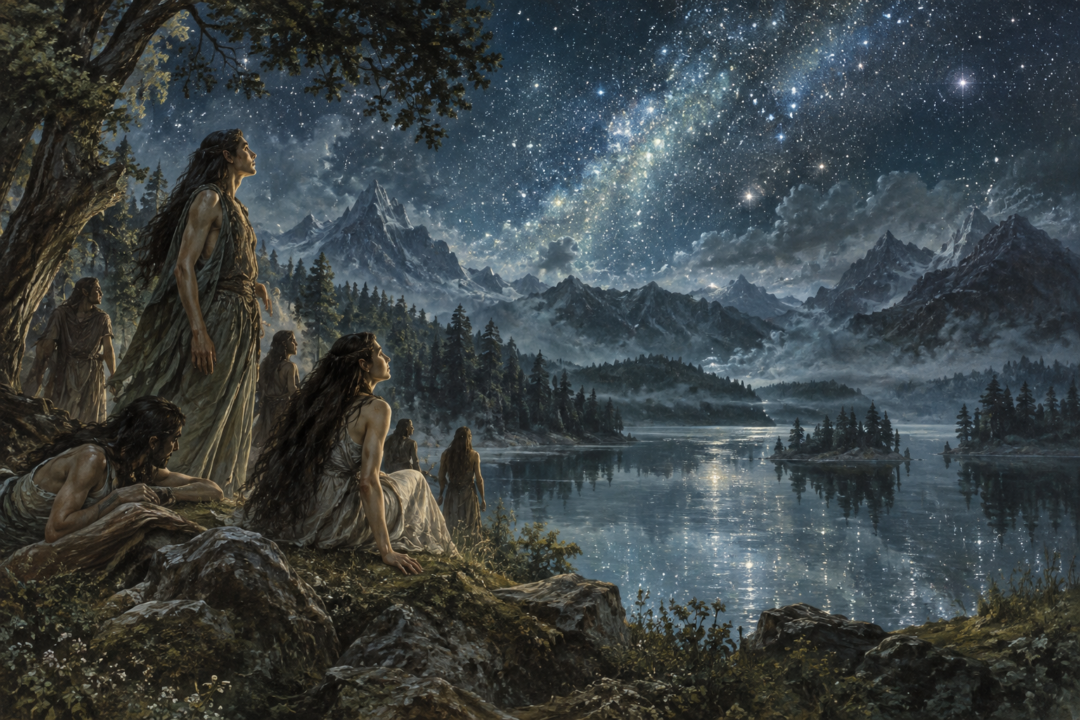
The First Age Did Not Always Begin With the First Sunrise
The first sunrise over Middle-earth feels like an obvious beginning.
The Moon has already appeared. Fingolfin and the Noldor have crossed the Helcaraxë. Morgoth is entrenched in Angband. Then the Sun rises for the first time, Men awaken in the East, and the familiar solar chronology of the wars of Beleriand begins.
It is therefore tempting to call that moment the beginning of the First Age.
But Tolkien’s chronological schemes do not support that as a universal rule. In several important formulations, the First Age had already been unfolding long before the Sun existed. In one particularly clear late chronological statement, its beginning is tied instead to the Awakening of the Elves. Earlier conceptions could stretch the First Age even farther backward.
The confusion comes from treating three different things as though they were identical: an Age of history, a system for measuring years, and the arrival of the Sun.
They were not necessarily the same boundary.
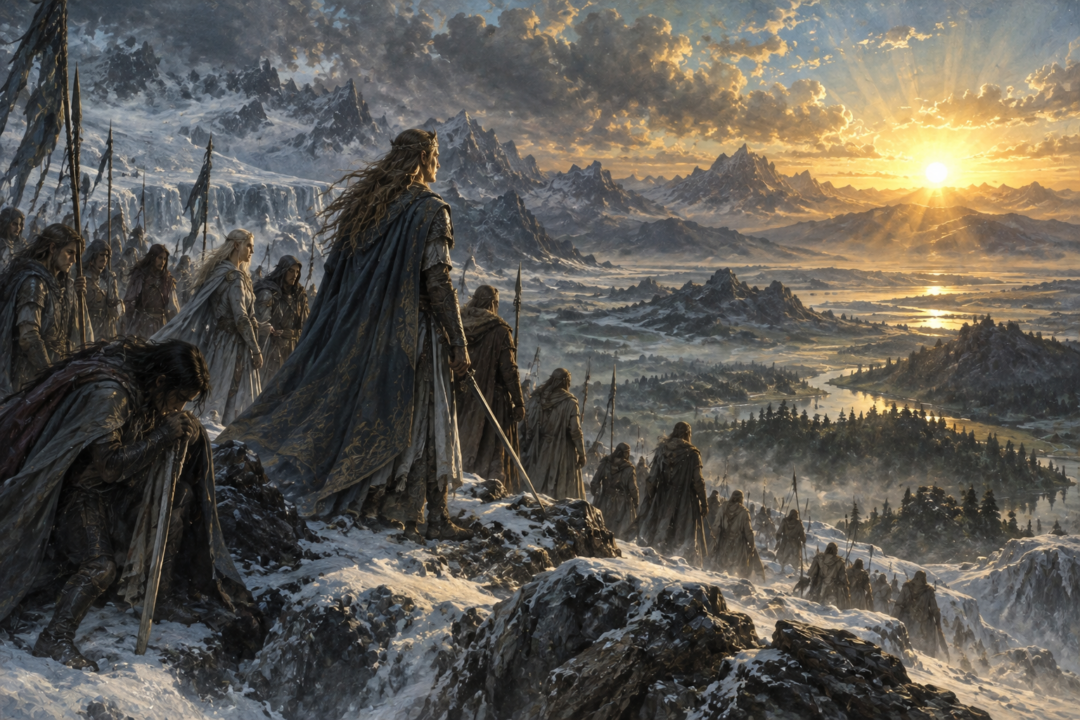
The First Sunrise Was a Revolution in Timekeeping
In the published Silmarillion, the creation of the Sun and Moon follows the destruction of the Two Trees and the flight of the Noldor.
Before that, the great light of the Blessed Realm came from Telperion and Laurelin. Middle-earth remained beneath the stars. After the Trees were poisoned by Melkor and Ungoliant, the Valar preserved their last living light: Telperion produced a final flower and Laurelin a final fruit, from which the Moon and Sun were fashioned.
The first rising of the Sun was therefore an enormous cosmological transition.
It also provided a new way to reckon time. The detailed chronologies preserved in The Annals of Aman distinguish the older reckoning associated with Valinor and the Trees from the subsequent Years of the Sun.
That distinction helps explain a familiar modern notation in which the wars of Beleriand are assigned dates such as Year 455, 472, or Nirnaeth-era dates within roughly six centuries of solar history.
But “Year 1 of the Sun” does not automatically mean “Year 1 of the First Age.”
That is the crucial distinction.
The Elves Could Already Be Living in the First Age
One of the clearest chronological conceptions places the beginning of the First Age at Cuiviénen.
In The Annals of Aman, the Awakening of the Elves occurs during the Years of the Trees, long before the first sunrise. This provides a natural boundary for what can be understood as the First Age of the Children of Ilúvatar: the Age begins when the first of those Children awaken.
A later chronological note published in The Nature of Middle-earth is especially direct: the First Age begins with the Awakening and ends with the downfall of Angband.
Under that scheme, an enormous amount of history usually placed mentally “before the First Age” is actually inside it.
The Elves awaken beneath the stars. Oromë discovers them. The Valar wage war against Melkor. Utumno is broken. The Great Journey begins. Some of the Eldar reach Aman. Thingol and Melian establish their realm in Beleriand. The Noldor flourish in Valinor. Fëanor creates the Silmarils. Melkor and Ungoliant destroy the Trees. Fëanor rebels, the Noldor depart, and the Exiles return toward Middle-earth.
All of this precedes the first sunrise.
Yet in the Awakening-to-Angband conception, all of it belongs to the First Age.
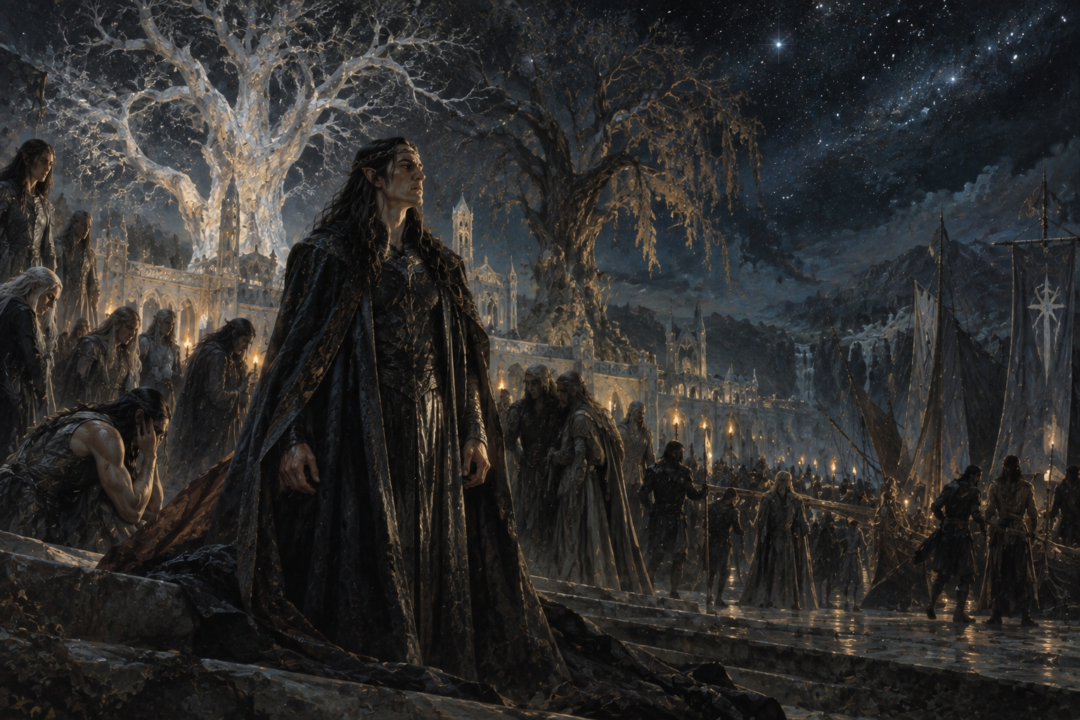
The Lord of the Rings Quietly Points the Same Way
This is not merely an inference drawn from posthumously published chronological material.
The Lord of the Rings itself contains language that becomes difficult to reconcile with the idea that the First Age simply began when the Sun rose.
Appendix F describes the High Elves who returned in exile to Middle-earth as doing so near the end of the First Age.
That return was already underway around the transition from the Years of the Trees to the Years of the Sun. Fëanor had reached Middle-earth before the first sunrise, while Fingolfin’s host crossed the Helcaraxë and arrived as the new lights appeared.
If the First Age began only with the Sun, calling the Exiles’ return an event at its “end” would be an oddly compressed description.
If the Age had begun much earlier, with the awakening and long history of the Eldar, the language makes considerably more sense.
Appendix B provides the other boundary clearly: the First Age ends with the Great Battle in which Morgoth is overthrown.
The familiar six centuries of solar warfare are therefore best understood, in this conception, as the final phase of a much longer First Age.
Why “First Age 1” Can Be Misleading
Modern Tolkien chronologies need convenient labels.
Once the Sun exists, the chronology of Beleriand can be expressed through ordinary solar years. Calling the first of those years “F.A. 1” is understandable shorthand, and it makes tables much easier to read.
The danger comes when the notation is mistaken for a statement about the metaphysical or historical beginning of the Age.
A label such as “First Age 472” commonly means the 472nd Year of the Sun during the First Age. It need not mean that only 471 years had elapsed since the First Age itself began.
This also resolves an otherwise striking problem.
The Second Age lasts 3,441 years. The Third lasts 3,021 years according to the usual Gondorian reckoning. If the First Age consisted solely of the approximately six centuries between the first sunrise and Morgoth’s overthrow, it would be dramatically shorter than either.
Yet Tolkien elsewhere described the First Age as the longest.
Once the long pre-solar history of the Elves is included, that statement ceases to be puzzling.
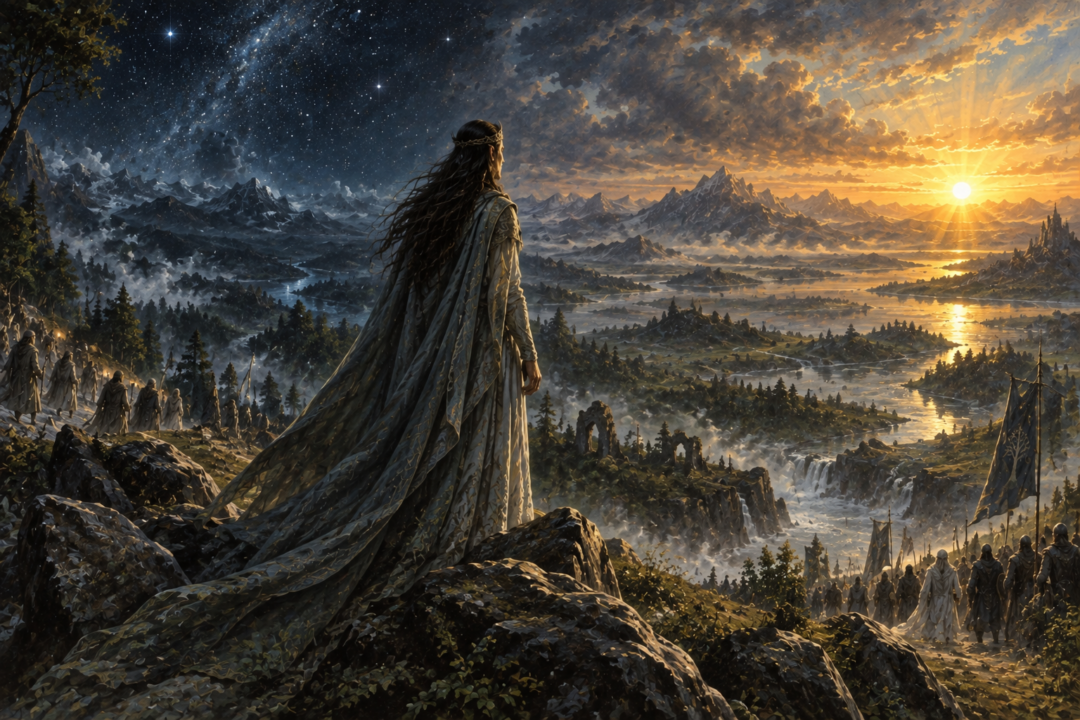
The First Age Was Not Defined Identically in Every Scheme
There is still an important warning against replacing one oversimplification with another.
Tolkien’s chronology changed.
His evolving conception of Arda, the Sun, the Moon, Elvish ageing, Valian time and the relationship between myth and imagined history produced multiple chronological schemes. Not every surviving text uses “First Age” with precisely the same boundary.
Earlier writings could employ broader ideas of the first ages of the world, extending the relevant period farther backward than the Awakening of the Elves.
There is also evidence for a specifically Valinorean division in which the first rising of the Sun could itself mark the ending of a First Age, rather than its beginning. That scheme should not simply be blended with the Exilic Noldorin chronology in which the wars against Morgoth continue as the concluding centuries of the First Age.
This is exactly why categorical statements such as “the First Age began when the Sun rose” are dangerous.
The surviving chronological traditions do not reduce cleanly to one universal formula.
For the conception most useful to the familiar history of the Children of Ilúvatar, however, the Awakening of the Elves is a strongly attested beginning, while the downfall of Angband marks the end.
The Sun Divides the First Age Rather Than Necessarily Beginning It
The cleaner mental picture is therefore not:
Years of the Trees → First Age → Second Age.
Instead, in the Awakening-based scheme, two systems overlap.
The Years of the Trees are a chronological reckoning. The First Age is a historical Age. Part of the First Age occurs during the Years of the Trees, and its final centuries occur during the Years of the Sun.
That distinction matters because the first sunrise remains tremendously important without having to perform every chronological function at once.
It marks the beginning of solar reckoning. It accompanies the awakening of Men in the published mythology. It transforms the physical experience of Middle-earth. It falls near the return of the Noldorin Exiles and the opening of the great solar-year chronology of the Wars of Beleriand.
But it does not have to begin the First Age.
In one sense, the sunrise comes surprisingly late.
By then the Elves have already awakened, divided into kindreds, undertaken the Great Journey, founded realms, learned from the Valar, created the Silmarils, suffered the Darkening of Valinor, sworn the terrible Oath of Fëanor, shed blood at Alqualondë, and begun their return to Middle-earth.
The great tragedy is already in motion before the first dawn.
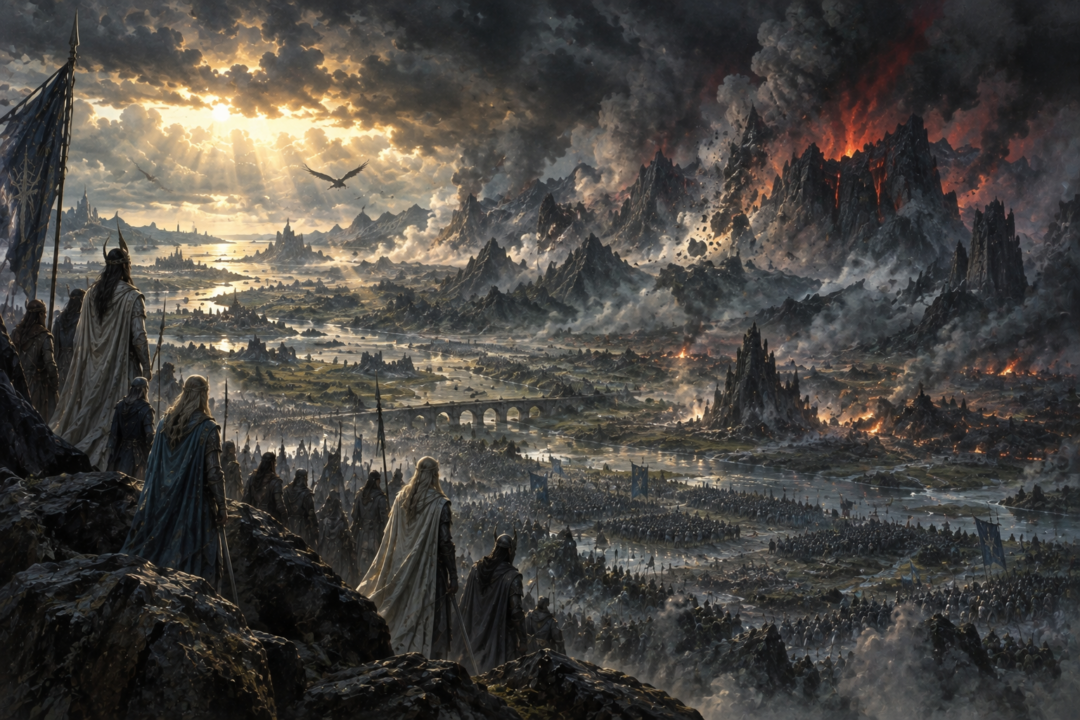
A First Age Born Under the Stars
This changes the emotional shape of the Elder Days.
The First Age is often imagined as the brilliant but doomed era of Beleriand: Fingolfin before Morgoth, the hidden kingdoms of Gondolin and Nargothrond, Beren and Lúthien, Túrin, the Nirnaeth Arnoediad, Eärendil and finally the War of Wrath.
Those stories unquestionably belong to it.
But the Age’s roots reach deeper.
In the Awakening-based chronology, the First Age does not begin beneath a golden sunrise. It begins beside the waters of Cuiviénen, when the first Elves open their eyes beneath stars.
The Sun arrives only after innocence has already been damaged.
Melkor has already terrorized the world. The Elves have already been divided by choices of journey and allegiance. Fëanor has already made the Silmarils and lost them. Finwë is dead. The Trees are dead. The first Kinslaying has occurred. The Noldor are already divided by betrayal and grief.
Dawn is therefore not the beginning of their story.
It illuminates a story already burdened with consequences.
And that may be the most useful way to understand Tolkien’s overlapping chronologies: the first sunrise is one of the greatest boundaries in the history of Arda, but a boundary in the reckoning of time is not necessarily the boundary of an Age.
In some of the clearest surviving schemes, the First Age was already ancient when the world saw its first morning.
Sources & Notes
- Tolkien Gateway, “First Age” — surveys Tolkien’s chronological formulations and the evidence for beginning the Age with the Awakening of the Elves. https://tolkiengateway.net/wiki/First_Age
- Tolkien Gateway, “Years of the Trees” — explains that much of the First Age was reckoned before the Years of the Sun. https://tolkiengateway.net/wiki/Years_of_the_Trees
- Tolkien Gateway, “The Annals of Aman” — identifies Tolkien’s detailed pre-solar chronology and its Valian-year reckoning. https://tolkiengateway.net/wiki/The_Annals_of_Aman
- Tolkien Gateway, “Awakening of the Elves” — dates the Awakening to the Years of the Trees and identifies it as the First Age’s beginning in this scheme. https://tolkiengateway.net/wiki/Awakening_of_the_Elves
Sources distinguish the First Age from the solar year-count, document the Awakening of the Elves as its beginning in the Annals/Nature chronology, place much of the Age in the Years of the Trees, and identify the first sunrise as the start of solar reckoning rather than a universal Age boundary.