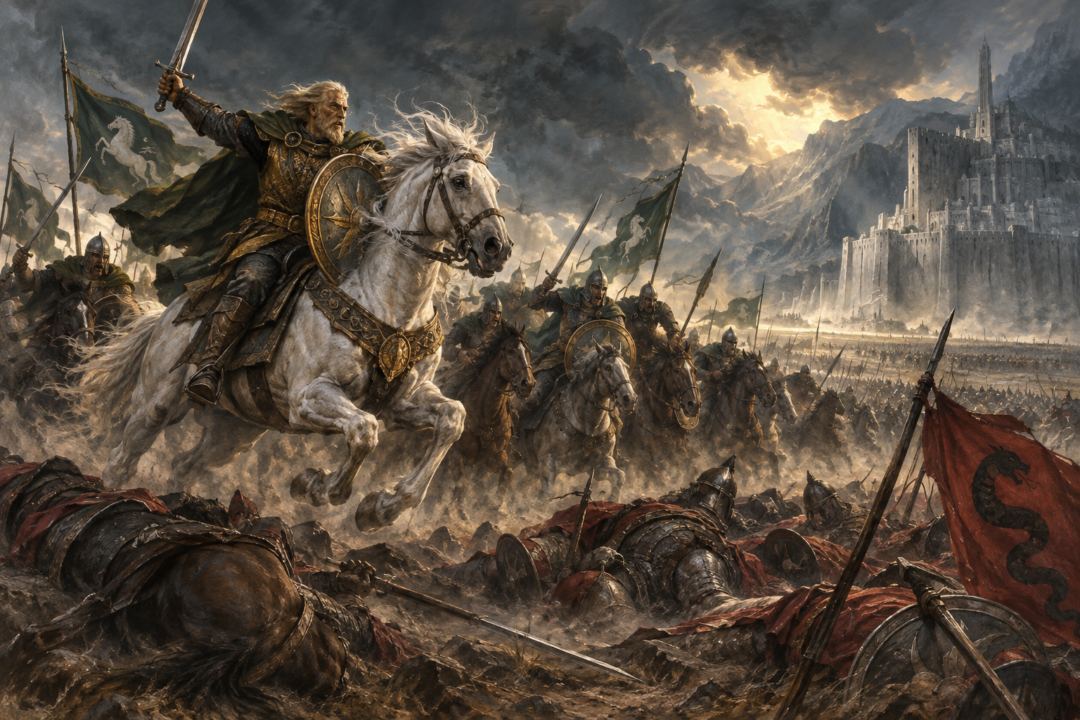
King Théoden rides onto the Pelennor Fields at the height of his restored strength. He is no longer the diminished old king whom Gandalf found sitting uncertainly in Meduseld. At Minas Tirith, he is mounted on Snowmane, leading the Rohirrim personally, and for a brief, astonishing stretch of the battle he seems almost unstoppable.
Then his victory ends without an enemy warrior ever reaching him with a sword.
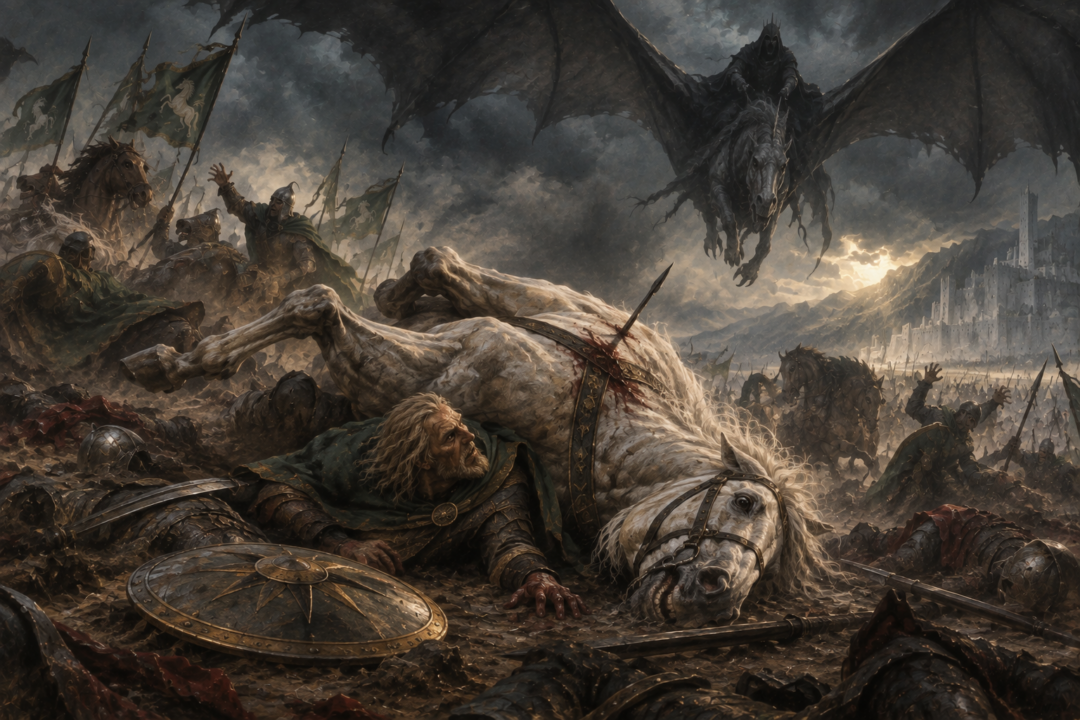
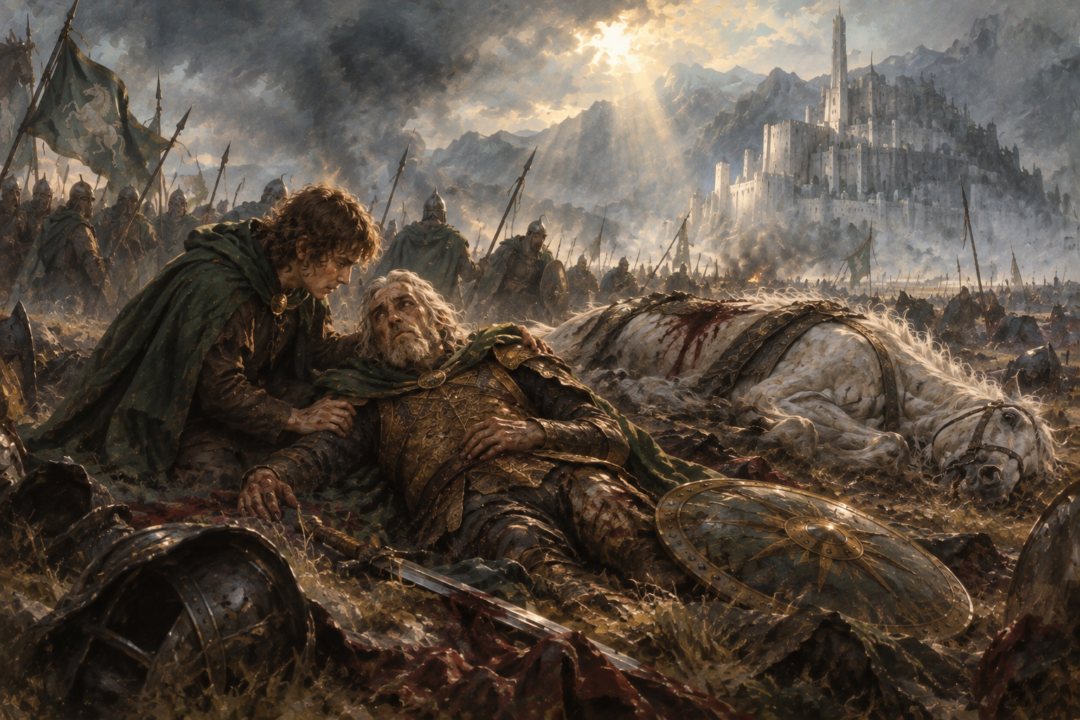
Snowmane panics. A black dart strikes the horse. He crashes onto his side, and Théoden falls beneath him.
It is one of the cruelest reversals in The Lord of the Rings, because the king is not defeated in a conventional duel. The horse that has carried him into glory becomes, through terror and mortal injury, the weight that traps him on the battlefield.
That distinction matters. Snowmane does not betray Théoden, and the text never treats him as cowardly. The tragedy is precisely the opposite: a faithful creature becomes the instrument of his master's death because the Enemy can attack something deeper than armor.
Théoden Is Winning When the Disaster Comes
The timing makes the scene especially brutal.
The Rohirrim arrive while Minas Tirith is under terrible pressure. Théoden sees the City surrounded and the Pelennor filled with enemies, yet the sight does not break him. Instead, he straightens, sounds his horn, and launches the charge.
The transformation is complete. The king who once seemed prematurely aged is again commanding his people from the front.
Snowmane is essential to that image.
The horse carries Théoden so swiftly that the king rides ahead of his own household knights. The narration compares the charging Théoden, borne upon Snowmane, to Oromë, the great hunter of the Valar. This is not merely transportation. Horse and rider together form the image of Rohan's recovered power.
Théoden then meets the cavalry of the Southrons. He drives through them, casts down their chieftain, draws his sword when his spear is broken, and cuts down their standard.
The enemy cavalry flees.
At exactly that point, the nature of the battle changes.
Théoden has survived the charge. He has survived the collision of cavalry. He has survived the weapons of the Southrons.
His catastrophe begins with fear.
The Shadow Attacks the Horses First
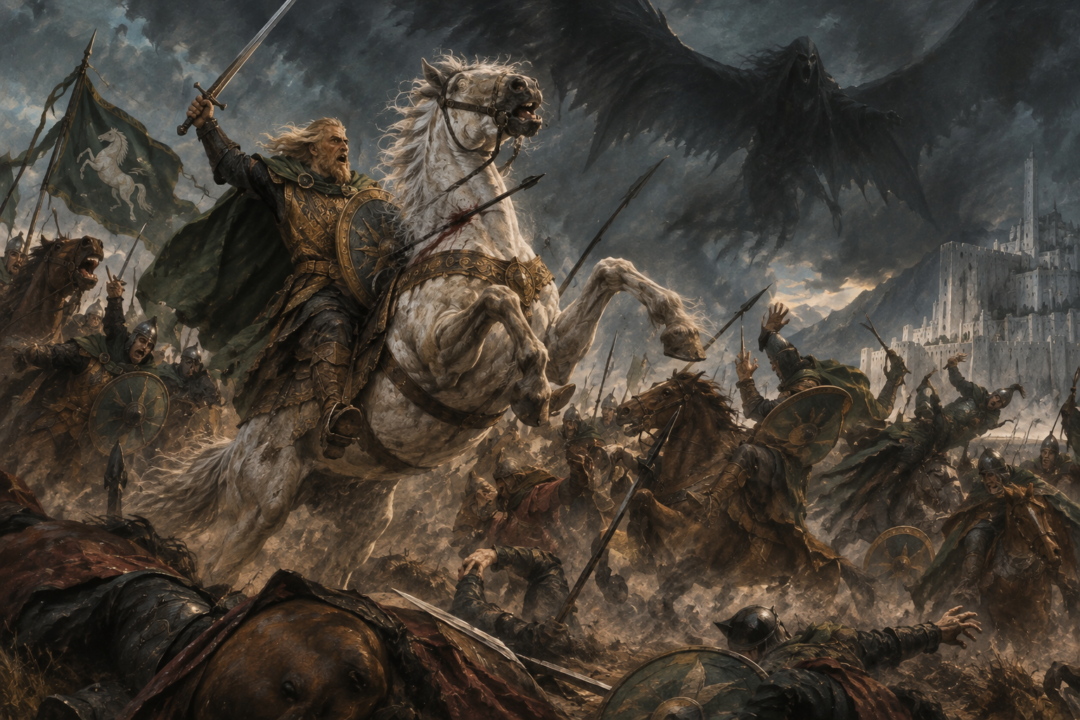
The coming of the Lord of the Nazgûl is described as a sudden blotting out of the morning. Darkness falls around Théoden. Horses rear and scream. Riders are thrown.
This is important because the terror is not confined to Snowmane.
The Witch-king's presence affects the Rohirrim's mounts across the immediate battlefield. Men who remain physically capable of fighting can still be neutralized because their horses cease to obey them.
For a cavalry force, that is devastating.
The Rohirrim's military strength depends heavily upon the extraordinary bond between rider and horse. Their speed, cohesion, shock, and ability to maneuver all depend upon living animals that can themselves experience terror.
Against ordinary enemies, their horsemanship is an advantage.
Against the Nazgûl, it becomes a vulnerability.
Théoden tries to resist the terror directly. He calls his riders to him and tells them to fear no darkness.
But courage in the rider cannot simply erase terror in the horse.
Snowmane rises high, described as wild with fear and fighting against the air. Then the second blow comes: a black dart has pierced him.
He falls upon his side.
Théoden goes down beneath him.
The Text Does Not Say the Witch-king Personally Shoots Snowmane
This detail is worth keeping precise.
The narrative explicitly says that Snowmane is pierced by a black dart. It does not explicitly identify the individual who fired it.
The Lord of the Nazgûl descends immediately afterward upon his winged creature, so the whole catastrophe unfolds under the shadow of his arrival. But it goes beyond the text to state as a certainty that the Witch-king himself shoots Snowmane.
The safer reading is also the more interesting one.
The Enemy does not need a dramatic killing stroke from the Witch-king's own hand. The combination of supernatural terror, battlefield violence, and Snowmane's mortal wound is enough.
Théoden is brought down before the confrontation with the Nazgûl truly becomes a duel.
That separates his death sharply from Éowyn's subsequent encounter.
She stands before the Witch-king. She exchanges words with him. His weapon breaks her shield and arm. Merry strikes him with the blade from the Barrow-downs, and Éowyn finally destroys him.
Théoden receives no such last contest.
His battle ends underneath his horse.
Snowmane Becomes a Physical Trap
A fallen warhorse is not a minor obstacle.
The text does not give Snowmane's measurements or Théoden's exact injuries, so there is no need to invent them. What it does establish is enough: the king falls beneath Snowmane and is mortally hurt.
Snowmane eventually rolls away from him before dying, but the damage has already been done.
The scene overturns everything that Snowmane represented only moments earlier.
His speed allowed Théoden to outrun his knights.
His strength carried the king through the enemy cavalry.
His obedience helped make Théoden's charge possible.
Now that same body pins the king to the ground.
The tragedy therefore comes not from any failure of loyalty, but from the physical reality of mounted warfare. Théoden's greatest battlefield advantage is inseparable from a living creature he cannot completely protect.
A shield might stop a weapon aimed at the king.
Armor might turn a blow.
Skill might defeat another rider.
None of those things can save Théoden when Snowmane himself collapses beneath him.
“Faithful Servant Yet Master’s Bane”
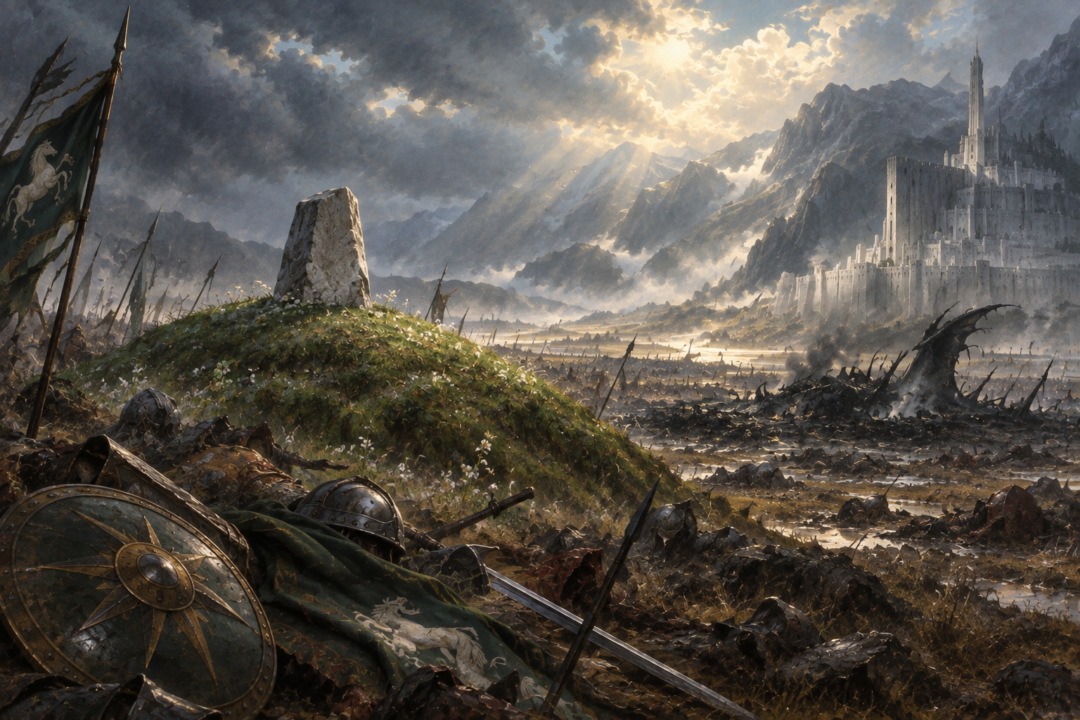
The Rohirrim later bury Snowmane on the Pelennor and raise a stone over his grave.
Its inscription calls him:
“Faithful servant yet master’s bane”
That line prevents the reader from reducing Snowmane's role to either guilt or innocence.
Both halves remain true.
He was faithful.
His fall destroyed his master.
The word “bane” does not require deliberate action. Snowmane is not blamed as a traitor. Instead, the memorial preserves the terrible contradiction of the event: the creature that served Théoden magnificently also became the immediate cause of his ruin.
That is why Snowmane receives honor rather than condemnation.
His grave remains on the battlefield, and the grass grows green and long upon his mound. Nearby, the carcass of the Nazgûl's winged beast is burned, and the ground where it lay remains black and bare.
The contrast is unmistakable.
Snowmane belongs among the honored dead.
The creature of the Nazgûl belongs to corruption and destruction.
Yet the faithful horse still became his master's bane.
Théoden’s Death Is Not a Defeat of Courage
There is another reason the manner of Théoden's fall matters.
His story has been deeply concerned with the recovery of agency.
When the reader first meets him in The Two Towers, Théoden has been weakened by age, grief, bad counsel, and the influence of Wormtongue. Once restored, he repeatedly chooses action despite the certainty of danger.
He rides to war.
He fights at the Hornburg.
He answers Gondor's call.
He leads the charge himself.
At the Pelennor, fear does not make him retreat. Even as supernatural darkness descends, he is still calling his people onward.
The disaster therefore does not reverse his recovery.
Théoden does not become the frightened, passive king of his earlier decline. His body fails because Snowmane falls upon him, but his courage remains intact.
That distinction becomes clear in his final moments.
When Merry comes to him, Théoden is dying, but he believes he has redeemed the honor of his house and can go to his fathers without shame. His thoughts turn to Éomer, whom he names as his successor, and to Éowyn, whose presence on the battlefield he does not yet understand.
His final tragedy is not that he failed to become the king he wished to be.
It is that he finally became that king completely, and almost immediately had to die.
The Enemy Wins by Breaking the Relationship Between Horse and Rider
The fall of Snowmane also reveals something larger about the Nazgûl.
Their power is not simply the ability to kill.
They disrupt.
They terrify.
They make ordinary courage harder to translate into effective action.
Around Théoden, horses panic and riders are thrown. His household is scattered or slain; later the narrative explains that some have been carried away by maddened mounts.
The Witch-king's arrival attacks the structure that makes Rohirric cavalry work.
This does not mean the Nazgûl possess some special canonical power specifically designed against horses. The text establishes the animals' terror, not a formal magical rule.
But the tactical consequence is clear.
A rider may remain brave while losing control of the battle because his mount cannot endure the same horror.
Théoden demonstrates the cruelest possible version of that vulnerability.
He commands his men not to fear.
Snowmane cannot obey that command.
Then the dart strikes.
The King Who Could Not Be Reached Is Brought Down From Beneath
Only moments before his fall, Théoden is moving through the Pelennor with extraordinary speed. His own knights struggle to keep pace. The Southron cavalry cannot stop him. Their leader falls, their standard is cut down, and their surviving horsemen flee.
A conventional heroic ending might have given him a final duel against the Witch-king.
Instead, the story denies him one.
The king is not beaten sword against sword. He is brought down through the collapse of the creature carrying him.
That is why Snowmane's grave inscription feels so powerful. It does not simplify the event into victory or defeat, loyalty or betrayal.
It remembers the contradiction.
Snowmane carried Théoden into the greatest charge of his life. His speed helped make the king glorious. His terror and mortal wound brought that glory crashing into the earth.
And beneath the body of his faithful horse, with no enemy blade required to strike the final blow, the King of the Mark reaches the end of his road.
Sources & Notes
- The Encyclopedia of Arda, “Snowmane” — https://www.encyclopedia-of-arda.com/s/snowmane.html
- The Encyclopedia of Arda, “Snowmane’s Howe” — https://www.encyclopedia-of-arda.com/s/snowmaneshowe.html
- The Encyclopedia of Arda, “Battle of the Pelennor Fields” — https://www.encyclopedia-of-arda.com/b/battleofthepelennor.html
- The Encyclopedia of Arda, “Théoden” — https://www.encyclopedia-of-arda.com/t/theoden.html
Sources document Théoden’s charge on the Pelennor, Snowmane’s terror and dart wound, the horse’s fall upon the king, and the burial inscription naming him both faithful servant and master’s bane. Interpretive conclusions remain the author’s.