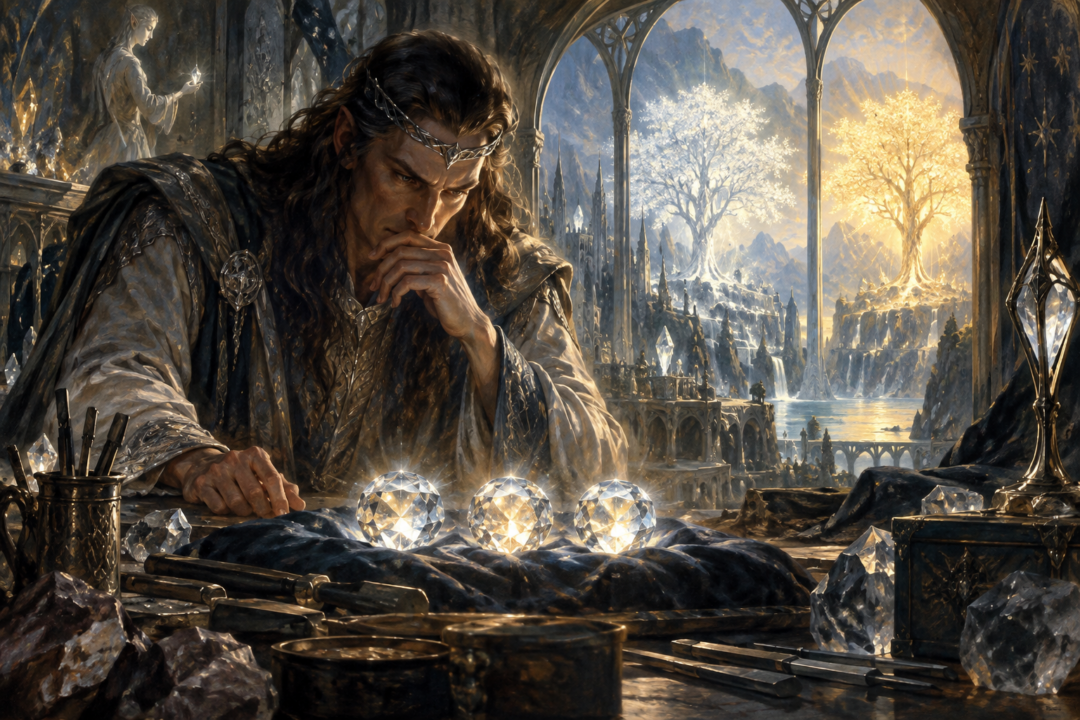
Imagine recovering everything.
The secret crystalline substance called silima. The silver light of Telperion. The golden light of Laurelin. The furnaces and instruments of the Noldor in Aman. Every physical ingredient that once lay before Fëanor when he created the three Silmarils.
Would that be enough to make a fourth?
The lore points strongly toward no.
The Silmarils were not merely gemstones assembled from exceptionally rare materials. Their creation belonged to a particular maker, a particular moment in the history of Arda, and powers that could not simply be reproduced by gathering the same ingredients again. Most importantly, Fëanor himself says that he could not make their like a second time.
That detail changes what the Silmarils actually are. They are not a lost technology waiting to be rediscovered. They are an unrepeatable act of creation.
Fëanor Himself Says the Work Cannot Be Repeated
The clearest evidence comes immediately after the destruction of the Two Trees.
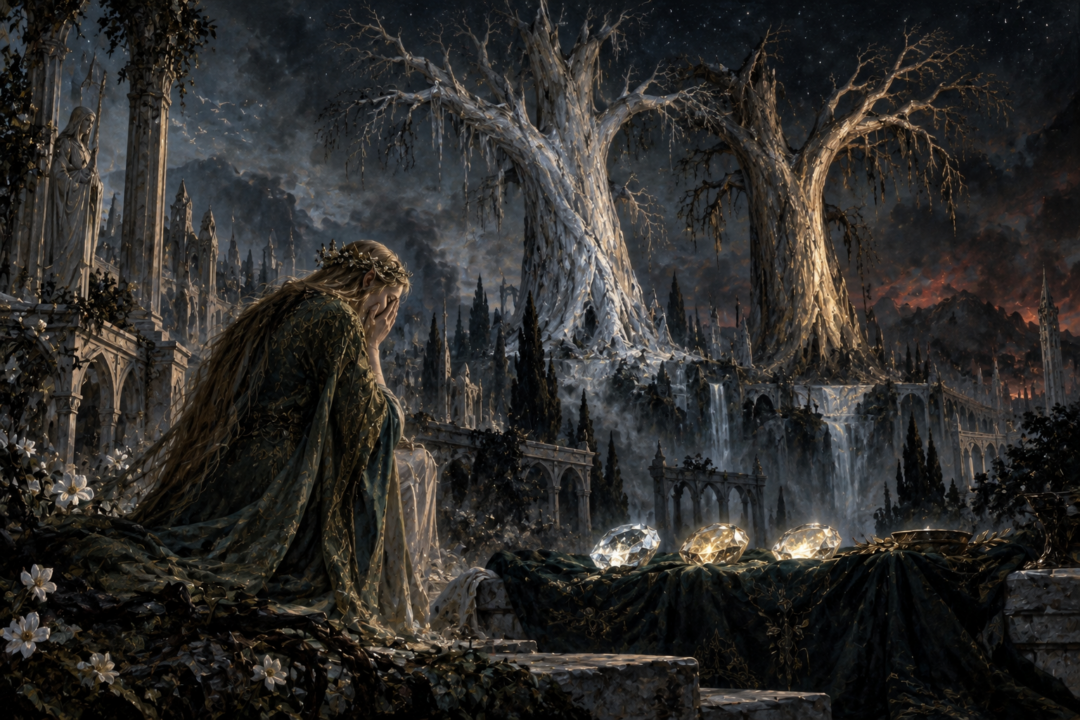
When Melkor and Ungoliant attack Valinor, Telperion and Laurelin are poisoned and their light fails. Yavanna examines them and declares that their life might still be rekindled if she could obtain some of the unmarred light they had possessed.
By then, that light survived within the Silmarils.
The Valar therefore ask Fëanor to surrender the jewels so they can be broken and their light used to restore the Trees.
Fëanor’s answer is crucial. He does not treat the loss of the Silmarils as something that could eventually be repaired by making another set. He says that for him to break them would break his heart, and that he could never again make their like.
His possessiveness is already becoming disastrous, so his words should not automatically be treated as detached technical analysis. Yet the narrative gives us no reason to believe that another set of Silmarils was actually within his power.
Quite the opposite: everything about their description emphasizes singularity.
Fëanor had reached a height of craftsmanship that even Fëanor could not simply revisit.
The Problem Begins With Silima
The visible bodies of the Silmarils were made from a substance called silima.
The Silmarillion describes it as appearing like the crystal of diamonds while being stronger than adamant. No violence within the Kingdom of Arda could mar or break it.
But silima was not simply a naturally occurring mineral that Fëanor discovered and mined.
Its nature was his secret.
The text deliberately withholds exactly what it was made from, saying that this will not be known until Fëanor returns at the End. That makes the hypothetical idea of collecting the “original materials” difficult from the beginning. We do not actually know what those materials were, or whether silima should even be understood as an ordinary mixture of substances.
What we can safely say is that Fëanor devised it and that the secret was uniquely associated with him.
Someone possessing a fragment of silima would therefore not necessarily possess the knowledge required to produce more of it.
But even unlimited silima would solve only part of the problem.
A transparent shell was not what made a Silmaril a Silmaril.
The Silmarils Contained Something That No Longer Existed
Inside the jewels was the blended light of the Two Trees.
That distinction matters enormously.
Telperion and Laurelin did not merely illuminate Valinor in the way lamps illuminate a room. Their living radiance belonged to the Blessed Realm before the rising of the Sun and Moon. During the periods when their lights mingled, Fëanor contemplated how that light might be preserved imperishably.
The Silmarils became its vessels.
Then Melkor and Ungoliant destroyed the Trees.
Afterward, Yavanna could not simply grow two identical replacements. Even she declares that she cannot make their like again in Arda.
This creates a striking parallel.
Yavanna cannot repeat the creation of the Trees.
Fëanor cannot repeat the creation of the Silmarils.
Both have produced something so great that its making belongs to a moment that cannot simply be recreated.
The final flower of Telperion and fruit of Laurelin survive and eventually become the Moon and Sun, but the Silmarils preserve the unmarred light of the Trees from before their poisoning.
So even if another craftsman somehow learned to manufacture silima, the essential light required for a true duplicate was no longer freely available.
It survived precisely because Fëanor had already captured it.
A Silmaril Was More Than Fëanor’s Craftsmanship
There is another element that makes simple replication even less plausible.
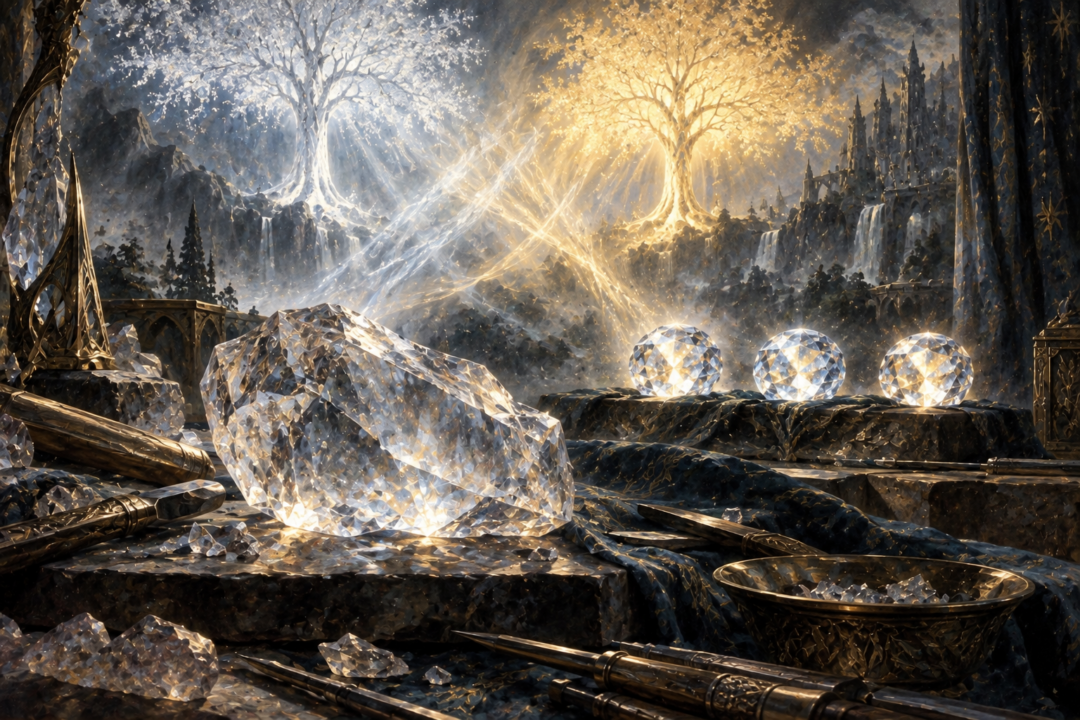
After the Silmarils were created, Varda hallowed them.
From that point, no mortal flesh, unclean hands, or evil being could touch them without being scorched and withered.
Morgoth discovers this directly. Although he possesses the Silmarils after stealing them from Formenos, their holiness burns him. Much later, Maedhros and Maglor also find themselves unable to hold the jewels without agony after the terrible deeds committed under their oath.
This property was therefore not merely a clever mechanism built into the stones.
It came through the action of Varda.
A hypothetical craftsman copying Fëanor’s technique could not simply manufacture Varda’s hallowing as another stage of production.
This is one reason describing the Silmarils as extremely advanced Elven jewels can be misleading. Their final nature involved both created craftsmanship and a blessing from one of the Valar.
They stand at an intersection between art and holiness.
Having the Same Ingredients Does Not Mean Repeating the Same Creation
Middle-earth repeatedly distinguishes between possessing materials and possessing the power to reproduce what another maker achieved with them.
The Silmarils are perhaps the greatest example.
Suppose, purely hypothetically, that someone could assemble everything Fëanor once possessed.
Silima could somehow be made again.
The unmarred light of the Trees could somehow be provided.
Fëanor’s tools could be recovered.
Even then, the texts never establish that another craftsman could reproduce his achievement.
The act depended upon Fëanor himself.
This is consistent with the way his greatest works are described. He is not presented merely as someone who knows unusually complicated procedures. His creative power is intensely personal. The Silmarils are the supreme expression of that power.
His statement after the Darkening suggests that creating them consumed something that was not renewable in the ordinary sense.
That does not mean we should invent a literal magical rule in which Fëanor possessed a measurable quantity of “crafting energy.” The texts say nothing of the sort.
The safer conclusion is more profound: certain acts of sub-creation in Arda are unique because the maker cannot simply return to the same creative height at will.
The Strange Parallel Between Fëanor and Yavanna
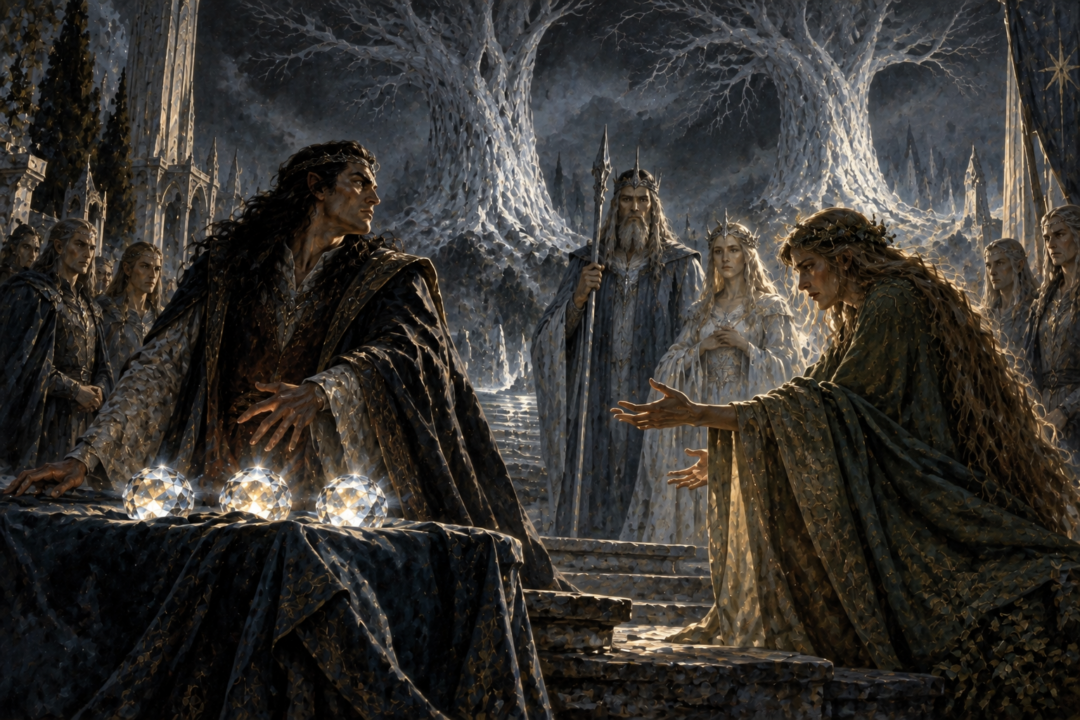
This is what makes the confrontation after the destruction of the Trees so tragic.
Yavanna needs Fëanor’s work because she cannot repeat her own.
Fëanor refuses because he cannot repeat his.
Both understand irreparable loss.
Yavanna asks for the Silmarils because the Trees cannot otherwise be restored. Fëanor sees the request as demanding the destruction of the one work that he believes he can never make again.
His refusal has catastrophic consequences, although events have already moved beyond his knowledge: Morgoth has murdered Finwë and stolen the Silmarils from Formenos.
Yet the moral tension remains.
Fëanor is being asked to surrender the irreplaceable in order to restore something else that is irreplaceable.
That is much more painful than a choice between selfishness and property.
It is a choice between two wonders that the world cannot manufacture twice.
Even the Valar Do Not Simply Make New Silmarils
This point is easy to overlook.
The Valar desire the light preserved within the Silmarils after the Trees are destroyed. Yet the solution proposed is not to have Aulë, greatest in smithcraft among the Valar, manufacture replacement jewels.
They ask Fëanor for the existing ones.
That does not prove that Aulë was metaphysically incapable of creating any comparable jewel; the text does not explicitly establish such a rule. But it does show that the narrative presents the three existing Silmarils as uniquely necessary.
The same pattern continues throughout the First Age.
No replacement Silmarils appear.
No substitute captures what was lost.
Instead, kingdoms fall and generations die over possession of the original three.
Their uniqueness is not an incidental detail of the story. It is the foundation of their importance.
The End of the Silmarils Reveals Their True Purpose
By the end of the First Age, the three jewels have been separated.
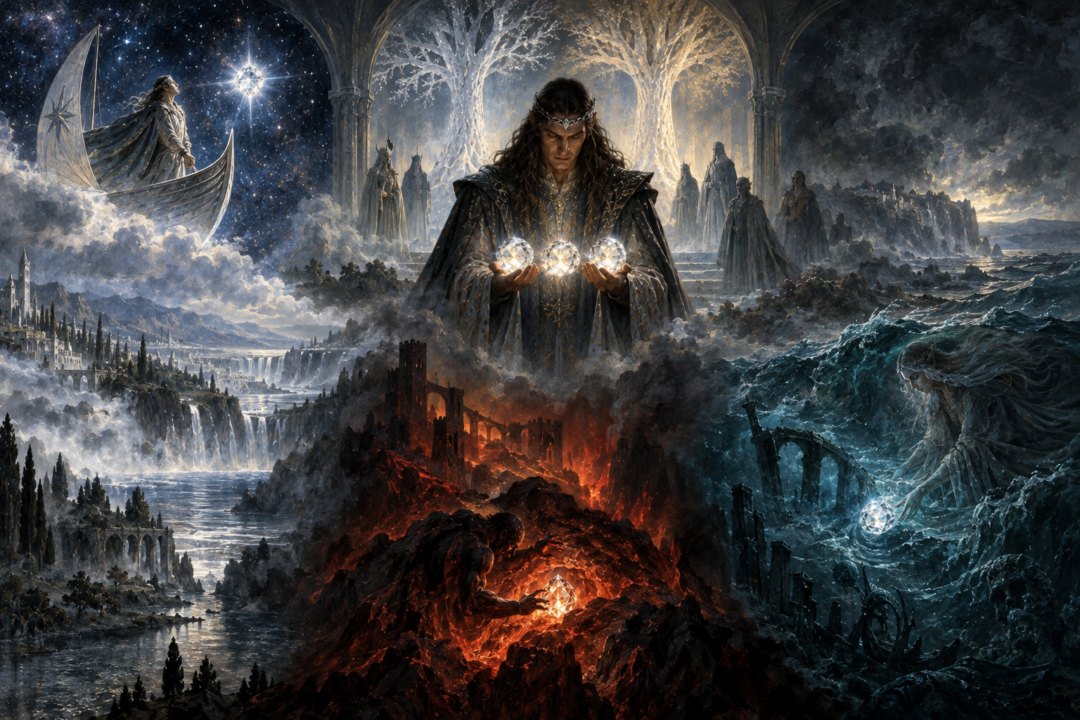
The Silmaril borne by Eärendil passes into the heavens. One taken by Maedhros disappears with him into a fiery chasm. Maglor casts the last into the sea.
Thus their light passes into air, earth, and water.
In later versions of the tradition concerning the world’s ending, the Silmarils are eventually recovered, and Fëanor himself breaks them. Their released light allows Yavanna to rekindle the Two Trees.
This material belongs to Tolkien’s developing traditions about the end of Arda and should not be treated as though every detail had a single finalized canonical form. But the underlying idea is revealing.
At the world’s healing, the answer is still not: make three more Silmarils.
The originals must return.
And Fëanor must finally surrender what he once refused to surrender.
The Silmarils Are Irreplaceable Because History Is Irreplaceable
That may be the deepest reason a Silmaril cannot simply be reproduced from a list of ingredients.
The jewels contain history.
They preserve the light of a world that has already passed away. Their substance comes from Fëanor’s secret craft. Their form represents the greatest achievement of a maker who says he cannot repeat it. Their holiness comes from Varda. Their light comes from living Trees that even their own maker cannot recreate.
Remove any one of those elements and you may still have a magnificent jewel.
You do not necessarily have a Silmaril.
The tragedy of the First Age therefore depends upon something more interesting than scarcity. The Silmarils are not valuable merely because there are only three.
There are only three because the circumstances capable of producing them existed once.
That is why recovering the original ingredients would not solve the problem.
To make another Silmaril, you would have to recover not merely lost matter, but a lost act of creation — Fëanor at the height of his power, the unmarred light of the Two Trees, and the blessing that transformed three jewels into objects whose fate became bound to the fate of Arda.
You would have to recreate a moment of the world that had already ended.
And Middle-earth is filled with reminders that some things, once lost, can be remembered, preserved, or healed — but never simply made again.
Sources & Notes
- Tolkien Gateway, “Silmarils” — https://tolkiengateway.net/wiki/Silmarils
- Tolkien Gateway, “Fëanor” — https://tolkiengateway.net/wiki/F%C3%ABanor
- Tolkien Gateway, “Two Trees of Valinor” — https://tolkiengateway.net/wiki/Two_Trees_of_Valinor
- Tolkien Gateway, “Yavanna” — https://tolkiengateway.net/wiki/Yavanna
Reference entries document the characters, places, events, and textual details discussed in this article.