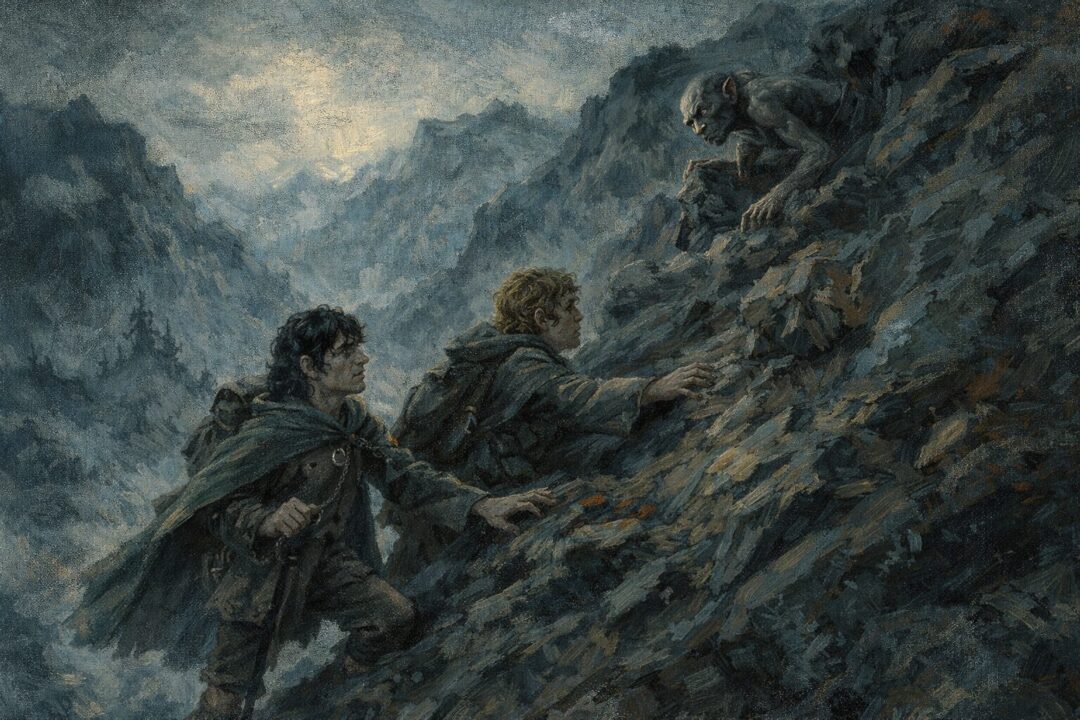
Gollum is often described as a creature of impulse—ruled by hunger, obsession, and fear. He crawls, mutters, strikes suddenly, and flees just as fast. On the surface, he appears chaotic and unstable, barely capable of sustained planning.
But this impression hides his most dangerous trait.
Not his strength.
Not his cunning.
Not even his obsession with the Ring.
It is his patience.
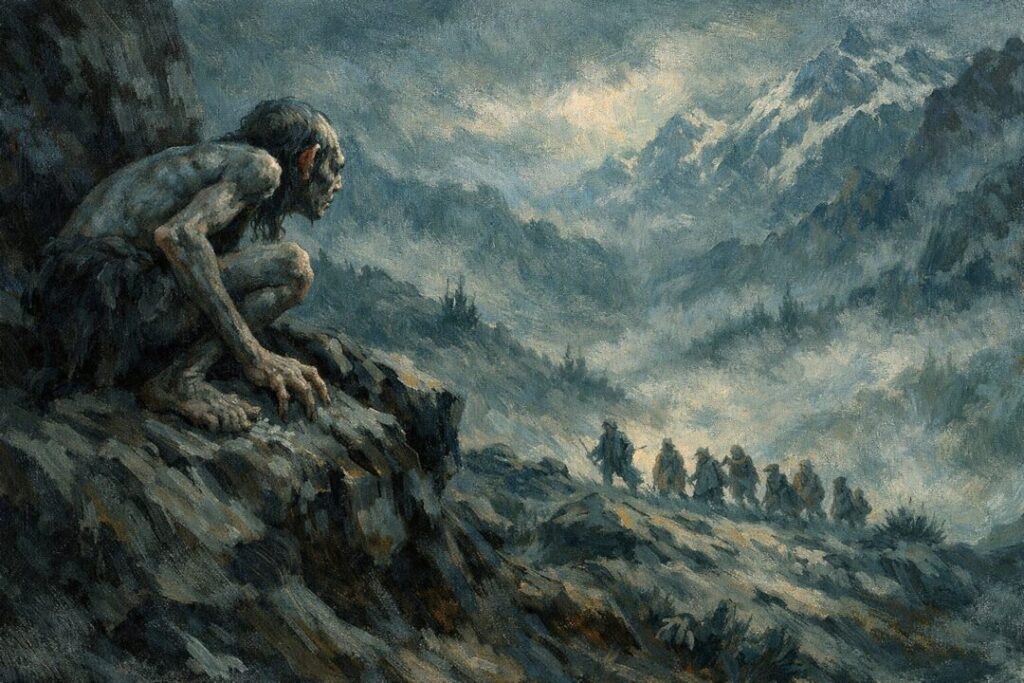
From the moment the Fellowship leaves Rivendell, Gollum is already moving—not behind them in a straight line, but around them. He circles wide. He lingers. He waits. He watches from places no one thinks to guard.
By the time Aragorn first senses that something is following the Company, Gollum has already learned something crucial:
This group does not travel like Orcs.
They do not move like merchants.
They do not advance like an army.
They move cautiously—but still along routes shaped by terrain, safety, and necessity.
And Gollum knows those routes.
Gollum Is Not Lost in Middle-earth — He Is Adapted to It
Before the War of the Ring ever begins, Gollum has already crossed vast stretches of Middle-earth alone.
He leaves the Misty Mountains after centuries in darkness.
He wanders through Wilderland with no allies and no shelter.
He reaches Mordor and is captured by the servants of Sauron.
He is tortured, questioned, and released.
He is hunted across Rhovanion by Aragorn.
And he escapes again.
Very few characters in the story travel so far with so little protection.
Unlike the Fellowship, Gollum does not rely on inns, firelight, or safe roads. He does not need companions to keep watch while he sleeps. He eats what he can catch. He drinks from streams. He sleeps in holes, roots, ruins, and crevices—places others would avoid instinctively.
This makes him uniquely suited to follow others without being seen.
Where the Fellowship must consider comfort, morale, and safety, Gollum considers only survival. And survival, for him, has always meant staying out of sight.
Why the Fellowship Never Fully Catches Him
Aragorn senses Gollum’s presence more than once—but sensing is not the same as finding.
Gollum never approaches the Fellowship directly.
He never closes distance unless terrain forces it.
He never remains in a position where he can be surrounded or pursued.
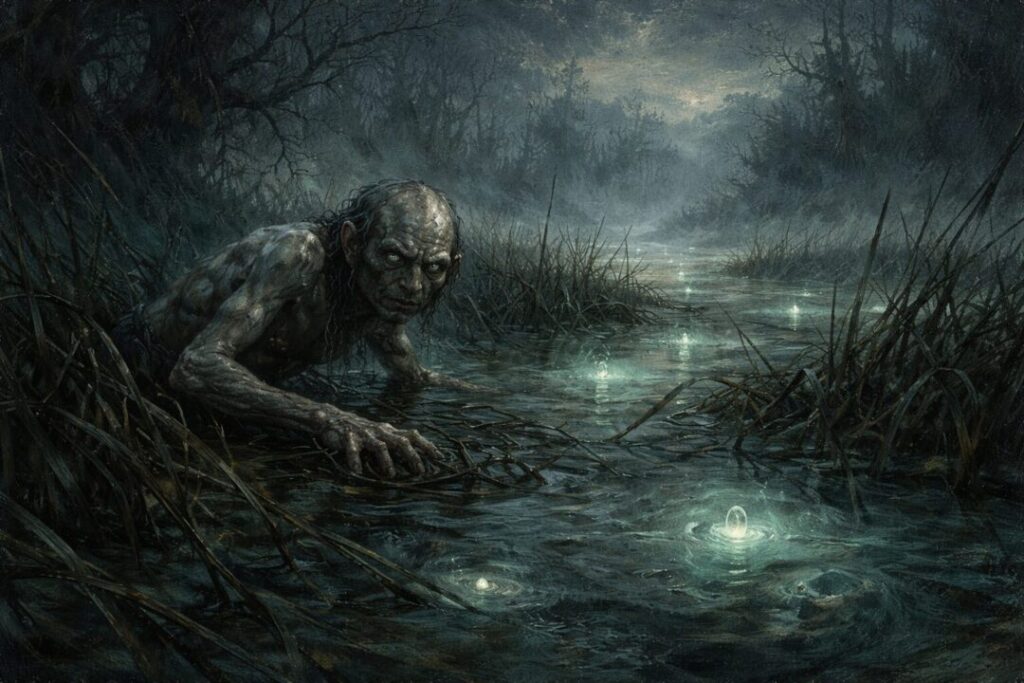
When Aragorn attempts to track him, Gollum simply changes elevation—climbing, descending, slipping into water, or vanishing into rock and shadow. He understands something vital: pursuit favors the pursued if the pursuer must protect others.
The Fellowship cannot scatter. Gollum can.
Later, when Gandalf confirms that Gollum followed the Fellowship through Moria, the revelation carries a deeper meaning.
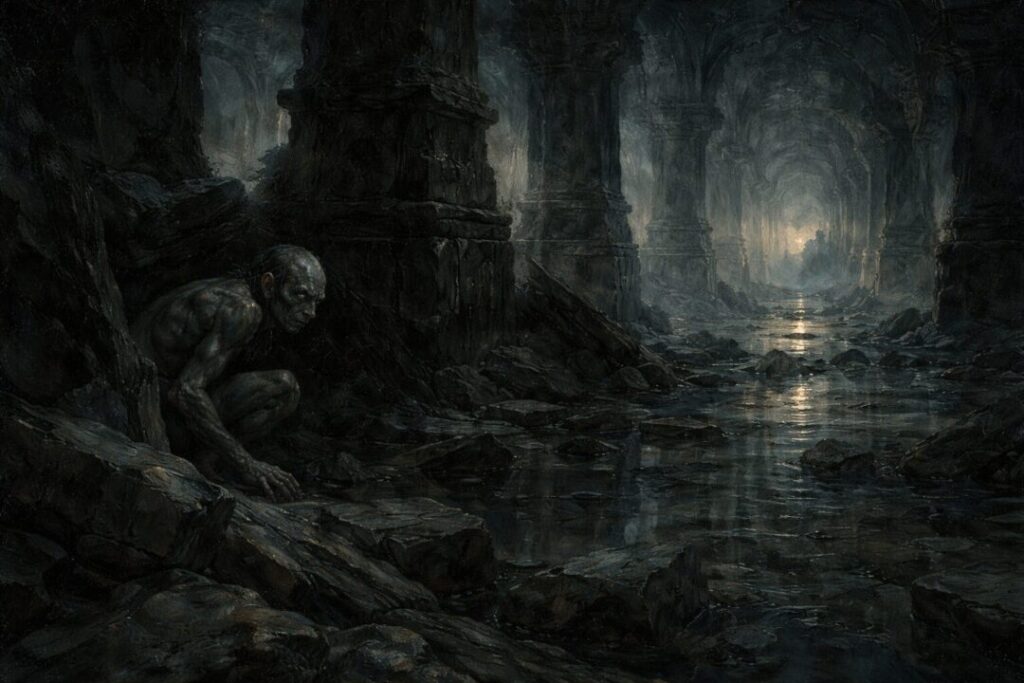
Gollum did not fear the dark places of the world.
He belonged to them.
The Fellowship fears Moria because it is unknown, ancient, and hostile. Gollum fears it only because it reminds him of home—and even that fear is familiar.
Darkness does not disorient him.
Silence does not unnerve him.
Confinement does not weaken him.
In places where others lose their bearings, Gollum becomes more confident.
He Does Not Follow Paths — He Follows People
One of the most important details about Gollum’s pursuit is this:
He does not track the Fellowship by footprints alone.
He watches behavior.
He learns how they rest.
How they space themselves.
How they react to danger.
Over time, he understands their rhythm.
This is why he never needs to remain close. He knows when they will slow down. He knows when they will avoid certain routes. He knows that fear will push them toward “safer” paths—paths that are often more predictable.
Gollum does not need to hurry.
He only needs to be there when the Ring-bearer hesitates.
The Ring Pulls — But It Does Not Guide Him
It is tempting to assume that the Ring itself guides Gollum across Middle-earth.
But the Ring does not work that way.
It does not whisper directions.
It does not point out roads.
It does not act as a beacon.
The Ring draws desire—but only in those already near it.
What truly guides Gollum is memory.
He has carried the Ring for centuries. He knows how it weighs on the mind. He knows how it slows its bearer—not physically, but emotionally. He knows the pauses, the doubt, the moments of fixation.
Gollum does not chase Frodo because he senses the Ring’s location like a compass.
He follows Frodo because he understands how a Ring-bearer moves.
And he knows that sooner or later, the Ring will create hesitation.
After the Fellowship Breaks, Everything Changes
When Boromir falls and the Fellowship scatters, Gollum’s task becomes easier—not harder.
Nine companions bound by leadership, strategy, and mutual protection are difficult to stalk. Two Hobbits alone are not.
Frodo and Sam do not know they are being hunted.
They stop to argue.
They pause to consider.
They double back.
And Gollum waits.
Not because he is confident—but because waiting has always kept him alive.
He understands that exhaustion will make them careless. Fear will make them visible. Loneliness will weaken their defenses more surely than any attack.
By the time he finally allows himself to be seen, he knows exactly how fragile they have become.
Why Gollum Is Never Truly Detected Until He Chooses To Be
This is the most important detail of all:
Gollum is not caught because he never forces discovery.
He reveals himself only when hunger, fear, and obsession outweigh caution—at the precise moment when Frodo and Sam are already vulnerable.
That moment is not accidental.
It is the result of weeks—perhaps months—of silent pursuit, shaped by restraint rather than aggression.
Gollum survives because he understands a truth that stronger beings often forget:
Visibility is danger.
The Fellowship carries light, fire, weapons, and hope. Gollum carries none of these.
He carries only endurance.
Why This Matters
Gollum’s tracking of the Fellowship is not a coincidence, and it is not a narrative shortcut.
It reinforces one of the deepest truths of Middle-earth:
The most dangerous threats are not always the strongest.
Sometimes, they are the ones who understand how to endure unnoticed—who know where not to be seen, when not to act, and how long to wait.
Gollum does not conquer Middle-earth.
He does not command armies.
He does not win battles.
But he outlasts nearly everyone.
And by the time he finally steps fully into the story, his presence has already shaped its outcome in ways no one can undo.
By then…
It is already too late.
Sources & Notes
- J.R.R. Tolkien, The Lord of the Rings, Book I, Ch. 2 ‘The Shadow of the Past’ — gives Gollum’s history after losing the Ring: leaving the Misty Mountains, wandering, being drawn toward Mordor, and revealing key names under questioning.
- J.R.R. Tolkien, The Lord of the Rings, Book II, Ch. 2 ‘The Council of Elrond’ — Gandalf and Aragorn describe the long hunt for Gollum, his capture, escape from the Wood-elves, and the danger that he may still be abroad.
- J.R.R. Tolkien, The Lord of the Rings, Book II, Ch. 4 ‘A Journey in the Dark’ — Frodo hears following footsteps in Moria and Gandalf identifies the pale-eyed pursuer as Gollum, already trailing the Company through darkness.
- J.R.R. Tolkien, The Lord of the Rings, Book II, Ch. 9 ‘The Great River’ — Aragorn and Frodo detect Gollum again on the Anduin, showing his ability to shadow the Fellowship by water and night without being caught.
- J.R.R. Tolkien, The Lord of the Rings, Book IV, Ch. 1 ‘The Taming of Sméagol’ — Gollum finally closes on Frodo and Sam in the Emyn Muil, where his climbing, stealth, hunger, and obsession overcome his caution.