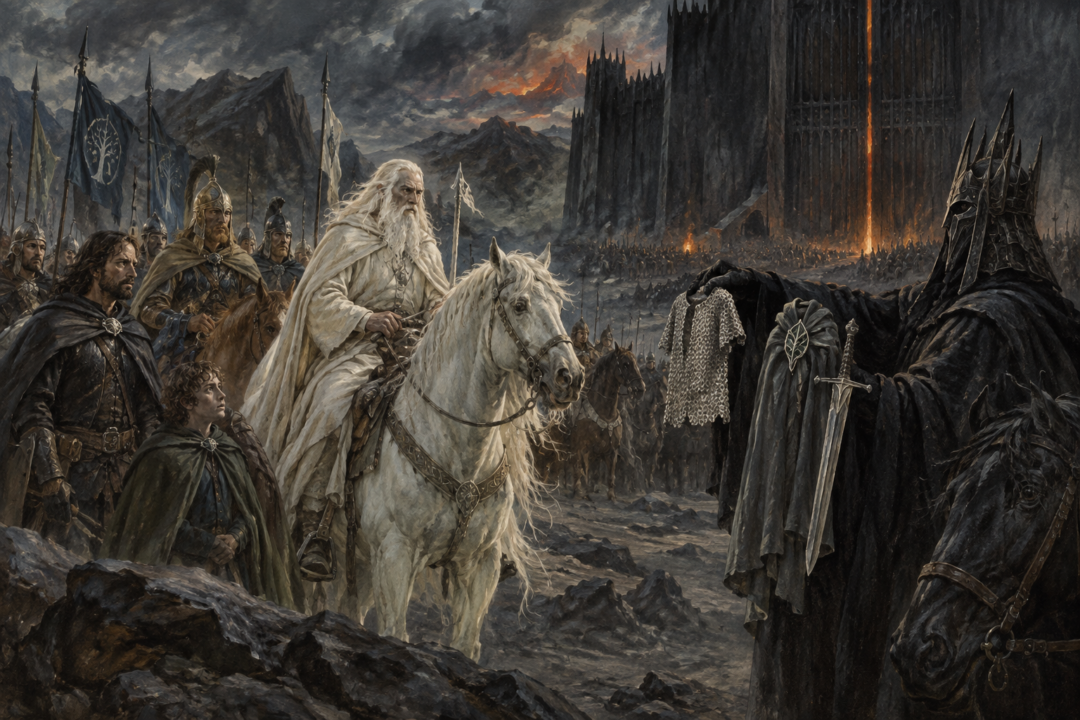
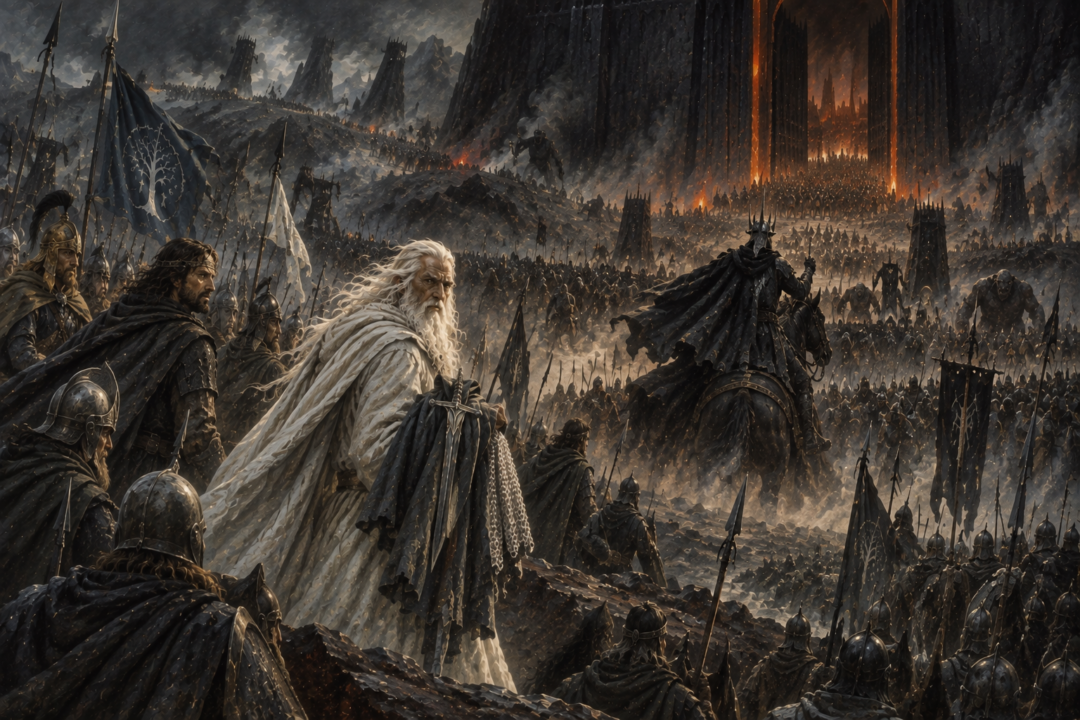
At the Black Gate, the Mouth of Sauron produces three objects that seem capable of destroying the last hope of the West: a short sword carried by Sam, a grey Elven cloak, and Frodo’s mithril coat.
The Captains recognize them.
For a terrible moment, they have every reason to fear that Frodo has been captured and that the secret mission has failed.
Then Gandalf does something extraordinarily disciplined.
He does not tell the Mouth of Sauron that he is lying.
He does not claim that Frodo is free.
He does not reveal what Frodo was carrying.
He does not explain why the objects fail to prove Sauron’s story.
Instead, Gandalf lets the enemy speak, discovers how much the enemy actually knows, takes back the tokens, and rejects Sauron’s terms completely.
The scene in “The Black Gate Opens” is therefore more than an exchange of threats. It is a contest over information. And Gandalf wins that contest largely because he refuses to prove that Sauron’s bluff is a bluff.
The Evidence Is Real
The first important detail is that the Mouth of Sauron does not arrive with fabricated evidence.
The objects are genuine.
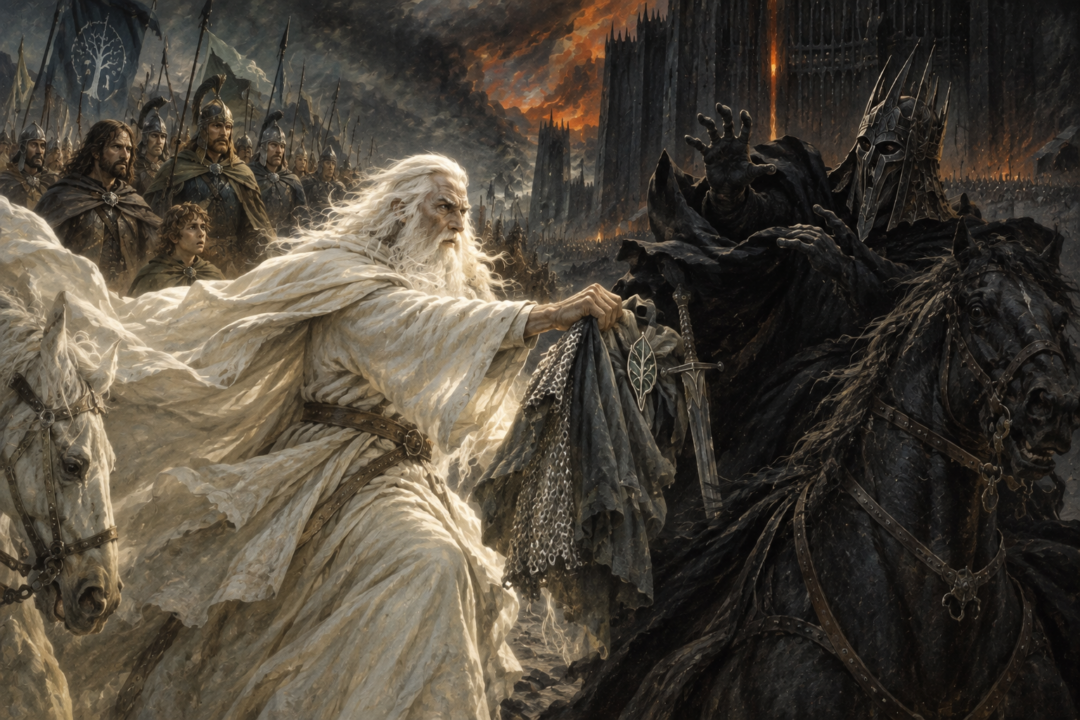
Sam had carried the short sword. The grey cloak and Elven brooch belong to the equipment brought from Lórien, and the mithril coat is Frodo’s. These things had fallen into the hands of Sauron’s servants after Frodo was captured by the Orcs near Cirith Ungol.
That is what makes the deception effective.
The lie is not necessarily in the objects. It is in what the Mouth encourages the Captains to conclude from them.
He wants them to believe that Sauron possesses not merely Frodo’s belongings, but Frodo himself — alive, helpless, and available as a hostage.
Yet he never demonstrates that.
He shows no prisoner.
He offers no information that proves Frodo remains captive.
Instead, he speaks conditionally, suggesting that perhaps the bearer of these things matters to them and that the prisoner’s fate depends upon their response.
It is psychological warfare built around a gap in knowledge.
And Gandalf notices the gap.
Gandalf Makes the Mouth Reveal What He Does Not Know
When the tokens appear, Gandalf does not immediately challenge their authenticity. He acknowledges that he knows them and their history.
But he also points out something much more important: the Mouth does not know their full history.
Then Gandalf asks why they have been brought.
That question is deceptively powerful.
Gandalf already understands the emotional meaning of the objects. What he needs to discover is what Mordor thinks they mean.
The Mouth obliges.
His description treats the collection as evidence of some vague conspiracy involving a spy from the Shire. That is an enormous clue.
Sauron has captured equipment connected with a Hobbit, but his messenger does not announce that the Hobbit carried the One Ring. He does not accuse the West of attempting to destroy it. He does not even demonstrate a clear understanding of why this “spy” entered Mordor.
That ignorance matters enormously.
The entire strategy of the Captains depends upon Sauron continuing to misunderstand their purpose.
Sauron Is Looking in the Wrong Direction
The march to the Morannon is deliberately desperate.
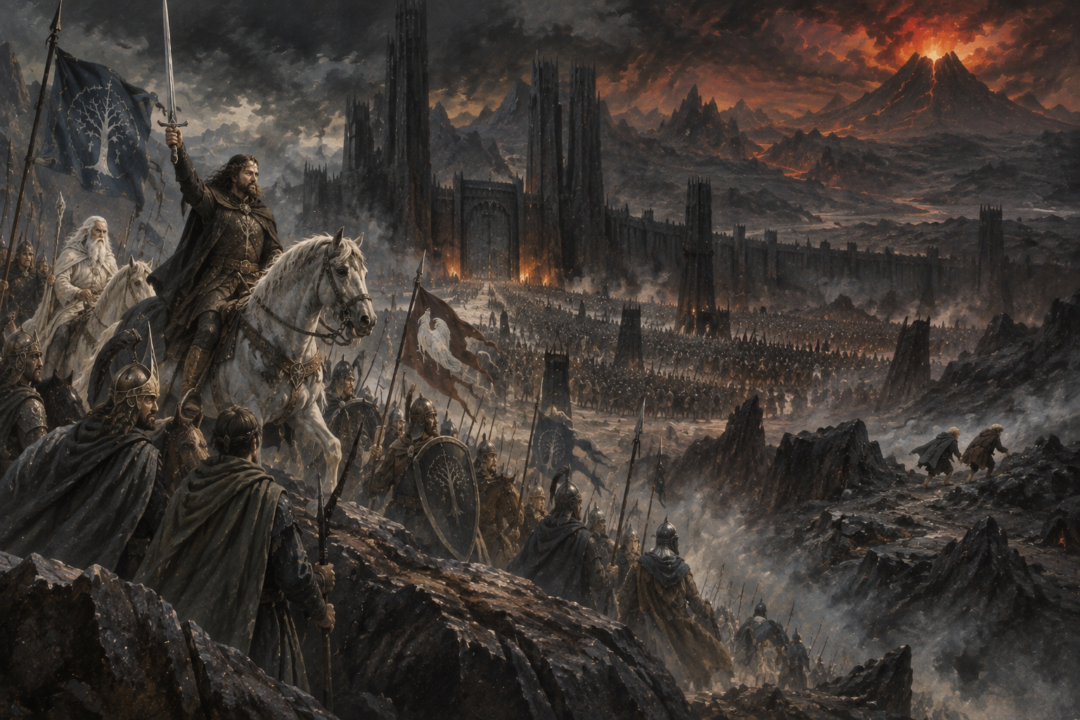
Aragorn, Gandalf, and the other Captains know that they cannot defeat Sauron by conventional military strength. Their host is far too small. The purpose of marching openly against the Black Gate is to draw Sauron’s attention outward and give Frodo whatever chance remains to reach Mount Doom.
Their strategy depends on Sauron interpreting Aragorn as the central threat.
That misunderstanding is plausible because Aragorn has revealed himself through the palantír and openly challenged Sauron. The heir of Isildur is advancing toward Mordor with an army after victory at the Pelennor Fields.
From Sauron’s perspective, this can look like the behavior of someone who possesses a weapon powerful enough to make otherwise irrational confidence seem possible.
The Mouth’s performance confirms that Sauron still has not understood the real plan.
He knows a Hobbit entered Mordor.
He possesses Frodo’s equipment.
But nothing in the embassy shows that he understands the crucial truth: the Ring itself is being carried toward the fire in which it can be destroyed.
Gandalf must preserve that ignorance.
Why Gandalf Cannot Simply Call the Bluff
Imagine Gandalf answering differently.
Suppose he had said that Frodo had escaped.
Or that Sauron had only captured his belongings.
Or that the prisoner described by the Mouth was no longer in the Tower.
Any such answer would give Mordor information.
Even an accurate denial could reveal that Gandalf knows more about events inside Mordor than Sauron expects.
Worse, an emotional attempt to prove that the hostage claim is false could encourage the Mouth to ask why Gandalf is so confident.
Gandalf therefore refuses to debate the factual premise.
He does not need to prove that the hostage story is false.
He only needs to avoid confirming anything useful.
This is one of the sharpest features of the encounter: Gandalf understands that when the enemy possesses incomplete information, correcting him can be more dangerous than allowing him to remain mistaken.
The Terms Reveal Sauron’s Real Objective
The Mouth eventually states Sauron’s demands.
The army of Gondor and its allies must withdraw beyond the Anduin and swear never again to attack Sauron. Lands east of the Anduin are to belong permanently to Sauron. Lands westward toward the Misty Mountains and the Gap of Rohan are to become tributary, their people disarmed. Isengard is to be rebuilt and occupied by Sauron’s lieutenant.
These are not limited terms for the release of one captive.
They amount to the political destruction of meaningful resistance in the West.
The proposed settlement would strip Gondor and its allies of the ability to oppose Mordor while extending Sauron’s control far beyond his existing borders.
The supposed hostage is therefore being used as leverage for surrender.
And there is another reason Gandalf cannot treat the offer as trustworthy: the terms come from Sauron.
Gandalf explicitly calls him faithless. The Captains have no reason to assume that submission would produce a stable peace or that promises made by the Dark Lord would protect them afterward.
The choice being offered is not really between war and peace.
It is between continuing resistance and accepting Sauron’s domination.
Gandalf Takes the Tokens — Not the Terms
Then comes Gandalf’s masterstroke.
The Mouth demands that the Captains take Sauron’s terms or leave them.
Gandalf answers by taking something else.
He suddenly seizes the sword, cloak, and mithril coat from the messenger, declaring that these they will take in memory of their friend.
But Sauron’s terms are rejected utterly.
The distinction is precise.
Gandalf does not announce that Frodo is alive. Calling him “our friend” and treating the objects as memorial tokens allows the Mouth to continue believing that his display has caused despair.
Nor does Gandalf expose the weakness in the Mouth’s evidence.
He simply removes the evidence from the messenger’s possession and ends the negotiation.
The Mouth receives no explanation.
That is exactly what Gandalf needs.
Even the Captains Do Not Know Frodo’s Exact Fate
There is an important restraint here that makes the scene stronger.
Gandalf himself cannot know with certainty exactly what is happening to Frodo at that moment.
The Captains know the mission. They know what must happen for Sauron to be defeated. But they do not have continuous knowledge of Frodo and Sam’s movements inside Mordor.
The tokens therefore genuinely terrify them.
Their horror is not theatrical.
For all Gandalf knows when the objects appear, something catastrophic may indeed have happened.
What he can infer, however, is that the Mouth’s knowledge is incomplete.
That distinction matters.
Gandalf is not confidently exposing a lie because he secretly knows every fact.
He is recognizing that the enemy has failed to prove his claim — and, more importantly, has revealed ignorance of the larger truth.
That is enough.
Pippin Nearly Gives the Game Away
The emotional danger becomes visible through Pippin.
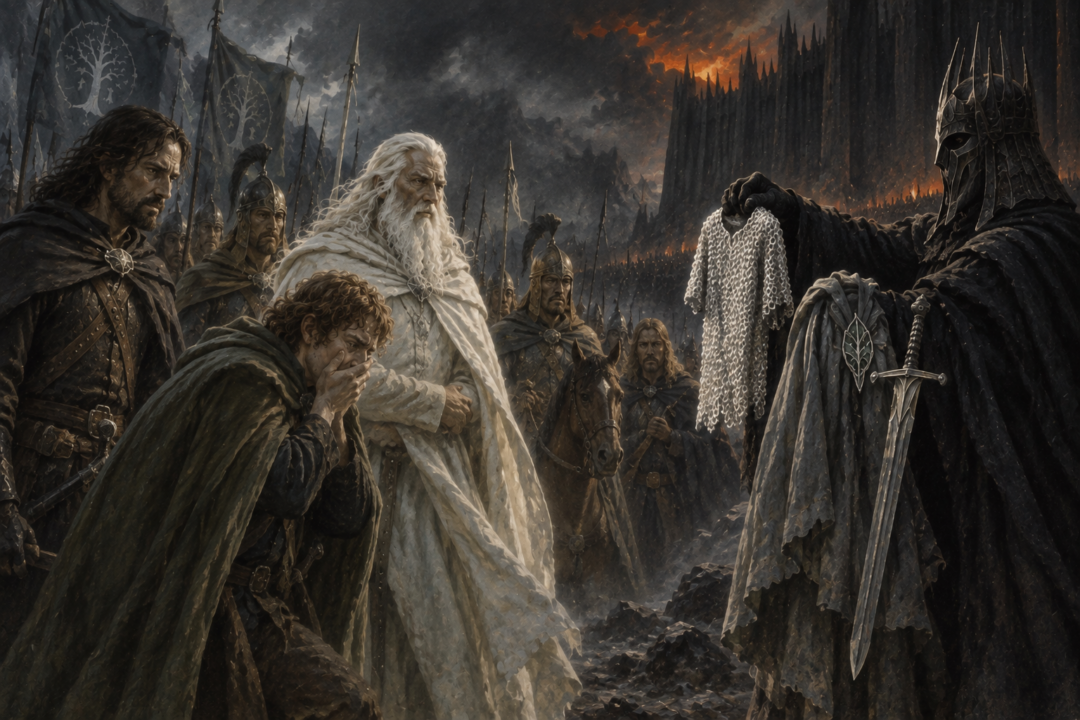
When the tokens are displayed, he cries out in grief.
The Mouth notices the reaction and is pleased because it tells him that the objects matter.
This is exactly the kind of information Gandalf avoids supplying verbally.
The enemy is watching faces as carefully as the Captains are listening to words.
Every reaction becomes intelligence.
Yet even Pippin’s grief does not reveal the essential secret. It confirms that the owner of the objects is important to the people before the Gate, but it does not explain why.
Sauron still sees a captured spy and a desperate enemy army.
He does not see the Ring-bearer approaching the heart of his realm.
The Bluff Works Because It Contains Part of the Truth
Calling the Mouth’s performance a bluff does not mean everything he says is fabricated.
That would make the scene much simpler than it is.
Sauron’s servants really had captured Frodo. They really had taken his possessions. The mithril coat really had reached Barad-dûr’s authorities.
What the Mouth cannot prove is the present condition of the prisoner whose belongings he displays.
Readers know something he apparently does not: Sam rescued Frodo from the Tower of Cirith Ungol, and the two Hobbits continued into Mordor.
The deception therefore rests on outdated but dangerous intelligence.
Sauron possesses enough truth to frighten his enemies, but not enough truth to understand what is actually happening.
Gandalf’s task is to keep it that way.
The Last Battle Depends on Sauron Remaining Wrong
Immediately afterward, negotiation ends and Sauron’s armies close upon the Host of the West.
Militarily, Gandalf and the Captains appear to have gained nothing.
They are surrounded by overwhelming forces, exactly as their enemies intended.
Strategically, however, Sauron has done what the Captains hoped he would do.
His attention is fixed upon them.
His strength is being directed toward the Black Gate.
And his messenger has just demonstrated that the central secret remains hidden.
That is why Gandalf’s refusal is so effective.
He never proves the Mouth of Sauron wrong because proving him wrong would serve no purpose.
Instead, he learns what Mordor knows, reveals almost nothing in return, refuses terms that would surrender the West, and allows Sauron to continue acting on a catastrophic misunderstanding.
The Mouth arrives believing he possesses the decisive secret.
In reality, his ignorance is the most important thing he reveals.
And Gandalf is careful not to correct him.
Sources & Notes
- Tolkien Gateway, “Mouth of Sauron” — describes the parley at the Black Gate, the captured tokens shown to the Captains, Sauron’s demands, and Gandalf’s seizure of the items. https://tolkiengateway.net/wiki/Mouth_of_Sauron
- Tolkien Gateway, “The Black Gate Opens” — summarizes the chapter’s exchange, including the Mouth’s presentation of Frodo’s belongings and Gandalf’s rejection of the proposed surrender. https://tolkiengateway.net/wiki/The_Black_Gate_Opens
- Tolkien Gateway, “Battle of the Morannon” — outlines the Captains’ diversionary march, their confrontation with the Mouth of Sauron, and the battle that followed the failed negotiation. https://tolkiengateway.net/wiki/Battle_of_the_Morannon
- The Encyclopedia of Arda, “Mouth of Sauron” — records Sauron’s lieutenant confronting the Captains at the Morannon, presenting the tokens, and delivering the Dark Lord’s terms. https://www.encyclopedia-of-arda.com/m/mouthofsauron.html
Sources document the Black Gate parley, the authentic tokens displayed by the Mouth of Sauron, the demands attached to them, and Gandalf’s refusal. The article’s information-war reading is interpretive.