Boromir’s Last Journey: When There Was No Grave, the Fellowship Gave Him River, Weapons, and Song
Boromir dies far from Minas Tirith.
There is no tomb waiting for the heir of the Steward. No company of Gondor to carry him home. No time even for Aragorn, Legolas, and Gimli to raise a proper cairn. Merry and Pippin have been taken, Frodo has vanished, Orcs are escaping westward, and the Fellowship has broken apart.
Yet Boromir is not simply left beneath the trees of Amon Hen.
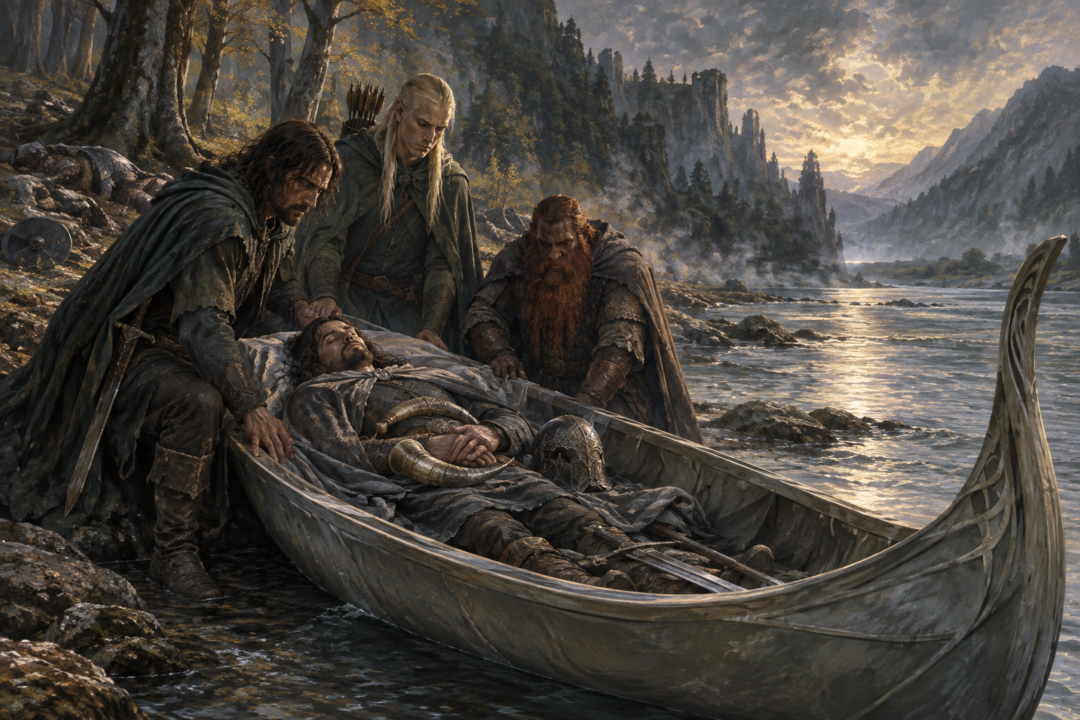
Instead, his surviving companions create one of the strangest and most moving funerals in The Lord of the Rings. They place him in an Elven boat. They arrange the broken things of his final battle around him. They give him the weapons of the enemies he killed. Then they surrender him to the Anduin and sing while the river carries him toward Rauros.
It is an improvised burial, made from whatever the broken Fellowship still possesses.
And almost every part of it means something.
There Was No Time to Make a Grave
Boromir's death comes at the worst possible moment.
He has already succumbed briefly to the temptation of the Ring, trying to persuade and finally frighten Frodo into surrendering it. Almost immediately afterward, he recognizes what he has done. Then, when Merry and Pippin are attacked, Boromir fights desperately in their defense.
Aragorn finds him beneath a tree, pierced by many arrows, with slain Orcs around him. Boromir confesses what happened with Frodo and tells Aragorn that he has failed.
Aragorn answers by emphasizing what Boromir accomplished in his final defense rather than allowing his last judgment upon himself to be failure.
Then Boromir dies.
There is scarcely time to mourn.
Legolas and Gimli return, and the three survivors face an immediate practical problem. They cannot bury Boromir properly. The ground is difficult, they lack the necessary tools, and more importantly they cannot afford the delay. Nor can they construct a cairn substantial enough to protect his body.
Merry and Pippin may still be alive in enemy hands.
So the companions turn to the one thing capable of carrying Boromir away from the battlefield: one of the boats given to the Fellowship in Lórien.
His funeral therefore grows directly out of catastrophe. It is not a planned Gondorian ceremony. The text never presents it as the standard burial custom of Gondor, and it would be unsafe to treat it as one.
It is something Aragorn, Legolas, and Gimli make for their fallen companion because a grave is impossible.
They Do Not Hide the Evidence of His Last Battle
The preparation of Boromir's body is remarkably deliberate.
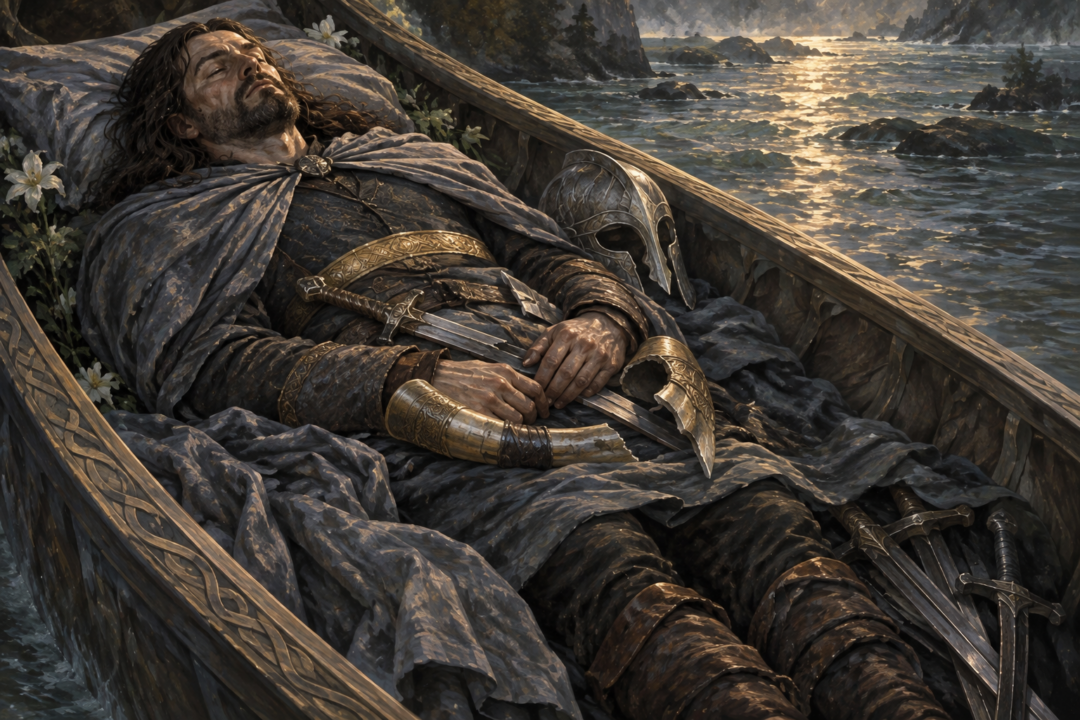
His grey hood and Elven cloak are folded beneath his head. His long dark hair is combed and arranged upon his shoulders. The golden belt given to him in Lórien remains around his waist. His helm is placed beside him.
Then come the broken objects.
Across his lap are laid his cloven horn and the hilt and shards of his sword.
That detail matters because Boromir's funeral does not restore him to an artificial image of untouched glory. His companions do not replace the broken sword or conceal the shattered horn.
The objects of his defeat become part of his honor.
His sword broke in his last battle. His Great Horn, which had announced him from Rivendell to the borders of Gondor's world, has been cut in two.
Those fragments testify to what happened.
There is something particularly fitting about this because Boromir himself dies morally wounded as well as physically wounded. He had failed Frodo only shortly before. Yet his final actions are courageous: he fights for Merry and Pippin against overwhelming enemies and repents of what he did concerning the Ring.
The funeral does not require either side of Boromir to erase the other.
His story ends broken, but not without honor.
The Swords at His Feet Tell the Story He Cannot
There is another striking detail.
The swords of the Orcs Boromir killed are placed beneath his feet.
The text does not explicitly explain the symbolism of this arrangement, so we should not turn it into a formal rule of Gondorian burial. But its narrative effect is unmistakable.
Boromir's body carries evidence of his last stand.
Aragorn, Legolas, and Gimli know that he died surrounded by enemies he had slain. Merry and Pippin are gone. There are no Gondorian witnesses to proclaim what the son of Denethor did beneath the trees.
So the weapons accompany him.
The broken sword across his lap shows the cost.
The enemy blades at his feet show the resistance.
This is especially important because Boromir himself believed he had failed. His last conversation with Aragorn is haunted by that belief. Yet Aragorn refuses to define Boromir solely by his fall before the Ring.
Boromir had fallen into temptation.
Then he rose and defended others.
The funeral preserves that final victory without pretending the earlier failure never happened.
The Anduin Becomes the Road Home
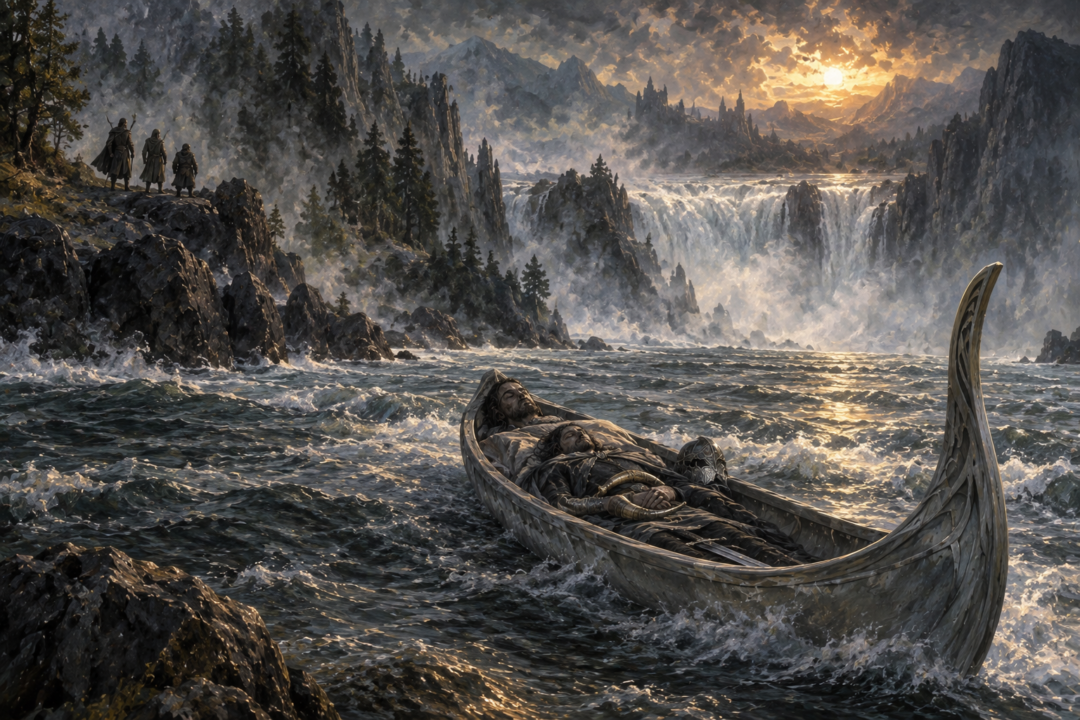
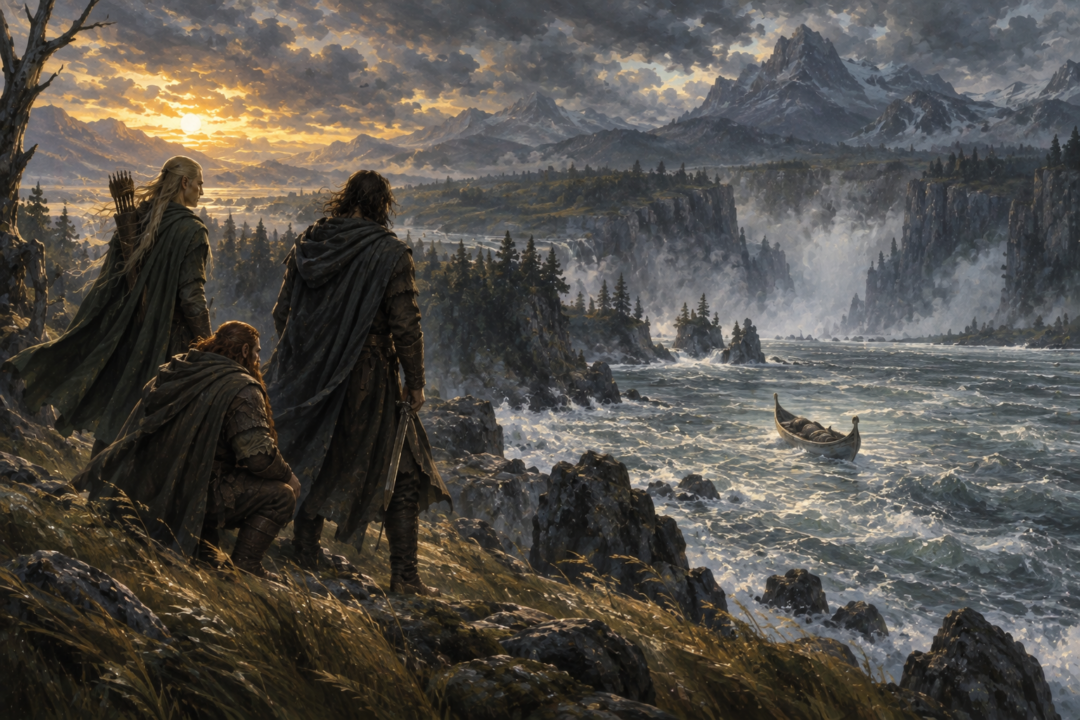
Once Boromir is prepared, the companions tow his boat into the current.
Ahead lies Rauros.
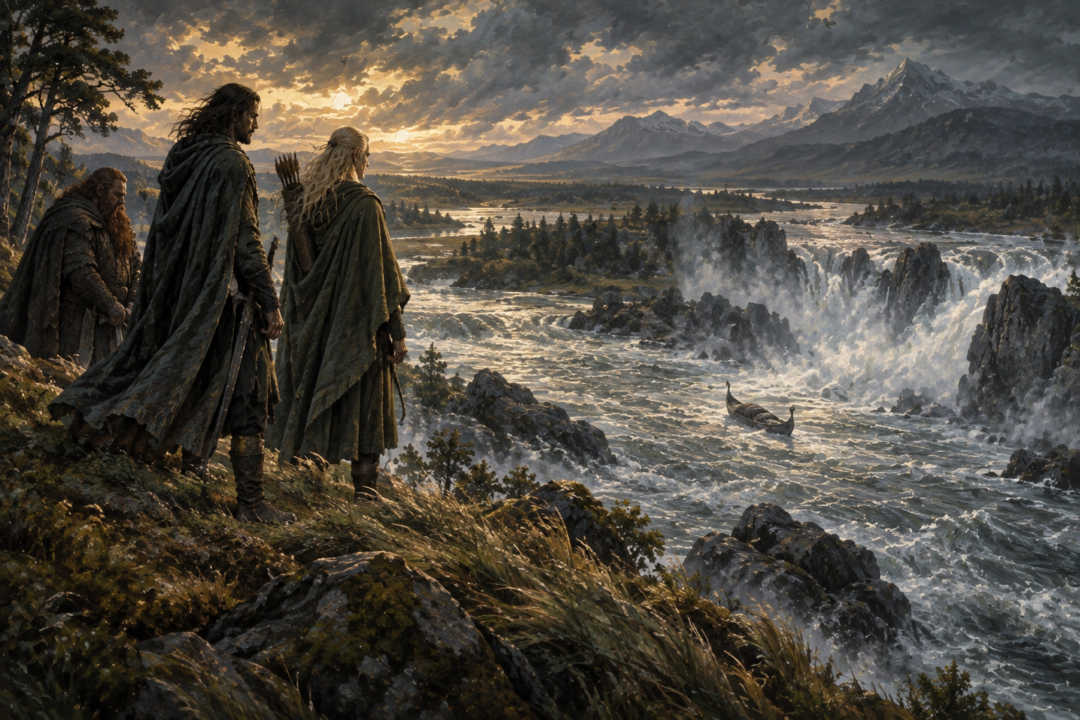
There is no ordinary expectation that a funeral vessel should survive such a journey. The great falls mark the southern end of Nen Hithoel, and Boromir's companions watch the boat pass toward them until it disappears.
Yet this is not the last appearance of the vessel.
Later, in Ithilien, Faramir tells Frodo that he saw a boat upon the Anduin while he was near Osgiliath. In it lay a dead warrior surrounded by a strange light. Looking closely, Faramir recognized his brother.
The broken sword was there.
But the horn was gone.
The two pieces of Boromir's horn were separately found and eventually brought to Denethor, giving Gondor terrible evidence of his death.
Faramir, however, believes he truly saw Boromir himself passing down the river.
The narrative leaves something mysterious around the journey. It does not provide a mechanical explanation for how the boat passed Rauros intact. Earlier, the Fellowship had been told of the remarkable qualities of the Elven boats, but the precise manner of Boromir's passage remains unexplained.
In Gondor, the tale afterward was that the boat passed through Osgiliath, down the mouths of Anduin, and ultimately into the Great Sea.
Whether every element of that later tradition should be read literally is less important than the image it preserves.
Boromir could not be carried home to Minas Tirith.
So the river of his homeland carried him through it.
The Funeral Has No Priest — It Has a Song
After releasing the boat, Aragorn and Legolas sing.
Gimli does not compose a verse. When Legolas asks him to sing, the Dwarf says the East Wind should be left to him and that he will say nothing of it. The lament therefore turns around three winds: West, South, and North.
The song imagines voices in Minas Tirith asking the wandering winds for news of Boromir.
The West remembers his journey through empty lands.
The South comes from the Sea and brings memories associated with Gondor.
The North finally brings the decisive answer: Boromir will return no more.
The structure transforms geographical distance into grief. Minas Tirith cannot see what has happened at Amon Hen. Boromir's people are far away. His father and brother do not stand beside his body.
So the winds become messengers.
This also gives the funeral an unusual emotional scale. Boromir is only one dead man in a war that will soon consume kingdoms, yet for these few moments the landscape seems to participate in his departure: river beneath him, winds around him, Rauros ahead.
The Fellowship cannot give him a grave.
It can give him remembrance.
His Horn Reaches Gondor Before His Body Ever Could
Boromir's Great Horn makes the funeral even more poignant.
During his final defense of Merry and Pippin, he blows it repeatedly. Aragorn hears it and runs toward him, but arrives too late to save him.
Far to the south, the horn has another consequence.
Faramir later says that he heard the horn sounding, though faintly, and Denethor also knew of it. Eventually the broken halves are found and brought to Minas Tirith.
The horn therefore completes a journey that Boromir cannot.
It returns as proof of disaster.
That creates a painful reversal of Boromir's confidence earlier in the story. At Rivendell he had proudly declared that he would not go forth like a thief in the night and sounded his horn as the Company departed, despite Elrond's warning not to announce their journey unnecessarily.
At Amon Hen, the horn sounds again.
This time it is not pride or ceremony.
It is a call for help.
And only echoes answer soon enough.
Boromir’s Burial Refuses a Simple Judgment
That is why the funeral matters beyond its beauty.
Boromir is one of the clearest demonstrations in The Lord of the Rings that moral failure need not be the final word on a person.
The Ring reaches him through something that initially looks almost admirable: his desperate desire to defend Gondor. He wants power because his people are losing men, territory, and hope.
But that desire becomes dangerous when he begins believing that power can be seized and controlled for righteous ends.
He falls.
What follows is equally important.
He recognizes the horror of what he has done. He does not continue pursuing Frodo. He does not betray him to the Orcs. Instead, when Merry and Pippin are threatened, Boromir spends his final strength defending them.
His death does not undo his attempt to take the Ring.
His temptation does not erase his last stand either.
The funeral holds both truths together.
A broken sword rests upon him.
Enemy weapons lie beneath him.
The horn that could not summon rescue is shattered.
And the man who thought he had failed is sent away with honor.
A Grave Made From What Remained
There is no stone over Boromir.
No inscription records his deeds at Amon Hen.
Aragorn, Legolas, and Gimli cannot even remain beside him for long. Almost immediately they must decide whether to follow Frodo or pursue the Orcs carrying Merry and Pippin.
Everything is moving.
The Fellowship is broken. Frodo and Sam are crossing toward Mordor. Merry and Pippin are being carried toward Isengard. Aragorn, Legolas, and Gimli will soon begin their desperate pursuit across Rohan.
Boromir alone travels south.
That makes his burial uniquely suited to the moment.
The companions use an Elven boat from Lórien, the weapons of a fallen Man and his enemies, the Great River of Gondor, and a song improvised by friends who cannot accompany him any farther.
Nothing can stop the disaster that has already happened.
But they can decide what his final departure means.
Boromir entered the last day of the Fellowship by trying to take something that was not his.
He ended it by giving his life for others.
And when no grave could be made for him, his companions entrusted him to the river that flowed toward his home.
Sources & Notes
- The Encyclopedia of Arda, “Boromir” — identifies Boromir as Denethor’s warrior heir and records his death at the hands of Orcs beneath Amon Hen. https://www.encyclopedia-of-arda.com/b/boromir.php
- The Encyclopedia of Arda, “Great Horn” — traces Boromir’s horn from its breaking in his final battle, through its placement on the funeral boat, to the recovery of its two halves. https://www.encyclopedia-of-arda.com/g/greathorn.php
- The Encyclopedia of Arda, “River Anduin” — recounts that the surviving Fellowship placed Boromir in a funeral boat, set it downriver, and then pursued the Orcs who had taken Merry and Pippin. https://www.encyclopedia-of-arda.com/a/anduin.html
- The Encyclopedia of Arda, “Rauros-foot” — documents Boromir’s death near Rauros and the sending of his funeral boat over the falls. https://www.encyclopedia-of-arda.com/r/raurosfoot.html
Sources document Boromir’s death beneath Amon Hen, the improvised river burial, the broken horn carried with him, the boat’s passage over Rauros, and the survivors’ urgent pursuit of the Orcs.