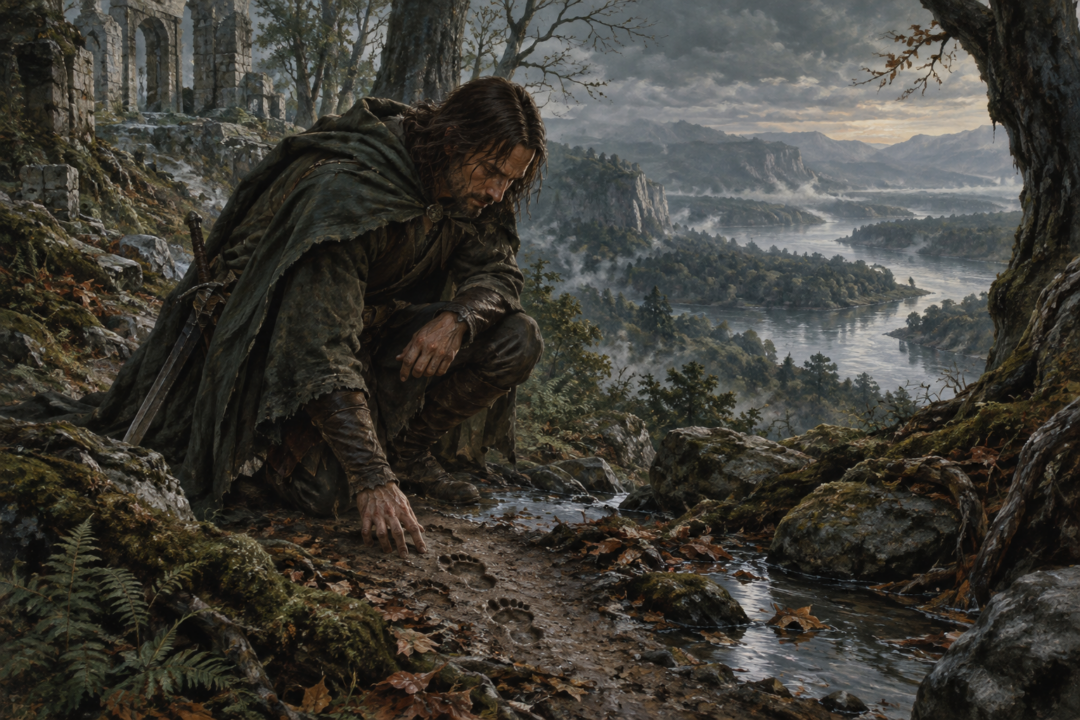
At Amon Hen, the Fellowship does not break cleanly.
It shatters.
Frodo disappears. Boromir returns alone and shaken. Merry and Pippin rush into the woods. Sam vanishes in another direction. Legolas and Gimli begin searching. Then Orcs descend upon the scattered Company.
In the middle of that chaos, Aragorn does something that can seem strange when the story is remembered mainly as the beginning of the famous pursuit across Rohan: he searches for Frodo.
Even after signs of danger appear, Frodo remains his immediate concern until the sound of Boromir's horn forces him to turn aside.
Why?
Because Aragorn does not yet know what the reader soon knows. He does not know that Frodo has chosen to cross the Anduin with Sam. He does not know which hobbits have been captured. And above all, he does not yet know whether the Fellowship's central purpose—the protection of the Ring-bearer long enough for him to continue toward Mordor—has already passed beyond his responsibility.
Aragorn's search is therefore not a mistake before the "real" chase begins. It is the final act of his leadership of the Fellowship, and the moment when he discovers that leadership sometimes means recognizing that someone else's road can no longer be yours.
The Fellowship Breaks Before Aragorn Understands How
The crisis begins with Frodo's decision.
At Parth Galen, Aragorn gives Frodo time to decide what he will do. The Company has reached the point where its roads may divide: Boromir intends to go to Minas Tirith, while Frodo must eventually turn east if he is to continue the Quest.
But Frodo's solitude is interrupted by Boromir.
Boromir first tries to persuade him to bring the Ring to Gondor. His desperation then overwhelms him, and he attempts to seize it. Frodo escapes by putting on the Ring.
When Boromir returns to the Company, he admits that he became angry with Frodo and that Frodo vanished, but the full consequences are not yet clear to everyone.
The search immediately becomes disorderly. Merry and Pippin run off. Aragorn sends Boromir after them. Legolas and Gimli search elsewhere. Sam also leaves—but Sam has understood Frodo better than the others. He guesses that Frodo will return to the boats and attempt to leave alone.
Aragorn does not yet possess that insight.
This matters because his later decisions are sometimes flattened into a simple choice between "follow Frodo" and "rescue Merry and Pippin." That choice only becomes clear afterward. During the attack itself, Aragorn is working with fragments of information.
He knows Frodo has disappeared.
He knows the Ring is with him.
And he knows that finding the Ring-bearer is the most urgent responsibility remaining from the original mission.
Why Aragorn Goes Up Amon Hen
When The Two Towers opens, Aragorn is already tracking Frodo.
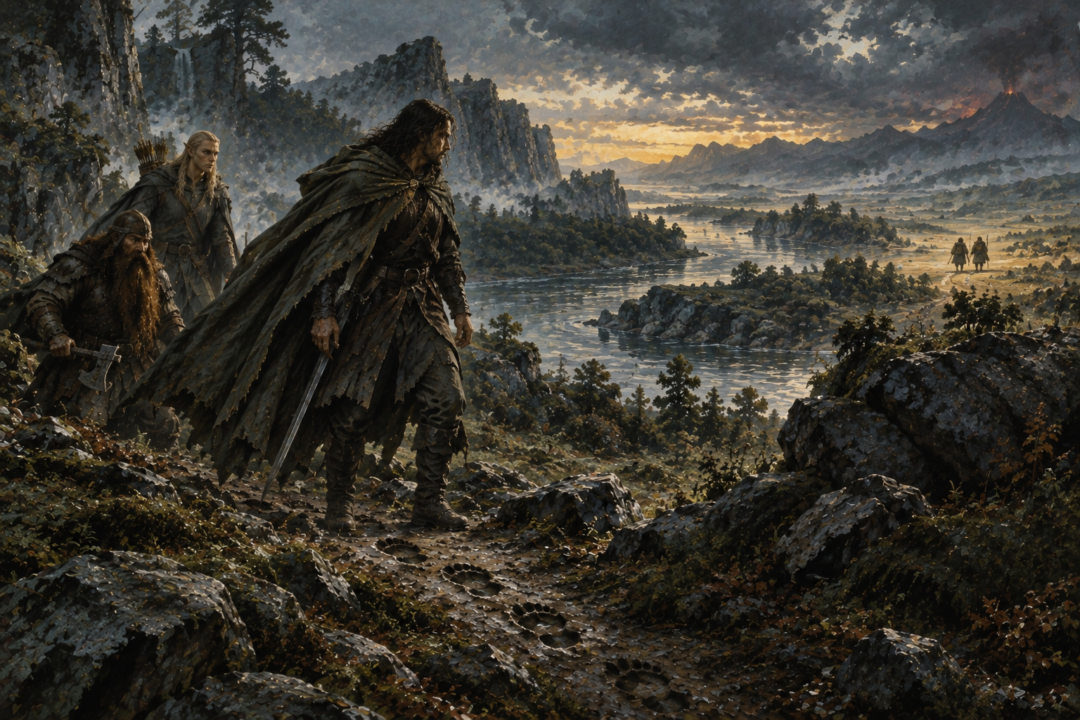
Hobbit footprints are difficult even for a Ranger to follow, but near the summit of Amon Hen he finds Frodo's tracks where a spring has softened the ground. The signs tell him that Frodo ran to the hilltop and then came back down.
That discovery creates another choice.
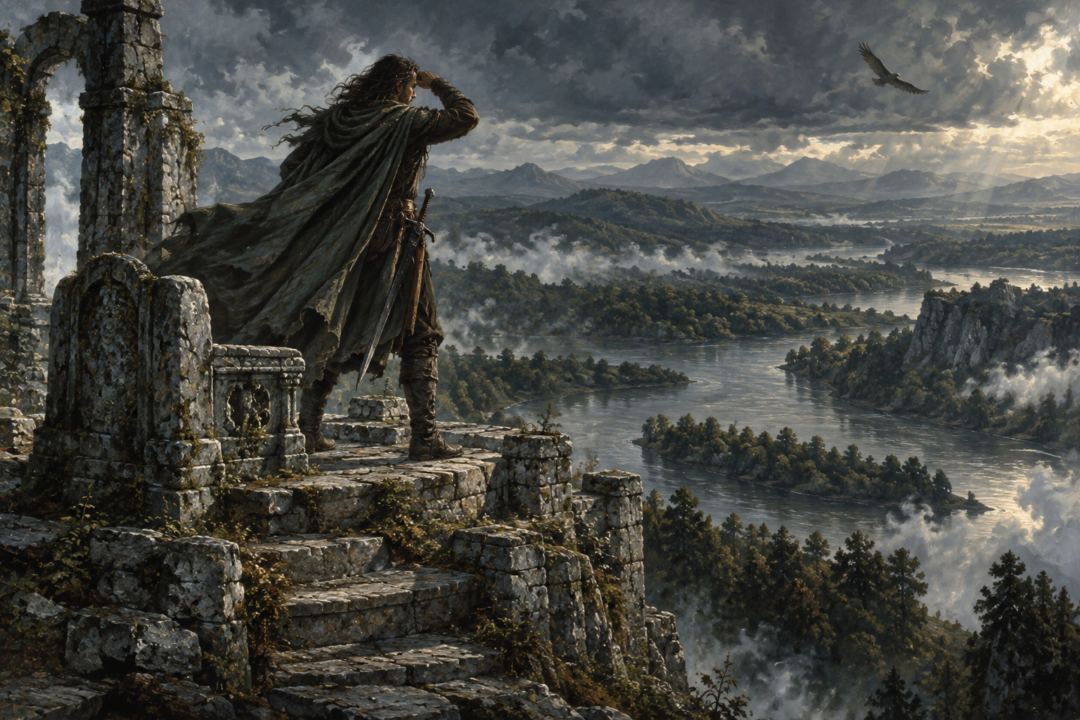
Amon Hen is the Hill of Seeing, crowned by the ancient Seat of Seeing associated with Gondor. Aragorn hopes that from the high seat he might discover something that will resolve his uncertainty.
He hesitates because time is running out, but climbs.
The decision is revealing. Aragorn is not wandering aimlessly through the woods. He is actively trying to reconstruct Frodo's movements and obtain information.
Yet when he reaches the Seat, it gives him no useful answer. Unlike Frodo, who shortly before had seen visions of distant lands and the gathering war from Amon Hen, Aragorn sees little that helps him.
Then he hears something far more immediate.
Boromir's horn.
The Horn Changes Everything
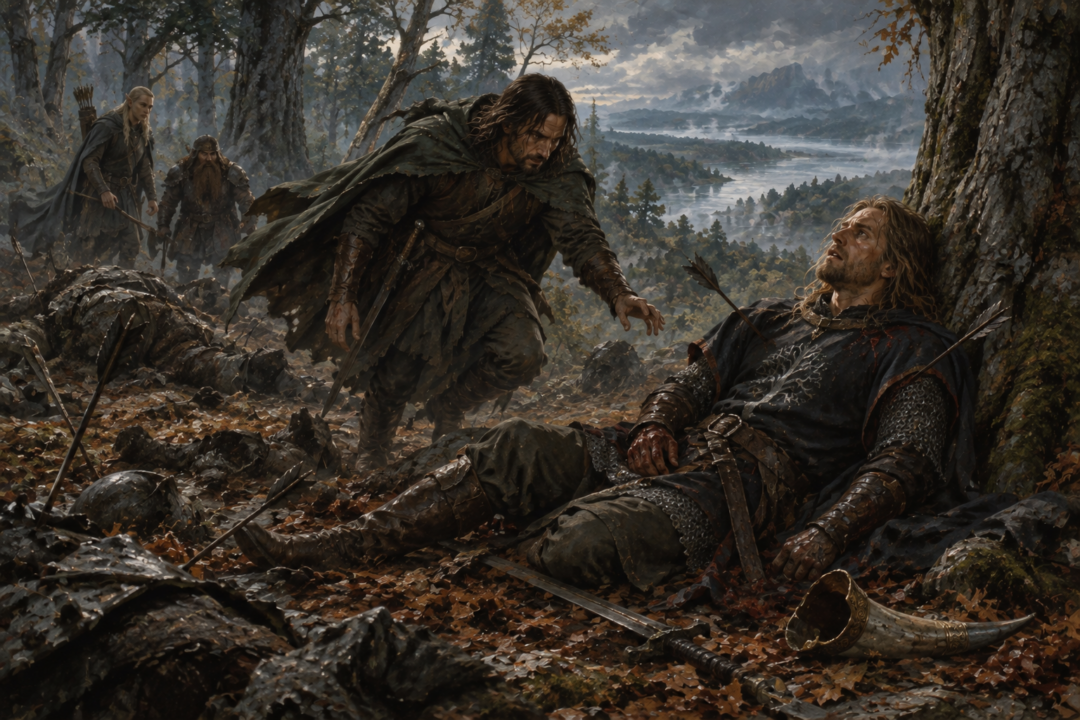
Aragorn recognizes the horn and understands what its repeated blasts mean: Boromir is in desperate need.
This forces him to abandon the search for Frodo.
That distinction is important. Aragorn does not discover Frodo and decide that Boromir matters more. He turns because an unmistakable signal tells him that one of his companions is under attack while Frodo's location remains unknown.
By the time Aragorn reaches Boromir, the battle is effectively over.
Boromir is mortally wounded beneath a tree, surrounded by slain Orcs. His sword is broken near the hilt, and his horn has been cloven. He has fought to defend Merry and Pippin, but the Orcs have carried them away.
Before dying, Boromir also confesses what happened with Frodo: he tried to take the Ring.
This gives Aragorn another crucial piece of the puzzle.
Frodo's disappearance was not merely indecision or panic. Something had happened within the Fellowship itself.
The Ring had already begun to divide them.
Aragorn Believes He Has Failed
One of the most revealing elements of the episode is how severely Aragorn judges himself.
Gandalf had fallen in Moria, leaving Aragorn with a burden of leadership he had not expected to assume so soon. Now, at Amon Hen, everything seems to have collapsed under his command.
Boromir is dead.
Merry and Pippin are gone.
Frodo has vanished.
Sam is missing.
Legolas and Gimli have been separated from the others during the attack.
Aragorn openly laments that his decisions have gone wrong and fears that Gandalf's trust in him has proved vain.
Yet the irony is that the disaster cannot simply be reduced to poor leadership.
Boromir's temptation, Frodo's independent decision, Sam's loyalty, and the Orc attack all converge almost simultaneously. Aragorn cannot control all of them.
His real test comes afterward.
Can he stop trying to restore the Fellowship exactly as it was and understand what has actually happened?
The Missing Boat Solves Frodo's Disappearance
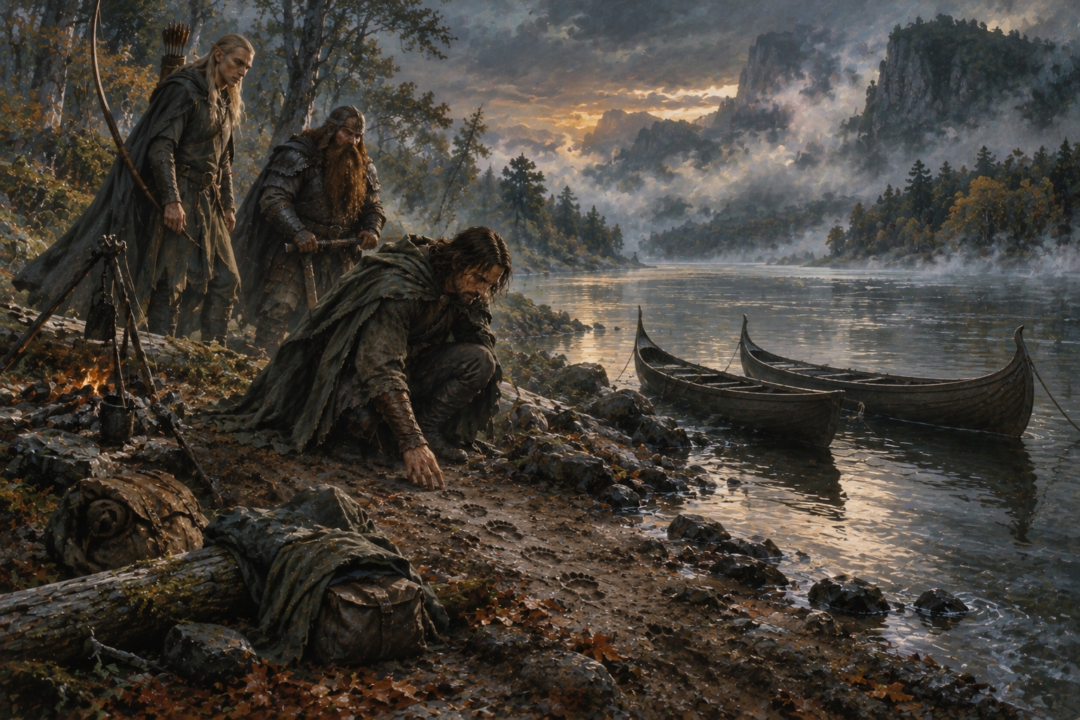
After Boromir's death, Aragorn, Legolas, and Gimli return toward Parth Galen and begin assembling the evidence.
The physical clues matter.
There are only two boats where there should have been three.
Aragorn finds hobbit footprints near the water.
Two packs are missing, and he recognizes one as Sam's.
The scattered facts suddenly form a coherent story.
Frodo has crossed the Anduin.
Sam has gone with him.
Aragorn then understands something deeper about Frodo's choice. He reasons that Frodo did not want to lead his friends to death in Mordor, but nevertheless knew that he himself had to go.
This is the moment when Aragorn's duty changes.
Until then, searching for Frodo is entirely rational. The Ring-bearer is missing in hostile country during an Orc attack. Aragorn cannot simply assume Frodo has safely continued the Quest.
Now he can.
Not because Frodo is safe—he plainly is not—but because Frodo has deliberately chosen his road.
Why Aragorn Does Not Follow Frodo
Once the evidence is clear, Aragorn faces the decision readers often remember.
He could cross the Anduin and attempt to follow Frodo and Sam toward Mordor.
Or he could pursue the Orcs carrying Merry and Pippin.
He chooses Merry and Pippin.
The reason is not that they have suddenly become more important than the Ring.
It is almost the opposite.
Aragorn recognizes that the fate of the Ring-bearer is no longer in his hands. The Fellowship has carried Frodo as far as it could. Frodo has made his choice and intentionally separated himself from the others.
Pursuing him would mean overriding that decision and possibly exposing the Ring once again to the dangers Frodo was trying to escape.
Merry and Pippin, by contrast, have made no such choice.
They are prisoners.
They have been taken alive by enemies.
And Aragorn, Legolas, and Gimli still possess the power to help them.
That moral distinction determines the road of the Three Hunters.
Frodo's Freedom Becomes Aragorn's New Duty
There is a subtle reversal here.
Earlier, Aragorn's responsibility is to find Frodo because he does not know whether Frodo is lost, captured, wounded, or fleeing.
Later, his responsibility is to leave Frodo alone because he finally understands what Frodo has chosen.
The difference is knowledge.
Aragorn does not abandon the Ring-bearer. He accepts the Ring-bearer's decision.
That acceptance also respects the unusual nature of the Quest. The Ring cannot be carried toward Mordor by conventional military strength. Increasing the size of Frodo's escort might not increase his chances of success. The Fellowship has already learned how dangerous the Ring can be even among honorable companions.
Boromir's fall makes that danger painfully immediate.
Frodo and Sam now move by secrecy.
Aragorn, Legolas, and Gimli can still act openly.
Their road therefore turns west and north after the Orcs.
The Choice That Leads Toward the War
Aragorn cannot know what his decision will eventually set in motion.
The pursuit of Merry and Pippin brings the Three Hunters into Rohan. There they meet Éomer. They encounter Gandalf returned as the White Rider. Aragorn becomes involved in the defense of Rohan and later takes the Paths of the Dead before coming to Gondor's aid.
None of this means Aragorn somehow foresees those consequences at Amon Hen.
He does not.
That is precisely why the choice matters.
He chooses according to the duty immediately before him.
Frodo has freely taken responsibility for the road to Mordor.
Merry and Pippin have been violently deprived of their freedom.
Aragorn cannot do everything. So he goes where his strength can still serve someone who has no choice.
The great pursuit across Rohan begins not with certainty, but with the acceptance of limitation.
At Amon Hen, Aragorn finally understands that he cannot keep the Fellowship together.
He cannot carry Frodo's burden.
He cannot undo Boromir's fall.
He cannot guarantee the survival of everyone entrusted to him.
But he can still choose whom not to abandon.
And that is why, only after searching for Frodo and discovering that Frodo has chosen his own road, Aragorn turns from the Ring-bearer's trail and begins the hunt for the Orcs.
Sources & Notes
- The Encyclopedia of Arda, “Aragorn Elessar” — summarizes the Fellowship’s division at Amon Hen and Aragorn’s decision to pursue the Orcs carrying Merry and Pippin. https://www.encyclopedia-of-arda.com/a/aragorn.html
- Tolkien Gateway, “Breaking of the Fellowship” — reconstructs Frodo’s disappearance, Aragorn’s search, Boromir’s horn-call and confession, and the resulting pursuit. https://tolkiengateway.net/wiki/Breaking_of_the_Fellowship
- The Encyclopedia of Arda, “Seat of Amon Hen” — documents the ancient Gondorian Seat of Seeing, its position above Nen Hithoel and Rauros, and its power to reveal distant events. https://www.encyclopedia-of-arda.com/s/seatofamonhen.html
- The Encyclopedia of Arda, “Boromir” — identifies Boromir’s place in the Company and his death to Orcs in the woods beneath Amon Hen. https://www.encyclopedia-of-arda.com/b/boromir.html
Sources document the sequence at Amon Hen: Frodo’s disappearance, Aragorn’s search and climb to the Seat of Seeing, Boromir’s horn-call, and the later decision to pursue Merry and Pippin’s captors. Interpretive conclusions remain the author’s.