
Bilbo Baggins did not tell the truth about how he acquired the Ring.
That fact creates one of the strangest problems in Middle-earth. The account of his encounter with Gollum exists in more than one form. Yet the later tradition does not simply throw Bilbo’s false version away and replace it with an authoritative correction. Instead, the surviving manuscript tradition preserves evidence of both.
That distinction matters. The Red Book of Westmarch is not presented as a flawless history descending untouched from a single all-knowing narrator. It is a book written, continued, copied, annotated, corrected, translated, and preserved by different hands.
Marginal notes and scribal corrections therefore do something remarkably useful inside the fiction. They allow errors, linguistic problems, conflicting accounts, and later knowledge to be acknowledged without pretending that Bilbo, Frodo, or Sam originally knew everything.
The imperfections become part of the history of the book itself.
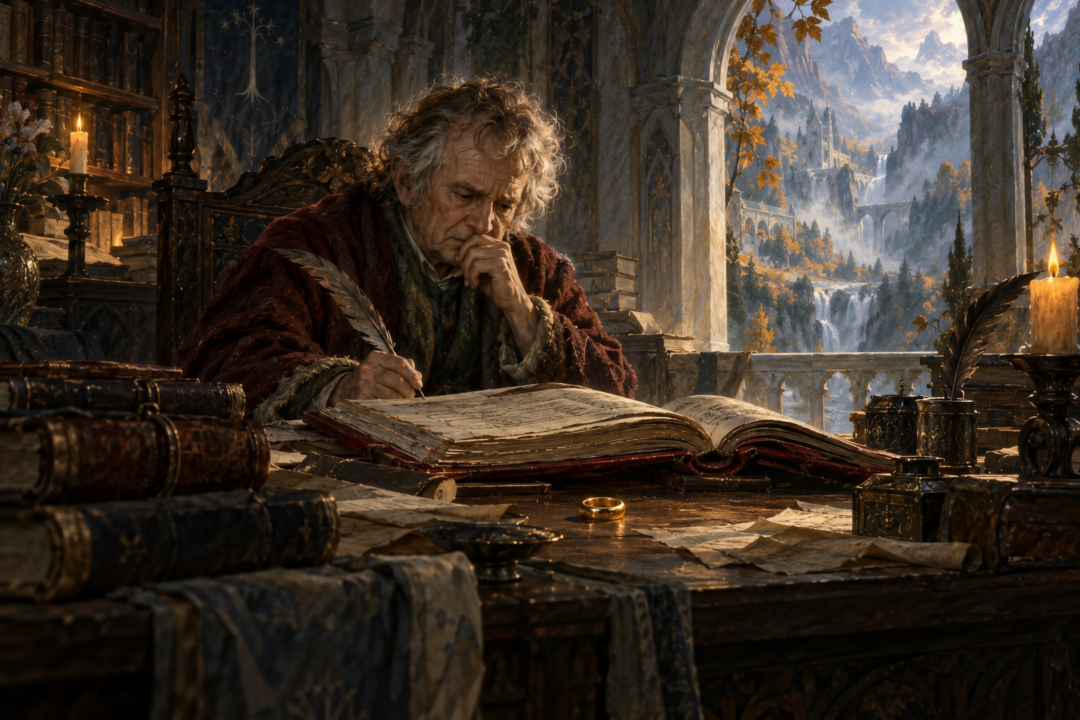
The Red Book Was Never the Work of One Author
The familiar story begins with Bilbo’s own writings. His record of his journey was eventually continued by Frodo, whose account became the great narrative of the War of the Ring. Sam also had a role in the book’s final transmission, while Bilbo’s three volumes of Translations from the Elvish were attached to it.
Already, then, the Red Book represents several kinds of knowledge.
Bilbo can describe things he personally experienced. Frodo can record his own journey and draw upon the testimony of companions. Material concerning much older ages comes through traditions and records available to Bilbo in Rivendell. Later historical material could be supplied by people who knew things that the original hobbit writers did not.
The Prologue to The Lord of the Rings, especially the “Note on the Shire Records,” makes the transmission even more complicated.
Copies of the Red Book were made. One important copy, the Thain’s Book, was taken to Gondor. There it received extensive annotation and correction, particularly concerning Elvish names, words, and quotations. Additional material was also attached to the textual tradition.
This means that when readers encounter a corrected detail, they do not necessarily have to imagine Frodo somehow possessing impossible knowledge.
A later scholar may have supplied it.
Minas Tirith Could Correct What the Hobbits Could Not
This becomes especially important when the subject is language.
Frodo was learned by hobbit standards and knew more of Elves and the outside world than almost anyone in the Shire. But he was not an Elvish philologist with access to the archives and learned traditions of Gondor.
The manuscript history accounts for that limitation.
The Thain’s Book received “many corrections” in Minas Tirith, particularly to Elvish linguistic material. Within the fictional framework, this creates a plausible distinction between an original narrative and its later scholarly apparatus.
Imagine Frodo recording an unfamiliar name as accurately as he could. A Gondorian scribe with better sources could later identify an error or normalize its form. The correction would not require pretending Frodo had written the corrected form in the first place.
That preserves two different truths simultaneously.
Frodo remains the fictional author of his account.
The surviving text can nevertheless contain knowledge supplied after Frodo’s authorship.
That is precisely the kind of problem marginal annotation is designed to solve.
Bilbo’s Lie Shows the System at Its Most Important
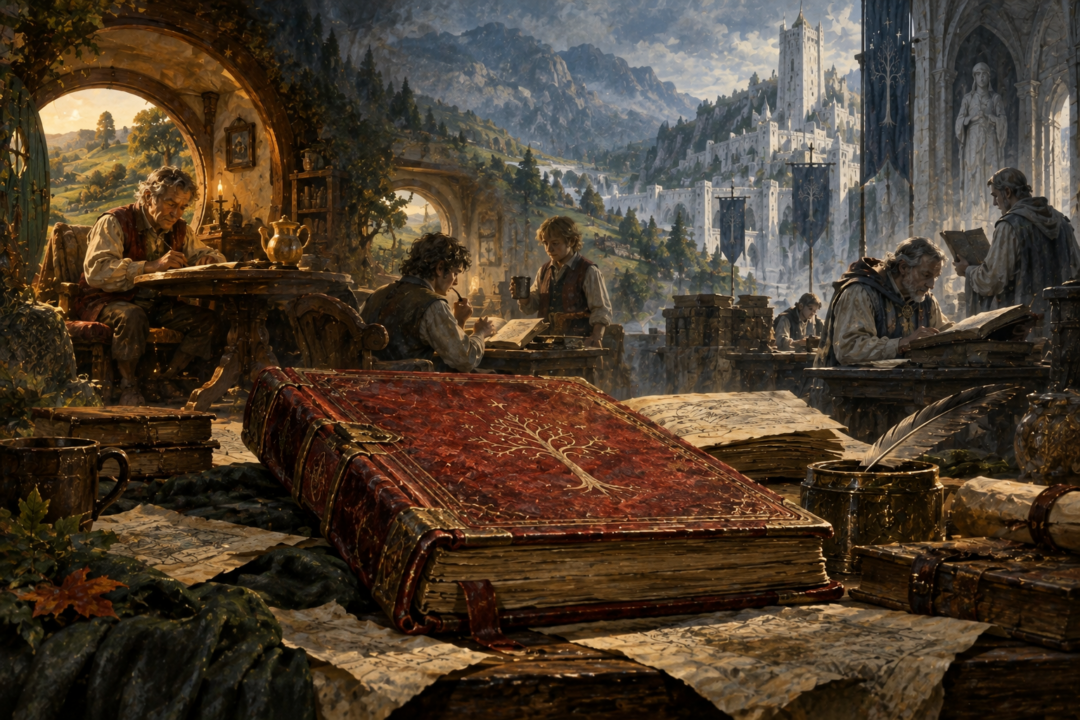
The clearest example concerns “Riddles in the Dark.”
Bilbo’s original account of acquiring the Ring was false. He claimed, in essence, that Gollum had intended to give him the Ring as a present after Bilbo won the riddle-game. The later account reveals that Bilbo found the Ring independently and that Gollum never willingly surrendered it.
Within the story, this discrepancy is not treated merely as a defective chronicle.
It becomes evidence.
Gandalf is disturbed by Bilbo’s dishonesty because it reveals the Ring’s influence. Bilbo had no need to manufacture a morally convenient claim to ownership, yet he did. His altered story therefore tells Gandalf something about the object itself.
More remarkably, the textual tradition preserves the problem rather than erasing it.
The Prologue explains that Bilbo apparently never changed his own written version. Some copies therefore retained the false account. Other copies contained the true version, apparently derived from information known to Frodo and Sam. Yet they seem to have been reluctant simply to delete what Bilbo himself had written.
That is a crucial principle.
Correction does not require destruction.
The later scribes can know that Bilbo was wrong while still treating Bilbo’s words as historically meaningful.
His lie belongs to the history of the Ring.
Erasing it would actually remove evidence.
A Discrepancy Can Become Part of the Story
This changes how contradictions function within the Red Book framework.
Ordinarily, two conflicting versions of an event might look like a simple textual problem: one must be correct and the other discarded.
But a manuscript with several authors, copyists, commentators, and editors can preserve disagreement.
One account may represent what a witness initially claimed. Another may contain what was discovered later. A marginal correction may preserve better linguistic knowledge. A later addition may record an event that occurred after the original narrative was completed.
The discrepancy acquires a history.
That does not mean every inconsistency anywhere in the wider writings can automatically be explained as a scribal variant. The texts do not provide such an explanation for every difficulty, and it would be unsafe to invent one.
But where the Red Book framework explicitly establishes multiple textual layers, corrections and competing accounts are entirely consistent with the fictional history.
Middle-earth’s books behave like old books.
They accumulate hands.
Findegil Is More Important Than He Looks
One of the most revealing figures in this entire system is a man who never enters the great narrative at all.
Findegil, the King’s Writer, completed a copy of the Thain’s Book in the Fourth Age. The “Note on the Shire Records” identifies his work as an exact copy of the book preserved in Minas Tirith.
His appearance is tiny, but its implications are enormous.
By the time Findegil worked, the War of the Ring had already become history. The original participants belonged to an earlier generation. Their writings had entered libraries, archives, and traditions of copying.
The story was no longer merely Frodo sitting at Bag End and remembering what happened.
It had become a document transmitted by institutions.
Findegil also stands at the end of a chain. Bilbo writes. Frodo continues. Sam preserves. Copies are made. Peregrin is associated with the transmission of the Thain’s Book to Gondor. Gondorian scholars annotate it. Findegil copies that developed textual tradition for the Shire.
The result is not a manuscript miraculously immune to history.
It is a manuscript that has survived because people cared enough to preserve it.

Later Additions Do Not Have to Become Frodo’s Knowledge
The same mechanism helps explain material that extends beyond Frodo’s immediate perspective.
The Thain’s Book contained additions made in Gondor, including an abbreviated version of portions of The Tale of Aragorn and Arwen lying outside the main account of the War. The full tale is attributed within the tradition to Barahir, a grandson of Faramir.
That attribution matters.
It prevents later historical knowledge from being silently placed in Frodo’s mouth.
Frodo can remain responsible for his memoir while the textual collection around that memoir continues to grow.
The Red Book is therefore better understood not merely as one book but as a developing textual tradition.
Its margins, appendices, annotations, alternative accounts, and later copies preserve different historical layers.
Even the Margins Have Authors
The fictional manuscript tradition extends beyond corrections to serious history.
The prefatory account attached to The Adventures of Tom Bombadil describes poems associated with the Red Book tradition, including material found in margins and blank spaces and attributed, with varying degrees of certainty, to different hands.
That small detail makes the imagined manuscript feel used.
People do not merely copy it reverently. They add things. Poems circulate. Fragments survive. Attributions become uncertain. Material of different origins gathers around an important book.
The distinction between author and later contributor becomes blurred without disappearing.
A poem in a margin does not suddenly become something Frodo composed merely because it survives in a book associated with him.
Likewise, a Gondorian correction does not mean Frodo possessed the knowledge behind the correction.
The location of a statement in the surviving textual tradition is not necessarily identical to its original authorship.
The Translator Layer Adds One More Distance
There is another complication: the familiar names and languages are themselves presented through translation.
Appendix F explicitly discusses the rendering of Westron into English and explains that names belonging to the Common Speech have often been translated into corresponding English forms. “Samwise,” for example, participates in this larger system of represented rather than literally reproduced language.
So the reader is several stages removed from the supposed events.
There are experiences.
Then memories and testimony.
Then written accounts.
Then copying and annotation.
Then later manuscript traditions.
Then translation into the language presented to us.
Each stage can potentially explain why wording, names, or knowledge need not correspond perfectly to what an original witness would literally have written.
But the frame never requires us to discard those witnesses.
Instead, it protects them.
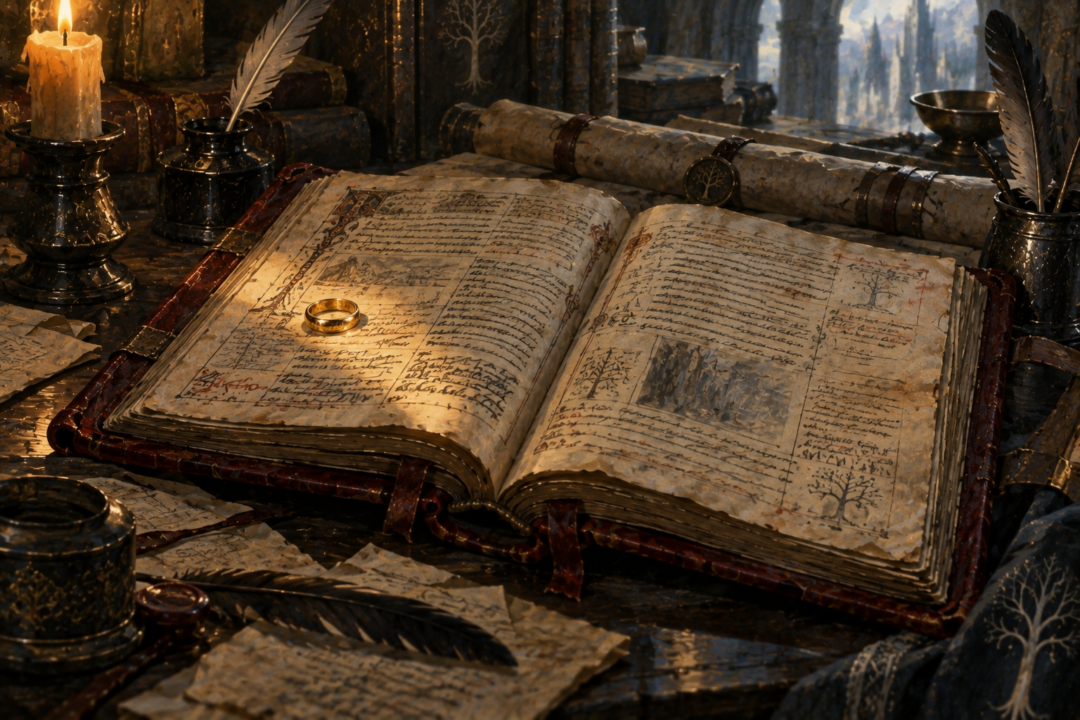
The Imperfections Make the Fictional Authors More Real
The deepest effect of the marginal-note system is not that it provides an excuse for mistakes.
It is that it gives the books of Middle-earth memories.
Bilbo can lie.
Frodo can have limited knowledge.
A Gondorian scholar can know more about an Elvish word than a hobbit memoirist.
A later historian can add information unavailable when the original narrative was written.
A scribe centuries later can preserve all of them.
The resulting text can contain correction without pretending the original author was never wrong, and later knowledge without pretending the original author somehow possessed it.
That is why the marginalia matter.
They do not erase fictional authorship. They preserve its boundaries.
The Red Book feels old precisely because its history has not been flattened into one perfect voice. Behind the story we read are imagined writers, translators, scholars, copyists, libraries, lost versions, corrected names, alternative accounts, and notes left by hands separated by generations.
And sometimes the most revealing thing in the entire manuscript is not the polished sentence in the center of the page.
It is the correction someone carefully refused to erase.
Sources & Notes
- The Encyclopedia of Arda, “Red Book of Westmarch” — outlines the book’s composite authorship by Bilbo, Frodo, and Sam, its copying history, and the annotated Thain’s Book tradition. https://www.encyclopedia-of-arda.com/r/redbook.html
- The Encyclopedia of Arda, “Thain’s Book” — describes the copy made at Frodo’s request, its journey to Gondor, and the annotations and corrections added there. https://www.encyclopedia-of-arda.com/t/thainsbook.html
- The Encyclopedia of Arda, “Translations from the Elvish” — explains Bilbo’s three-volume work, its attachment to the Red Book, and its preservation through Findegil’s Gondorian copy. https://www.encyclopedia-of-arda.com/t/translationsfromtheelvish.html
- The Encyclopedia of Arda, “Gollum’s Ring” — recounts that Bilbo found the Ring by accident and took it, rather than receiving it as Gollum’s promised gift. https://www.encyclopedia-of-arda.com/g/gollumsring.html
Sources document the Red Book’s layered authorship and transmission, the Gondorian annotations to the Thain’s Book, Bilbo’s attached translations, and the true circumstances of his finding the Ring.