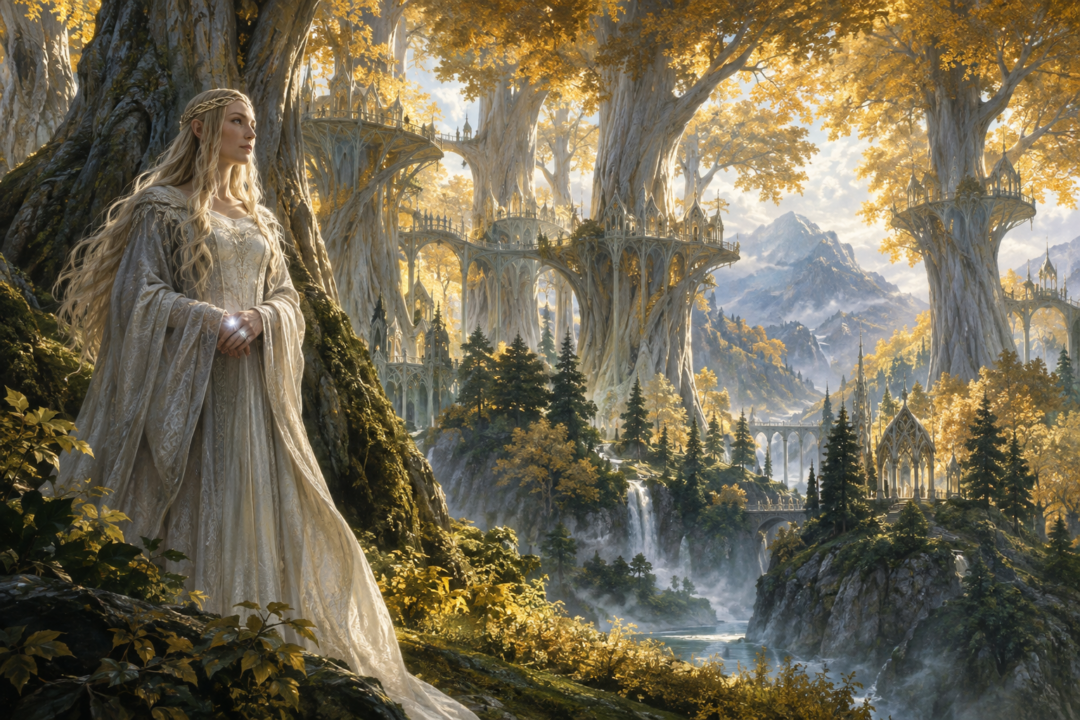
When the Fellowship enters Lothlórien, the strangest thing about the Golden Wood is not simply that it is beautiful. It feels preserved.
Frodo senses that he has crossed into a place where the ordinary movement of the world has somehow been restrained. The grass, trees, light, and silence seem to belong to an older order of things. Sam struggles even more to explain it. Lórien is not merely another Elven settlement hidden behind strong borders. It is a fragment of an earlier world surviving deep into the Third Age.
That is why its fate is so easily misunderstood.
Lothlórien does not need to be conquered for Lothlórien as we know it to disappear. Its greatest enemy is ultimately not an invading army.
It is time.
And the defeat of Sauron, paradoxically, removes one of the chief powers that had been holding time at bay.
Galadriel Already Knows What Victory Will Cost
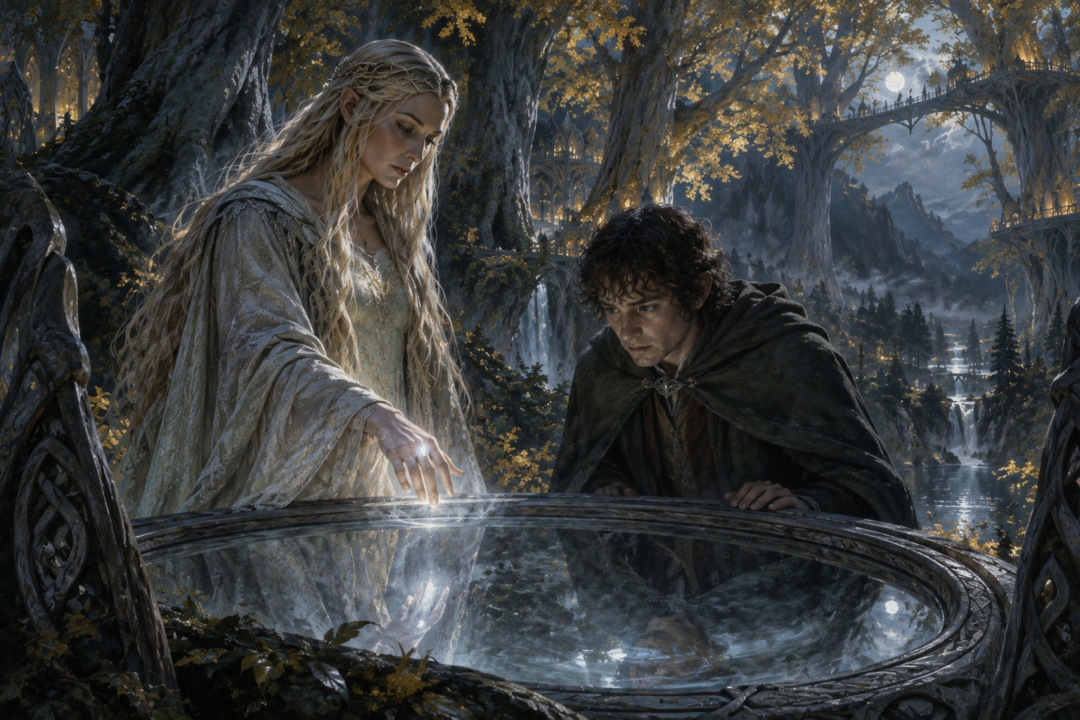
The central explanation comes during Frodo's conversation with Galadriel.
She reveals that she bears Nenya, the Ring of Adamant, one of the Three Rings of the Elves. Frodo then understands something terrible about his quest.
If he fails, Lórien may eventually be exposed to Sauron.
But success has a cost too.
Galadriel tells him plainly that if the One Ring is destroyed, the power sustaining her realm will be diminished and Lothlórien will fade. The Elves will have to depart into the West or gradually become a lesser people, forgetting and being forgotten.
This is one of the most important contradictions in the War of the Ring.
For Gondor, Rohan, and the Shire, destroying the Ring means survival.
For Galadriel, it means survival and loss at the same time.
She still accepts that price.
That decision reveals what makes the Elven struggle against Sauron fundamentally different from Sauron's own desire for power. Galadriel possesses something capable of preserving what she loves, yet when keeping that preservation becomes incompatible with the freedom of Middle-earth, she accepts its ending.
Nenya Was Not Simply a Magical Shield
It is tempting to imagine Nenya primarily as a defensive weapon surrounding Lothlórien with an invisible barrier.
That is too simple.
The Three Rings were especially associated with preservation: resisting decay, weariness, and the changes brought by time. The lore surrounding the Rings describes their purpose in terms of preserving beauty and postponing the fading of things.
Nenya therefore helps explain the extraordinary character of Lórien.
The realm is ancient even by the standards of the Third Age, but entering it does not feel like walking among ordinary old ruins. Its beauty remains immediate and living.
This does not mean every tree or flower is literally frozen in time. The texts never establish such a mechanical rule.
Rather, the broader implication is that Galadriel's power, greatly enhanced through Nenya, allows Lórien to resist the ordinary diminishment affecting the Elves and their works in Middle-earth.
The Golden Wood is therefore something almost impossible: an ancient realm that has not yet become merely a memory of itself.
The Three Rings Share the Fate of the One
Here lies the fatal weakness.
Celebrimbor made the Three without Sauron's direct participation, and Sauron never touched them. They were therefore not corrupted in the same manner as the Nine.
But they were still made using the ring-lore associated with the greater Rings of Power.
When Sauron forged the One Ring, the Elves perceived what he had done and removed their Rings. They would not openly use the Three while Sauron possessed the One.
After Sauron was overthrown at the end of the Second Age and the One was lost, the Three could be used more freely during the Third Age.
Yet their fate remained tied to the Ruling Ring.
Elrond explains the dilemma before the Fellowship leaves Rivendell. If the One is destroyed, the Three may fail and many beautiful things preserved through them may fade.
The Wise do not know every consequence with certainty beforehand.
But they accept the risk.
When the One is finally destroyed, that fear proves justified. The power of the Three comes to an end.
Lórien therefore loses something that no army could restore.
Sauron's Defeat Does Not Restore the Old World
This is where the ending of The Lord of the Rings becomes much more melancholy than a conventional victory story.
Sauron is defeated.
Barad-dûr falls. His armies are broken. Aragorn becomes King. The Shadow is removed from vast regions of Middle-earth.
Yet the victory does not reset history.
The Elder Days do not return.
The Elves do not suddenly regain everything that has been lost during thousands of years of decline. Instead, Sauron's fall helps clear the way for a new age dominated increasingly by Men.
Lothlórien belongs spiritually to the world that is passing.
Its preservation during the Third Age has delayed that truth, not abolished it.
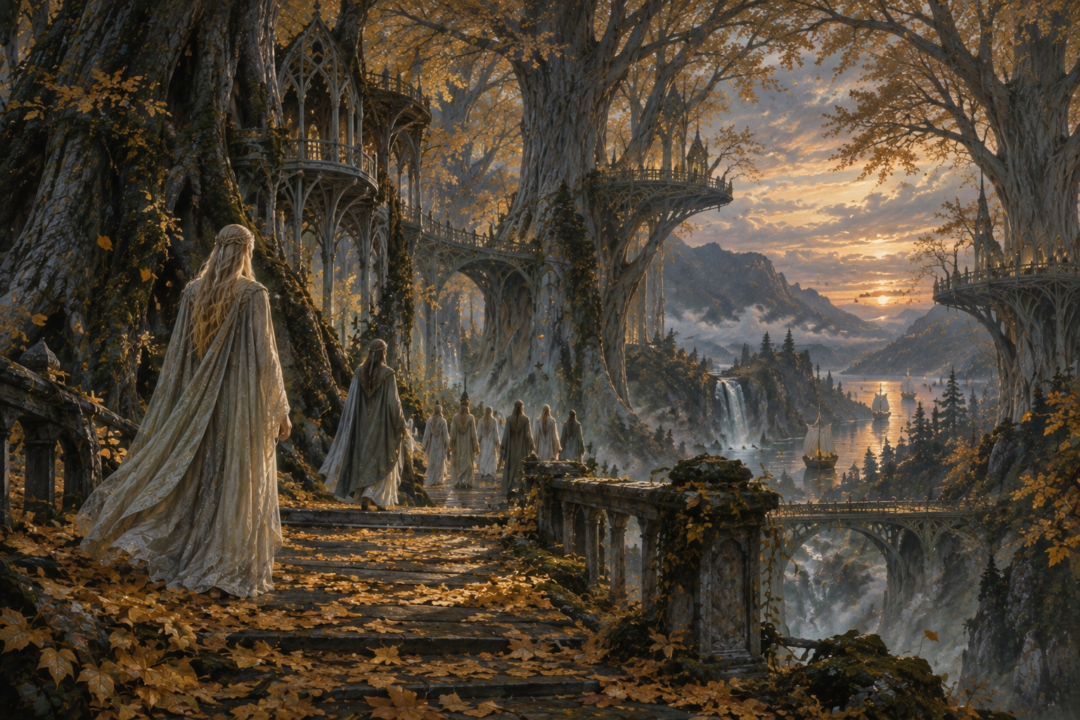
Once Nenya loses its power, Galadriel can no longer maintain Lórien in quite the same state. Nothing needs to burn Caras Galadhon. No Orc army needs to occupy Cerin Amroth. No Dark Lord needs to plant a banner beneath the mallorn trees.
Ordinary history is enough.
The Elves Themselves Are Leaving
There is another reason Lórien cannot simply continue after the war.
Its people are part of the fading.
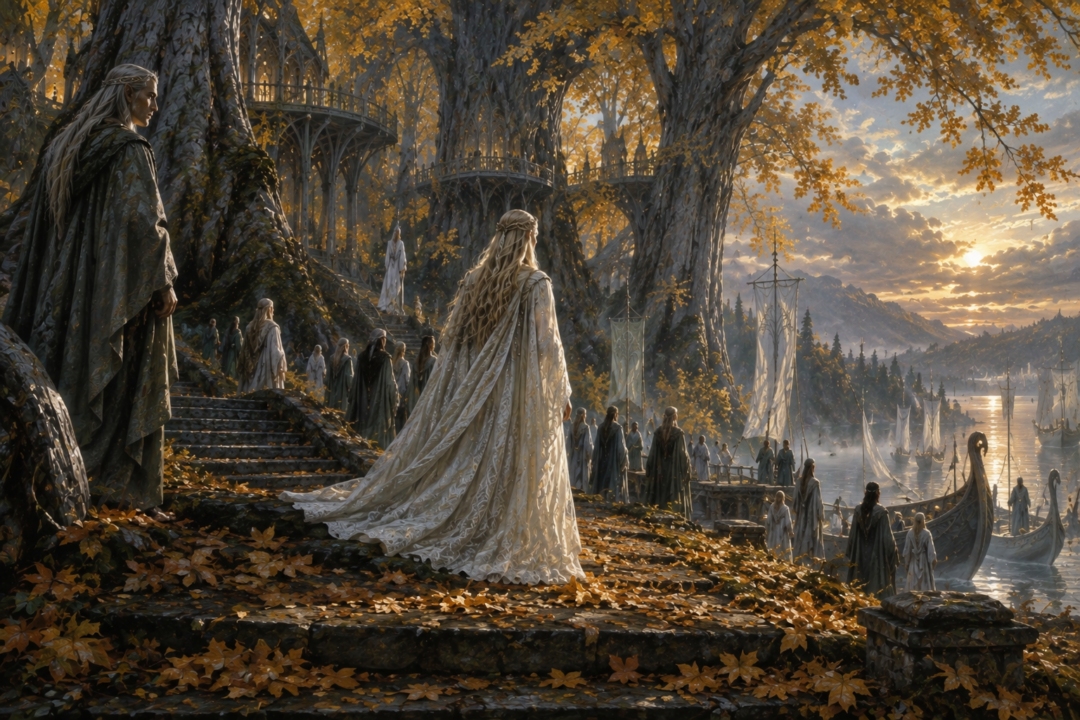
Throughout The Lord of the Rings, Elves are departing Middle-earth by sea. The Grey Havens exist because this movement has been happening long before Frodo's journey.
Lórien is therefore not an isolated kingdom with an indefinitely stable population.
It belongs to a civilization already approaching its end in Middle-earth.
Galadriel eventually departs. So does Elrond. The Keepers of the Three leave together from the Grey Havens, carrying Nenya, Vilya, and Narya with them.
Celeborn remains in Middle-earth for a time, and Appendix B records that after Galadriel's departure he eventually goes to Rivendell. His final departure across the Sea is not dated.
The crucial point is that the old center cannot survive unchanged when the people and powers that defined it are dispersing.
A forest can remain standing after a civilization disappears.
That does not mean the civilization survived.
Lórien Survives the War — But Not the Age
Lothlórien is attacked during the War of the Ring.
According to the chronology in Appendix B, forces from Dol Guldur assault the realm three times. The attacks are driven back. After Sauron's fall, Celeborn and Galadriel cross the Anduin, and Dol Guldur is overcome; Galadriel throws down its walls and lays its pits bare.
Militarily, Lórien survives.
That makes what follows more striking.
Its decline cannot be explained simply as wartime destruction.
The Golden Wood has won its battles.
What it cannot win is the struggle against the passing of its own age.
This distinction matters because it changes the meaning of Lórien's disappearance. The realm is not another Osgiliath, destroyed by repeated warfare. Nor is it another conquered territory waiting to be liberated.
Its problem is deeper.
The conditions that allowed Lórien to exist in its extraordinary Third Age form are disappearing.
Arwen Returns to an Empty Lórien
The final image of the Golden Wood is among the saddest in the legendarium.
After Aragorn dies in the Fourth Age, Arwen leaves Minas Tirith and travels to Lórien.
But the place she knew is gone.
The land is silent, and the people have departed. She comes to Cerin Amroth, where she and Aragorn had once pledged themselves to one another, and there she dies.
The significance is difficult to miss.
Nothing has conquered the hill.
There is no victorious enemy standing over it.
Instead, absence has replaced the world that once surrounded it.
That is the final form of Lórien's fading.
Not annihilation.
Departure.
The Hidden Tragedy of Elven Preservation
Lothlórien exposes one of the deepest tensions behind the Rings of Power.
The desire to preserve beauty is not evil in itself.
Galadriel loves Middle-earth. The Elves love the things they have made and the places in which they have lived. Their sorrow comes partly from watching those things change and disappear while they themselves endure.
The Three Rings offered a way to resist that loss.
That makes them very different in purpose from Sauron's Ring, whose defining purpose is domination.
Yet the Three still belong to the same great Ring-making tragedy. Their preservation cannot continue indefinitely once the One is destroyed.
The victory over Sauron therefore demands more than courage in battle.
It demands relinquishment.
Galadriel has to accept a world in which the Golden Wood will no longer remain what she made it.
Elrond must accept the passing of Rivendell's age and separation from Arwen.
The Elves must allow history to continue without them at its center.
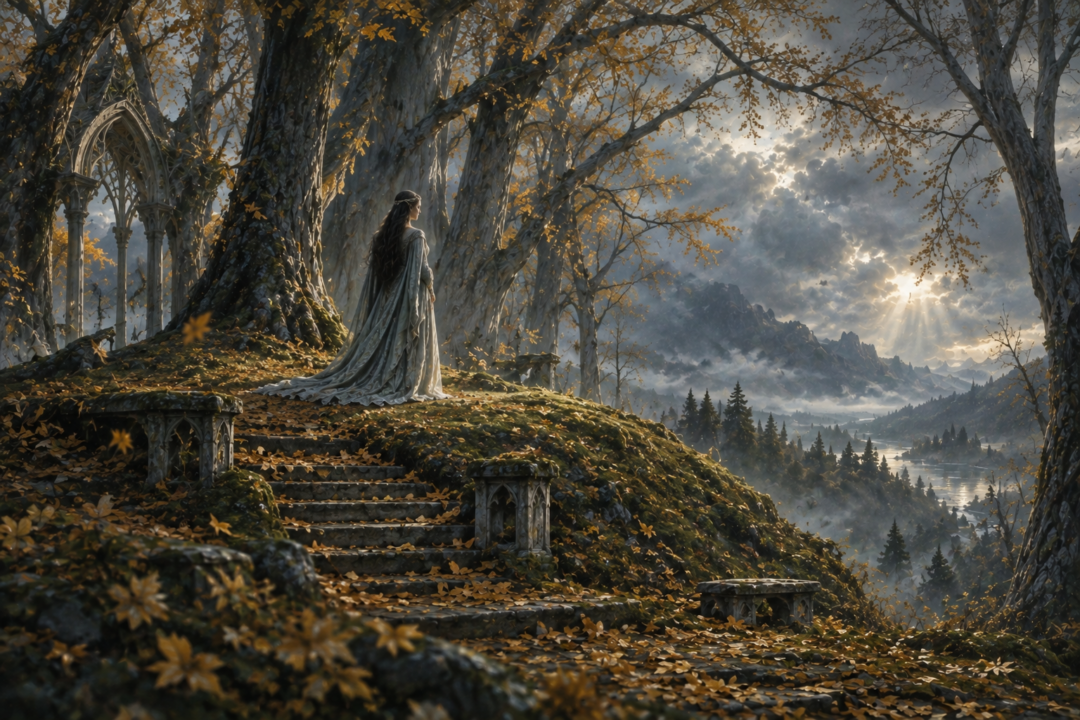
Why Lothlórien Had to Fade
The Golden Wood fades because its Third Age splendor was never simply the natural condition of an immortal kingdom.
It was a preserved enclave within a changing world.
Nenya helped Galadriel maintain that preservation. The destruction of the One Ring ended the effective power of the Three. At the same time, the great Elven departure from Middle-earth accelerated, and the Fourth Age belonged increasingly to Men.
Sauron did not need to conquer Lothlórien.
In fact, that is precisely what makes its fate so powerful.
The Elves win.
The Shadow falls.
Lórien survives its enemies.
And still the Golden Wood passes away.
The destruction of the Ring saves Middle-earth because it allows the world to move forward freely. But for a realm whose wonder depended partly upon holding back the movement of time, freedom and loss arrive together.
Lothlórien is therefore one of the clearest reminders that victory in Middle-earth does not mean preserving everything worth loving.
Sometimes victory means accepting that something beautiful must end.
Sources & Notes
- The Encyclopedia of Arda, “Three Rings” — https://www.encyclopedia-of-arda.com/t/threerings.html
- The Encyclopedia of Arda, “Nenya” — https://www.encyclopedia-of-arda.com/n/nenya.html
- The Encyclopedia of Arda, “Lothlórien” — https://www.encyclopedia-of-arda.com/l/lothlorien.html
These reference entries document the Three Rings’ dependence on the One, Nenya’s preservation of Lórien, and Lothlórien’s history. Interpretive conclusions remain the author’s.