Faramir cannot give Frodo and Sam an army. He cannot accompany them into Mordor. He cannot persuade them to abandon their road without destroying the very purpose that has brought them so far.
So, at the edge of the Shadow, he gives them walking-staves.
It is one of the quietest gifts in The Lord of the Rings, easily overshadowed by Sting, the Phial of Galadriel, lembas, or the Ring itself. Yet the staves are remarkably specific. They are made from lebethron, shaped for the hobbits, fitted for hard country, and endowed with what Faramir calls a “virtue” connected with finding and returning.
That last detail changes everything.
Faramir is sending two small travellers toward a land from which almost no sensible person could expect them to return. His gift is practical, but it also expresses something deeper: he equips them for the possibility of coming home even when their own hope of doing so is fading.
A Gift Made for the Road Ahead
The staves appear when Frodo and Sam leave Faramir after their refuge at Henneth Annûn. The timing matters.
Faramir has learned enough to understand that Frodo carries a terrible burden, even though Frodo has carefully avoided naming the Ring at first. He has also discovered where the hobbits intend to go. Their guide, Gollum, proposes to lead them toward Cirith Ungol, a route Faramir regards with dread.
He warns Frodo strongly against trusting Gollum and against taking that road. Yet Frodo sees no alternative.
Faramir therefore faces a moral choice. He can attempt to seize control of the quest, or he can respect a burden that is not his to command.
He chooses the latter.
But releasing Frodo does not mean washing his hands of him. The Rangers replenish the hobbits’ supplies, and Faramir gives them two stout polished staves. They are iron-shod and have carved heads fitted with leather thongs. More importantly, they have been deliberately altered to suit Frodo and Sam: Faramir explains that they have been cut down to the hobbits’ height and newly shod.
That small detail reveals extraordinary care.
These are not ceremonial souvenirs. Someone has prepared them for two particular travellers.
Why Lebethron Matters
Faramir identifies the wood as lebethron, a tree valued by the woodwrights of Gondor. The Men of the White Mountains use such staves for walking and climbing in wild country.
The text gives no botanical description detailed enough to identify lebethron securely with a real-world species, so claims about exactly what kind of tree it is should be treated cautiously. What matters in the story is its Gondorian character and the esteem in which its wood is held.
Lebethron appears again much later in a very different setting. At Aragorn’s coronation, the ancient crown is brought from Rath Dínen in a casket of black lebethron bound with silver.
That does not prove that the wood itself possesses some inherent supernatural power. The text never says so. But it does establish lebethron as a material associated with skilled Gondorian workmanship and, in the coronation scene, with an object of great dignity.
The hobbits therefore carry something unmistakably Gondorian toward Mordor.
They are not merely carrying sticks.
They are carrying the craftsmanship and goodwill of a people whose country stands directly in the path of Sauron.
What Is the “Virtue” of Finding and Returning?
The most mysterious part of Faramir’s gift is his statement that a virtue has been set upon the staves relating to “finding and returning.”
The book never provides a mechanical explanation.
We are not told who set this virtue upon them, exactly how it operates, whether words or ritual were involved, or whether it should be understood as what a modern reader would straightforwardly call a spell.
That ambiguity is important.
Middle-earth repeatedly contains objects whose unusual properties are described without turning them into a rigid system of magic. Elven works can possess qualities that seem extraordinary to outsiders, while their makers do not necessarily divide craft and enchantment in the way a modern fantasy rulebook might.
The lebethron staves belong comfortably within that atmosphere.
What should not be claimed is that they function as infallible magical guides capable of leading Frodo and Sam to Mount Doom. Nothing in the text establishes such a power.
Faramir himself is cautious. He hopes the virtue will not entirely fail beneath the Shadow into which the hobbits are travelling.
Even he does not speak as though the staves guarantee anything.
Faramir Gives Them What He Cannot Give Himself
There is a painful irony in the phrase “finding and returning.”
Faramir knows the hobbits are going toward Mordor.
Return is precisely what seems least likely.
By this stage Frodo's quest is increasingly becoming a journey undertaken without expectation of personal survival. Later, near the Morgul-road, the enormity of what lies ahead weighs heavily upon him. The closer he comes to Mordor, the less the story resembles an adventure whose hero confidently expects to go home.
Faramir nevertheless gives him an object associated with return.
This need not mean Faramir believes some enchantment will simply bring Frodo back. A more conservative reading is that the gift embodies his refusal to treat the hobbits as already dead.
He cannot promise their survival.
He can send them away equipped as travellers rather than victims.
That distinction fits Faramir remarkably well. His encounter with Frodo is defined by restraint. Once he understands something of the temptation that destroyed Boromir, he refuses to grasp at the weapon that might supposedly save Gondor.
He cannot control the Ring-bearer.
Instead, he helps him walk.
An Echo of the Gifts of Lothlórien
There is also a meaningful structural resemblance between the departure from Henneth Annûn and the earlier departure from Lothlórien.
The parallel should not be pushed too far; Gondorian craftsmanship and Elvish craft are not presented as identical. But Frodo and his companions leave both refuges carrying gifts intended to help them survive what lies beyond.
Galadriel's gifts are personal and purposeful. The Phial given to Frodo becomes especially important when ordinary light fails. Lembas sustains Frodo and Sam deep into the final journey.
Faramir behaves on a humbler scale.
He does not possess the resources or stature of Galadriel. Indeed, he begins his farewell by saying he has no fitting gifts.
Then he gives exactly the kind of gift Frodo and Sam need.
That modesty is part of the scene's power. Faramir does not offer a weapon of domination. He gives support, supplies, advice and friendship.
In a story dominated by the temptation to possess power, one of Gondor's greatest acts of assistance is simply helping two exhausted people keep moving.
Frodo Actually Carries His Staff Toward Cirith Ungol
The staves do not immediately disappear from the narrative.
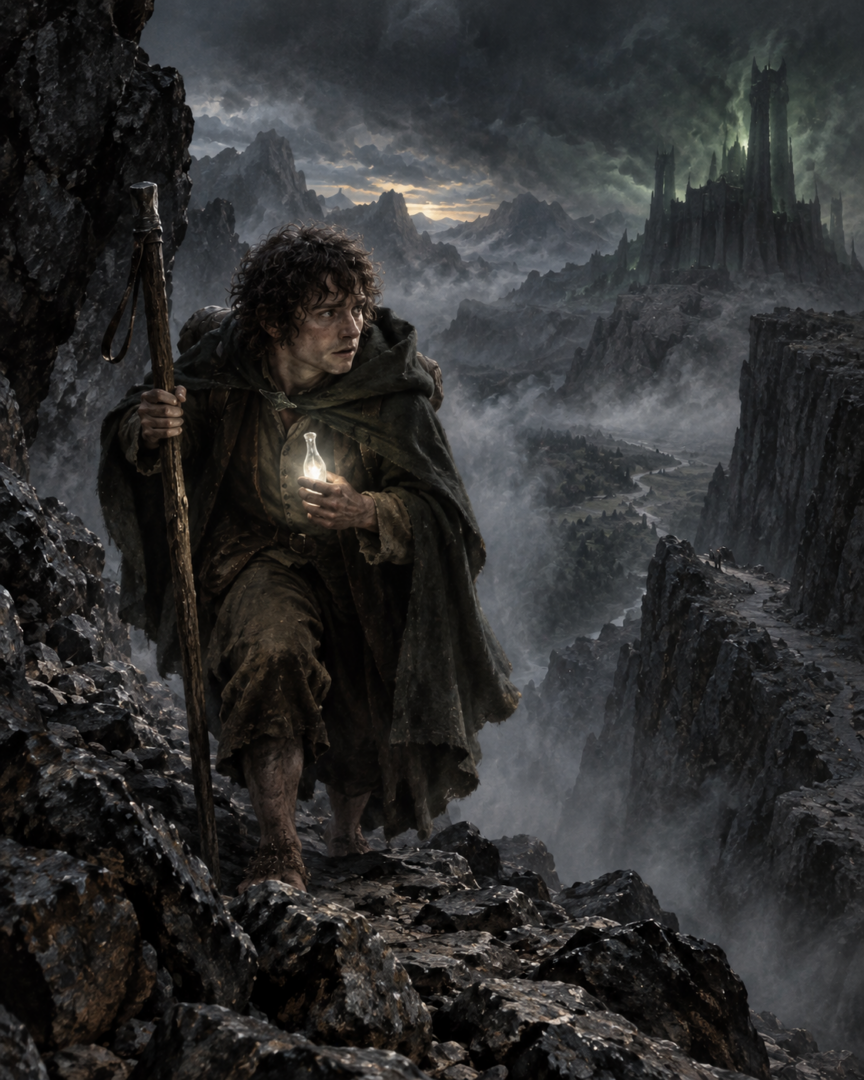
As Frodo approaches the dreadful road above Minas Morgul, he still has his staff. At a moment when despair presses heavily upon him, he rises to continue. The staff is in one hand; Galadriel's Phial is in the other.
The image is easy to overlook, but it brings two separate friendships together.
From Lothlórien comes light.
From Gondor comes something to lean upon.
Neither removes Frodo's burden. Neither makes the road safe. Neither chooses for him.
They help him continue.
That is an important distinction throughout the quest. Frodo receives enormous assistance, but nobody can perform his central task for him. The greatest gifts do not erase his responsibility; they make endurance possible for a little longer.
Faramir's staff belongs to that pattern.
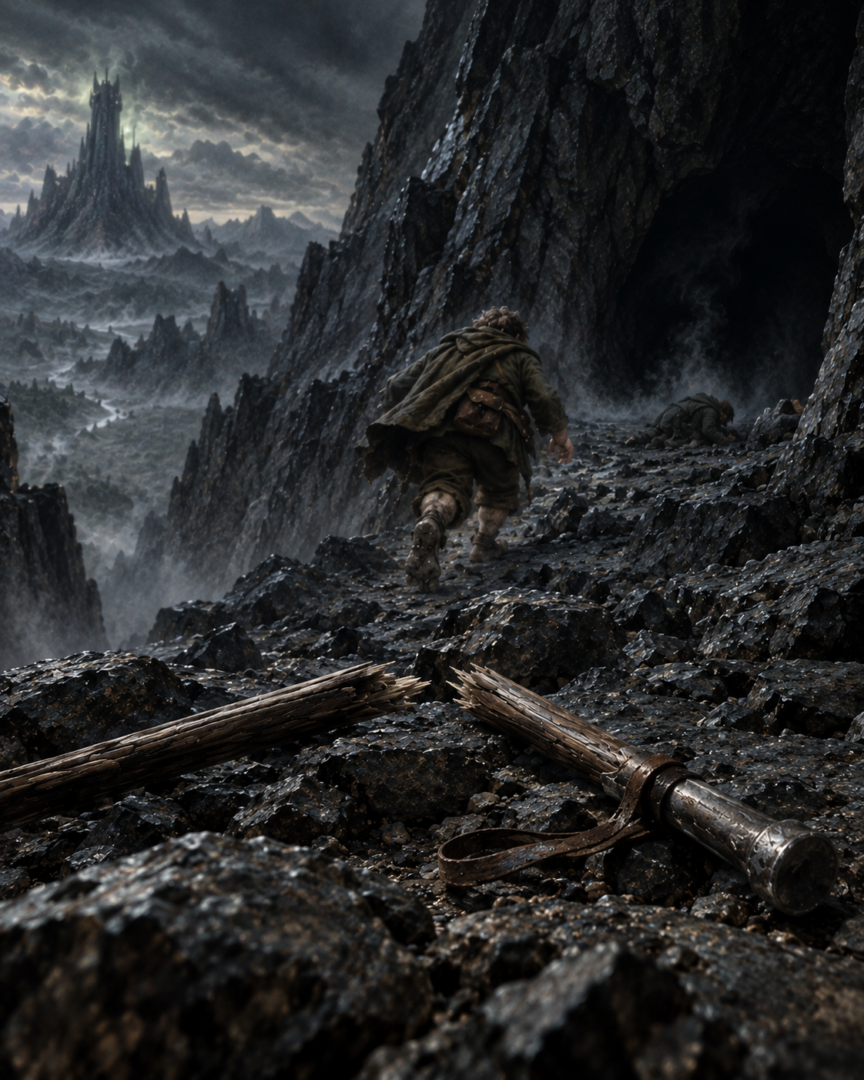
Sam Turns the Walking-Staff Into a Weapon
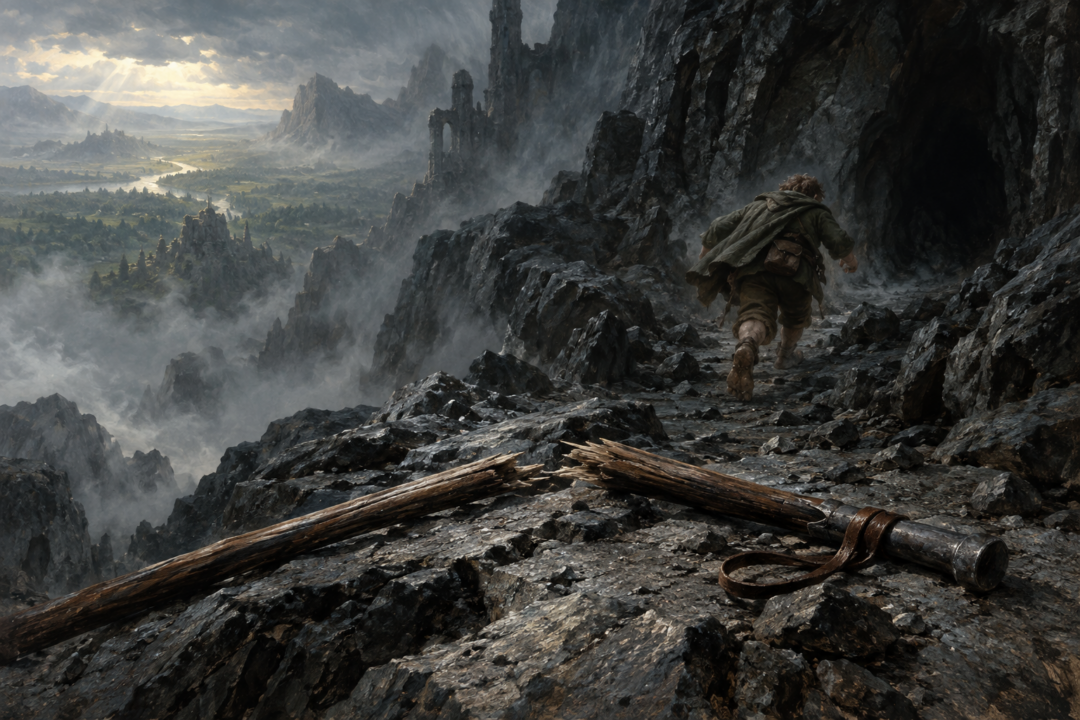
The most concrete payoff comes during Gollum's betrayal near Shelob's lair.
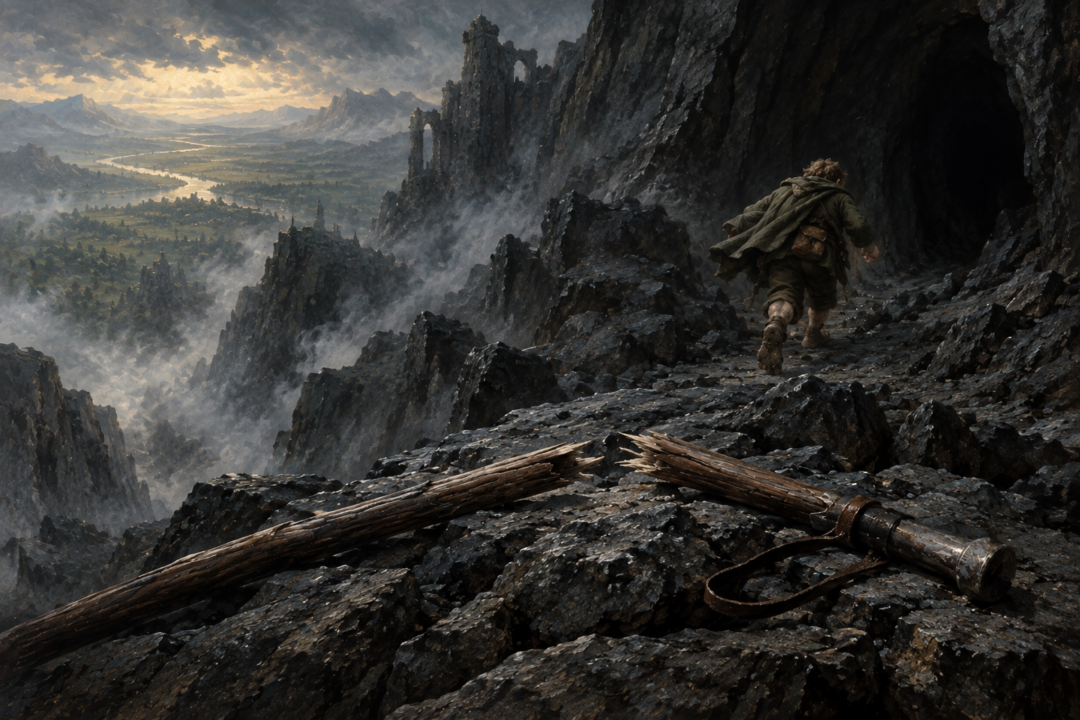
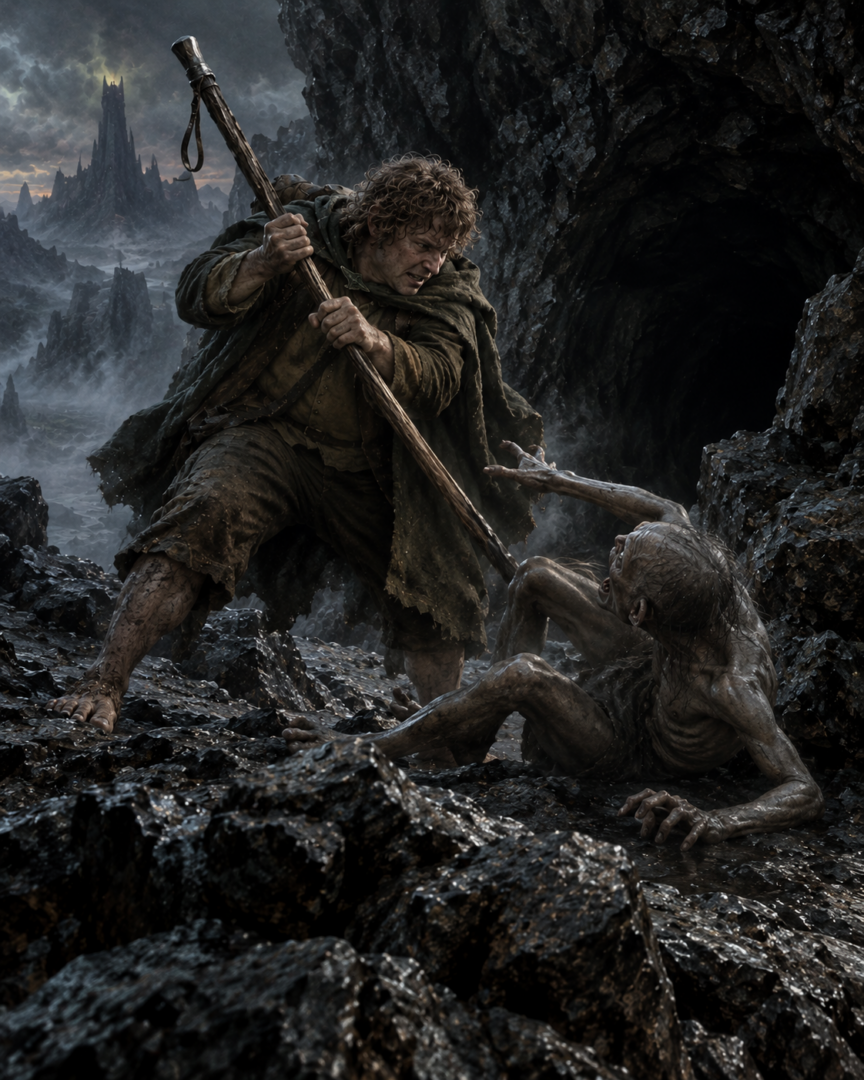
Gollum attacks Sam while Shelob goes after Frodo. Sam still has Faramir's staff hanging from his arm by its thong. In the struggle, after losing his sword from his hand, Sam manages to seize the staff.
He strikes Gollum with it.
The first blow forces Gollum to release him. Sam attacks again, and the second blow lands across Gollum's back.
Then the staff breaks.
This is not a triumphant revelation of some hidden magical weapon. Faramir explicitly gave the staves for walking and climbing. Yet at the moment Sam desperately needs it, the ordinary purpose of the object expands.
A walking-stick from Gondor becomes the means by which Sam escapes Gollum's grip.
Its destruction is therefore strangely appropriate. The staff does not survive as a treasured artifact. It is spent in service.
And because Gollum retreats, Sam is able to turn back toward Frodo and Shelob.
It would go beyond the text to say that the staff's “virtue” magically caused this outcome. The narrative never makes that claim.
But the thematic connection is difficult to miss: Faramir gives Sam something to help him on his road, and at a decisive moment that gift does exactly that.
Did the Staves Ever Bring Them Home?
Not literally, as far as the text tells us.
Sam's staff breaks before the hobbits enter Mordor. Frodo's staff is not given a clearly narrated final fate. We should therefore resist the tempting idea that the virtue of “finding and returning” is demonstrated by the staves physically accompanying the hobbits all the way to Mount Doom and back to Gondor.
They do not.
Yet the words spoken over them still matter.
Frodo and Sam eventually do return from Mordor, against almost every reasonable expectation. Their rescue comes only after the Ring is destroyed, when the Eagles find them on the slopes amid the ruin.
That outcome should not be attributed to the staves. The text provides no basis for doing so.
The deeper significance lies elsewhere.
Faramir's farewell occurs before the worst darkness. He sees two exhausted hobbits walking toward a place he believes horrifying beyond measure, led by a creature he distrusts, carrying a burden upon which immense events may depend.
He cannot save them from that road.
So he gives them food.
He gives them counsel.
He gives them friendship.
And he gives them staves made for finding and returning.
That is why the gift is so memorable once noticed. The staves express Faramir's character in miniature. He possesses power but does not clutch at greater power. He recognizes danger without surrendering to despair. He cannot command the outcome, so he helps where help is actually possible.
Before Frodo and Sam enter the Shadow, Gondor gives them something to lean on.
And, however briefly, they do.
Sources & Notes
- Tolkien Gateway, “Lebethron” — documents the Gondorian wood, Faramir’s staves for Frodo and Sam, and the later crown-casket parallel. https://tolkiengateway.net/wiki/Lebethron
- Tolkien Gateway, “Journey to the Cross-Roads” — summarizes Faramir’s farewell, provisions, warning, and gift of staves for the hobbits’ fatigue. https://tolkiengateway.net/wiki/Journey_to_the_Cross-Roads
- Oxford Centre for Fantasy, “They Cannot Conquer for Ever! — LOTR: An Author’s Journey, Bk 4 Ch 7” — offers a chapter-level literary discussion of Faramir’s farewell and the journey toward the Cross-roads. https://podcast.oxfordcentreforfantasy.org/tolkiens-literary-journey-lotr-chapter/
Sources document the lebethron staves, their practical place in Faramir’s farewell, the wood’s later use for the royal crown-casket, and a chapter-level literary reading of the gift and journey.