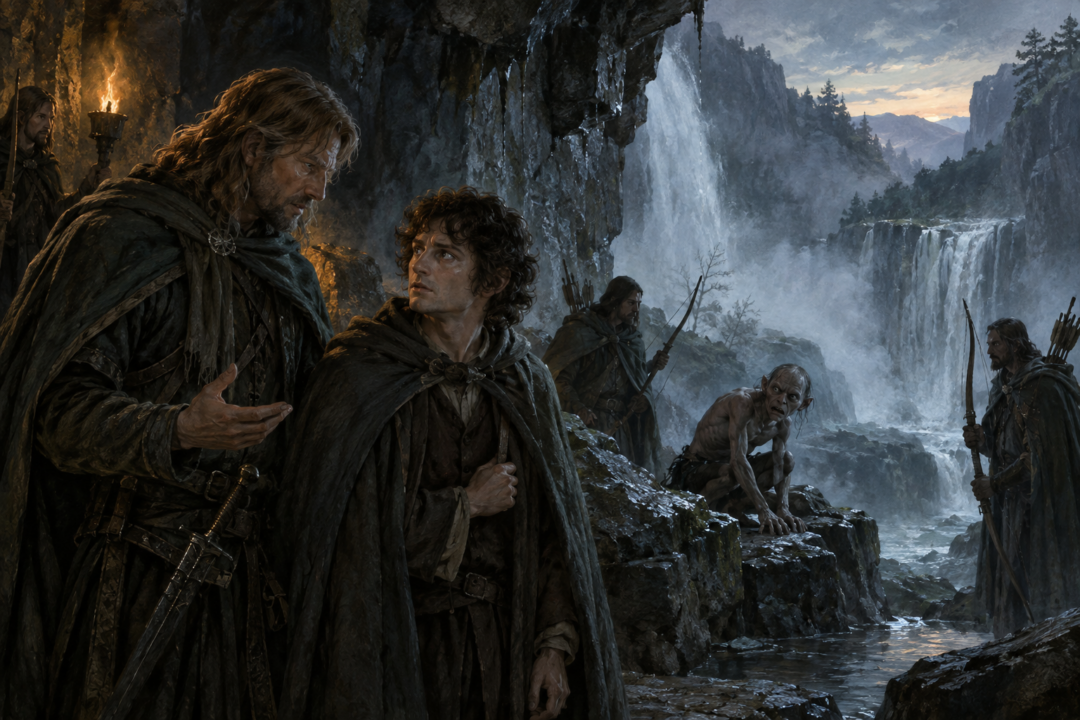
When Frodo leaves Henneth Annûn, he is no longer simply a lost traveller following the only guide who claims to know a road into Mordor.
Faramir has changed that.
Before their meeting, Frodo knows that Gollum is dangerous, unstable, and divided against himself. But he does not know the name of the mountain pass toward which Gollum is leading him. At Henneth Annûn, Faramir identifies it: Cirith Ungol. More importantly, he recognizes Gollum’s reaction to that name and concludes that the creature has concealed something.
Then Faramir gives Frodo an extraordinary warning: do not go that way.
Frodo goes anyway.
That decision can look reckless once we know what waits there. Gollum is indeed betraying him, and Cirith Ungol leads through the domain of Shelob. Yet the episode is more complicated than a hero ignoring good advice. Faramir cannot tell Frodo exactly what the danger is. He cannot offer him a workable alternative route. And Frodo believes that abandoning Gollum would violate a promise he has repeatedly made.
The warning therefore does not make Frodo simply guilty of choosing badly. It does something more interesting: it transforms his journey from ignorance into conscious moral risk.
Before Faramir, Frodo Does Not Even Know the Pass’s Name
At the Black Gate, Frodo and Sam discover what should have been obvious but had never been solved: reaching Mordor is not the same thing as entering it.
The Morannon is heavily guarded. Walking through it is effectively impossible.
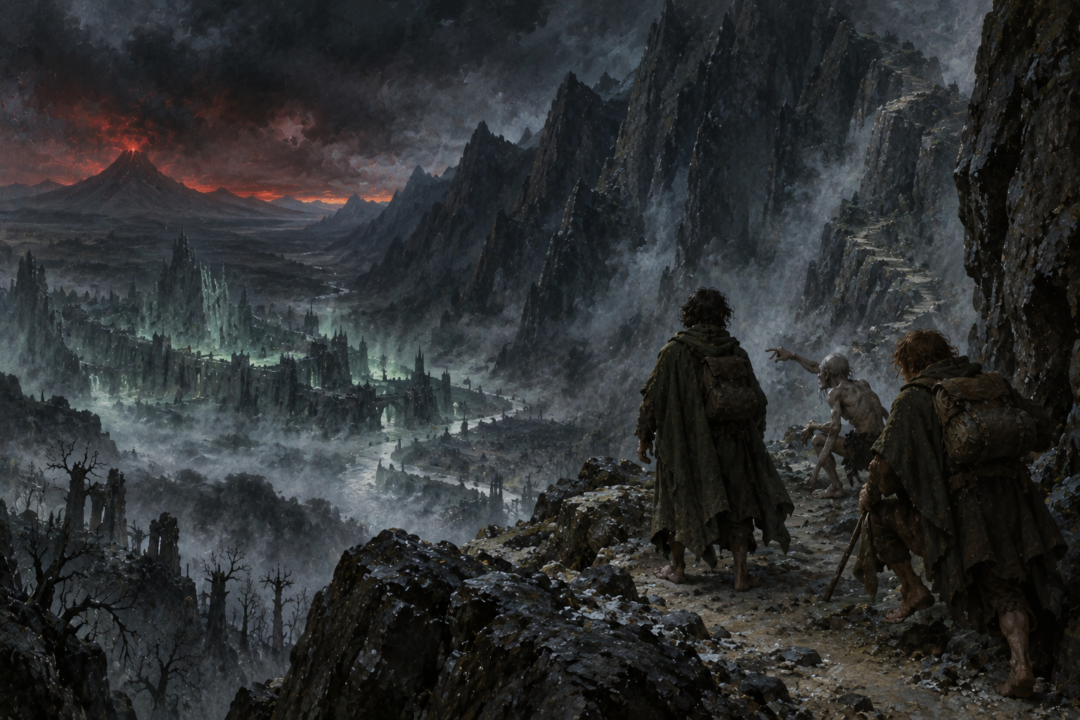
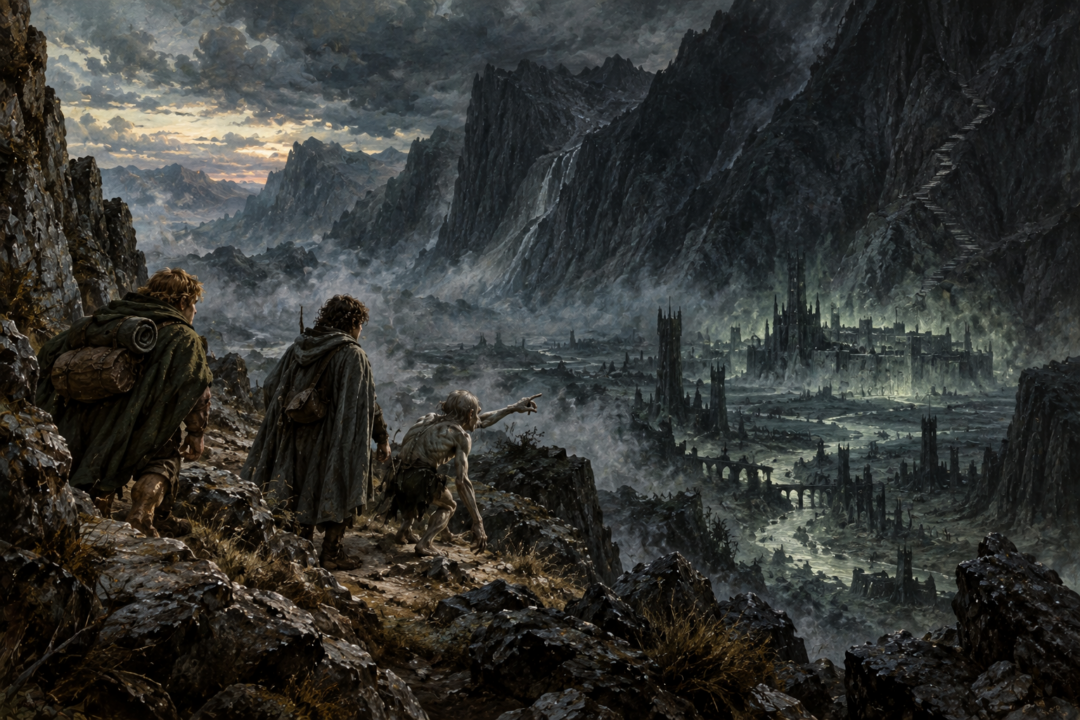
Gollum then offers another possibility. He knows a road south toward the former Minas Ithil, now Minas Morgul, and from there a path climbing into the Mountains of Shadow.
Frodo knows remarkably little about it.
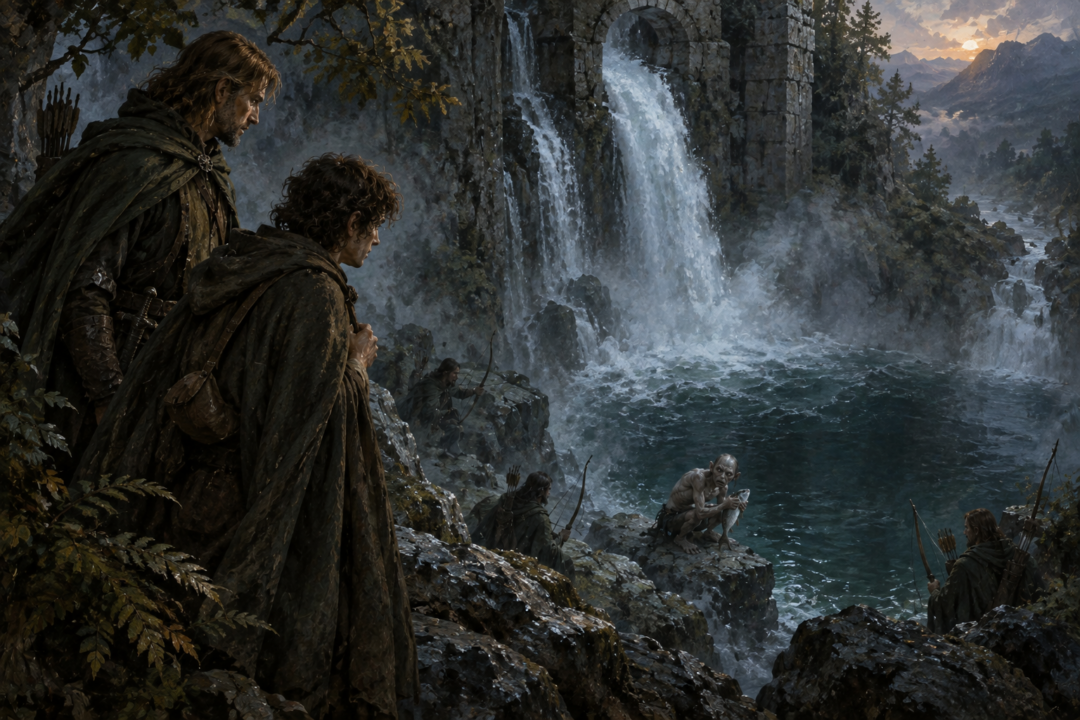
When Faramir questions him in “The Forbidden Pool,” Frodo describes a path rising north of the Morgul Vale to a high cleft. Faramir asks whether he knows the pass’s name.
Frodo does not.
Faramir does: Cirith Ungol.
Gollum’s response immediately deepens the suspicion. He first denies the name, then reluctantly admits that he has heard it. Faramir notices enough to conclude that Gollum knows more than he has revealed.
This matters because Frodo’s earlier reliance upon Gollum had been made under severe ignorance. After Henneth Annûn, that excuse is weaker.
He has been warned.
Faramir Detects the Lie Without Knowing the Whole Truth
Faramir never tells Frodo that Shelob waits in the pass.
He cannot. He does not know that.
He openly admits the limits of Gondor’s knowledge. The younger Rangers do not travel into the Mountains of Shadow, and what Gondor remembers about Cirith Ungol survives largely as old report and dreadful tradition. Faramir knows that some terror inhabits the passes above Minas Morgul, and that the name itself causes old men and loremasters to react with fear.
That is all.
Yet Faramir’s warning is not merely superstition.
He has also observed Gollum.
When Cirith Ungol is named, Gollum reacts violently. Faramir has already judged him to contain growing malice, and he believes that Gollum has deliberately withheld information about the route.
His conclusion is therefore based on two things: Gondor’s inherited dread of the pass and Gollum’s suspicious behavior.
The reader later discovers that Faramir’s instinct is devastatingly accurate.
Gollum knows Shelob. He has encountered her before, and his plan is to lead the hobbits into her lair so that she will kill them, leaving him free to recover the Ring. Frodo cannot know those details at Henneth Annûn.
But after Faramir speaks, he can no longer honestly believe that Gollum has told him everything.
Faramir Gives Frodo Permission to Break Away
The most important part of the conversation is not actually the warning about the pass.
It is the argument about obligation.
Frodo explains that he has repeatedly promised to protect Gollum and to go where Gollum leads. He asks whether Faramir would have him break faith.
Faramir refuses to answer casually.
He respects the moral seriousness of Frodo’s promise. He will not simply command Frodo to betray someone under his protection. But he makes an important distinction: Frodo may be bound to deal faithfully with Gollum without being bound to follow him into Cirith Ungol.
That distinction changes the moral situation.
Frodo cannot later say that his promise left him absolutely no choice. Faramir has explicitly challenged that interpretation.
Indeed, Faramir offers Gollum safe-conduct toward the borders of Gondor if Frodo will part from him. Frodo refuses because he believes Gollum would simply follow him again.
That is a reasonable fear. But it is still a decision.
Frodo chooses to continue the relationship.
Why Frodo Still Goes
If the warning is so serious, why does Frodo ignore it?
Because Faramir identifies the danger without solving Frodo’s actual problem.
Frodo must enter Mordor.
The Black Gate has failed. Faramir provides no secret Gondorian road into the Black Land. When Frodo asks where else he should go, the question exposes the weakness in Faramir’s advice.
“Do not go there” is excellent counsel only if another route exists.
Faramir cannot provide one.
This is the trap surrounding Frodo throughout the final stage of the Quest. Almost every available choice is terrible. Returning north wastes time and brings him again toward the guarded Morannon. Abandoning the Quest is unthinkable while Sauron’s war is approaching its climax. Following Gollum is dangerous, but Gollum remains the only companion present who has actually crossed into Mordor and claims to know a concealed route.
Frodo therefore does not choose Cirith Ungol because he considers it safe.
He chooses it because the known alternatives appear useless.
That distinction is essential when judging his responsibility.
Mercy Has Created a Dangerous Obligation
There is another reason Frodo cannot treat Gollum as merely an unreliable guide.
He has come to see something of himself in him.
Both are Ring-bearers. Frodo understands more clearly than Sam does what prolonged possession of the Ring has done to Sméagol. Earlier, Gandalf had rebuked Frodo’s readiness to judge Gollum deserving of death and had emphasized the importance of pity.
By the time Frodo reaches Ithilien, that lesson has become personal.
At the Forbidden Pool, Gollum can legally be killed under the rules protecting Henneth Annûn. Frodo intervenes. He goes down to the pool himself and draws Gollum into the Rangers’ hands, knowing that Gollum may experience the capture as betrayal even though Frodo is actually saving his life.
Frodo consequently feels responsible for him in a way that cannot be reduced to strategy.
This is why Faramir’s warning creates such a painful dilemma. Frodo is not choosing between obvious goodness and obvious evil. He is balancing his duty to the Quest against his word to a damaged creature whom he has promised to protect.
His mercy toward Gollum is morally serious.
It is also dangerous.
Middle-earth repeatedly refuses to guarantee that mercy will produce immediate safety.
Frodo Is Responsible for the Risk, Not for Gollum’s Treachery
Knowing the later outcome makes it tempting to say Frodo should have listened.
In practical terms, Faramir was right.
Gollum is hiding something. Cirith Ungol contains a horror. The guide intends betrayal.
But responsibility needs to be divided carefully.
Frodo chooses to accept a danger after being warned that the danger is real. That belongs to him. His trust in Gollum survives stronger evidence than it possessed before Henneth Annûn.
Gollum’s treachery, however, remains Gollum’s.
Frodo does not know about Shelob. Faramir does not know about Shelob. Neither man can tell him exactly what Gollum intends. Frodo has also seen genuine conflict within Sméagol and has reason to believe that the creature is not simply, uniformly evil.
So the warning increases Frodo’s responsibility without making him omniscient.
He knowingly enters a suspected trap.
He does not knowingly choose Shelob.
The Cruel Irony Is That Frodo’s Judgment Is Both Wrong and Not Entirely Wrong
Gollum ultimately betrays Frodo.
That seems to settle the argument in Faramir’s favor.
Yet Gollum also performs something nobody else available to Frodo could have done: he gets Frodo into Mordor.
Even more importantly, Gollum remains indispensable to the final destruction of the Ring. At the Cracks of Doom, Frodo finally claims the Ring instead of destroying it. Gollum attacks him, bites the Ring from his hand, and falls with it into the fire.
This does not retroactively make every decision Frodo made about Gollum correct.
It does show why the story resists simple moral arithmetic.
Faramir correctly perceives the immediate danger. Frodo correctly understands that Gollum cannot simply be reduced to an obstacle that ought to be eliminated. Gandalf’s earlier hope that Gollum might still have some part to play is ultimately fulfilled in a way none of them could have planned.
The Quest succeeds not because Frodo perfectly calculates every danger, but partly because mercy leaves possibilities open that wisdom cannot foresee.
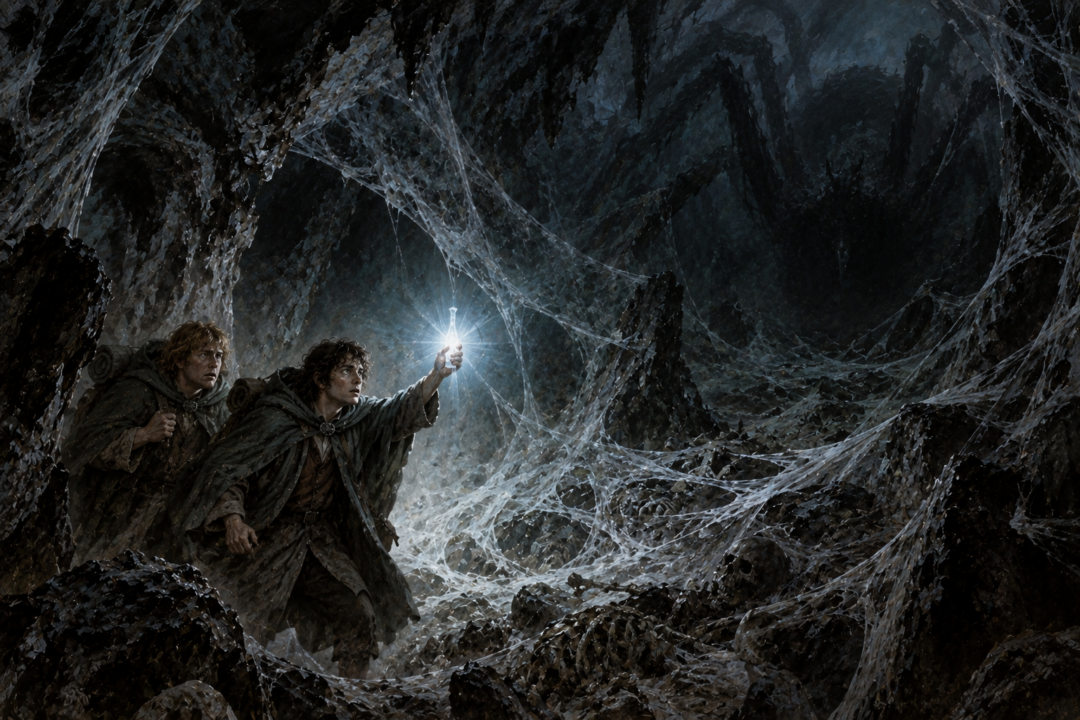
Cirith Ungol Makes Frodo’s Courage More Complicated
Faramir’s warning changes the meaning of Frodo’s departure.
Before Henneth Annûn, he follows Gollum because he lacks knowledge.
After Henneth Annûn, he follows him despite knowledge.
Not complete knowledge. Not enough to reveal Shelob. Not enough to expose Gollum’s precise plan.
But enough to know that something is wrong.
That makes Frodo more responsible for entering Cirith Ungol, yet it also makes the decision more courageous. He is not wandering innocently into darkness. He understands that his guide may be deceiving him and that Gondor remembers the pass with terror.
Still, Mount Doom lies beyond those mountains.
Frodo accepts the road because his task allows him no safe road.
That is the deeper significance of Faramir’s warning. It does not remove Frodo’s freedom, and it does not give him a clean alternative. Instead, it strips away one final comfort: the ability to believe that following Gollum is merely an innocent necessity.
From Henneth Annûn onward, Frodo knows he may be walking into betrayal.
And he walks on.
Sources & Notes
- The Encyclopedia of Arda, “Faramir” — https://www.encyclopedia-of-arda.com/f/faramir.php
- The Encyclopedia of Arda, “Cirith Ungol” — https://www.encyclopedia-of-arda.com/c/cirithungol.php
- The Encyclopedia of Arda, “Frodo Baggins” — https://www.encyclopedia-of-arda.com/f/frodobaggins.php
Reference entries document the characters, places, events, and textual details discussed in this article.