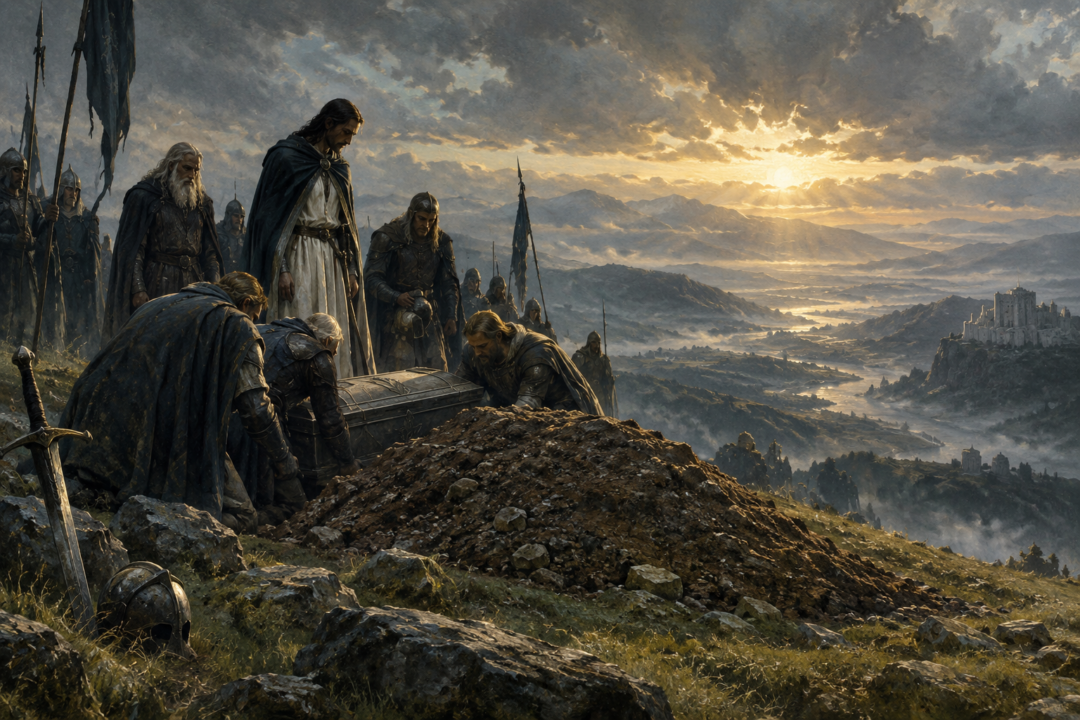
Long before the beacons burned between Gondor and Rohan, one of the hills beneath them guarded a secret.
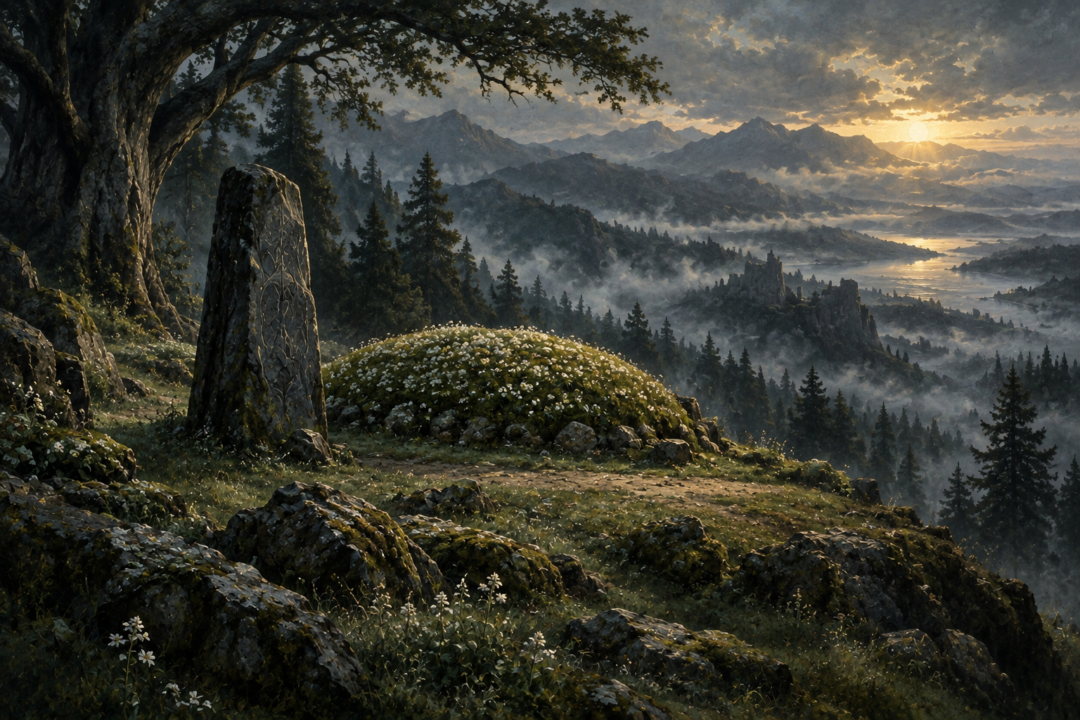
Deep within the forest later called the Firien Wood stood a mountain known to Gondor as Amon Anwar, the Hill of Awe. On its summit lay a low mound. Beneath that mound rested the remains of Elendil, father of Isildur and founder of the Númenórean kingdoms in exile.
For centuries, almost nobody knew it was there.
Yet in the Third Age, Steward Cirion deliberately brought Eorl the Young to this hidden hallow. Beside Elendil’s tomb, the two rulers swore the oaths that bound Gondor and the Éothéod in enduring friendship and established the political relationship from which Rohan emerged.
Much later, after the War of the Ring, Aragorn and Éomer renewed their bond upon the same mountain.
Why did this obscure grave become such an important place for an alliance between two living kingdoms?
The answer lies in what Elendil represented—and in the remarkable way Gondor turned an ancient secret of kingship into shared political memory.
A Grave Hidden at the Heart of Gondor
The history is preserved most fully in Unfinished Tales, in “Cirion and Eorl and the Friendship of Gondor and Rohan.”
After the overthrow of Sauron at the end of the Second Age, Isildur prepared to leave Gondor and return north. Before doing so, he journeyed through the South-kingdom with Meneldil and trusted companions.
They came to a hill called Eilenaer, situated near the middle of the lands then claimed by Gondor.
There Isildur established a hallow for his father.
Elendil had died fighting Sauron during the final struggle on Orodruin. His burial place therefore carried significance beyond ordinary royal commemoration. Elendil was the High King who had escaped Númenor’s destruction, founded the realms in exile with his sons, and entered the Last Alliance with Gil-galad against Sauron.
Isildur placed his father’s remains in a casket within a mound on the summit. The place was hallowed, and the hill thereafter became known as Amon Anwar.
But Isildur did not make it a public monument.
He made it a secret.
The Tradition of Isildur
Knowledge of Elendil’s resting place was closely guarded.
According to the tradition established by Isildur, the King of Gondor could visit the hallow, particularly in times of distress when he desired wisdom and reflection. A king would also bring his heir there when the heir had reached maturity, revealing the history and secrets attached to the place.
That distinction matters.
Amon Anwar was not simply a cemetery. It functioned as a place where the memory and responsibility of Gondor’s kingship could pass from one generation to another.
After the royal line failed with the disappearance of Eärnur, the Ruling Stewards inherited the authority necessary to preserve the tradition, though they seldom visited the hallow.
For roughly two and a half millennia, therefore, Elendil’s tomb remained concealed from nearly everyone.
Then Gondor nearly collapsed.
And Cirion chose to reveal it.
The Crisis That Created Rohan
In T.A. 2510, Gondor faced a grave invasion by the Balchoth, enemies advancing from the East.
Cirion, the Ruling Steward, sought help from the Éothéod, a Northman people then dwelling far up the Anduin. Eorl answered.
His riders made the extraordinary journey south and arrived when Gondor’s army was in desperate danger at the Field of Celebrant. Their intervention helped turn disaster into victory.
Cirion now faced another problem.
Calenardhon—the great territory between the Anduin and the Isen—had become sparsely populated and difficult for Gondor to defend effectively. The Éothéod needed new lands.
Cirion saw a solution to both problems.
He proposed granting Calenardhon to Eorl and his people.
This was no small reward to a useful military ally. It was a major territorial settlement that would permanently change the political geography of northwestern Gondor.
Such an arrangement required more than gratitude.
It required trust capable of surviving the men who made it.
Why Cirion Chose Elendil
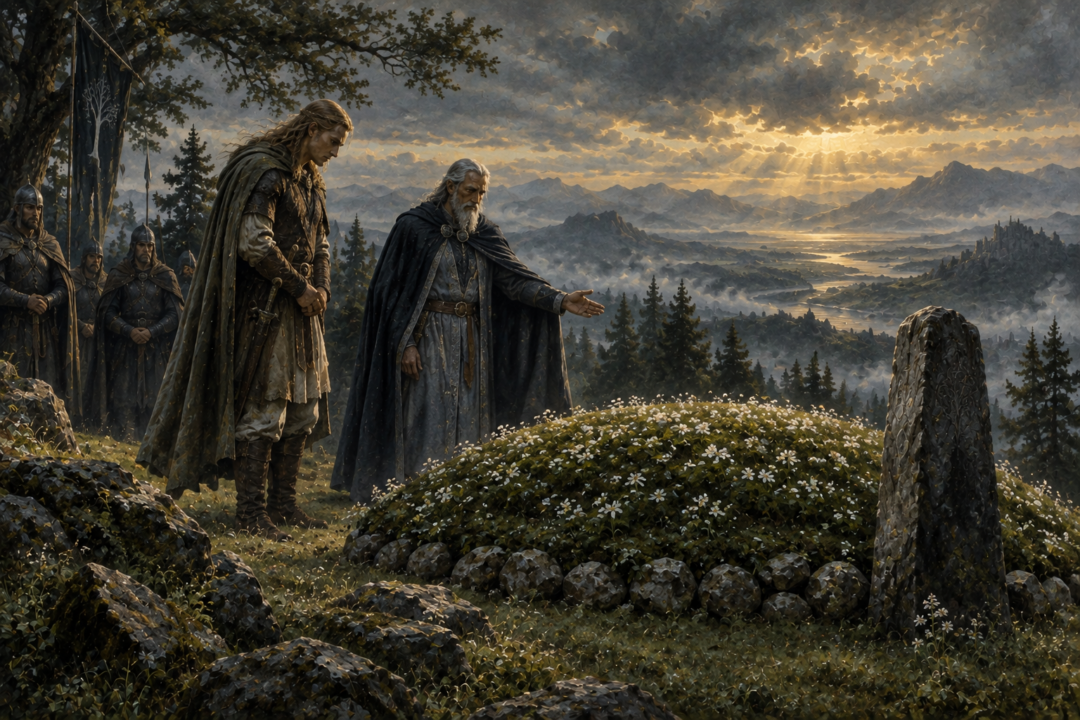
Cirion arranged to meet Eorl again and led him to Amon Anwar.
The choice was deliberate.
At the summit, the company came to the ancient mound. Its significance was not initially obvious to everyone present. Cirion revealed that this was the resting place of Elendil the Faithful.
The political agreement was thereby placed inside a much older story.
Elendil was not merely Cirion’s ancestor or an ancient ruler of Gondor. He represented resistance to the Shadow and the preservation of the Faithful after Númenor’s catastrophe. He had also entered an alliance with another people against Sauron.
The parallel should not be pushed too far: the Last Alliance of Elves and Men and the agreement between Gondor and the Éothéod were very different events. Yet Unfinished Tales explicitly gives Cirion’s oath extraordinary solemnity, associating it with the ancient memory of Elendil and his alliance with Gil-galad.
Cirion was effectively placing the new friendship under the moral authority of Gondor’s deepest political memory.
Eorl was not simply receiving land from a Steward.
He was being admitted into a covenant made before the founder of the realm.
An Alliance Based on Mutual Need
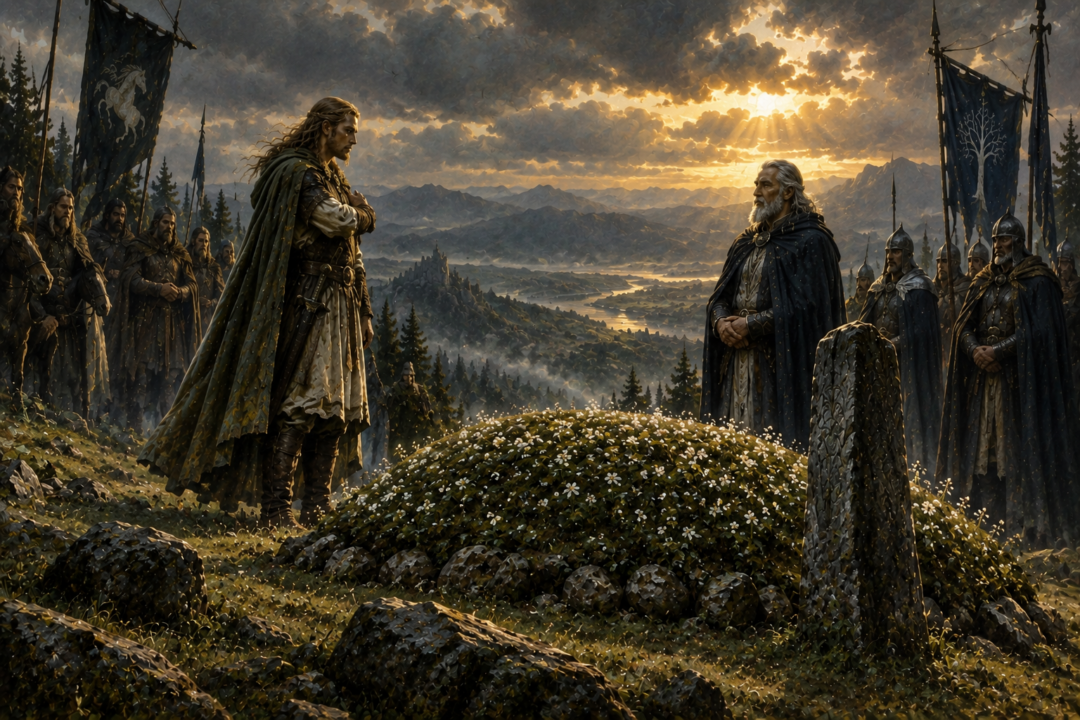
Eorl’s oath promised lasting friendship between his people and Gondor.
The crucial idea was reciprocity: Gondor’s enemies would be their enemies, and Gondor’s need would become their need. Cirion answered with his own oath, confirming the bond.
This helps explain why Amon Anwar was so appropriate.
The agreement was not framed merely as payment for military service.
Eorl had already ridden to Gondor’s aid before receiving Calenardhon. His intervention at the Field of Celebrant demonstrated the kind of loyalty the later oath formalized.
Cirion, meanwhile, did not reduce the Éothéod to subjects of Gondor. He gave them a land in which they could establish their own realm while binding the two peoples in friendship.
That distinction became fundamental to the later relationship between Gondor and Rohan.
They were separate realms.
Their strength came precisely from choosing to answer one another.
The Tomb Stood Where Gondor Had Changed
There is another reason the location was powerful.
When Isildur selected Eilenaer, the hill stood near the center of Gondor as it then existed.
By Cirion’s lifetime, that geography had changed dramatically.
Gondor had suffered plague, invasion, population loss, and territorial contraction. Calenardhon was no longer the secure interior province it had once been.
The ancient center had effectively become a frontier.
Cirion’s grant transformed that frontier again. Lands west of Amon Anwar became the home of Eorl’s people, while Gondor remained to the east and south.
The location of Elendil’s tomb therefore exposed an uncomfortable truth: kingdoms are not permanent simply because their founders were great.
Borders move. Populations diminish. Institutions survive by adapting.
Cirion’s achievement was not restoring Isildur’s Gondor exactly as it had been. That was impossible.
Instead, he used the memory of its founder to legitimize a new arrangement suited to a changed world.
Why Elendil’s Remains Were Moved
The transformation created a problem.
The original Tradition of Isildur had depended partly upon the position and secrecy of Amon Anwar. After Cirion revealed the hallow and granted Calenardhon to Eorl’s people, the old conditions no longer held.
The hill was no longer situated as it had been in Isildur’s kingdom.
Cirion therefore had Elendil’s remains removed from the mound and transferred to the Hallows of Minas Tirith.
This is an easily overlooked detail, but it changes the meaning of the story.
Cirion did not simply turn Elendil’s tomb into a permanent public shrine for Rohan and Gondor.
The actual tomb was relocated.
What remained at Amon Anwar was the memory of what had happened there.
The sacred geography shifted from burial place to oath-place.
Eventually the hill became the westernmost of Gondor’s beacon hills and was known among the Rohirrim as Halifirien, the Holy Mountain.
The secret of one kingdom had become part of the shared tradition of two.
From Hidden Kingship to Shared Memory
That transformation mirrors the larger political change.
Originally, Amon Anwar belonged to a closed tradition.
King brought heir.
Knowledge passed privately through the ruling house.
Cirion broke that pattern for an exceptional reason. He brought an outsider—Eorl—into a place whose secrecy had been guarded since Isildur.
But Eorl was about to become something more than an outsider.
He was becoming the founder of a neighboring realm whose survival would be tied to Gondor’s.
Revealing the tomb therefore carried symbolic weight. Cirion entrusted Eorl with something Gondor had protected for centuries.
The alliance began not only with land and military obligation, but with shared memory.
That may be one reason the bond proved unusually resilient.
Aragorn and Éomer Return to the Mountain
The meaning of Halifirien did not end with Cirion and Eorl.
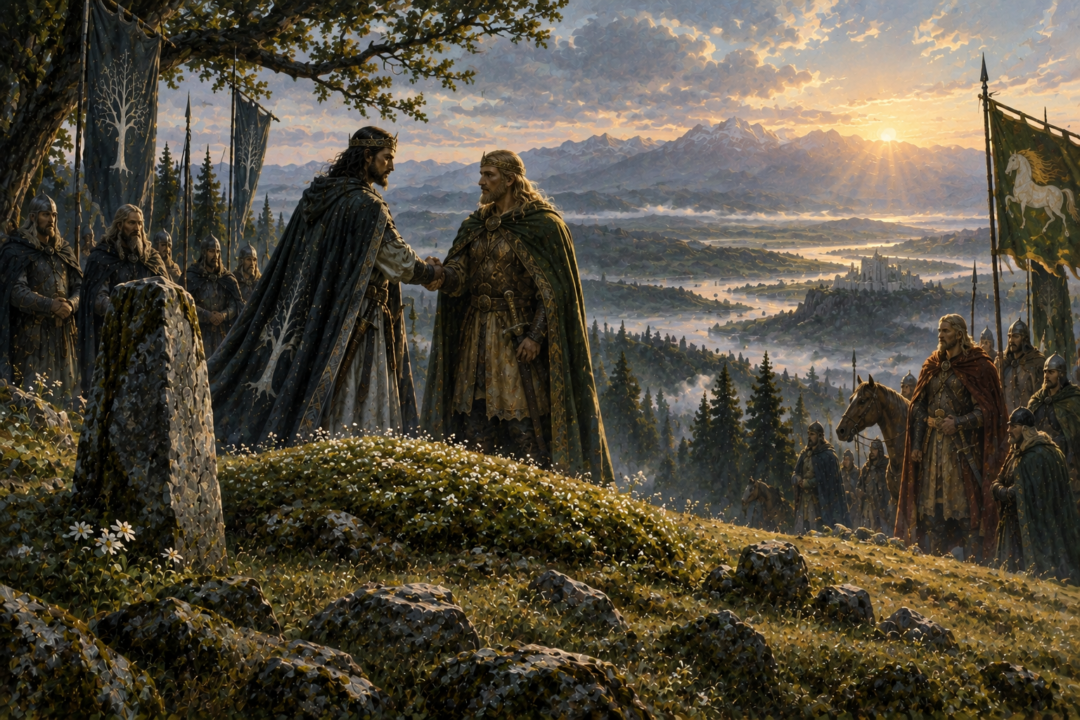
After the War of the Ring, Aragorn Elessar and King Éomer renewed the bond of their realms at the same place.
By then Elendil’s body had long since been removed.
Yet the mountain still mattered.
This was where Gondor and the ancestors of the Rohirrim had transformed emergency cooperation into enduring friendship. Returning there connected the restored kingship of Gondor and the continuing House of Eorl to that earlier act.
There is a striking symmetry in it.
Cirion had been a Steward governing in the absence of a king. He stood beside Elendil’s grave and pledged Gondor’s friendship to Eorl.
Centuries later, Elendil’s direct heir through Isildur returned as King of the Reunited Kingdom and renewed the bond with Eorl’s royal descendant.
The location tied those moments together.
The Deeper Meaning of the Hill of Awe
Elendil’s hidden tomb became an alliance site because it possessed something a council chamber could not provide: historical weight.
It reminded everyone present that political power existed inside a much longer struggle.
Elendil’s world had fallen.
Gondor’s borders had contracted.
Calenardhon had emptied.
The line of Gondor’s kings had failed.
Yet continuity survived—not through refusing change, but through people choosing obligations worthy of what had come before.
That is what makes Amon Anwar more than an obscure piece of Gondorian history.
Isildur made it a place where rulers remembered their inheritance.
Cirion made it a place where inheritance could be shared.
And when Gondor and Rohan later returned there to renew their friendship, they were not simply repeating an old ceremony.
They were affirming the principle that had made the alliance possible in the first place: kingdoms endure not only through bloodlines, fortresses, or borders, but because the living choose to keep faith with one another.
Sources & Notes
- The Encyclopedia of Arda, “Elendil” — https://www.encyclopedia-of-arda.com/e/elendil.php
- The Encyclopedia of Arda, “Halifirien” — https://www.encyclopedia-of-arda.com/h/halifirien.php
- The Encyclopedia of Arda, “Oath of Eorl” — https://www.encyclopedia-of-arda.com/o/oathofeorl.php
Reference entries document the characters, places, events, and textual details discussed in this article.