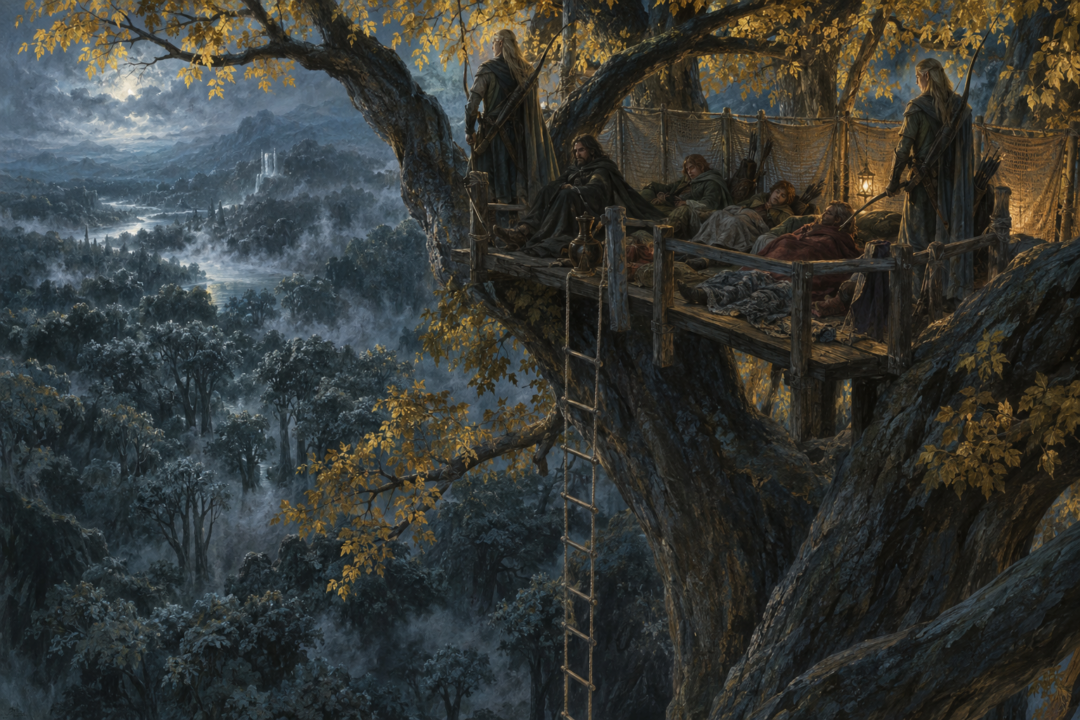
When the Fellowship reaches Lothlórien, exhausted from Moria and grieving for Gandalf, their first secure night in the Golden Wood is not spent around a sheltered campfire.
They climb a tree.
High among the branches, the Galadhrim have constructed a platform—a flet, or talan—reached by a rope ladder. It is an unexpectedly simple structure for one of Middle-earth’s most mysterious Elven realms. Yet that simplicity hides a practical answer to a serious problem.
Lothlórien is a forest sanctuary surrounded by danger. Orcs can cross its streams. Enemies can approach beneath the trees. The borders must be watched without turning the Golden Wood into a landscape of forts, roads, cleared fields, and permanent military camps.
The flets help solve that contradiction.
They allow the Galadhrim to inhabit and defend a forest while disturbing remarkably little of the forest floor. And on the very night the Fellowship sleeps above the ground, the wisdom of that arrangement becomes frighteningly clear.
The Fellowship Learns Why Height Matters
In “Lothlórien,” Haldir and his companions lead the Fellowship to a great mallorn where a platform has been constructed among the branches. The Company climbs by a rope ladder.
The structure is hardly a fortress. It has no ordinary walls, and the Fellowship must use screens against the wind. Yet its position transforms it into something a ground camp cannot easily become: a concealed sleeping place and observation post occupying the same location.
That distinction matters almost immediately.
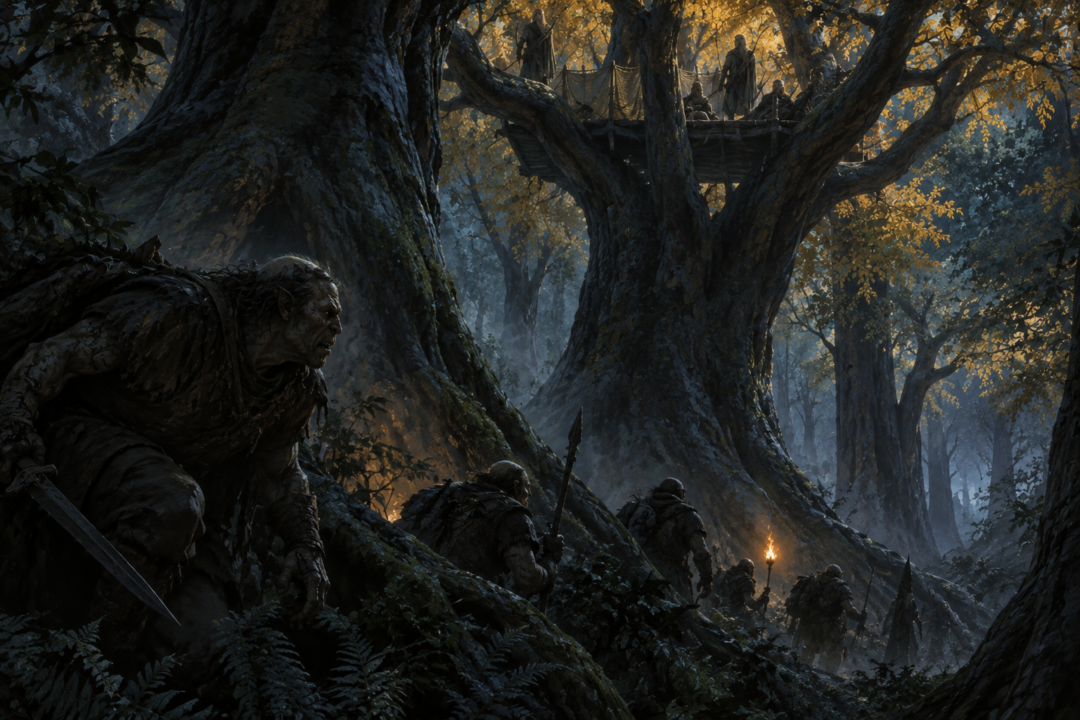
During the night, Frodo awakens and becomes aware of movement below. Orcs have crossed the Nimrodel and entered the woodland. Haldir and the other Elves are already responding to the intrusion.
The episode gives the flet its clearest tactical context. The Fellowship is not merely enjoying an unusual Elven sleeping custom. They have been placed above a forest floor through which enemies are moving.
A ground camp would put sleeping travellers directly in that contested space.
The flet does not make them invulnerable, and the text never claims that Orcs are incapable of climbing or attacking elevated positions. Its advantage is more modest and therefore more believable: anyone moving on the ground must approach from below, while those on the platform possess separation, concealment, and a better opportunity to observe what is happening around them.
A Watch-Post That Barely Looks Like One
The most striking feature of a Lórien flet is how little architecture seems necessary.
There is no stone tower. No palisade. No gatehouse. No ditch.
The Galadhrim instead use the height already provided by the trees.
This fits the border-watch function explicitly associated with such platforms. The flet encountered by the Fellowship is part of the defensive life of Lórien, where watchers guard the marches against threats approaching the Golden Wood.
From a military perspective, elevation is valuable because it changes lines of sight. A watcher standing among trees at ground level has trunks, undergrowth, slopes, and other obstacles directly in the field of vision. A watcher raised into the branches may gain longer views through or above portions of the woodland.
But Lórien's system has another advantage: it does not require the Galadhrim to remake the forest in order to defend it.
A conventional watchtower needs foundations and building material. A fortified camp requires cleared space. Larger permanent defenses can require roads, earthworks, gates, walls, and open approaches.
A talan uses the living structure already present.
That does not mean the Galadhrim possess no other defenses, nor that every flet serves exactly the same purpose. Caras Galadhon has far more elaborate elevated structures. But on Lórien's borders, the platforms show a distinctly woodland solution to surveillance.
The forest itself becomes the tower.
The Rope Ladder Creates a Controlled Boundary
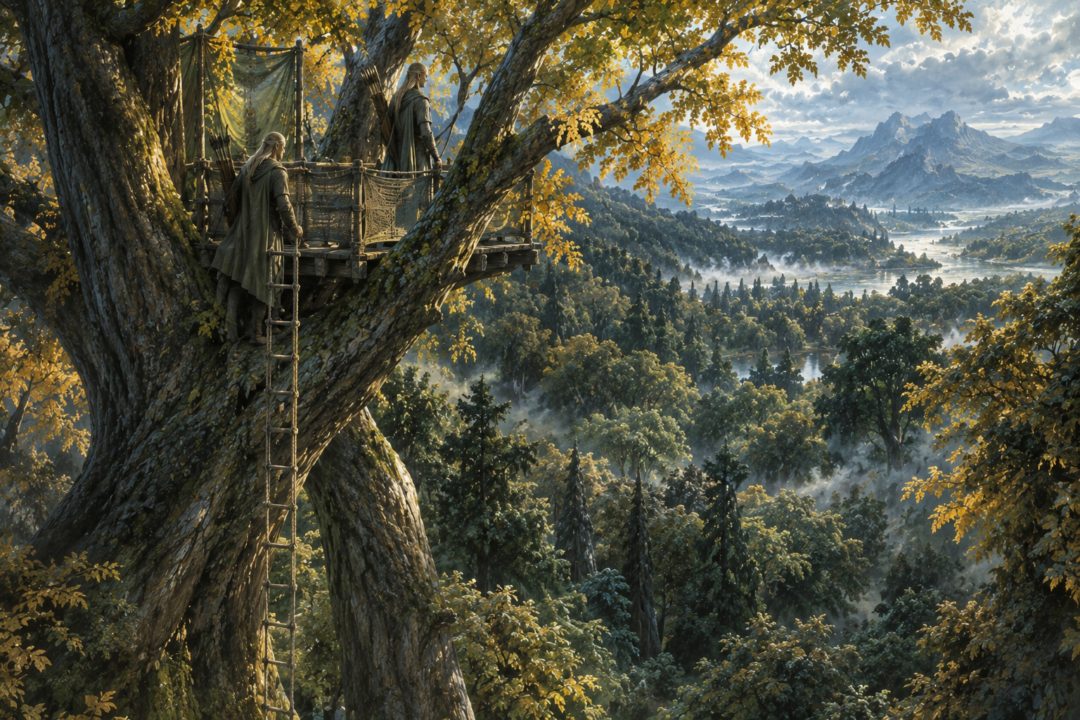
One easily overlooked detail makes the arrangement even more useful: access is by rope ladder.
When the ladder is lowered, visitors can climb.
When it is drawn up, the platform is no longer connected to the ground by an obvious staircase or ramp.
The text does not present this as an impregnable security system, so it would be going too far to call a flet an Elven fortress. But the practical benefit is evident. Ordinary access can be controlled from above without constructing a permanent entrance at ground level.
That matters particularly for sleeping.
A ground camp has a perimeter that must be watched continuously. Anyone approaching it is already on approximately the same level as its occupants. Tents may conceal sleepers, but they also conceal what is outside.
On a flet, the relationship is reversed. The sleepers occupy the harder-to-reach space, while the likely avenue of approach remains below.
The platform therefore separates two activities that are dangerously intertwined in a normal woodland camp: resting and guarding the ground around you.
It does not remove the need for sentries.
It gives the sentries a better problem to solve.
Lórien Can Watch Without Clearing the Forest
There is also a larger cultural consequence.
The Galadhrim are the Tree-people. Their realm is defined not merely by living near a forest but by living within one.
That makes conventional fortification potentially awkward. To defend a woodland by cutting broad sightlines through it, constructing extensive walls, or creating large military clearings would mean sacrificing some of the environment being defended.
The flets point toward another possibility.
Instead of forcing the land to conform to architecture, architecture conforms to the trees.
This should not be overstated into a universal rule of Elven construction. The texts do not say that the Galadhrim refuse all ground structures or that ecological preservation is an articulated military doctrine. But the physical arrangement described in Lothlórien unmistakably minimizes the need for massive construction at these watch-posts.
That is part of what makes them feel so characteristic of the Golden Wood.
Their defense does not visually dominate the landscape.
It disappears into it.
An enemy entering Lórien may therefore be moving through territory that appears comparatively unfortified while being observed from above.
Amroth Shows That the Idea Was Bigger Than Camping
The connection between height and vigilance appears elsewhere in Lórien's history.
Amroth, the former King of Lórien, was associated with dwelling high in the trees, and later material concerning him connects his elevated dwelling with watchfulness toward the growing danger of Dol Guldur.
That gives the flet a strategic dimension far beyond the Fellowship's single night.
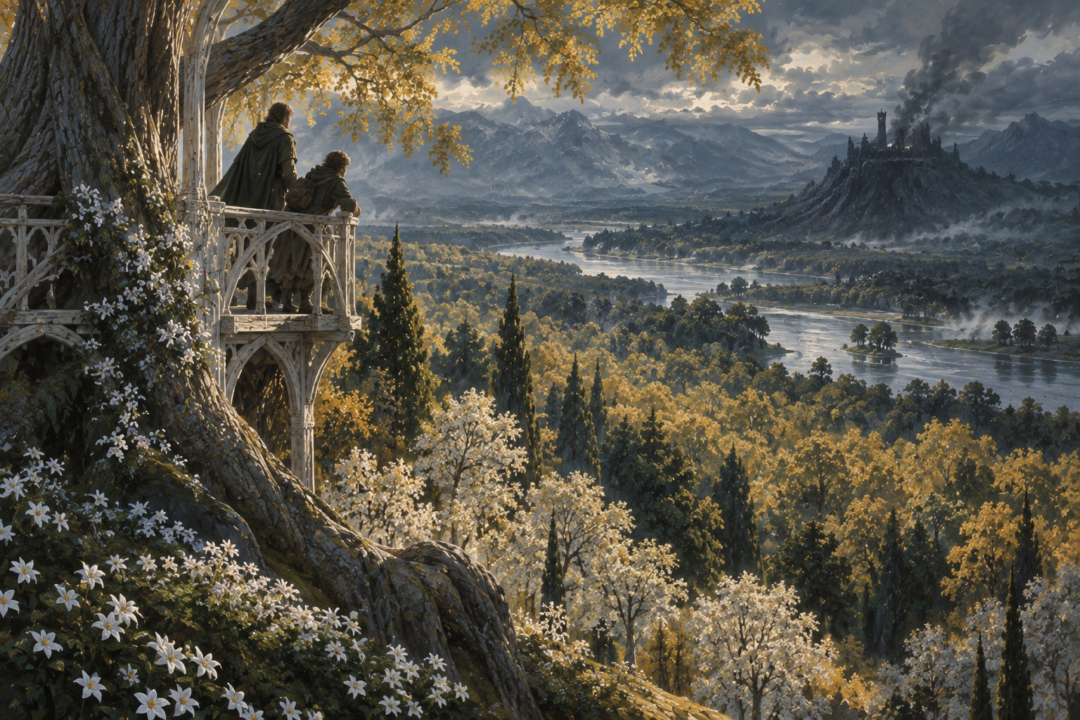
Cerin Amroth preserves the memory of this older world. When the Fellowship reaches the hill, Frodo and Sam climb to a high platform. From there they can look outward across the surrounding lands, including toward the dark stronghold across the Anduin.
The contrast is almost architectural symbolism.
Lórien watches from living trees.
Dol Guldur threatens from a fortress.
One power has imposed itself upon its environment; the other has found a way to use the environment without ceasing to inhabit it.
The texts do not explicitly present those structures as deliberate opposites. Yet visually and thematically, the contrast is difficult to miss.
The Flet Also Changes the Psychology of the Forest
There is another advantage that is less strictly military.
Sleeping on the ground in hostile woodland makes the forest feel enormous. Darkness begins a few feet beyond the camp. Every tree trunk can hide movement. Every sound seems to come from the same unseen level.
A flet changes that relationship.
The traveller is no longer enclosed only by trunks and darkness. He occupies the canopy itself.
For the Fellowship, this does not eliminate fear. Frodo remains alert enough to sense danger during the night. Yet their temporary shelter places them inside the Galadhrim's own system of vigilance rather than leaving them as strangers camping beneath it.
That distinction becomes important because Lothlórien initially does not simply welcome everyone without question. Haldir is guarding a threatened border. Gimli's presence causes particular concern, and the Company's movement is controlled until the will of the Lord and Lady is known.
The flet is therefore both hospitality and security.
The strangers can be sheltered.
The border can still be watched.
Neither requirement has to cancel the other.
Caras Galadhon Turns the Same Idea Into a Civilization
Once the Fellowship reaches Caras Galadhon, elevated living is no longer merely a frontier measure.
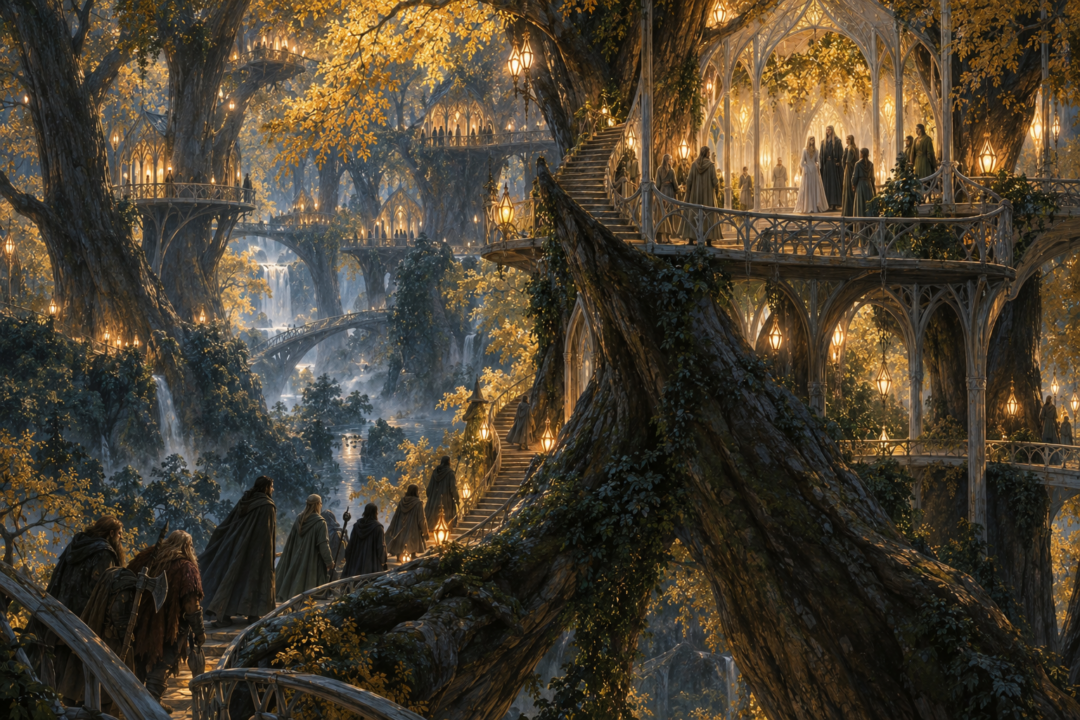
The city rises among enormous mallorn trees, with stairs and platforms high above the ground. Celeborn and Galadriel receive the Company in an elevated dwelling reached after a long ascent.
Here the principle has expanded.
What works as a watch-post on the border has become part of the spatial language of the realm's heart.
This does not mean every inhabitant of Lórien lives permanently on an exposed platform. The descriptions allow for more varied structures, and the ceremonial dwelling of the Lord and Lady is more substantial than the simple border flet.
But the continuity is revealing.
The Galadhrim do not abandon the trees when they move from military necessity to civic life.
They build upward into them.
The same environment that provides observation and security at the frontier provides dwelling and ceremony at the centre.
What Ground Camps Cannot Do
A ground camp can shelter travellers.
A watchtower can observe enemies.
A fortification can restrict access.
A flet can perform elements of all three while requiring remarkably little visible transformation of the woodland around it.
That is its real elegance.
It does not make Lothlórien unconquerable. The War of the Ring proves that the realm can be attacked, and its survival depends on far more than platforms in trees. The courage of the Galadhrim, the leadership of Celeborn and Galadriel, and the power associated with Galadriel's Ring all belong to the larger explanation of Lórien's resistance to the Shadow.
The flets solve a smaller problem.
But it is exactly the kind of smaller problem that makes an imagined culture convincing.
How does a forest people keep watch without building towers everywhere?
How do border guards sleep while enemies may be moving beneath the trees?
How can access to a shelter be controlled without constructing a gate?
How does a woodland realm defend itself without first clearing away the woodland?
Lothlórien's answer is not to build higher walls.
It is simply to climb.
And when Orcs pass beneath the Fellowship's sleeping place in the darkness, the practical intelligence behind that choice becomes suddenly visible. The Golden Wood may look untouched from the ground.
That does not mean nobody is watching from above.
Sources & Notes
- The Encyclopedia of Arda, “Flets” — https://www.encyclopedia-of-arda.com/f/flets.php
- The Encyclopedia of Arda, “Lothlórien” — https://www.encyclopedia-of-arda.com/l/lothlorien.php
- The Encyclopedia of Arda, “Galadhrim” — https://www.encyclopedia-of-arda.com/g/galadhrim.php
Reference entries document the characters, places, events, and textual details discussed in this article.