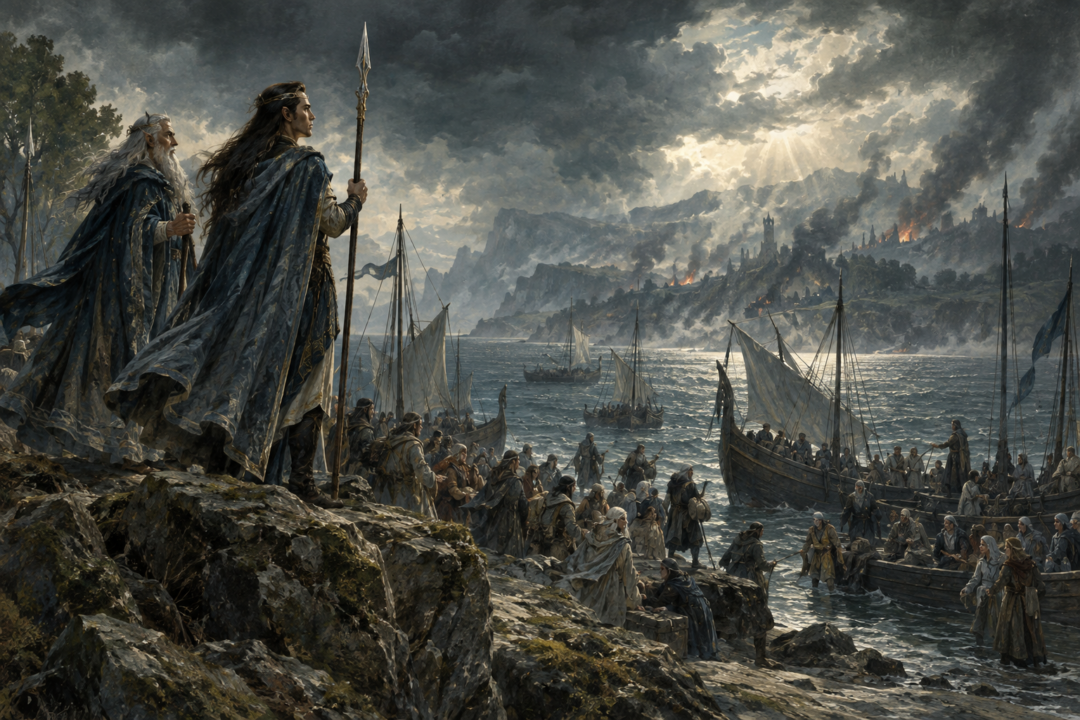
When Gil-galad emerges as the last High King of the Noldor in Middle-earth, the title sounds grander than the world he actually inherits.
The First Age had produced kingdoms whose names still carry enormous weight: Gondolin hidden among the mountains, Nargothrond beneath its hills, Doriath behind the Girdle of Melian, Hithlum in the north, and the Havens of the Falas beside the sea. By the beginning of the Second Age, none of those realms remained intact.
Some had been conquered. Some had been destroyed from within. Others had been abandoned. Finally, much of Beleriand itself was broken and drowned during the upheavals surrounding the War of Wrath.
Gil-galad therefore does not inherit Beleriand in the normal political sense. He inherits people who remember Beleriand.
That distinction helps explain what Lindon becomes. It is not simply another Elven kingdom replacing the ones that fell. It is a gathering place for remnants: Noldor, Sindar, survivors of shattered communities, and Elves deciding whether Middle-earth is still their home at all.
Gil-galad’s kingship begins amid that fragmentation.
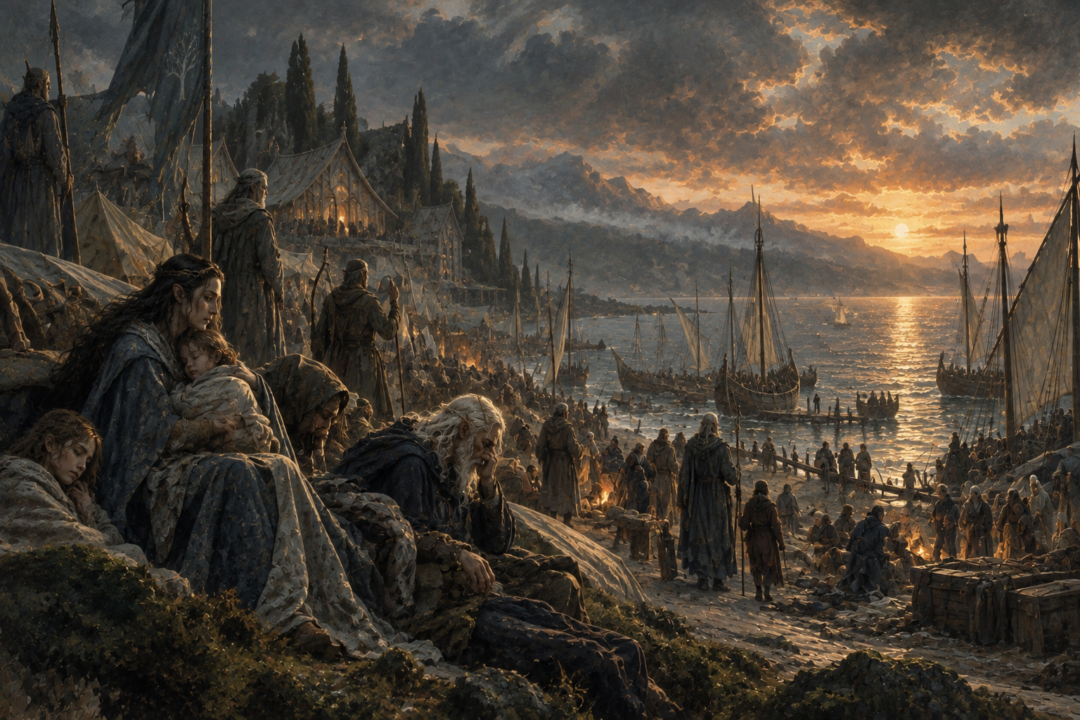
Before Lindon, Gil-galad Already Lives Among Refugees
Gil-galad’s connection with displaced communities begins before the Second Age.
There is a genuine textual complication surrounding his parentage. The published Silmarillion identifies him as the son of Fingon, while later genealogical work made him the son of Orodreth; Christopher Tolkien later said that publishing the Fingon parentage had been a mistake and that leaving Gil-galad’s ancestry unspecified would have been preferable. The safest conclusion is therefore not to build too much of his political story upon one disputed genealogy.
What matters here is much firmer: Gil-galad becomes associated with Círdan and the coastal refuges of western Beleriand.
After Morgoth’s forces destroy the Havens of the Falas, Círdan’s people withdraw to the Isle of Balar and the region around the Mouths of Sirion. These places increasingly become shelters for survivors of disasters elsewhere.
That makes the geography significant. Gil-galad’s path toward kingship does not principally run through the secure court of a flourishing realm. It runs through the last refuges of a collapsing country.
After Gondolin falls, he is recognized as High King of the Noldor. Yet the office now exists in circumstances radically different from those known by Fingolfin or Turgon.
The crown survives.
Most of the political world around it does not.
Beleriand Becomes a Collection of Remnants
The final decades of the First Age repeatedly produce refugees.
Nargothrond falls. Gondolin falls. Doriath is destroyed. Survivors gather at the Mouths of Sirion, where a final mixed community grows around Elwing and Eärendil.
Even that refuge is not safe.
The remaining sons of Fëanor attack the Havens in pursuit of the Silmaril borne by Elwing. This Third Kinslaying is particularly grim because the victims are already survivors of previous catastrophes. The Havens are not a mighty rival kingdom threatening Fëanorian power. They are effectively one of Beleriand’s last sanctuaries.
Círdan and Gil-galad come too late to prevent the destruction, and survivors escape by ship to Balar.
This gives Gil-galad’s later position a distinctive character. The people around him have not merely lost battles. Many have lost the political communities through which they once understood themselves.
A survivor from Gondolin can no longer return to Gondolin.
A survivor from Doriath can no longer return to Menegroth.
The Falathrim cannot simply rebuild the old Falas as though the First Age had paused.
And soon the destruction becomes geographical as well as political.
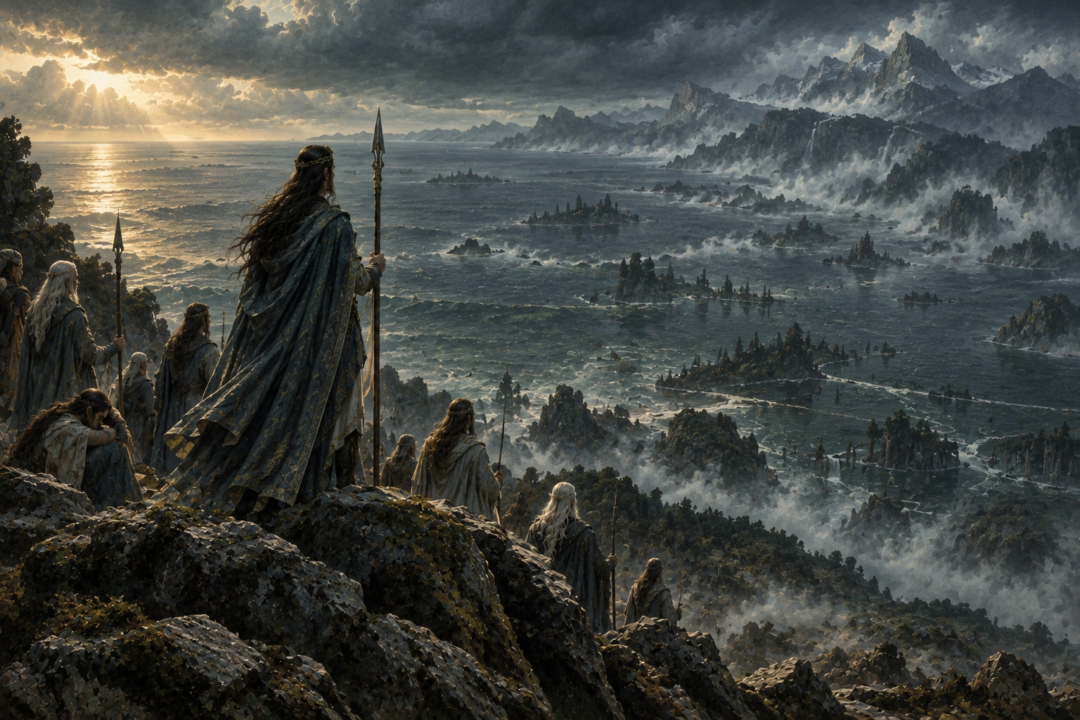
The War of Wrath Destroys the Possibility of Restoration
The War of Wrath defeats Morgoth, but victory does not restore the old map.
Beleriand is largely ruined and swallowed by the Sea. The Blue Mountains, once an eastern boundary of Beleriand, become part of the western edge of the surviving lands of Middle-earth. Ossiriand, or part of that ancient region, endures as Lindon.
This is one of the great ironies of the transition between the First and Second Ages.
The Enemy is defeated more completely than ever before, yet the victors cannot simply return home.
There is no restored Gondolin waiting for its exiles. There is no reconstructed Nargothrond ruled again from the halls of Finrod. Doriath does not rise once more beneath a renewed enchanted border.
The physical landscape has closed that possibility.
For the Eldar who survive, there are broadly different paths. They may accept the pardon of the Valar and depart over Sea, or they may remain in Middle-earth.
Those who remain must build something new.
Gil-galad therefore becomes king at precisely the moment when kingship can no longer mean recovering the old Noldorin order.
Lindon Is a New Realm Made From an Old Catastrophe
Appendix B of The Lord of the Rings places the foundation of the Grey Havens and Lindon at the beginning of the Second Age.
The wording matters. Lindon has geographical continuity with surviving lands of the Elder Days, but politically the Second Age begins with a new arrangement.
Gil-galad establishes his realm in the surviving country west of the Blue Mountains, while Círdan remains closely associated with the havens. The Gulf of Lhûn cuts into the changed landscape, and Mithlond—the Grey Havens—becomes one of the defining places of the new age.
Lindon contains many of the Noldor who remain in Middle-earth, but its Elvish population cannot be understood as the population of one old kingdom simply transplanted westward. The surviving Elves include different histories and affiliations, including Sindar and remnants connected with the old communities of Beleriand.
This makes Gil-galad’s authority unusual.
He is the last High King of the Noldor in Middle-earth, yet the society forming around him is living through the aftermath of the destruction of nearly every great First Age center.
His realm is consequently less a restoration of one Beleriand kingdom than a political answer to Beleriand’s disappearance.
The High King Rules People Who Can Still Leave
There is another constraint upon Gil-galad’s authority: Lindon is also a place of departure.
The Grey Havens face west.
Ships sail from them toward the Undying Lands, and that fact changes the emotional meaning of the realm. Gil-galad governs people for whom remaining in Middle-earth is not necessarily permanent. The West is no longer merely a memory beyond an inaccessible ocean. Passage is available to the Eldar who choose it.
Lindon therefore stands between two impulses.
One is preservation: remain in Middle-earth, build again, and continue the histories begun in the Elder Days.
The other is departure: relinquish Middle-earth and sail West.
Gil-galad cannot erase that choice, and the texts do not present him attempting to do so.
His kingdom exists beside the road out of his kingdom.
That may be one reason the Grey Havens become such an appropriate symbol for the entire later history of the Elves. They are simultaneously a settlement and an exit.
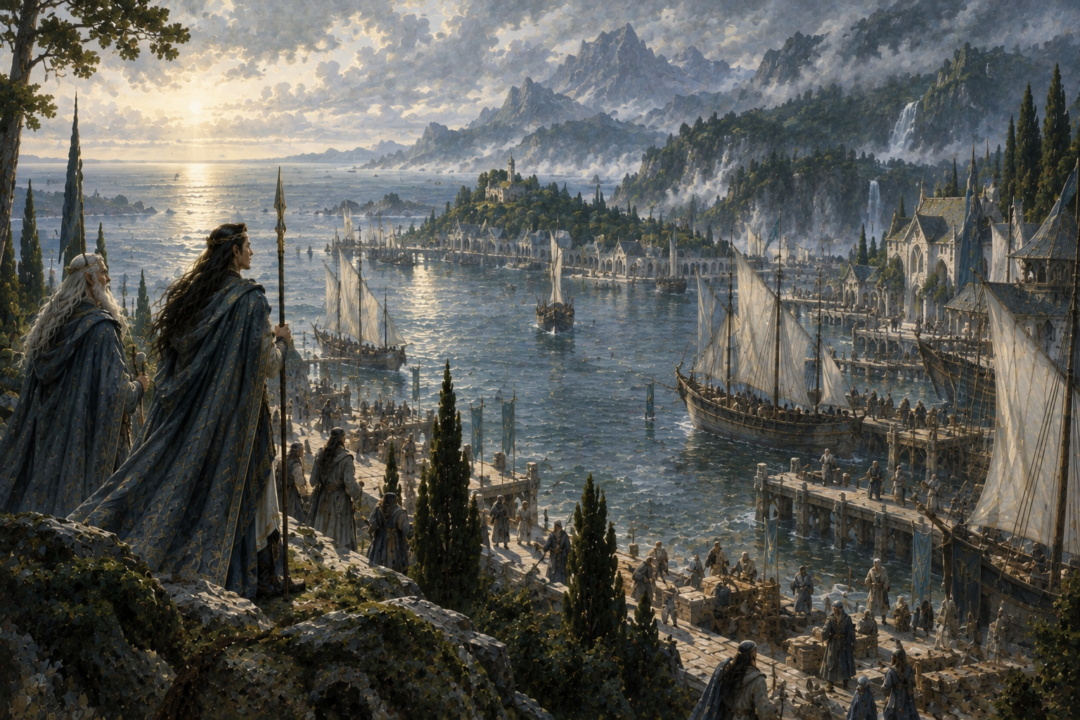
The Refugee Coalition Does Not Remain Politically Unified
Nor do all the Eldar who initially gather in or around Lindon remain permanently under one immediate political center.
During the Second Age, Elves move eastward.
Celebrimbor and other Noldor establish Eregion near Khazad-dûm. Galadriel and Celeborn are associated in varying textual accounts with movements into Eriador and lands farther east. Sindarin leaders such as Oropher and Amdír establish themselves among Silvan populations beyond Lindon.
The precise histories differ among Tolkien’s versions, so it would be unsafe to impose one perfectly settled political map upon the early Second Age. The larger pattern, however, is clear.
The survivors spread out again.
This is almost the reverse of the closing First Age. Catastrophe had driven communities westward toward the last refuges. Relative peace now allows some of them to move east and create new centers.
Gil-galad’s achievement is therefore not that he turns every surviving Elf into a permanent subject of one enormous successor-state.
Lindon instead becomes the strongest western anchor of Elvish power while other communities develop beyond it.
Gil-galad’s Strength Comes From Not Repeating the First Age
This is where Gil-galad differs most strikingly from many of the kings before him.
The First Age is filled with magnificent enclosed realms.
Thingol has Doriath and the Girdle of Melian.
Finrod has Nargothrond.
Turgon has Gondolin.
Each achieves extraordinary beauty and security for a time. Yet each is eventually destroyed.
Gil-galad’s Lindon is different. Its great defining feature is not secrecy. Its principal havens are connected to the Sea, and during the Second Age Gil-galad develops relationships beyond his own people.
When Númenórean mariners eventually return to Middle-earth, contact is established with Gil-galad. Much later, when Sauron’s power becomes unmistakable, Gil-galad understands the danger and participates in resistance extending far beyond Lindon’s borders.
The political lesson should not be overstated as an explicit doctrine; the texts never give us a manifesto in which Gil-galad explains that he has consciously rejected the models of Gondolin or Doriath.
But the contrast is still revealing.
The last High King survives for most of the Second Age not by recreating a hidden First Age kingdom, but by ruling in a world of alliances, havens, migration, and increasingly interconnected resistance.
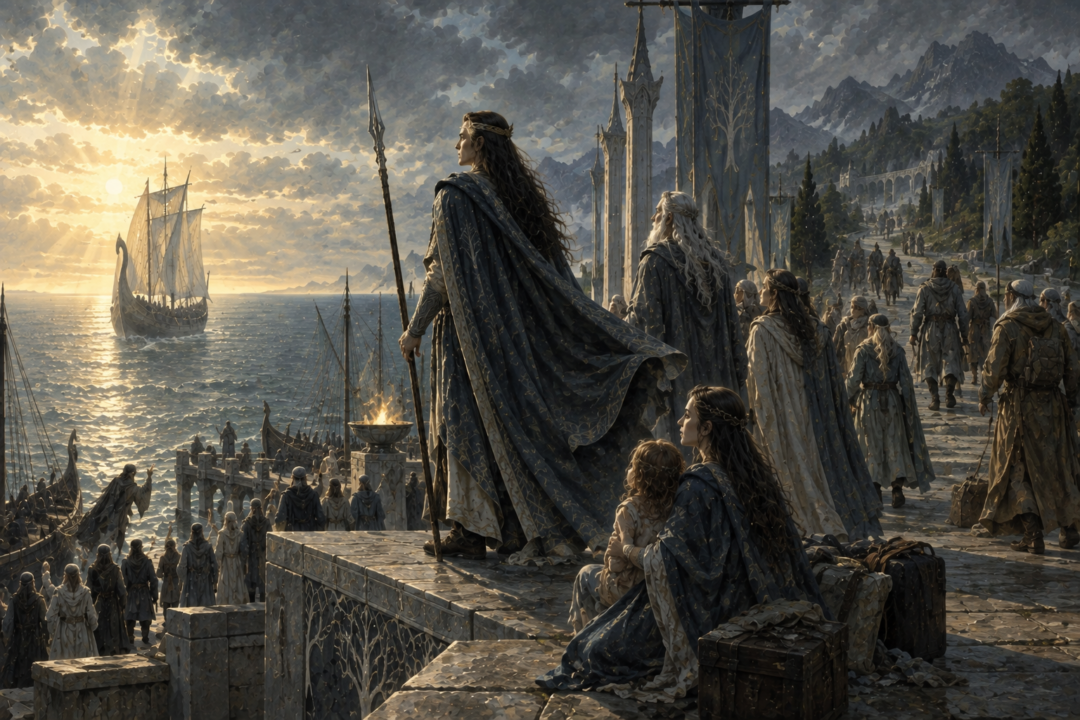
His Greatest Inheritance Is Memory
Gil-galad is often remembered from the end of his story: Aeglos, the Last Alliance, the march against Sauron, and his death alongside Elendil in the struggle that ends the Second Age.
But his earlier position gives that ending greater weight.
He belongs to the generation that carries the wreckage of the First Age into the Second.
Behind Lindon stand drowned lands.
Behind its people stand ruined kingdoms.
Behind its High King stand titles inherited from a political order that can never fully be rebuilt.
Yet Lindon endures for thousands of years.
That may be the most important thing about Gil-galad’s kingship. He does not receive one intact kingdom and preserve it unchanged. He helps give continuity to peoples whose old centers have been destroyed, while allowing a new political landscape to emerge around them.
The High Kingship survives the drowning of the country in which it arose.
But it survives by changing what a kingdom can be.
Gil-galad inherits refugees, exiles, mariners, survivors, and people who are still deciding whether to stay.
From them comes Lindon—the last great western realm of the Eldar in Middle-earth, built not upon the recovery of Beleriand, but upon the acceptance that Beleriand is gone.
Sources & Notes
- The Encyclopedia of Arda, “Ereinion Gil-galad” — https://www.encyclopedia-of-arda.com/g/gilgalad.php
- The Encyclopedia of Arda, “Lindon” — https://www.encyclopedia-of-arda.com/l/lindon.php
- The Encyclopedia of Arda, “Beleriand” — https://www.encyclopedia-of-arda.com/b/beleriand.php
Reference entries document the characters, places, events, and textual details discussed in this article.