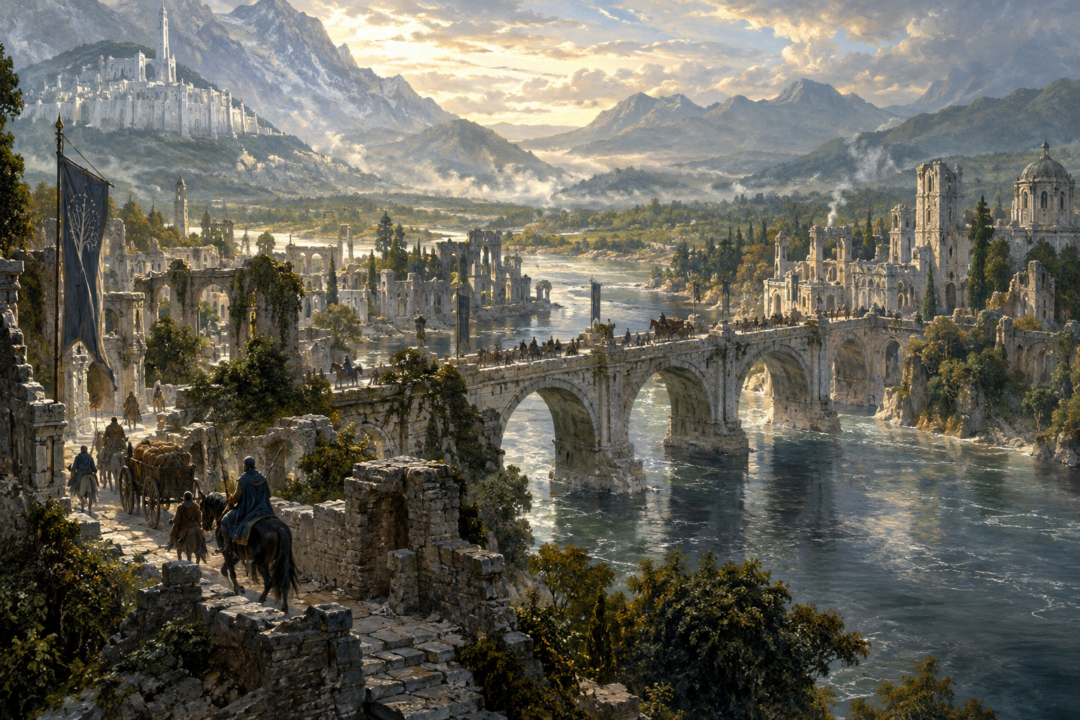
Osgiliath was built for a world in which the Anduin joined Gondor together.
By the end of the Third Age, it had become almost the opposite.
The ancient capital stood on both banks of the Great River, between the lands around Minas Tirith in Anórien and the green country of Ithilien to the east. Once it had been the political heart of the South-kingdom. By the War of the Ring, its ruined streets and broken crossings formed one of Gondor’s most dangerous military frontiers.
That difference matters when imagining the Fourth Age.
The texts never explicitly say that King Elessar rebuilt Osgiliath, nor do they give us a Fourth Age plan for its bridges, markets, gates, or roads. Any detailed reconstruction must therefore remain speculation. But the geography and postwar settlement described in The Lord of the Rings make one conclusion difficult to avoid: if Osgiliath became a functioning river crossing again, movement between western Gondor and restored Ithilien would change dramatically.
The ruined capital would no longer merely be a monument to Gondor’s decline.
It could become its hinge.
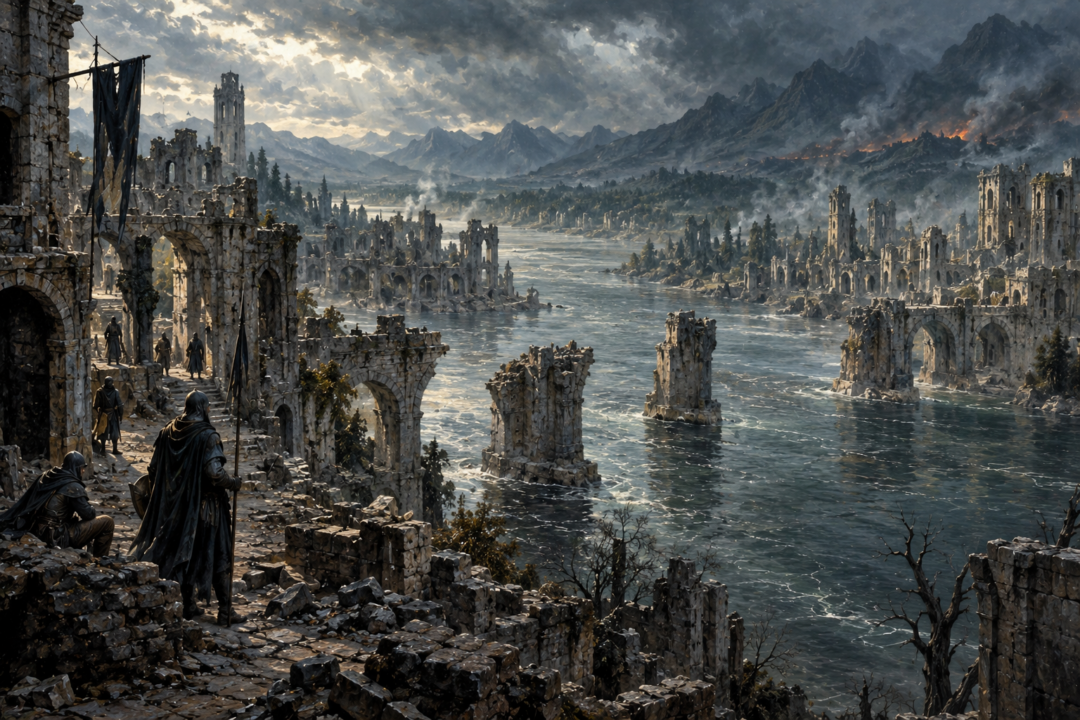
Osgiliath Was Built Around a Crossing
Osgiliath occupied both sides of the Anduin. That alone distinguished it from Minas Tirith, which stood west of the river beneath Mount Mindolluin, and Minas Ithil, later Minas Morgul, which lay far to the east beneath the Mountains of Shadow.
The city’s position connected the two halves of the old realm founded by Isildur and Anárion.
Its bridges therefore mattered for more than urban convenience. Whoever could cross the Anduin at Osgiliath could move directly between the western heartland of Gondor and Ithilien.
That strategic importance survives long after Osgiliath ceases to function as a living capital.
During the War of the Ring, control of the crossings becomes a central problem. Boromir and Faramir fought in the defence of Osgiliath before the Fellowship departed Rivendell, and Gondor destroyed the last bridge during its retreat from the eastern bank. In March 3019, Sauron’s forces had to overcome the river obstacle by other means when they attacked across the Anduin.
The ruined bridges were therefore doing something very important.
They were interrupting traffic.
In wartime that interruption helped defend Minas Tirith. In peace, the same broken connection would obstruct the recovery of Ithilien.
The Road West Was Already Waiting
Osgiliath did not stand in isolation.
A road led westward from the city across the river flats toward the Rammas Echor. At the wall it passed through the guarded Causeway Forts, and beyond them the road continued across the Pelennor toward Minas Tirith.
This route becomes painfully visible during Faramir’s retreat in the final days before the siege. Once the defenders can no longer hold Osgiliath, they fall back toward the Causeway Forts and eventually across the Pelennor.
Later, after the Battle of the Pelennor Fields, the Captains of the West march outward by this same general route toward Osgiliath before crossing into the lands beyond.
So a restored crossing at Osgiliath would not need to create an entirely new western transport corridor. The old geography already pointed directly toward Minas Tirith.
The more difficult transformation would be on the eastern side.
For centuries, crossing the river eastward increasingly meant approaching contested or enemy-dominated territory. After Sauron’s defeat, it would instead lead into a province Gondor was actively restoring.
That reverses the meaning of the road.
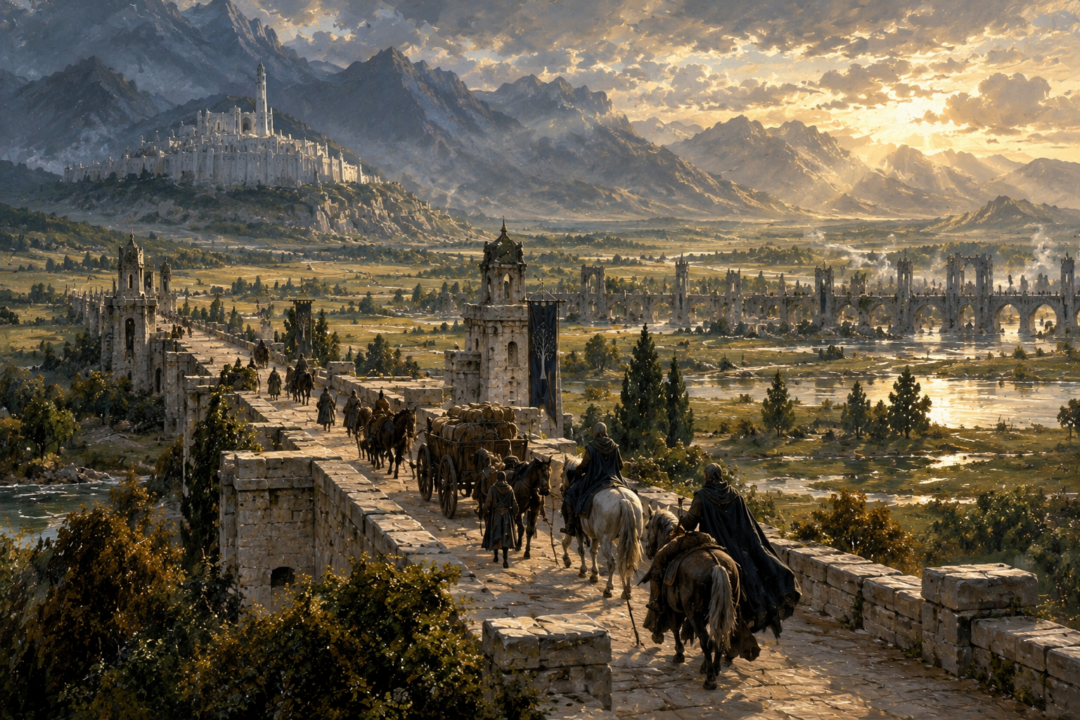
Ithilien Becomes a Place to Live Again
Ithilien is one of the great geographical tragedies of Gondor.
It is repeatedly described as beautiful, fertile country, watered by streams and clothed in woods. Yet proximity to Mordor gradually makes ordinary settlement increasingly dangerous. By the end of the Third Age, Faramir’s Rangers operate there as soldiers in a contested land rather than as inhabitants of a peaceful province.
The fall of Sauron changes that.
King Elessar makes Faramir Prince of Ithilien and Lord of Emyn Arnen. Faramir and Éowyn are to dwell there, and the appendices describe the Prince of Ithilien as one of Gondor’s great lords. Legolas later brings Elves out of Greenwood to Ithilien, and their presence contributes to the renewal of the land.
This is not merely a military occupation of former enemy territory. The text presents Ithilien as a land capable of flourishing again.
That creates a practical geographical problem.
Minas Tirith remains the seat of the King. Faramir remains Steward while also becoming Prince of Ithilien. His new home at Emyn Arnen lies east of Anduin.
The royal capital and the prince’s new domain therefore stand on opposite sides of the Great River.
A reliable Osgiliath crossing would make that separation much less significant.
Rebuilding the Bridge Would Reconnect Two Political Centres
There is an especially interesting consequence here.
Faramir does not disappear into retirement after Aragorn becomes king. His position changes, but he remains one of the greatest officers and lords of the restored kingdom.
His household, however, moves into Ithilien.
That means Fourth Age Gondor has an important political relationship running across the Anduin: Minas Tirith on the western side and the Prince of Ithilien’s domain on the eastern side.
The texts never describe the administrative traffic between them. We should not invent couriers, toll stations, scheduled convoys, or commercial regulations.
But some movement between the royal government and Faramir’s principality is a reasonable implication of their positions.
A functioning bridge at Osgiliath would turn that movement from a river-crossing problem into an ordinary journey along Gondor’s roads.
And the consequences would extend beyond nobles.
The Same Route That Carried Armies Could Carry Peace
The War of the Ring teaches us what Osgiliath’s roads can move when they are controlled.
Soldiers march along them. Messengers ride them. Defenders retreat through them. Enemy armies seek them because possession of the crossing opens the way toward Minas Tirith.
That military logic works in reverse during peace.
A secure road capable of supporting armies is also potentially useful for travellers, craftsmen, supplies, animals, building materials, and the ordinary movement required by settlement. The books do not specifically describe these categories of Fourth Age traffic at Osgiliath, so this remains an inference rather than a recorded event.
Yet Ithilien’s restoration would necessarily require access.
A restored Osgiliath would provide the most obvious direct connection between the Minas Tirith region and northern Ithilien.
Instead of ending at a broken riverfront, the road from the Pelennor could continue across Anduin.
That is a profound change because infrastructure alters the practical size of a kingdom.
Two territories may belong to the same crown on a map while remaining difficult to move between. Restore their crossing, and they become neighbours again.
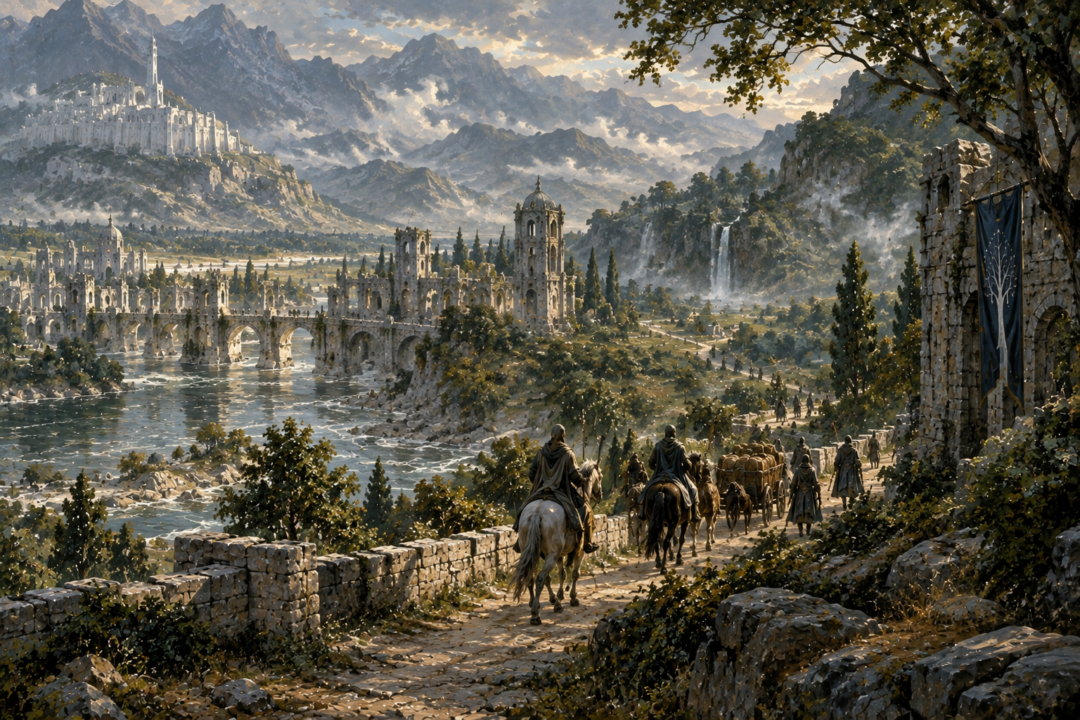
Osgiliath Would Also Control Where Traffic Converged
There is another consequence that is easy to miss.
A major bridge does not merely allow movement. It concentrates movement.
Travellers approaching a dependable crossing tend to converge upon the roads leading to it. In Osgiliath’s case, that could make the ruined city important even if it never regained its ancient status as Gondor’s capital.
This is interpretation, not a recorded Fourth Age development. The texts never tell us that Osgiliath became a commercial centre again.
But its geography makes such a role plausible.
Traffic from Minas Tirith could approach from the west. Traffic from restored Ithilien could approach from the east and south. The river itself remained one of Middle-earth’s great natural routes. Where road and river met, Osgiliath had once grown into Gondor’s chief city.
Rebuilding the crossing would reactivate part of the geographical advantage that created Osgiliath in the first place.
Not necessarily as a capital.
As a junction.
The Strategic Meaning of Osgiliath Would Change Too
For generations, Gondor had good reason to fear an intact east-west crossing.
The Enemy was east of the river.
The fighting in Osgiliath demonstrates the terrible defensive value of denying that crossing. When Gondor cannot hold the eastern side, destroying the bridge helps prevent an immediate passage of large forces into Anórien.
After Sauron falls, that calculation changes.
Mordor is defeated. Minas Morgul is to be destroyed rather than simply inherited as another Gondorian city. Ithilien is entrusted to Faramir and restored as Gondor’s eastern territory.
The frontier has moved.
That means Osgiliath no longer needs to function primarily as a barrier protecting the west from the east. A rebuilt city could instead help Gondor project peaceful authority eastward and keep Ithilien connected to the kingdom’s centre.
There is an elegant reversal in that.
During Gondor’s decline, broken Osgiliath helped separate the surviving kingdom from lands it could barely defend.
During Gondor’s renewal, restored Osgiliath could bind those lands together.
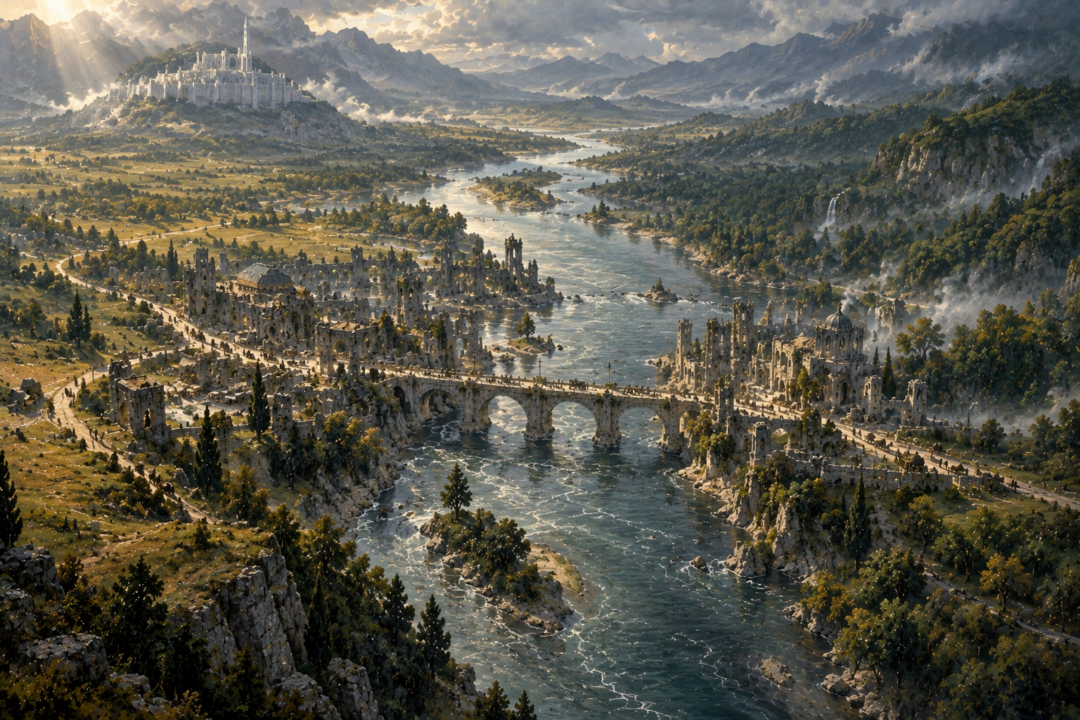
Rebuilding Osgiliath Would Be More Than Restoring Ruins
There is no canonical account of Elessar ordering Osgiliath rebuilt, and we should not turn a plausible Fourth Age project into an invented fact.
But asking what reconstruction would accomplish reveals why the city mattered so much.
Osgiliath was never important merely because impressive buildings once stood there. Its true strength was geographical. It occupied the place where western Gondor met the Anduin and where the road could continue into Ithilien.
Its destruction transformed that connection into a battlefield.
Its restoration would reverse the process.
The Causeway could cease to be remembered chiefly as the road of Faramir’s desperate retreat. The Anduin could cease to function there as the defensive obstacle that separated Gondor’s soldiers from the Enemy. Travellers moving between Anórien and Ithilien could once again pass through the place where the two sides of Gondor had originally been joined.
And that may be the most meaningful way to imagine Fourth Age Osgiliath.
Not as an attempt to recreate the lost grandeur of the old capital exactly as it had been.
But as a city whose bridges finally became more important than its walls.
Sources & Notes
- The Encyclopedia of Arda, “Osgiliath” — https://www.encyclopedia-of-arda.com/o/osgiliath.php
- The Encyclopedia of Arda, “Anórien” — https://www.encyclopedia-of-arda.com/a/anorien.php
- Tolkien Gateway, “Ithilien” — https://tolkiengateway.net/wiki/Ithilien
Reference entries document the characters, places, events, and textual details discussed in this article.