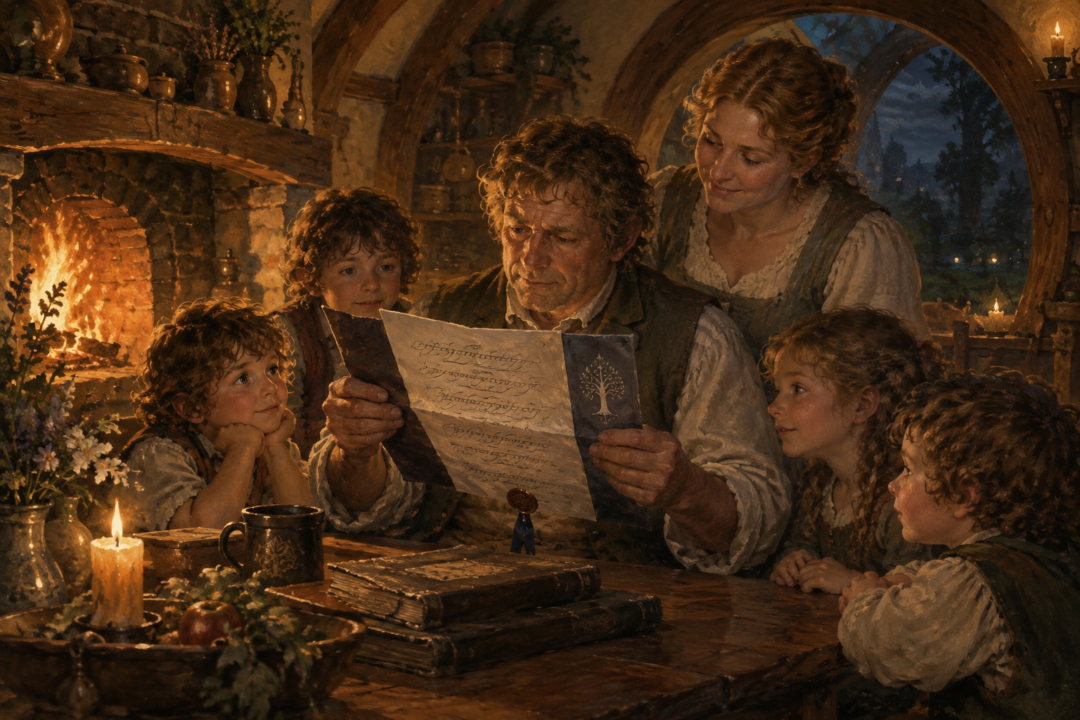
A letter from Aragorn should, at first glance, be one of the most unequal pieces of correspondence in Middle-earth.
By the time he writes to Samwise Gamgee, Aragorn is no longer the weather-beaten Ranger called Strider. He is Elessar Telcontar, King of Gondor and Arnor, ruler of the restored northern and southern kingdoms. Sam, for all his extraordinary history, is a hobbit living in the Shire.
Yet the surviving versions of the King’s Letter do not treat the Shire as a provincial corner expected simply to accommodate royal authority. The document does something subtler. Its languages, writing systems, forms of address, calendar references, and even the place chosen for the meeting all acknowledge that Sam and the Shire possess customs of their own.
It would go too far to claim that Tolkien explicitly tells us Aragorn selected a particular script because he wished to honor hobbits. He never states that motive directly. But the design of the letter supports a careful interpretation: Elessar communicates as a king without demanding that his friends abandon their own linguistic and cultural world to receive him.
That makes the King’s Letter a remarkable little document. The restored monarchy reaches the Shire, but it does not swallow it.
The Letter That Never Reached the Published Ending
The King’s Letter belongs to the abandoned epilogue of The Lord of the Rings, eventually published in Sauron Defeated. The scene takes place years after the War of the Ring, with Sam married to Rose and raising their children.
A message has come from King Elessar announcing that he intends to travel north. He wishes to meet Sam, Rose, their children, and his other friends at the Bridge of Baranduin.
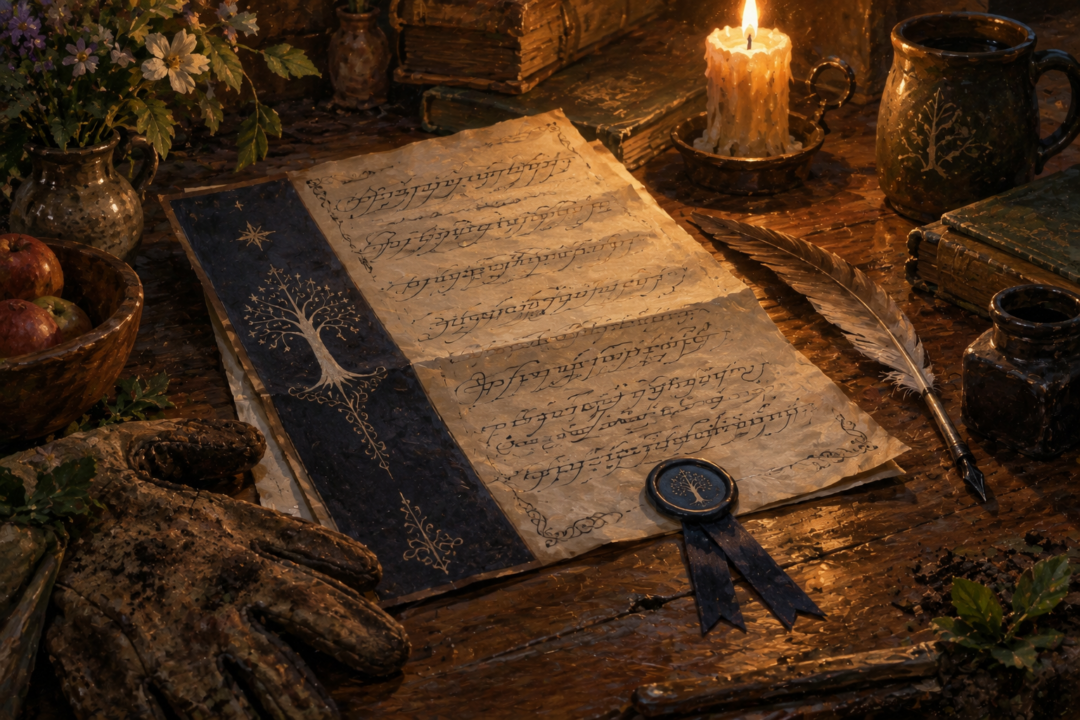
Several manuscript versions of the letter survive. They are particularly important to students of Tolkien’s invented languages because they provide substantial examples of Sindarin written with the Tengwar. The material also presents an English form representing the translated linguistic world of the story: English conventionally stands in for Westron, the Common Speech spoken by hobbits.
That distinction matters.
The Tengwar are not simply “the Elvish language written down.” They are a writing system capable of being adapted to different languages through different modes. A text can therefore be written with Tengwar without being linguistically Elvish.
In the King’s Letter, the relationship between language and script is consequently more interesting than a king merely displaying elegant Elvish calligraphy.
Aragorn Does Not Require Sam to Become Gondorian
One of the easiest mistakes is to imagine the restored kingdom as culturally uniform.
It is not.
The Shire lies within the territory of the restored northern kingdom, but its hobbits have their own habits, vocabulary, calendar, offices, and social customs. Aragorn’s kingship does not erase those differences.
The letter reflects that.
Its translated Westron form is intelligible in the linguistic world associated with Sam and other hobbits. Alongside it survives a Sindarin version, also rendered in Tengwar. The existence of the two forms should not be turned into an unsupported claim that Aragorn was following a known royal rule of bilingual correspondence; no such rule is established.
What can safely be said is that the document joins different cultural registers rather than forcing everything into one.
Elessar can identify himself through the traditions of Númenórean kingship and the Elvish languages that have accompanied his life, while addressing Sam in terms that belong to Sam’s world.
The effect is not assimilation. It is connection.

Tengwar Do Not Automatically Mean “Elvish”
This is where the script itself becomes important.
Appendix E of The Lord of the Rings explains that the Tengwar of Fëanor were widely used and adapted for different languages. The letters therefore cannot be treated as belonging exclusively to Quenya or Sindarin.
The King’s Letter provides a particularly vivid example of that flexibility. Its surviving forms employ Tengwar for material represented in English/Westron as well as for Sindarin, using modes suited to the languages concerned.
That gives the document a visual unity without requiring linguistic uniformity.
A royal letter can look prestigious and participate in the learned writing traditions of the West while still carrying the Common Speech of its hobbit recipient.
Calling that a deliberate political gesture would go beyond the evidence. But as a literary and cultural detail, it fits the larger relationship between Elessar and the Shire remarkably well. High culture does not have to obliterate local culture. The same sophisticated writing tradition can accommodate more than one language.
The king’s world and the hobbit’s world can appear on the same page.
Even the Date Makes Room for the Shire
The most revealing courtesy may not be the lettering at all.
It is the calendar.
The letter gives the proposed meeting according to a broader seasonal reckoning and then translates it into Shire-reckoning: the second day of April.
That is a tiny detail with enormous thematic weight.
A ruler could simply issue a date according to his own administrative system and expect distant subjects to convert it. Instead, the letter recognizes the recipient’s reckoning.
The Shire’s calendar is treated as useful information rather than rustic trivia.
Again, we should not turn this into a formal constitutional doctrine. The text does not tell us that Elessar required royal correspondence with hobbits to include Shire dates.
But in this particular letter, the king communicates across cultural boundaries rather than pretending those boundaries no longer exist.
For Sam, the important day is not merely a date in the restored kingdom’s system.
It is April 2.
“Master Samwise” Is Not How the Story Began
The transformation becomes even clearer in the way Sam is addressed.
The gardener who once called Aragorn “Strider” is now identified as Master Samwise and Mayor of the Shire. His wife and children are individually acknowledged.
There is also an affectionate linguistic joke hidden in the Sindarin version. Samwise is rendered as Perhael, corresponding to the “half-wise” sense behind his name, and the letter adds that he ought rather to be called Panthael—“Fullwise.”
This is not empty court ceremony.
It recalls what Sam has become without pretending he has ceased to be Sam. His courage has earned him extraordinary honor, but the honor is expressed through his ordinary identity: husband, father, Mayor, friend.
That distinction matters throughout the ending of The Lord of the Rings. The hobbits do not return home to become miniature Gondorian aristocrats. Merry and Pippin carry the marks of their service abroad, and Sam eventually becomes Mayor, but the Shire remains recognizably the Shire.
Elessar’s letter speaks into that world rather than replacing it.

The King Stops at the Border
The strongest evidence for the respect underlying the entire exchange is not linguistic.
It is geographical.
In the later history recorded in the Prologue, King Elessar issues an edict forbidding Men to enter the Shire, which becomes a Free Land under the protection of the Northern Sceptre. When he comes north, he meets his friends outside its boundary rather than claiming royal privilege to pass through.
The King’s Letter likewise announces a meeting at the Bridge of Baranduin.
That makes the location symbolically powerful even without assuming that every element of the abandoned epilogue maps perfectly onto every later chronological detail.
Aragorn possesses vastly more political power than the hobbits. Yet his relationship with them is repeatedly expressed through restraint.
The king approaches.
He does not simply intrude.
That same pattern helps explain why the linguistic texture of the letter feels significant. Its respect is not proved by one alphabetic choice. It emerges from several details working together: multiple linguistic traditions, recognition of Shire-reckoning, respectful naming, personal acknowledgment of Sam’s family, and a meeting arranged at the edge of hobbit country.
The page and the geography tell similar stories.
A Kingdom That Does Not Need Everyone to Become the Same
The restored kingship at the end of the Third Age could easily have represented simple centralization: one victorious king, one realm, one culture spreading outward from Minas Tirith.
Instead, the surviving picture is more plural.
Rohan remains Rohan. The Drúedain receive protection for their forest. Gimli’s people establish themselves in the Glittering Caves. Legolas brings Elves into Ithilien. The Shire receives exceptional protection and retains its own way of life.
The King’s Letter belongs naturally within that pattern.
Its sophisticated Tengwar should not be reduced to a decorative “Elvish font,” nor can we prove that Aragorn consciously chose a script as a diplomatic compliment to Sam. The evidence allows a more interesting and defensible conclusion.
The letter shows that prestigious forms of writing can carry different languages, and its contents repeatedly translate royal communication into terms meaningful to hobbits.
Elessar does not honor the Shire by pretending it is Gondor.
He honors it by allowing it to remain the Shire.

The Smallest Detail Reveals the Larger King
That may be why this abandoned piece of the ending remains so compelling.
The War of the Ring is full of spectacular proofs of Aragorn’s fitness to rule: the Paths of the Dead, the standard unfurled at the Pelennor, the march to the Black Gate, the healing of the wounded, and his coronation.
The King’s Letter offers another kind of test.
What does a great king do when he has nothing left to conquer?
He writes to an old friend.
He recognizes the friend’s family and office. He accounts for the friend’s calendar. He communicates across languages. And when he comes north, the meeting is arranged at the boundary of the little country whose independence his authority protects.
No single feature proves a deliberate policy encoded in script. Tolkien never gives us such an explanation.
But taken together, the letter’s linguistic and cultural choices illustrate one of the quiet principles of Elessar’s restored world: legitimate authority does not always demonstrate its strength by making other people resemble itself.
Sometimes it demonstrates strength by knowing where to stop.
For the Shire, that boundary is visible on the map at the Brandywine.
In the King’s Letter, it is visible on the page.
Sources & Notes
- Tolkien Gateway, “King's Letter” — https://tolkiengateway.net/wiki/King%27s_Letter
- The Encyclopedia of Arda, “Tengwar” — https://www.encyclopedia-of-arda.com/t/tengwar.html
- The Encyclopedia of Arda, “The Shire” — https://www.encyclopedia-of-arda.com/s/shire.html
Reference entries document the characters, places, events, and textual details discussed in this article.