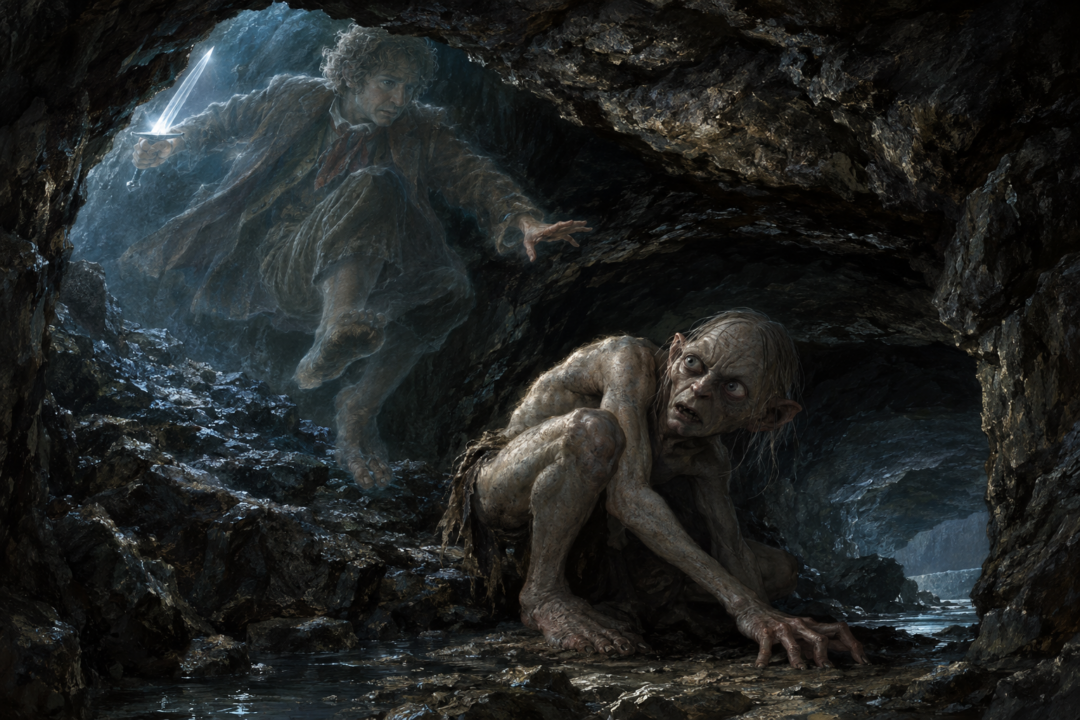
Deep beneath the Misty Mountains, Bilbo Baggins has something almost no one in Middle-earth would blame him for using: an invisible advantage over an enemy who intends him harm.
Gollum crouches between Bilbo and the way out. Bilbo has Sting. Gollum is unarmed. More importantly, Bilbo has accidentally discovered that the strange ring in his pocket can make him invisible. He could approach unseen, strike, and remove the creature standing between him and freedom.
Instead, Bilbo does something far more dangerous.
He jumps over him.
It seems like a small act beside the wars, sieges, and catastrophes that later surround the One Ring. Yet The Lord of the Rings deliberately returns to this instant and gives it enormous significance. Bilbo's refusal to kill Gollum is not merely evidence that he is kindhearted. It establishes how Bilbo first exercises power while possessing the Ring—and ultimately leaves alive the creature without whom the Ring may never have been destroyed.
Bilbo Has a Genuine Reason to Be Afraid
The scene in "Riddles in the Dark" should not be softened into simple sentimentality.
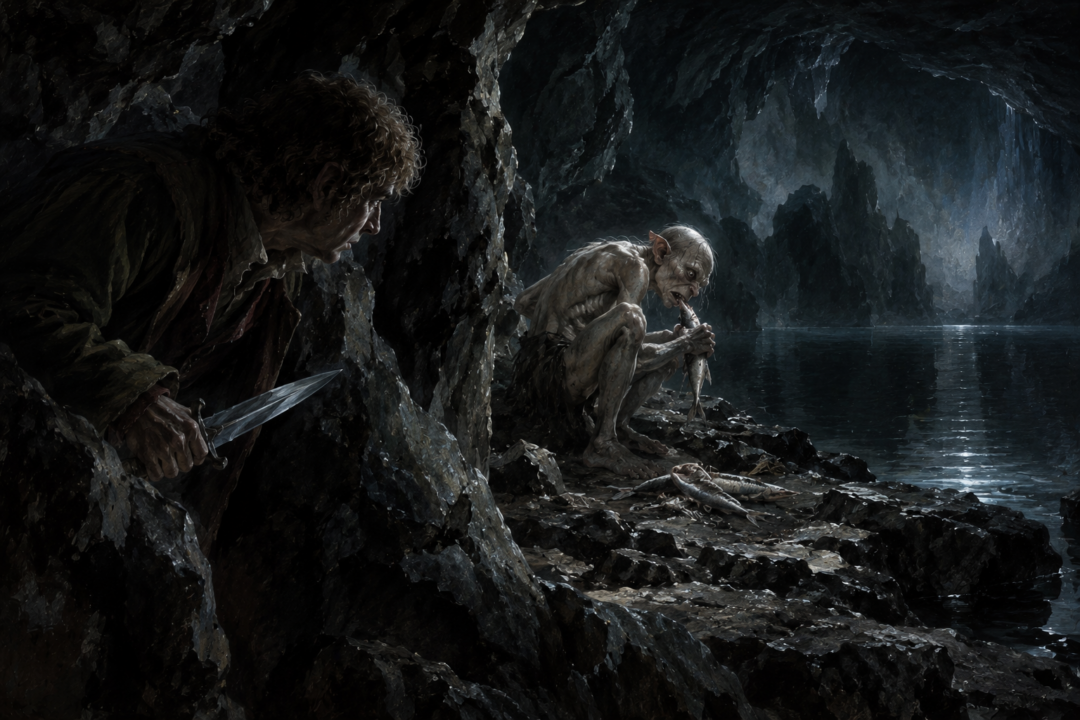
Bilbo has good reason to believe Gollum is dangerous. Gollum lives beneath the mountains, eats whatever creatures he can catch, and has already considered Bilbo as potential food. After losing the riddle-game and discovering that his precious ring is missing, Gollum becomes increasingly threatening.
Bilbo eventually follows him toward the goblins' back entrance.
There Gollum waits.
Bilbo understands that he must escape while he still has the strength. His first instinct is violent and practical: fight, stab Gollum, kill him.
But almost immediately Bilbo recognizes the moral imbalance of the situation. He is invisible. Gollum cannot see him. Gollum has no sword.
Whatever danger Gollum represents, killing him at that instant would not really be an equal fight. Bilbo would be using an extraordinary advantage to kill an opponent who could not properly defend himself.
That distinction matters.
Bilbo does not suddenly decide that Gollum is harmless. He decides that killing him is not yet necessary.
What Bilbo Sees When He Looks at Gollum
Then something unexpected happens.
For a moment, Bilbo imagines Gollum's existence.
The Hobbit describes pity rising in him together with horror as he glimpses what Gollum's life must be: endless days beneath the earth, without light or hope, amid stone, cold fish, secrecy, and loneliness.
Bilbo does not know Gollum's full history.
He does not know that Gollum was once Sméagol. He does not know how the Ring entered his life through the murder of Déagol. He certainly cannot know how deeply Gollum will become entangled in the future of the Ring.
What Bilbo perceives is simpler.
Misery.
For an instant Gollum stops being merely the monster blocking the passage. Bilbo recognizes him as a wretched creature trapped in a dreadful existence.
That recognition does not erase the danger. Bilbo still has to escape.
But it changes what he is willing to do.
The Leap Is Bilbo's Third Choice
The brilliance of the scene is that Bilbo is not forced to choose simply between killing Gollum and surrendering to him.
He discovers a third possibility.
He leaps.
The Hobbit makes the action physically precarious. Bilbo jumps over Gollum's head in the darkness, nearly striking the low roof of the passage. He chooses a course that preserves his own chance of escape without deliberately killing the creature beneath him.
That is what makes the decision meaningful.
Mercy costs Bilbo something.
Killing Gollum while invisible would arguably be the safer option. Jumping over him requires courage and exposes Bilbo to risk.
Bilbo therefore does not spare Gollum because he lacks the nerve to act. He has already shown increasing courage during the adventure, and he will later kill the giant spiders of Mirkwood when fighting is necessary.
His pity has limits, but it also has consequences.
When Bilbo can escape without killing, he refuses to kill.
The Ring Makes the Choice More Important
There is another layer that only becomes fully visible in The Lord of the Rings.
Bilbo is making this decision while wearing the One Ring.
He does not yet understand what he possesses. To him it is an astonishing magic ring that offers invisibility and a means of escape. But the later history reveals that this is Sauron's Ruling Ring, an object inseparable from domination and corruption.
Bilbo's first crucial use of that advantage against another person could therefore have been murder.
It is not.
Gandalf later tells Frodo in "The Shadow of the Past" that Bilbo benefited because his ownership of the Ring began with pity. Gandalf connects Bilbo's relatively limited spiritual damage from possessing it with the manner in which he acquired and first used it.
This should not be turned into a mechanical rule whereby one merciful deed makes someone immune to the Ring. Bilbo is not immune. By the time of his eleventy-first birthday, he has become possessive of it, suspicious when Gandalf challenges him, and reluctant to surrender it.
But his history with the Ring differs profoundly from Gollum's.
And that contrast begins with blood.
Sméagol Begins With Murder; Bilbo Begins With Mercy
The Lord of the Rings later reveals how Sméagol obtained the Ring.
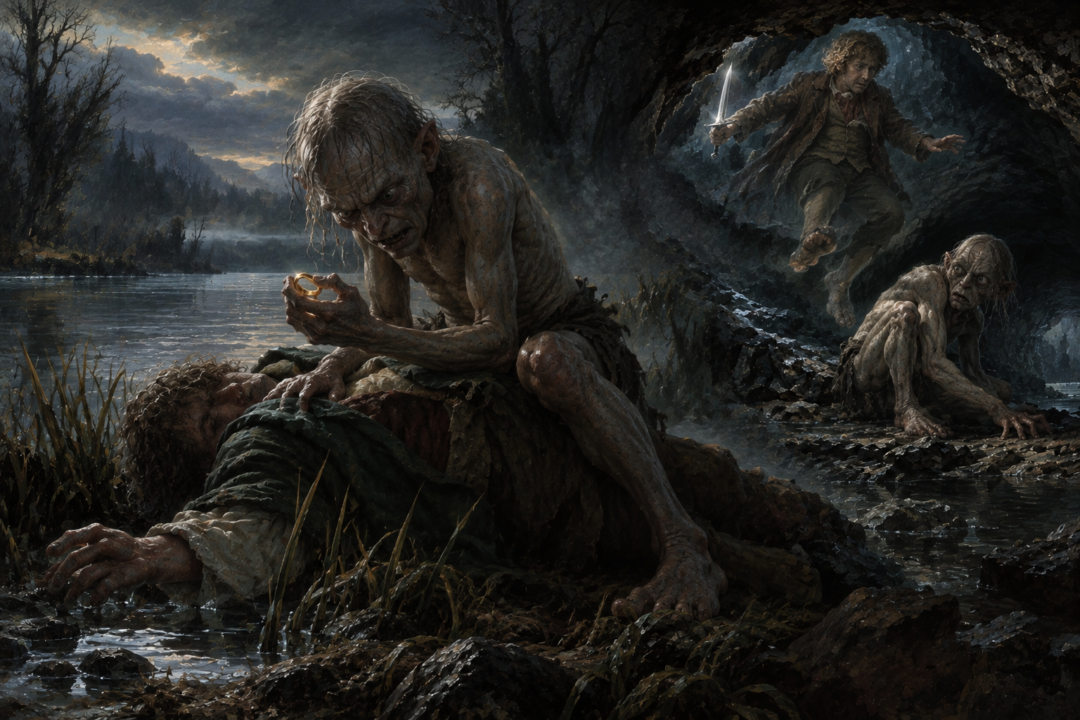
Déagol discovers it while fishing in the Gladden Fields. Sméagol immediately desires it. When Déagol refuses to surrender it as a birthday present, Sméagol murders him and takes it.
His possession therefore begins with an act of domination: another life is destroyed because Sméagol wants the Ring.
Bilbo encounters almost the opposite temptation.
He already has the Ring. He already possesses the advantage. The question is what he will do with that power.
And he refuses to use it for an unnecessary killing.
The contrast is one of the clearest moral patterns surrounding the Ring. Its danger is not merely that it makes people invisible or gives power according to the stature of its bearer. Its deeper temptation concerns the exercise of power over others.
Bilbo possesses power over Gollum in that tunnel.
He chooses restraint.
Gandalf Understands What Frodo Initially Does Not
Years later, Frodo hears what Gollum has done and reacts in a perfectly understandable way.
He wishes Bilbo had killed him.
Gandalf's response transforms the old adventure under the mountains into one of the central moral arguments of The Lord of the Rings. Bilbo was stayed by pity and mercy, Gandalf explains—not striking when there was no need.
Frodo protests that Gollum deserves death.
Gandalf does not simply deny that judgment. Instead, he challenges Frodo's certainty about what should follow from it. Many who live may deserve death, while others who die deserve life; no one can restore those lives, and even the wise cannot foresee every consequence.
This is not an argument that evil should never be resisted.
Middle-earth is full of necessary resistance to evil. Aragorn fights. Gandalf fights. Frodo himself carries a weapon and sometimes uses it.
The distinction is between resisting danger and eagerly assuming the right to kill someone when killing is not necessary.
Bilbo had another way out.
So he took it.
Mercy Does Not Make Gollum Good
Bilbo's choice becomes even more interesting because it does not magically redeem Gollum.
Gollum continues to commit terrible acts. He hunts Bilbo. He later leaves the mountains searching for the Ring, eventually falls into Sauron's hands, and betrays Frodo and Sam to Shelob.
Mercy does not guarantee gratitude.
That is essential to understanding the story.
If Bilbo spared Gollum only because Gollum would thereafter become good, then the act would resemble an investment. Bilbo would be choosing mercy because he could foresee a useful result.
He cannot.
Indeed, Gandalf himself later says that Gollum may still have some role "for good or ill." Even Gandalf does not claim to know exactly what will happen.
Bilbo's mercy matters precisely because he acts without knowing the end.
Frodo Eventually Faces Bilbo's Choice
Bilbo's decision also becomes an inheritance.
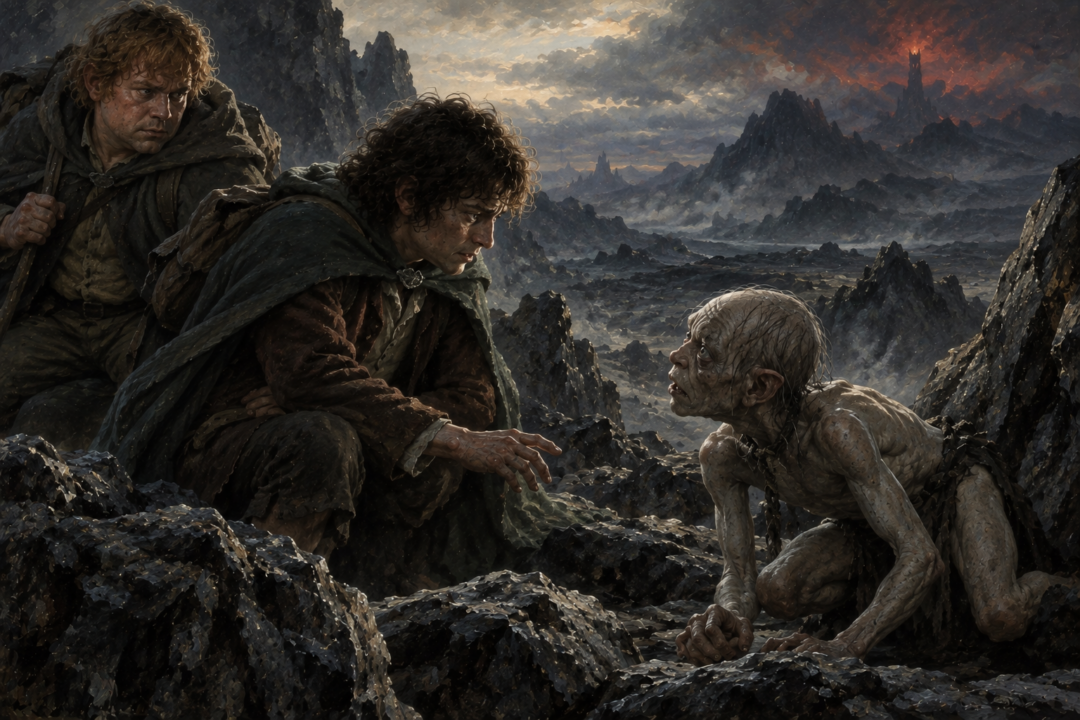
When Frodo finally meets Gollum, he understands something that was impossible for him to understand while sitting safely in Bag End.
He sees Gollum.
Frodo himself has now carried the Ring. He has begun to experience its weight, temptation, and possessiveness. The creature he once dismissed as simply deserving death becomes a terrifying image of what prolonged enslavement to the Ring can do.
Frodo consequently extends pity toward him.
That mercy is imperfect and difficult. Gollum remains dangerous, while Sam's suspicion of him is often justified. Yet Frodo repeatedly refuses to kill him and attempts to deal with Sméagol rather than merely destroy Gollum.
Bilbo's leap has become more than one hobbit's decision.
Its moral pattern continues through the next Ring-bearer.
At Mount Doom, Bilbo's Mercy Reaches Its Final Consequence
The greatest irony arrives at the very place where the quest seems to fail.
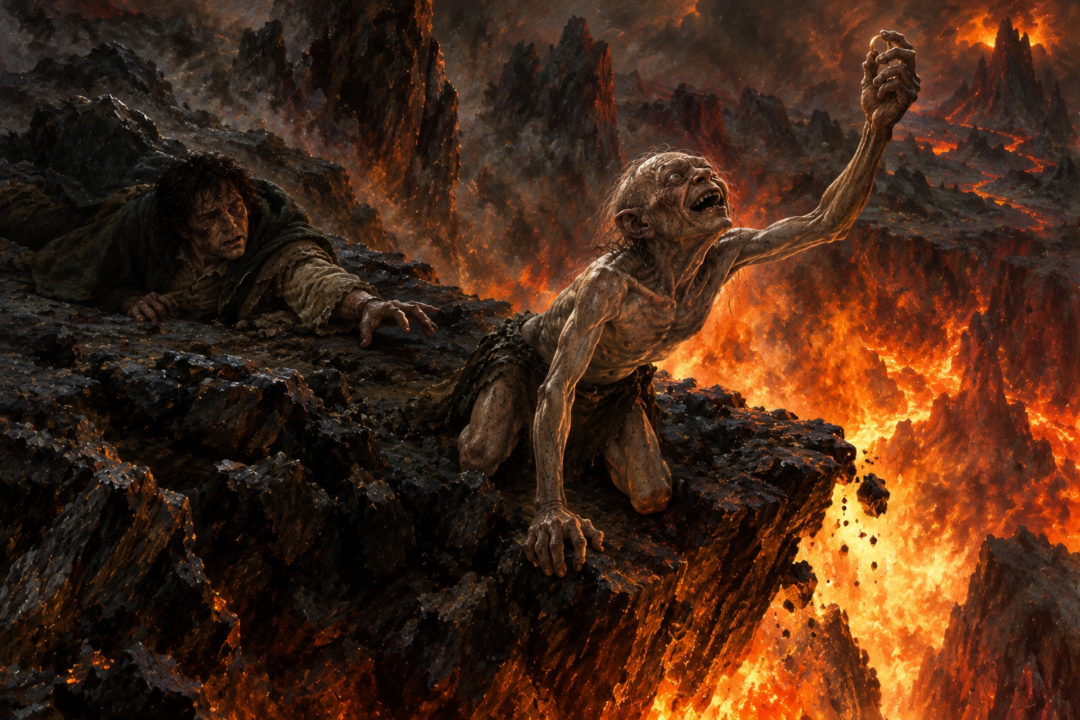
At the Cracks of Doom, Frodo cannot voluntarily destroy the Ring. At the final moment, after carrying it farther than anyone could reasonably have expected, he claims it.
Then Gollum attacks.
He bites the Ring from Frodo's hand, rejoices in recovering his precious, loses his footing, and falls into the fire.
The Ring is destroyed.
This does not mean Bilbo somehow foresaw the outcome beneath the Misty Mountains. He plainly did not. Nor does it mean Gollum consciously saves Middle-earth. His final action is driven by his desperate desire for the Ring.
But Gandalf's earlier intuition proves remarkably accurate.
Gollum does have a part to play before the end.
And he can play it only because he is alive.
The Smallest Decision Becomes One of the Greatest
Bilbo does not defeat Gollum beneath the mountains by overpowering him.
He refuses to become his executioner.
Then he jumps.
That leap captures something fundamental about the moral structure of The Lord of the Rings. The great struggle against evil is fought through armies, kings, fortresses, swords, and sacrifice—but history can also turn upon private acts of restraint that appear almost insignificant when they happen.
Bilbo cannot see Mount Doom.
He cannot see Frodo.
He cannot see the War of the Ring or understand the object in his pocket.
He sees only a miserable creature crouching in the darkness and realizes that he does not need to kill him.
So Bilbo takes the harder road over Gollum rather than the easier road through him.
Decades later, Middle-earth survives partly because that road was still open.
Sources & Notes
- Tolkien Gateway, “Riddles in the Dark” — summarizes the riddle-game, Bilbo’s invisibility, his pity for Gollum, and his leap over the creature to escape. https://tolkiengateway.net/wiki/Riddles_in_the_Dark
- Tolkien Gateway, “Gollum” — traces Gollum’s life under the Ring and records Bilbo’s decision to jump over rather than kill him. https://tolkiengateway.net/wiki/Gollum
- Tolkien Gateway, “The Shadow of the Past” — documents Gandalf’s account of the Ring and Gollum and his warning against dealing out death in judgment. https://tolkiengateway.net/wiki/The_Shadow_of_the_Past
- Tolkien Gateway, “The Hobbit 1st edition” — explains Tolkien’s revision of the Gollum episode to reflect the One Ring’s hold and Bilbo’s altered account. https://tolkiengateway.net/wiki/The_Hobbit_1st_edition
Sources document Bilbo’s invisible advantage, his thought of killing Gollum, the pity that prompts his leap, Gandalf’s later interpretation of that mercy, and the chapter’s revision around the Ring’s corrupting power.