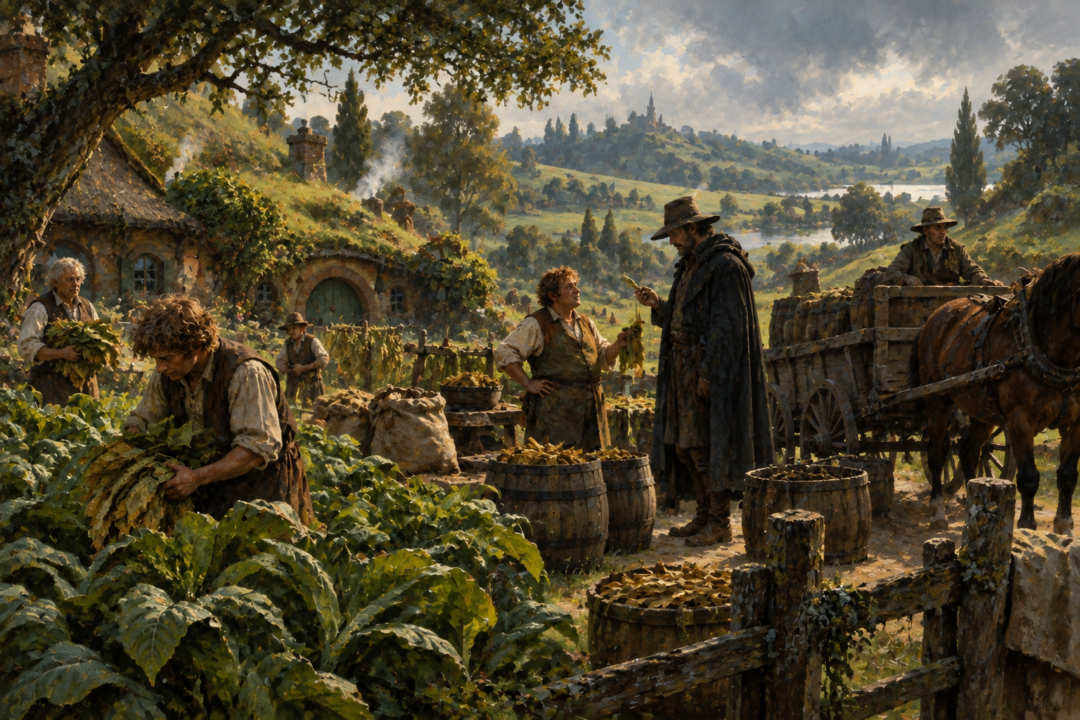
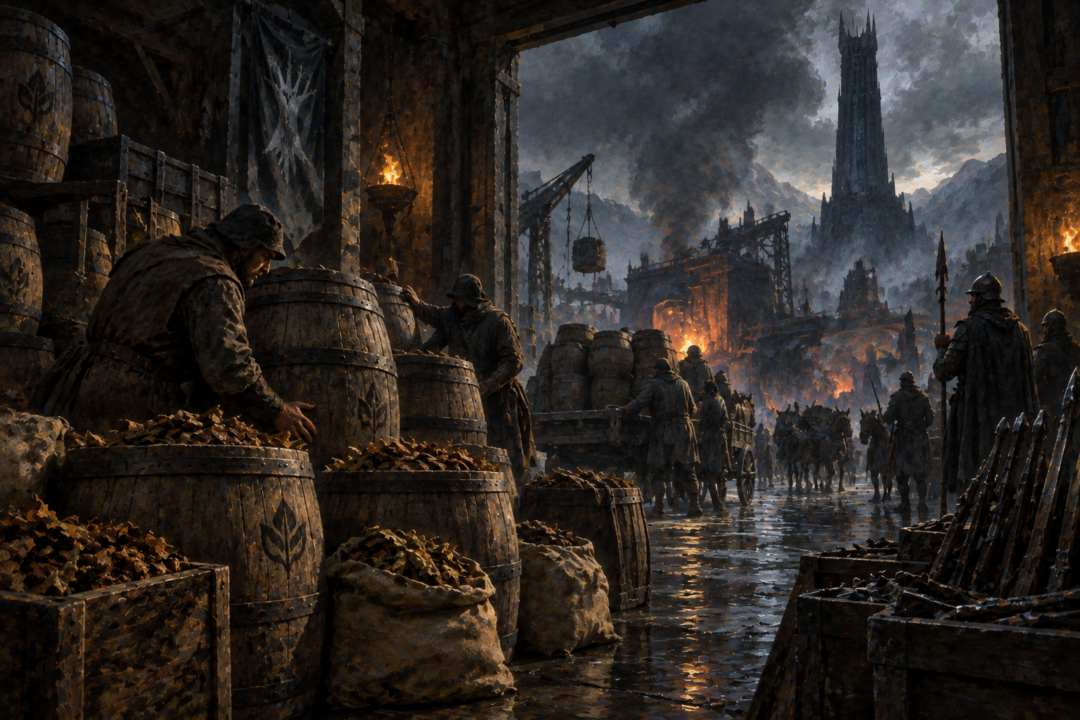
When Merry and Pippin searched the wreckage of Isengard, one discovery delighted them more than Saruman’s abandoned machinery or shattered storehouses: barrels of pipe-weed from the Southfarthing of the Shire.
To the two Hobbits, it was an unexpected luxury. To Aragorn, it was evidence.
The barrels bore the marks of the Hornblower family and came from the Shire-reckoning year 1417. That seemingly trivial detail raised an uncomfortable question. The Shire and Isengard were separated by a great stretch of sparsely travelled country. As Aragorn observed, goods and people had not been passing openly between those regions for many years.
Yet somebody had harvested pipe-weed in the Southfarthing, packed it into barrels, sold it, transported it beyond the Shire, and eventually delivered it into Saruman’s possession.
The remarkable part is that Saruman apparently did not need some fantastical method of acquiring it. The surviving texts instead point toward something much more mundane: purchasing agents, money, roads, merchants, wagons, and increasingly compromised local suppliers.
The pipe-weed at Isengard is therefore one of Middle-earth’s smallest but most revealing pieces of evidence. Saruman’s influence reached the Shire long before his ruffians openly ruled it.
The Hornblower Barrels Were a Clue
The crucial scene comes after the Ents have overwhelmed Isengard.
Merry and Pippin discover provisions intended for Men, including pipe-weed. Pippin identifies the barrels as belonging to the Hornblowers and dates the crop to S.R. 1417.
Aragorn immediately recognizes the significance.
His concern is geographical as much as political. He knows the lands between Rohan and the Shire and points out that ordinary traffic has not been moving openly across them. His conclusion is cautious but unmistakable: Saruman must have had secret dealings with somebody inside the Shire.
That distinction matters.
Aragorn does not imagine Orcs secretly raiding Hobbit farms for tobacco. Nor does the discovery require a mysterious hidden road running directly from Longbottom to Orthanc. The suspicious element is not that trade was impossible. It is that somebody had created a concealed commercial connection across regions that normally had little visible commerce with one another.
Later material concerning Saruman’s activities makes that picture considerably clearer.
Saruman Actually Bought Pipe-Weed
The background given in Unfinished Tales, particularly material associated with “The Hunt for the Ring,” explains that Saruman developed a private interest in the Shire partly because Gandalf was interested in it.
There was an embarrassing element to this curiosity.
Saruman had mocked Gandalf’s fondness for the Hobbits’ pipe-weed, yet eventually adopted the habit himself. His pride made him unwilling to admit that he had imitated Gandalf, so he attempted to keep his use of the leaf secret.
That required supplies.
The texts describe Saruman as obtaining pipe-weed through dealings with the Shire and indicate that money used for purchasing leaf increased his influence among certain Hobbits. This is an important glimpse of how his power operated before outright occupation.
He could corrupt through commerce.
A Hobbit grower did not necessarily need to understand Saruman’s larger ambitions. From the producer’s perspective, there could simply be a distant buyer willing to pay well for agricultural goods.
Saruman could remain almost invisible behind the transaction.

The Network Had Human Agents
Saruman eventually stopped personally investigating the Shire and relied on agents.
Unfinished Tales describes Men connected with him operating in or around the region, and one particularly trusted servant had been negotiating for pipe-weed and other supplies. This man was associated with Dunland and was returning from the borders of the Shire while Saruman was preparing Isengard for war.
That detail transforms the barrels from an unexplained curiosity into evidence of a supply system.
Saruman had purchasing agents.
Those agents could negotiate with local suppliers. Goods could then leave the Shire without the sellers necessarily having direct dealings with the Wizard of Orthanc himself.
The texts do not provide a complete shipping ledger, and it would go beyond the evidence to reconstruct every wagon stop or intermediary. But they provide enough information to establish the basic mechanism: Saruman’s servants were acquiring goods from the Shire through commercial dealings and carrying those supplies southward.
His secret network was therefore hidden less by magic than by intermediaries.
The Southfarthing Was Perfect for This
Pipe-weed was not a rare magical substance. It was an agricultural commodity.
According to the account of pipe-weed preserved in the Prologue to The Lord of the Rings, Tobold Hornblower of Longbottom first cultivated the plant successfully in the Shire around S.R. 1070. The Southfarthing became particularly associated with its production, including famous varieties such as Longbottom Leaf, Old Toby, and Southern Star.
That meant Saruman was dealing with an existing productive economy.
He did not need to create plantations himself. He only needed access to people willing to sell what they already grew.
This is one reason the Isengard discovery is so effective narratively. The Hornblower markings make the barrels traceable. They are not anonymous stores that might have originated anywhere. Merry and Pippin recognize them as products of their own homeland.
A familiar Hobbit commodity has somehow crossed hundreds of miles and ended up inside the industrial fortress of a fallen Wizard.
The ordinary object exposes an extraordinary connection.
How Did the Barrels Physically Travel?
The exact itinerary of the S.R. 1417 barrels is never given.
That limitation should be respected.
What can be reconstructed is the broader geographical framework.
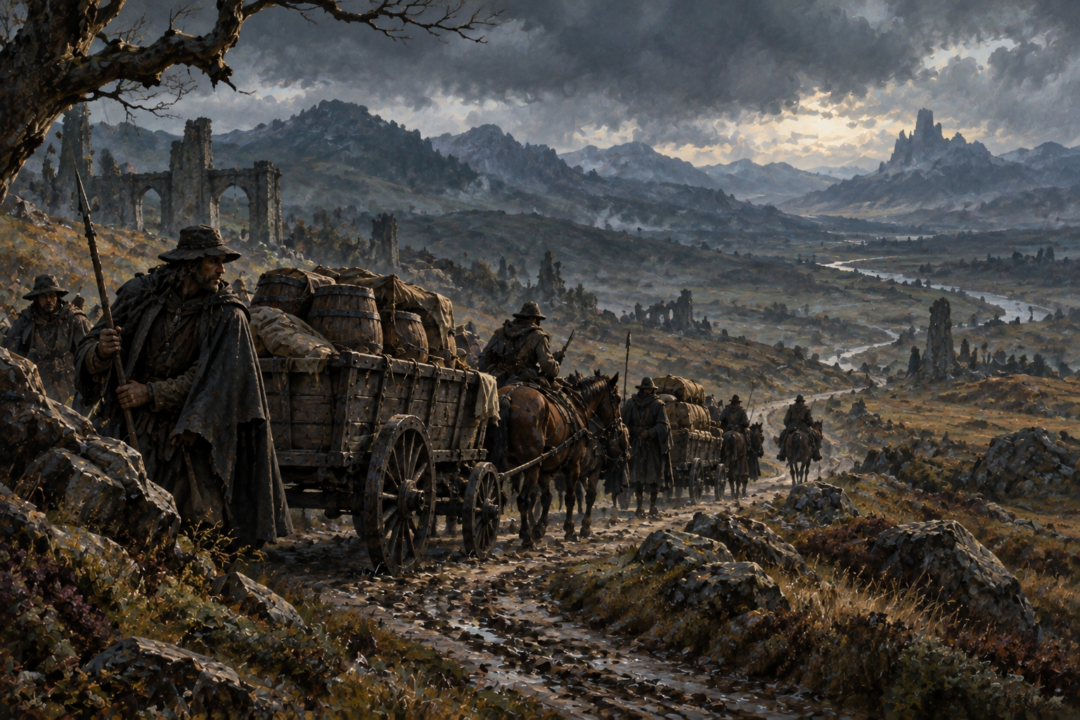
The Southfarthing had access toward Sarn Ford on the southern boundary of the Shire. Beyond lay the routes of Eriador, including connections ultimately leading toward the old North-South Road system. Saruman’s servants were able to operate in this wider region, despite the watch maintained around the Shire by the Rangers.
Unfinished Tales indicates that the Rangers were suspicious of Saruman’s servants but had not simply barred them, because Saruman was still outwardly regarded as an ally before his treachery became known.
That is crucial.
Saruman did not initially need to smuggle every barrel through enemy territory. His public reputation gave his servants freedom that obvious servants of Sauron would never have possessed.
A wagon carrying purchased goods could look like commerce rather than invasion.
The surviving texts do not specify every stage by which the Hornblower barrels reached Orthanc, so any precise route remains reconstruction. But nothing requires supernatural transportation. Roads, carts, pack animals, warehouses, intermediaries, and ordinary movement of goods are sufficient to explain the network described in the texts.
Money Came Before Ruffians
The later fate of the Shire reveals where this economic penetration could lead.
When the Hobbits return home in The Return of the King, they discover that Lotho Sackville-Baggins has accumulated property and power. Goods have been taken away from the Shire, ostensibly for trade, while the local population increasingly suffers shortages and coercion.
Saruman eventually becomes the power behind the regime.
But his interest in the Shire did not begin with armed occupation.
The earlier pipe-weed trade shows a subtler stage. Money entered first. Relationships formed. Agents learned who owned land, who produced valuable goods, who would sell, and who might be influenced.
The texts do not establish that every Hobbit involved in selling leaf knowingly supported Saruman’s political ambitions. That distinction is important. Ordinary commerce can serve sinister purposes without every participant understanding the final destination.
Saruman could exploit precisely that ambiguity.
A farmer sells a crop.
A middleman arranges transport.
A wagon leaves the Southfarthing.
Somewhere far away, Orthanc receives another barrel.
No single transaction needs to look like conquest.
Why Saruman’s Network Was So Dangerous
Saruman’s greatest strength was never simply his army.
He understood systems.
At Isengard he organized industry, fortification, breeding, provisioning, intelligence, and military movement. His dealings with the Shire reveal the same instinct applied at a smaller scale.
He discovered that economic relationships could create influence.
That makes the pipe-weed barrels an early warning of what eventually happens during the Scouring of the Shire. The later tyranny does not emerge entirely from nowhere. Saruman already possessed knowledge of the region, contacts connected with its economy, and experience acquiring its products.
The relationship changed from purchasing to domination.
That progression also fits Saruman’s broader moral decline. Things cease to possess value in themselves and increasingly become resources to acquire, control, organize, and exploit.
Even the peaceful cultivation of Hobbit pipe-weed becomes another strand in his web.

The Smallest Evidence at Isengard May Be the Most Revealing
After Helm’s Deep, armies and Wizards dominate the story. Against that scale, a few barrels of pipe-weed seem almost comic.
Aragorn knows better.
The barrels prove that Saruman’s reach extended much farther than the walls of Isengard. Somewhere in the supposedly protected and uneventful Shire, commercial relationships were already connecting Hobbit agriculture to the ambitions of Orthanc.
The mechanism was frightening precisely because it was ordinary.
Saruman did not need to conquer the Southfarthing to obtain its goods. He could send agents. He could pay suppliers. He could exploit his reputation and move through established roads and commercial relationships. The precise journey of each barrel is unrecorded, but the larger network is explicitly supported by the texts.
Only later would the Hobbits see where those relationships could lead.
So when Merry and Pippin happily opened the Hornblower barrels among the ruins of Isengard, they were unknowingly sitting beside evidence of the coming Scouring.
The Shire had not yet been invaded.
But one of its most famous products had already travelled south into the hands of its future oppressor.
Sources & Notes
- Tolkien Gateway, “Pipe-weed” — surveys the crop’s cultivation and export and records Saruman’s commerce with the Shire and the stores found at Isengard. https://tolkiengateway.net/wiki/Pipe-weed
- Tolkien Gateway, “The Hunt for the Ring” — summarizes the Unfinished Tales accounts of Saruman’s spies and an agent negotiating the price of pipe-weed for Isengard. https://tolkiengateway.net/wiki/The_Hunt_for_the_Ring
- Tolkien Gateway, “Hornblower Family” — identifies the Southfarthing growers and the Hornblower-marked barrels discovered in Isengard’s ruins. https://tolkiengateway.net/wiki/Hornblower_Family
- Tolkien Gateway, “Southfarthing” — documents the region’s pipe-weed economy, Saruman’s agents, local roads, and later exports to Saruman. https://tolkiengateway.net/wiki/Southfarthing
Sources trace the Hornblower barrels found at Isengard, pipe-weed’s Southfarthing production and export, Saruman’s concealed commerce with the Shire, and the purchasing agent described in the Hunt for the Ring material.