The mithril coat is one of the closest things Middle-earth has to legendary armor. It is astonishingly light, harder than tempered steel, fabulously valuable, and strong enough to turn weapons that should kill its wearer.
Yet after Frodo survives the spear-thrust in Moria, his body tells a more complicated story.
He is alive. The spear has not pierced him. The mail has done exactly what armor is supposed to do.
And Frodo is badly bruised.
That detail matters because it prevents mithril from becoming a simple fantasy device that makes its wearer invulnerable. The coat can stop a weapon without stopping the force behind it. Frodo's injuries reveal an important distinction: armor can remain intact while the person inside it still suffers.
That distinction makes Bilbo's gift more interesting—and makes Frodo's survival in Moria considerably less effortless than it first appears.
The Spear-Thrust That Should Have Killed Frodo
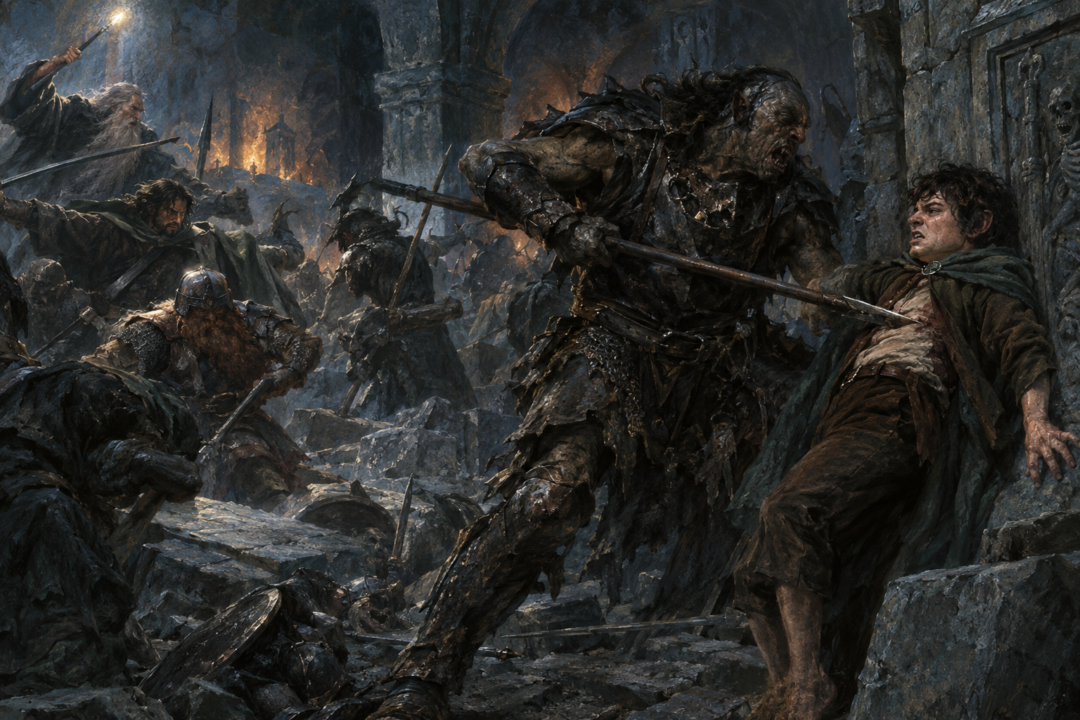
The decisive moment comes during the fighting in the Chamber of Mazarbul.
An Orc-chieftain attacks the Fellowship with a great spear. After knocking Boromir aside and getting past Aragorn, he drives his spear directly at Frodo. The impact catches Frodo in his right side and pins him against the wall.
The Company initially has every reason to believe the wound is mortal.
But Frodo survives.
Once they have escaped the immediate danger, he admits that although the spear did not skewer him, he feels as though he has been caught between a hammer and an anvil. Even breathing is painful.
Only later, after the Fellowship has escaped Moria and entered the lands beyond, does the full explanation become visible.
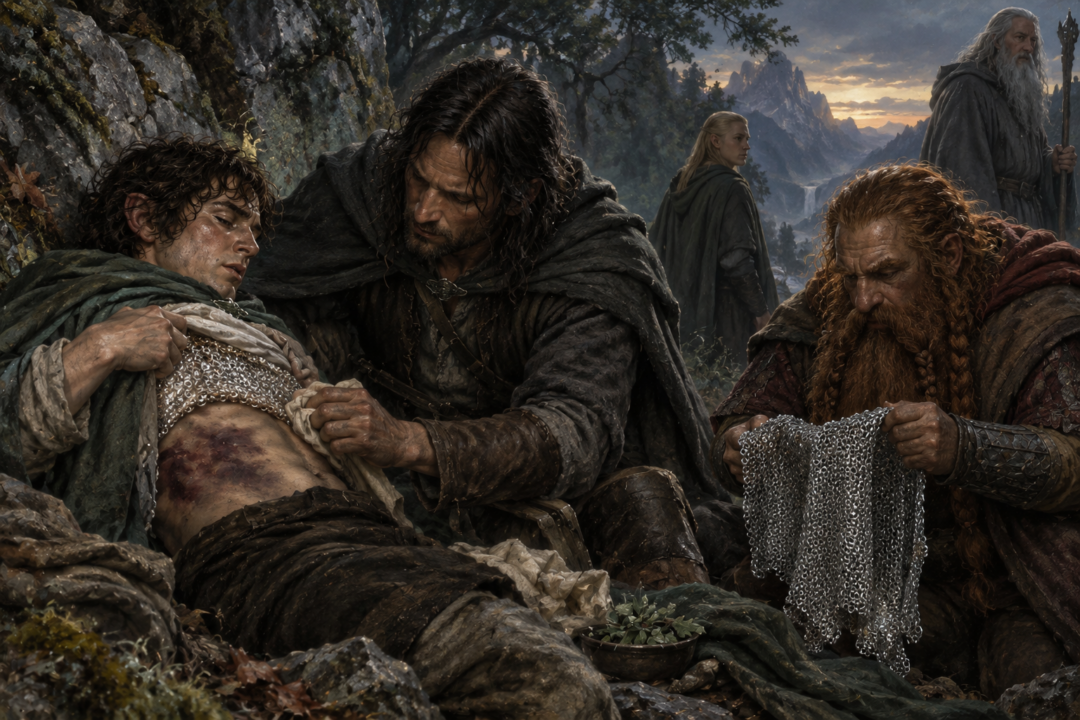
Frodo removes his outer clothing and reveals Bilbo's hidden mithril coat.
The mail itself has prevented penetration.
His body has not escaped untouched.
The Bruise Is the Important Detail
Frodo's right side and breast bear a dark bruise. Beneath the mithril he also wears soft leather, and at one point the force has driven the rings through that leather into his flesh. His other side is bruised as well from being hurled against the wall.
Nothing in the passage says that the mithril rings themselves broke.
That is the crucial distinction.
The spear fails to pass through the armor, but its momentum does not simply disappear. Frodo is violently compressed between the weapon and the wall behind him. His description of a hammer and anvil is therefore remarkably appropriate.
The coat prevents a penetrating wound that almost certainly would have been catastrophic. It does not isolate Frodo from impact.
The episode gives mithril extraordinary properties without making it magical invulnerability.
What the Text Actually Says Mithril Can Do
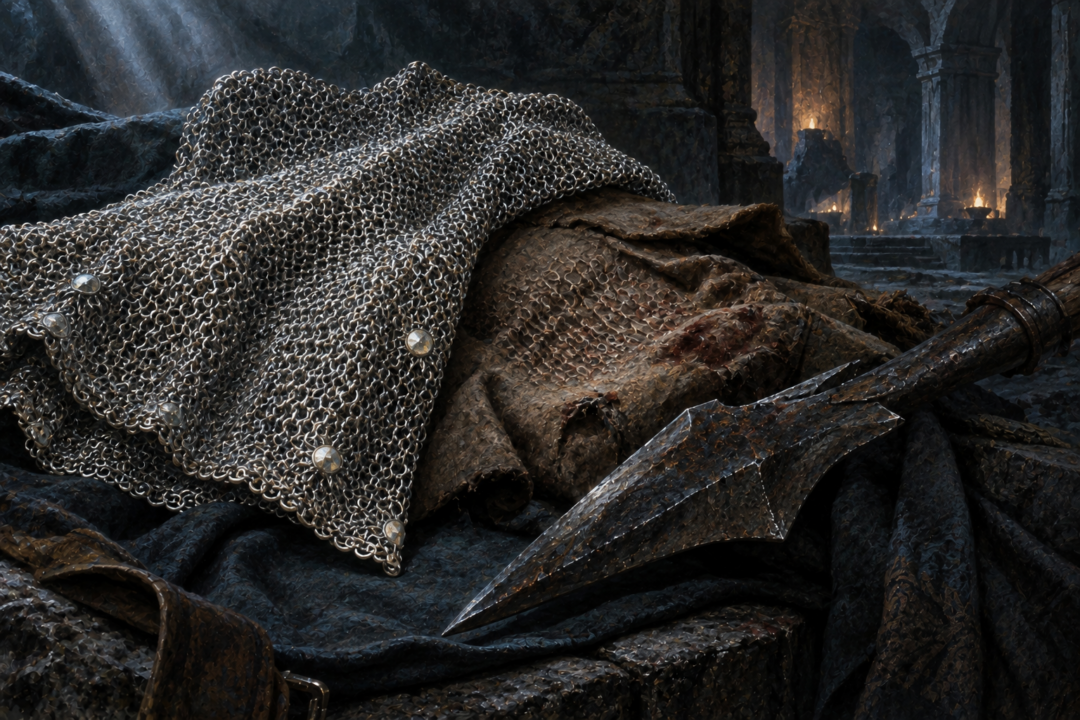
Earlier in Moria, Gandalf describes mithril as a remarkable metal that could be worked and polished while remaining extraordinarily strong. Dwarven craftsmanship could make from it a material lighter than steel yet harder than tempered steel.
That establishes exceptional material strength.
It does not establish that mithril cancels kinetic force, prevents crushing, protects uncovered flesh, or makes the wearer impossible to injure.
Bilbo's coat is also mail rather than rigid plate. Its many rings form a remarkably supple garment. When Frodo later reveals it, its lightness and flexibility astonish his companions.
Gimli goes so far as to declare that the arrows of all the hunters in the world would be useless against it. His words express his amazement at the quality of the mail; they should not necessarily be treated as a technical statement defining an absolute supernatural rule.
What the narrative actually demonstrates is impressive enough.
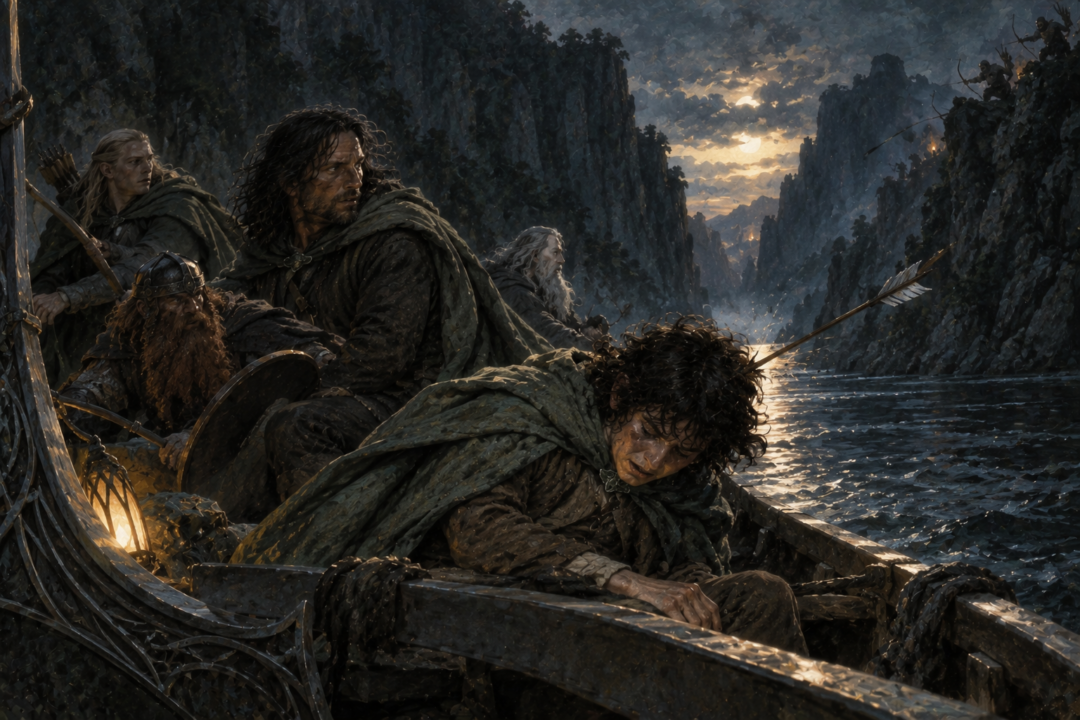
The coat turns an Orc-chieftain's spear-thrust that the Fellowship expects to have killed Frodo. Later, while the Fellowship travels down the Anduin, an Orc-arrow strikes Frodo between the shoulders and is turned by his hidden mail.
Mithril armor works spectacularly.
But spectacular protection is not the same thing as immunity.
Armor Can Win While the Wearer Still Pays
This is what Frodo's bruising makes visible.
The spear does not defeat the mail. In the most important sense, the armor succeeds completely: the weapon's point does not enter Frodo's body.
But Frodo still has to absorb the violence of the attack.
That gives the scene an unusually grounded logic. The mail prevents one form of injury without promising protection against every consequence of being struck.
The distinction becomes even clearer because Frodo is slammed against stone. The armor cannot prevent the wall behind him from hurting him. His left side is bruised from that secondary impact even though no weapon penetrates there.
The scene therefore separates three things that fantasy stories sometimes blur together: penetration, impact, and injury.
Mithril defeats the first.
It greatly reduces what would otherwise follow.
It does not erase the third.
Shelob Reveals a Different Limitation
Much later, another attack demonstrates that extraordinary armor can only protect what it actually covers.
Shelob does not pierce Frodo's mithril coat.
Her sting wounds him in the neck, above the protection of the mail.
This is important because there is no need to imagine that Shelob somehow possesses a weapon capable of defeating mithril. The text gives a simpler explanation: the attack reaches an exposed part of Frodo's body.
The coat remains extraordinary without becoming universal protection.
That is how armor functions throughout Frodo's journey. It changes the consequences of certain attacks, but it never removes vulnerability itself.
Frodo can still be poisoned. He can still be captured. He can still suffer exhaustion, hunger, fear, and wounds beyond the mail's coverage.
The mithril coat protects his body extraordinarily well within its limits.
Those limits remain real.
Bilbo's Gift Keeps Saving a Life Without Making It Safe
The coat's history makes this distinction even more powerful.
Thorin gave the small mail-shirt to Bilbo beneath the Lonely Mountain. Years later, at Rivendell, Bilbo quietly passed it to Frodo before the Fellowship departed.
Frodo did not initially understand the scale of what he was carrying.
In Moria, Gandalf explains that Bilbo's corslet was worth more than the Shire and everything in it. Frodo, already secretly wearing it, is stunned.
Its true value soon becomes more than monetary.
The coat saves him from the spear in Moria. It turns the Orc-arrow on the Anduin. After the War of the Ring, it protects him once again when Saruman attempts to stab him at Bag End.
Yet none of these survivals turns Frodo into an armored warrior who can ignore danger.
That is precisely why the gift works so well within the story.
It preserves his life without removing the cost of carrying the Ring.
The Strongest Armor Cannot Protect the Whole Person
There is an even deeper contrast surrounding Frodo.
He possesses perhaps the most extraordinary personal armor carried by any member of the Fellowship, yet his greatest injuries are not problems armor can solve.
The Morgul wound at Weathertop precedes his receiving the coat from Bilbo. Shelob finds exposed flesh. The burden of the Ring attacks no physical armor at all. By the end of the quest, Frodo carries wounds and memories that surviving weapons cannot undo.
The mithril coat therefore becomes almost paradoxical.
Something immensely strong surrounds someone increasingly wounded.
That does not make the armor useless. Quite the opposite. Without Bilbo's gift, Frodo's journey may have ended beneath the mountains.
But survival and wholeness are not the same thing.
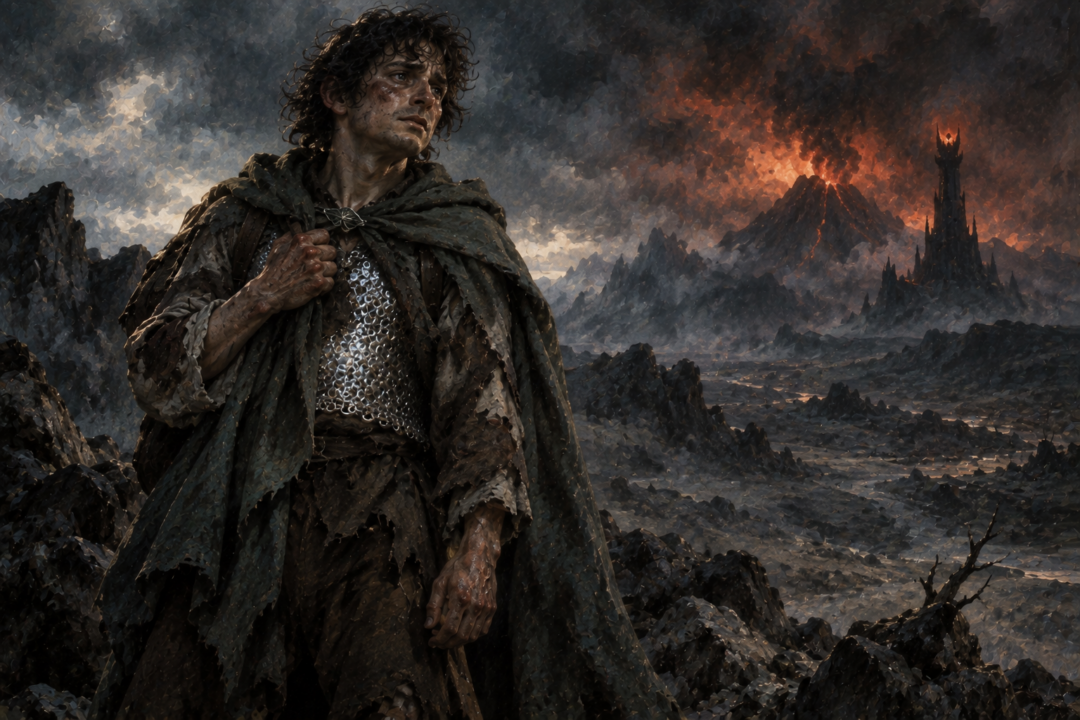
Why the Bruise Makes Mithril More Impressive
It might seem that Frodo's injury exposes a weakness in the mithril coat.
In fact, it shows exactly how extraordinary the coat is.
A powerful spear-thrust drives Frodo against stone hard enough to leave him blackened with bruising and painful breathing. The force is severe enough to press the rings through the leather beneath them and into his flesh.
And still the spear point does not pass through.
The mail does not need to make Frodo untouched to demonstrate its strength. Its achievement is that an attack capable of hurting him so badly does not become an impalement.
That is the hidden lesson of the scene.
Perfect armor need not mean painless armor.
In Middle-earth, even the finest protection usually preserves something fragile rather than abolishing fragility. Frodo survives because Bilbo gave him a treasure almost beyond price, fashioned from one of the greatest materials known in Middle-earth.
But afterward Aragorn still has to tend his injuries.
Frodo still hurts.
And he still has to put the coat back on and continue walking.
That may be the most revealing thing about mithril: its greatness is measured not by making its wearer invulnerable, but by allowing a vulnerable person to survive what should have stopped him.
Sources & Notes
- Tolkien Gateway — Mithril-coat https://tolkiengateway.net/wiki/Mithril-coat
- Tolkien Gateway — Mithril https://tolkiengateway.net/wiki/Mithril
- Tolkien Gateway — Chamber of Mazarbul https://tolkiengateway.net/wiki/Chamber_of_Mazarbul
These reference entries document Frodo's coat, mithril's properties, and the spear strike in the Chamber of Mazarbul. The distinction between preventing penetration and preventing blunt injury is the article's practical interpretation.