The Nine Rings: How Sauron Turned Mortal Kings Into the Nazgûl
The Nazgûl are among the most terrifying servants of Sauron, but their story did not begin with black robes, spectral horses, or the hunt for the One Ring. Long before they became the Ringwraiths, they were mortal Men—powerful figures who accepted extraordinary gifts and discovered too late what those gifts were designed to do.
Their tragedy lies at the heart of the history of the Rings of Power. The Nine Rings did not simply make their bearers evil overnight. They offered exactly the things ambitious mortals might desire: power, wealth, prestige, and life beyond its natural span. But every advantage drew their owners deeper beneath the domination of the One.
The Nine Were Forged in Eregion
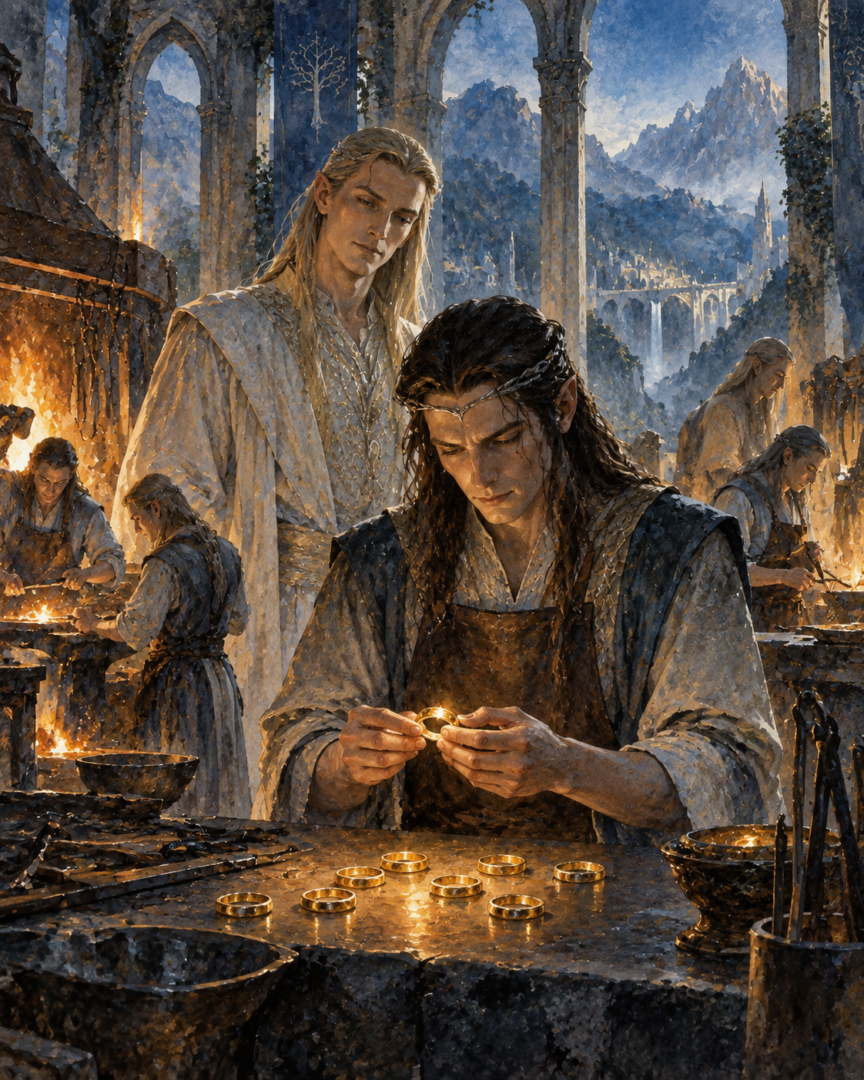
During the Second Age, the Elven-smiths of Eregion achieved astonishing skill in the making of magical rings. Their greatest craftsman was Celebrimbor, descendant of Fëanor.
Into this world came Sauron in a fair disguise. Calling himself Annatar, the Lord of Gifts, he presented himself as a teacher who could help the Elves improve Middle-earth. Celebrimbor and the smiths associated with the Gwaith-i-Mírdain learned from him, although Sauron's generosity concealed a larger plan.
The Rings were part of that plan.
The Nine Rings and the Seven were made with Sauron's knowledge and influence. The Three Rings of the Elves were made by Celebrimbor without Sauron's direct participation, although their craft still belonged to the same broader ring-lore.
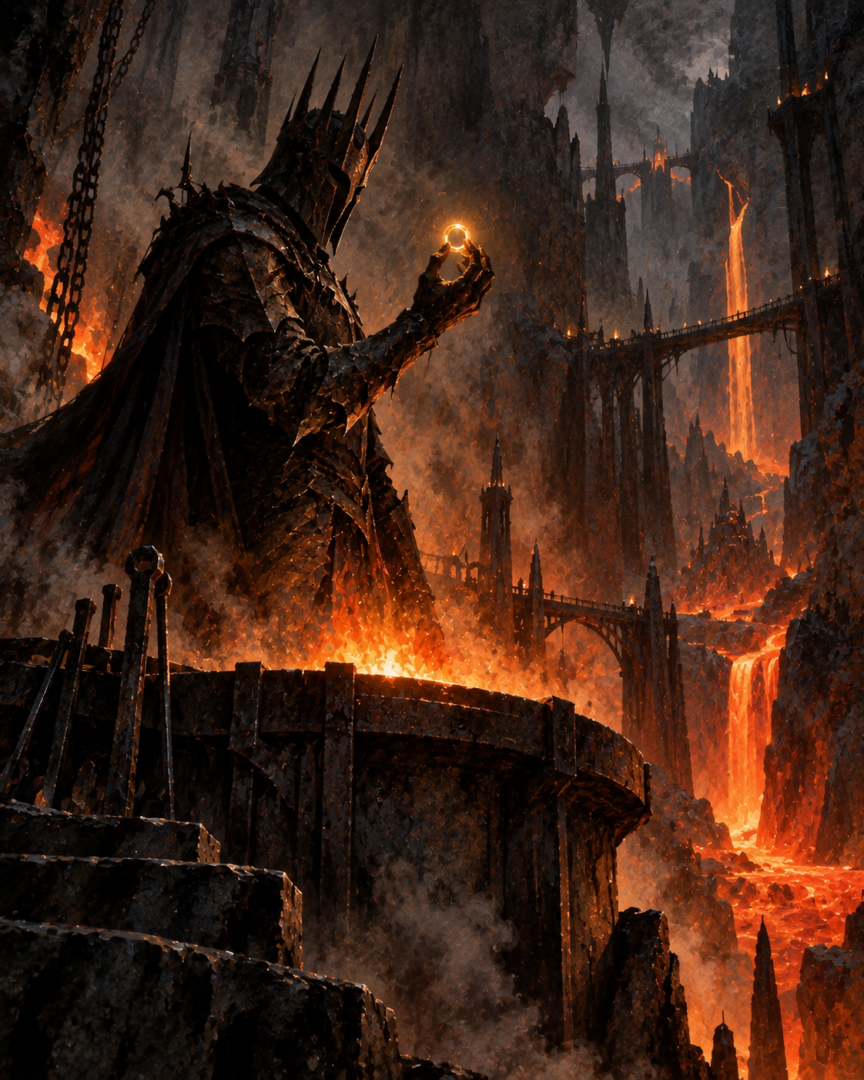
Sauron then went alone to Orodruin.
There, in the fires of Mount Doom, he forged the One Ring.
Why the One Ring Changed Everything
Sauron placed a substantial portion of his own power into the One. His intention was not merely to possess another magical artifact. The One Ring was designed to dominate the bearers of the other Rings of Power.
But the plan did not initially succeed as he expected.
When Sauron first put on the One Ring, the Elves who possessed the Three became aware of him and his purpose. They removed their rings and refused to use them while he held the One.
Sauron responded with war.
Eregion was devastated, Celebrimbor was killed, and Sauron seized the Rings he could recover. He subsequently distributed seven to Dwarves and nine to Men.
The Nine proved disastrously effective.
Why Men Were So Vulnerable
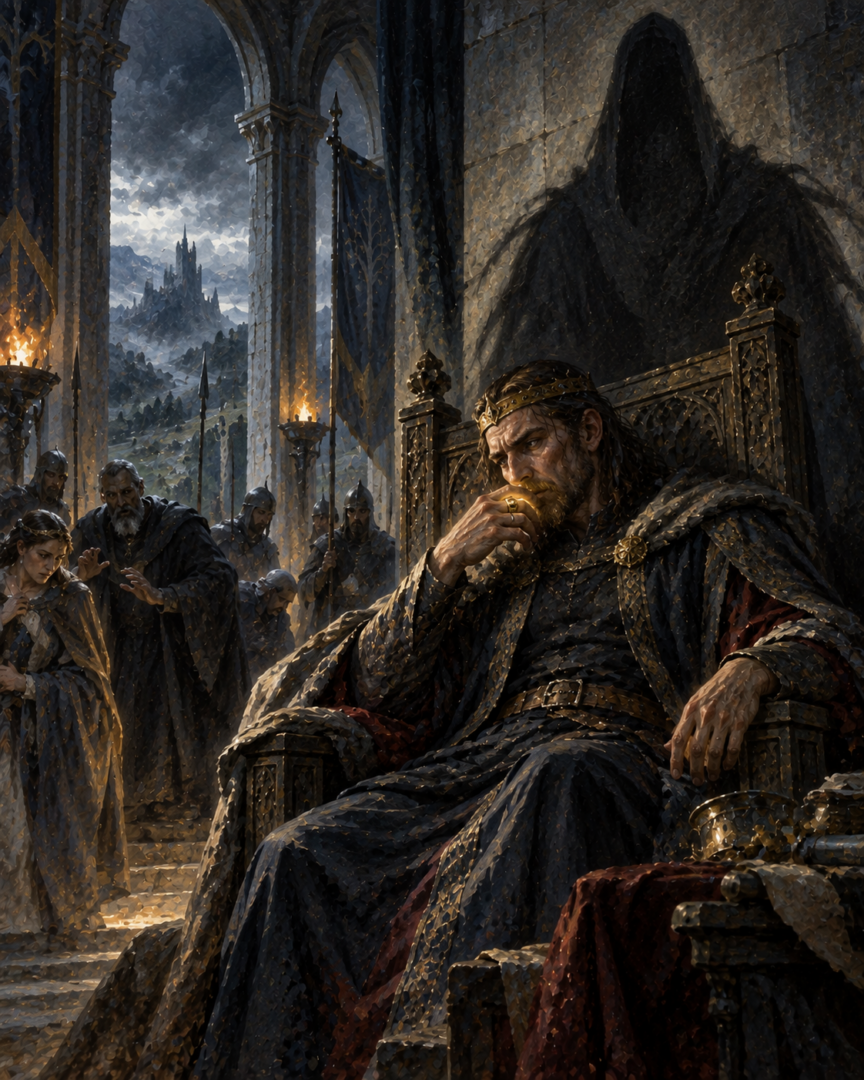
The recipients of the Nine became powerful in their own age. Tolkien describes them as kings, sorcerers, and warriors of old. The Rings brought them glory and great wealth, and they gained abilities that ordinary Men did not possess.
Most dangerously, their lives were extended.
That might sound like the greatest gift of all. In Tolkien's mythology, however, the mortality of Men is not simply a defect that can safely be repaired. The Rings did not grant true immortality. They stretched mortal existence beyond its natural limits.
The result was a kind of spiritual erosion.
Over time, the Nine increasingly perceived things belonging to the unseen world. Eventually they themselves faded from ordinary sight. Their continued existence became dependent upon the Rings that had prolonged their lives.
And behind those Rings stood Sauron.
One by one, the Nine fell completely under his domination.
They became the Nazgûl—the Ringwraiths.
They Did Not Become Wraiths Immediately
This is one of the most important details in understanding their story.
The Nine were not transformed the moment they placed the Rings on their fingers. Their corruption was gradual.
For a time, they could enjoy the advantages the Rings provided. They could accumulate power and treasure. They could command others. They could watch generations of ordinary people age and die while they continued living.
Yet the same process was slowly separating them from normal mortal existence.
This makes their fate more disturbing than a simple magical curse. The Rings offered benefits before revealing their full cost. Their bearers had time to become accustomed to power, longevity, and domination.
By the time the trap was complete, they had become permanently enslaved to Sauron's will.
The Nazgûl are therefore not merely servants who happen to wear Rings. Their existence demonstrates the central purpose of Sauron's ring-making scheme: domination through apparently desirable power.
Who Were the Nine?
Tolkien deliberately left most of their individual identities unknown.
This absence of names is significant. By the end of their transformation, their former identities have almost disappeared from the history that survives. They are remembered collectively as the Nine.
There is, however, one major exception.
Khamûl is the only Nazgûl other than their chief who is individually named in Tolkien's published legendarium. He was an Easterling and became one of Sauron's most important Ringwraiths.
The leader of the Nine is far better known, but not by his original mortal name.
He became the Witch-king of Angmar.
The Witch-king Was Their Greatest Captain
The chief of the Nazgûl emerged as one of Sauron's most formidable servants. During the Third Age he established the northern realm of Angmar and waged war against the Dúnedain kingdoms of Arnor.
His campaigns helped destroy the remaining northern kingdoms.
After the fall of Angmar, the Witch-king did not disappear. He later returned to Mordor and played a central role in Sauron's wars against Gondor. By the time of the War of the Ring, he commanded the Nazgûl and led Sauron's armies during the assault on Minas Tirith.
His original human identity remains unknown.
That anonymity fits the larger tragedy of the Nine. Whatever titles, families, kingdoms, and ambitions they once possessed had become almost irrelevant. Their identities were consumed by their service to Sauron.
Why the Nazgûl Inspire Terror
The Ringwraiths' greatest weapon is not simply physical strength.
It is fear.
Their presence produces supernatural dread, and their cries can overwhelm the courage of those who hear them. This becomes increasingly important as Sauron's power grows.
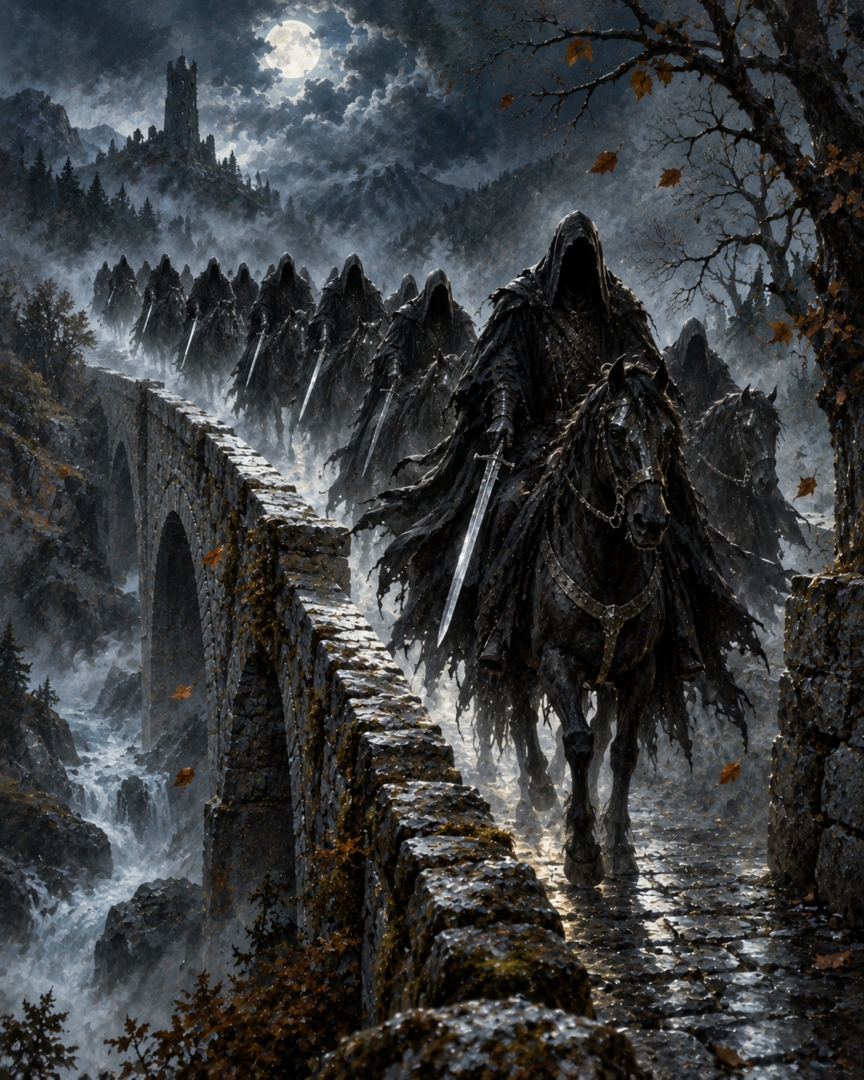
They also exist largely in the unseen realm. To ordinary eyes they appear as black-cloaked figures because the clothing gives visible shape to otherwise invisible beings.
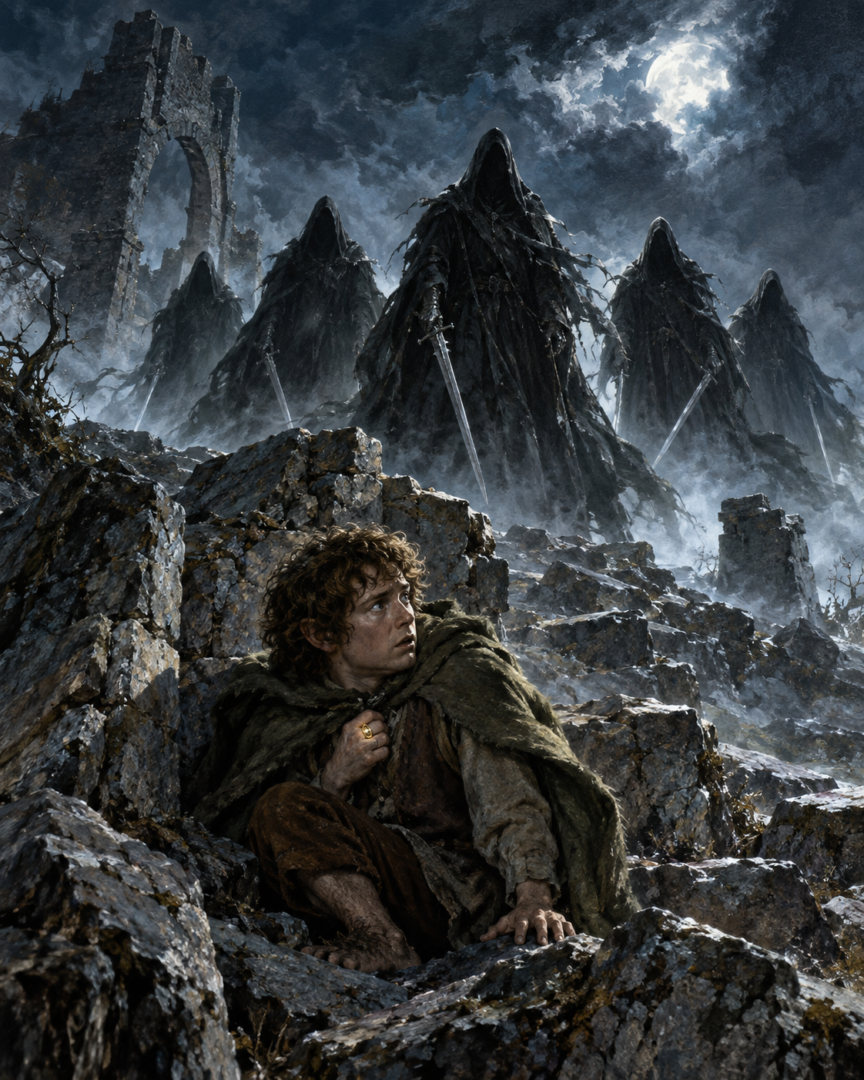
When Frodo sees them while wearing the One Ring at Weathertop, the situation changes. The Ring draws him toward the unseen world, allowing him to perceive the Ringwraiths differently. Beneath their black coverings are ancient spectral figures rather than ordinary men concealed by hoods.
It is a glimpse of what centuries of enslavement have made them.
Why They Wanted Frodo's Ring
During the War of the Ring, the Nine were sent to recover the One Ring after Sauron learned that it had resurfaced.
This created one of the most frightening pursuits in The Lord of the Rings.
The Nazgûl entered the Shire searching for "Baggins" and followed the Ring's trail across Eriador. Their pursuit eventually brought them to Weathertop, where five of them confronted Frodo and his companions.
The Witch-king stabbed Frodo with a Morgul-knife.
The wound was more dangerous than an ordinary injury. A fragment of the blade remained within Frodo and began working toward his heart. Had the process been completed, he would have faded and become a lesser wraith under the domination of the Nazgûl.
Frodo escaped that fate, but the encounter reveals something important about the Nine: they could potentially draw others into the same shadow-world that had consumed them.
What Happened to Their Rings?
A common misconception is that the Nazgûl necessarily continued wearing their Nine Rings throughout the events of The Lord of the Rings.
Tolkien's writings indicate that Sauron held the Nine Rings.
That gave him an additional means of controlling the Ringwraiths. Their enslavement was already complete, and unlike the Dwarves, Men had proved extraordinarily susceptible to Sauron's intended use of the Rings.
This also helps explain why destroying the One was catastrophic for the Nazgûl.
Their supernatural existence was ultimately bound to a system of power whose foundation was Sauron and the One Ring.
The End of the Nine
The Witch-king met his end during the Battle of the Pelennor Fields.
The remaining Nazgûl continued serving Sauron until the final moments of the War of the Ring. When Frodo claimed the One Ring inside Mount Doom, Sauron realized where it was and desperately sent the Ringwraiths toward Orodruin.
They arrived too late.
The One Ring fell into the fire and was destroyed.
Sauron's power collapsed with it. Mount Doom erupted, and the remaining Nazgûl were consumed in the catastrophe.
After thousands of years, the Nine were finally gone.
The Real Horror of the Nine Rings
The story of the Nazgûl is ultimately more tragic than the image of nine faceless riders might suggest.
They were once living Men with ambitions, possessions, identities, and futures. Sauron did not initially approach them by offering slavery. He offered power.
The Rings delivered enough of that promise to make the temptation meaningful.
Their bearers became greater than ordinary Men. They gained wealth. Their lives stretched across generations. They could exercise powers unavailable to others.
But every apparent victory carried them farther from humanity.
Eventually their kingdoms, names, bodies, and independent wills mattered less than the will of the being who had given them the means to become powerful.
That is why the Nine Rings occupy such an important place in Tolkien's mythology.
The One Ring represents domination in its purest form, but the Nine show how that domination can begin: not with chains, but with a gift that seems to offer exactly what its recipient desires most.
Sources & Notes
- Tolkien Gateway — Tengwar https://tolkiengateway.net/wiki/Tengwar
- Tolkien Gateway — One Ring https://tolkiengateway.net/wiki/One_Ring
- Tolkien Gateway — Black Speech https://tolkiengateway.net/wiki/Black_Speech
- Tolkien Gateway — Doors of Durin https://tolkiengateway.net/wiki/Doors_of_Durin
These reference entries document the Tengwar writing system, the Ring inscription's Black Speech, and the inscription on the Doors of Durin. The comparison of modes and language-specific spelling conventions follows from those documented examples.