What Happens to the Greenway When Arnor Returns?
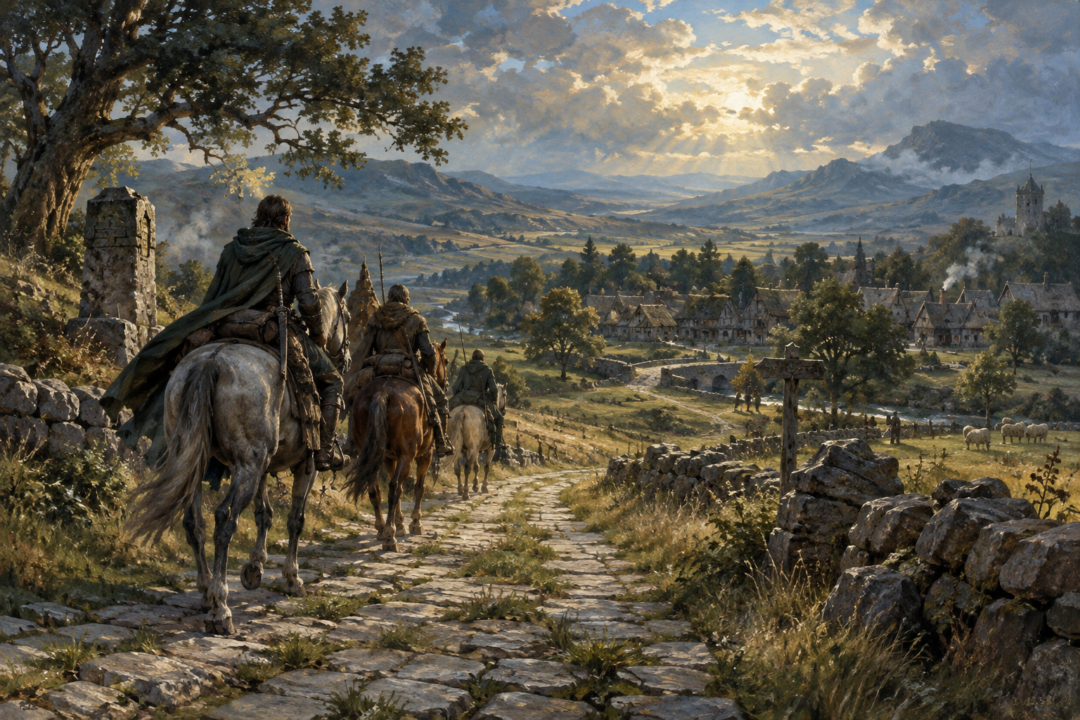
At Bree, two roads cross—and by the end of the Third Age, they tell two very different stories.
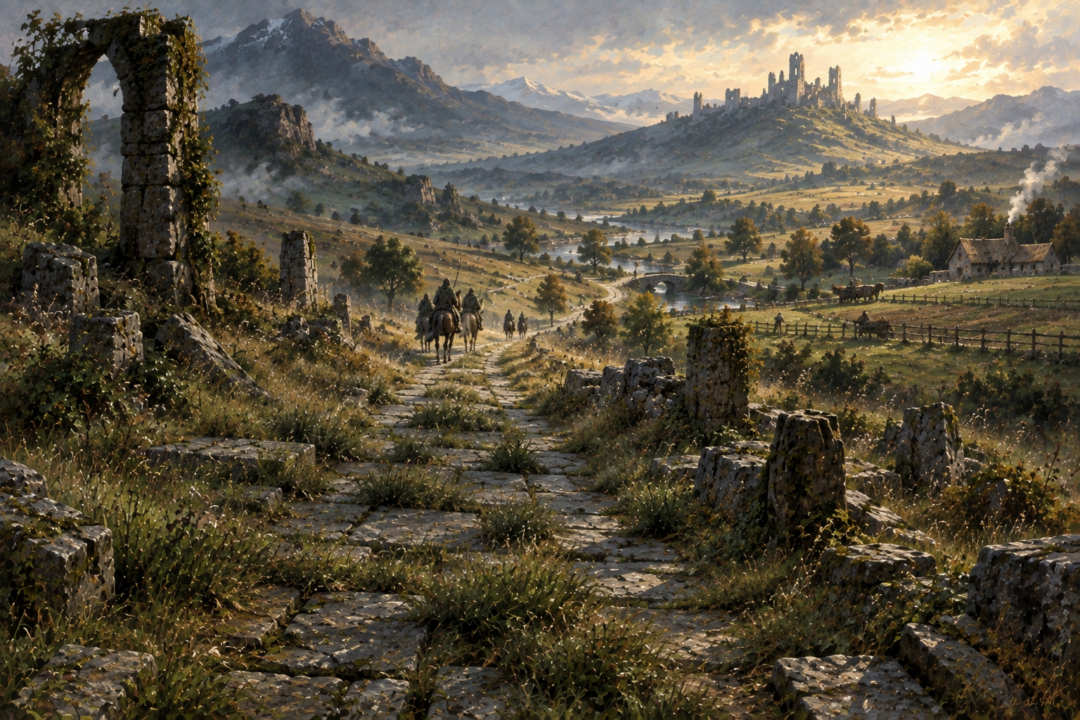
The East Road still carries travellers through the village. The other road, running north and south, has become so neglected that grass grows over it. The Bree-folk call it the Greenway. Once, however, this was part of the great North-South Road linking the realms of the Dúnedain. Its decay is therefore more than a problem of broken paving and weeds. It is a visible sign that the political world which built it has vanished.
Then Aragorn becomes King.
Suddenly an apparently minor prediction near the end of The Lord of the Rings becomes enormously important. Gandalf tells Barliman Butterbur that the Greenway will be opened again, the King's messengers will travel north, and lands that have long been wilderness will eventually contain people and fields.
That does not mean the texts give us a detailed Fourth Age reconstruction programme. They do not. But they give enough evidence to see what the reopening of the Greenway really means.
Arnor is not merely returning as a name.
Northern Middle-earth is becoming inhabited, connected, governed, and protected again.
The Greenway Is the Ruin of a Political System
The Greenway was not originally a lonely country track.
It formed the northern portion of the old North-South Road associated with the kingdoms founded by the Númenórean Exiles. In the early Third Age, this road connected the northern Dúnedain with Gondor far to the south.
Its later condition reflects the collapse of that world.
Arnor was divided into Arthedain, Cardolan, and Rhudaur. War with Angmar devastated the northern kingdoms, and eventually even Arthedain fell. Fornost, once a royal city, became a ruin remembered around Bree by the grim name Deadmen's Dike.
Farther south, the great crossing at Tharbad also declined. The settlement had once stood on a crucial route through the region of the Greyflood, but the bridge and road system eventually failed. By the late Third Age, travelling between northern Eriador and the southern kingdoms was difficult enough that Boromir's journey to Rivendell became a considerable ordeal.
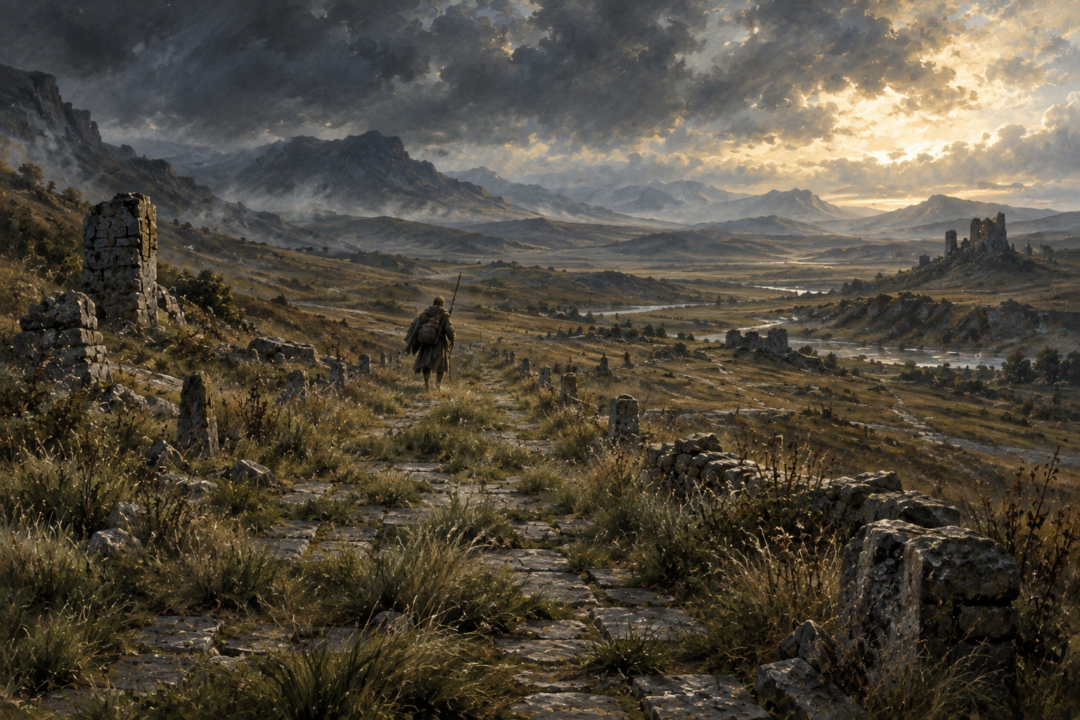
Around Bree, meanwhile, the old North Road became grass-grown.
That is why its name matters. "Greenway" sounds pleasant, but historically it represents decline. A major artery of civilization has become green because there is no longer enough traffic or authority to keep it functioning as it once did.
The grass is evidence of absence.
Aragorn Changes the Meaning of the Road
After the War of the Ring, Gandalf gives Butterbur a remarkably concrete glimpse of what royal restoration will mean.
The Rangers have returned. There is a king again. The Greenway will reopen. Royal messengers will travel north. Dangerous things will be driven from the waste.
This is one of the clearest indications of what the restored northern realm may actually look like.
The first transformation is therefore not necessarily monumental architecture. It is movement.
Messages can pass reliably.
Travellers can move with greater security.
Royal authority can reach places that have spent centuries beyond the effective administration of any kingdom.
The importance of this is easy to underestimate because the Rangers had already been defending parts of Eriador. The Hobbits and Bree-folk enjoyed a degree of security precisely because the Rangers quietly guarded regions whose inhabitants often knew little about them.
But the restored kingdom changes the character of that protection.
The hidden guardianship of a dwindling people can now become the public order of a recognized king.
The Greenway is where that change becomes visible.
Bree Suddenly Sits on an Important Crossroads Again
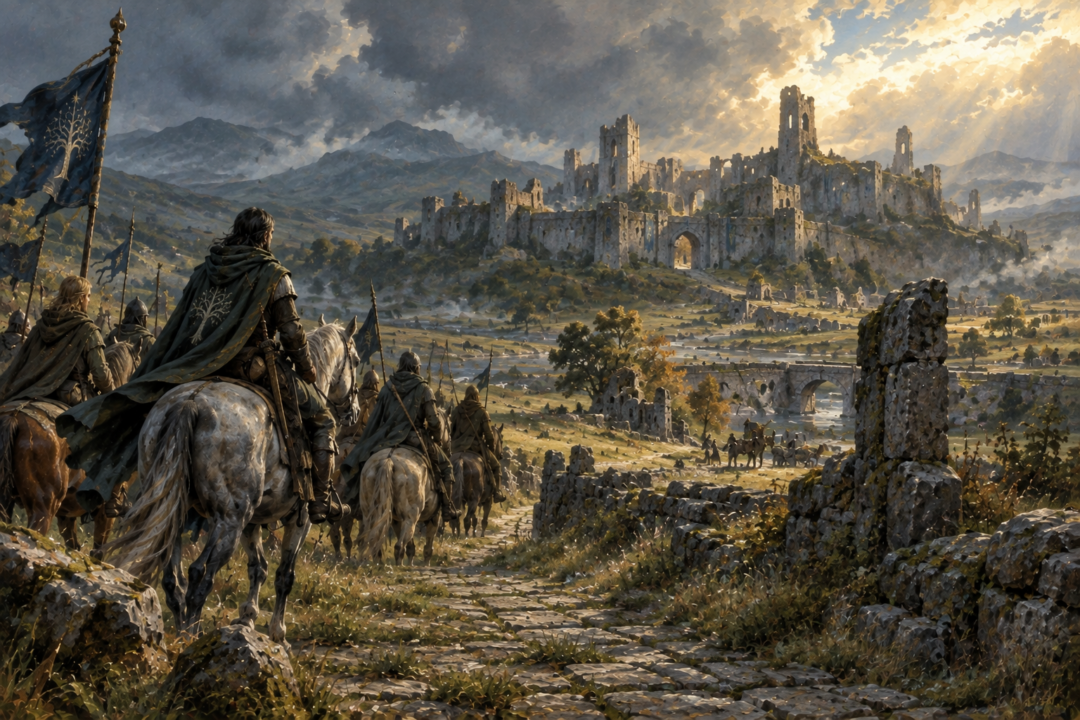
This restoration has an immediate consequence for Bree.
For generations, Bree has survived beside the crossing of two ancient roads while much of the surrounding country remains thinly inhabited. Its people are accustomed to travellers, but they are also deeply suspicious of disorder from outside.
Their suspicion is understandable.
During the troubles surrounding the War of the Ring, people coming from the South include refugees, vagabonds, and dangerous men. Bree itself suffers violence. Butterbur discovers how much the Rangers had protected the region only after that protection is temporarily withdrawn.
So when Gandalf predicts renewed traffic, Butterbur does not simply celebrate.
He worries.
He does not want another flood of troublesome outsiders or strangers settling all around Bree.
Gandalf's answer is significant. He reassures him that there is enormous room for settlement elsewhere—in lands between Isen and Greyflood and in the country south of the Brandywine—without crowding Bree.
The future implied here is not a metropolis swallowing the old village.
It is a populated landscape returning around an old crossroads.
Bree may remain Bree while the world beyond its hedges changes dramatically.
The Wilderness Begins to Become Country Again
Gandalf's prediction goes beyond reopening a road.
He foresees people and cultivated fields where wilderness had stood before.
That is perhaps the most consequential clue concerning the restoration of Arnor.
Much of Eriador at the end of the Third Age is defined by absence: abandoned ruins, empty downs, dangerous woods, broken infrastructure, and enormous distances between surviving settlements.
The Fourth Age appears poised to reverse at least part of that decline.
Exactly where new communities arise is not comprehensively recorded, and it would go beyond the texts to invent a detailed map of Fourth Age towns. Yet the direction is explicit: previously deserted lands will not remain empty forever.
That makes the Greenway a natural backbone for recovery.
This does not mean the text explicitly states that farms spread continuously along its entire length, nor does it describe royal engineers repaving every mile. Such details remain unknown.
But a reopened road carrying royal messengers through increasingly settled country strongly implies renewed infrastructure and safer movement.
The road ceases to lead primarily through ruins.
It begins connecting living places again.
Fornost Changes From Deadmen's Dike to a Royal Place
North of Bree stands the most powerful symbol of this reversal.
Fornost had been the capital of Arthedain. After its destruction and abandonment, its identity in local memory decayed along with the city itself. Butterbur knows the place as Deadmen's Dike and thinks of it as haunted country.
Gandalf corrects him.
Its proper name is Fornost Erain—Norbury of the Kings—and he predicts that the King will come there again.
That distinction is central to the restoration of Arnor.
The ruins do not disappear from history. Their meaning changes.
For Butterbur, Fornost belongs to a frightening past. For Aragorn's restored realm, it belongs to a recoverable political tradition.
The same process is even clearer at Annúminas.
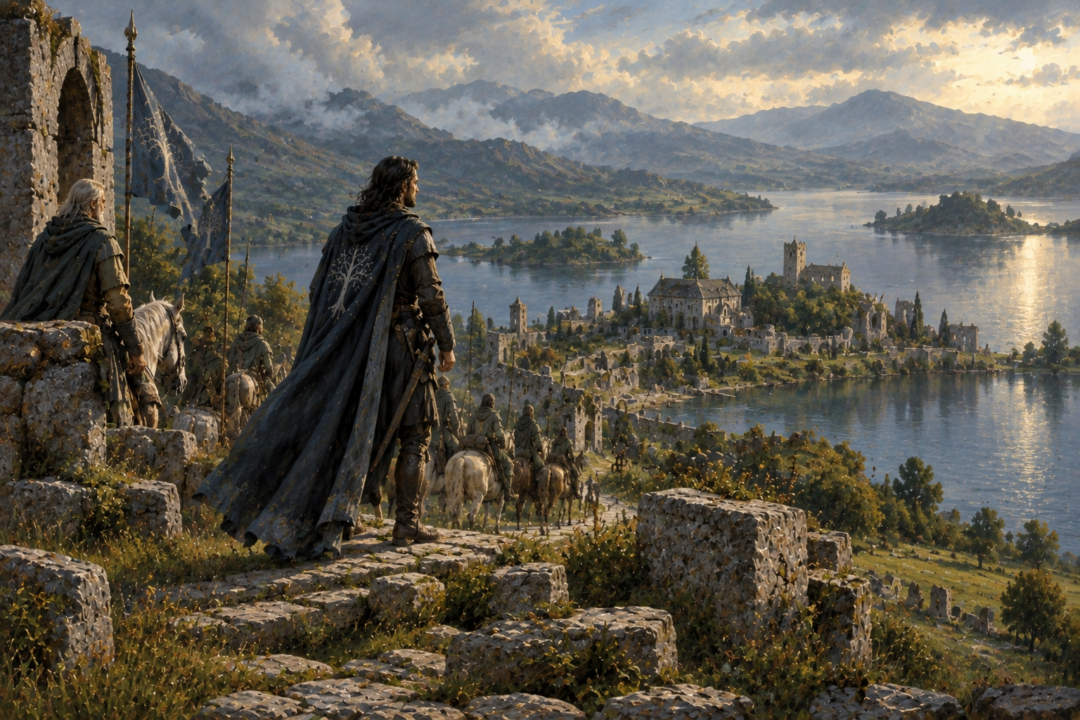
The ancient city beside Lake Evendim had once been the seat of the Kings of Arnor before the royal centre shifted to Fornost. In the Fourth Age, the surviving records tell us that King Elessar has a house in restored Annúminas and stays there during visits to the North.
By Fourth Age 15, he rides north and dwells for a time beside Lake Evendim.
So the restoration of the North is not merely theoretical. The King himself returns to the ancient heartland of Arnor.
Yet the New Kingdom Does Not Simply Recreate the Old One
There is an important limit to this restoration.
Aragorn does not seem interested in forcing every surviving community into a uniform political culture.
The clearest example is the Shire.
The Shire becomes a Free Land under the protection of the Northern Sceptre, and King Elessar establishes a law preventing the Big People from entering it. He obeys that law himself. When he travels north, he does not simply ride through Hobbit territory because royal convenience demands it.
Instead, he meets his Hobbit friends at the Brandywine Bridge.
Later, he even expands the Shire westward. In Shire-reckoning 1452, corresponding to Fourth Age 31, the Westmarch from the Far Downs to the Tower Hills is added to the Shire by the King's gift.
This gives us an important clue about what "Arnor returns" actually means.
The restored kingdom is not simply the old map painted over the landscape again.
Existing communities retain distinctive identities and privileges.
The Shire is protected rather than absorbed culturally.
Bree is reassured rather than displaced.
The North is restored, but not by pretending the previous thousand years never happened.
What About Tharbad?
The greatest uncertainty lies farther south.
The ancient North-South Road had once depended heavily upon Tharbad and its crossing of the Greyflood. By the time of the War of the Ring, Tharbad was deserted and its bridge had long since been ruined.
If traffic between the northern and southern portions of the Reunited Kingdom grew substantially, the old crossing would obviously matter.
But this is where caution is necessary.
The surviving texts do not explicitly describe Elessar rebuilding the bridge at Tharbad or refounding the city. It is reasonable to infer that improved communications between Arnor and Gondor would require practical work somewhere along this route, but the exact solution is not recorded.
A restored Tharbad is therefore plausible reconstruction, not established canon.
The distinction matters because the Greenway's future is clearer in principle than in engineering detail.
We know the road opens.
We know royal messengers travel north.
We know settlement returns to parts of the wilderness.
We know the King establishes himself at restored Annúminas and is expected again at Fornost.
We do not know every bridge, milestone, garrison, village, or paving project created along the way.
The Greenway May Eventually Stop Deserving Its Name
There is a final irony in all this.
The Greenway receives its familiar name because it is neglected.
Grass has conquered a road built for kingdoms.
But if the Fourth Age fulfils Gandalf's prediction, the very conditions that produced that name begin to disappear.
Hooves return.
Messengers return.
Settlers return to lands long empty.
The King rides north.
Fornost is remembered by its royal name instead of merely as Deadmen's Dike. Annúminas becomes a royal dwelling again. Bree finds itself not at the edge of a dying world, but at the crossing of roads inside a living realm.
Whether people ever cease calling the road the Greenway is not stated.
But symbolically, something profound has happened.
At the end of the Third Age, the grass-covered road is an archaeological scar: evidence that Arnor once existed.
In the Fourth Age, the same road becomes evidence that Arnor exists again.
And perhaps that is the deepest meaning of the northern restoration. Aragorn does not merely inherit the titles of dead kings. The landscape itself begins, slowly, to behave as though a kingdom has returned.
Sources & Notes
- Tolkien Gateway — Greenway https://tolkiengateway.net/wiki/Greenway
- Tolkien Gateway — Reunited Kingdom https://tolkiengateway.net/wiki/Reunited_Kingdom
- Tolkien Gateway — Arnor https://tolkiengateway.net/wiki/Arnor
These reference entries document the Greenway's route and decline, Arnor, and the restored Reunited Kingdom. Claims about renewed administration and traffic are identified as likely consequences rather than directly narrated events.